
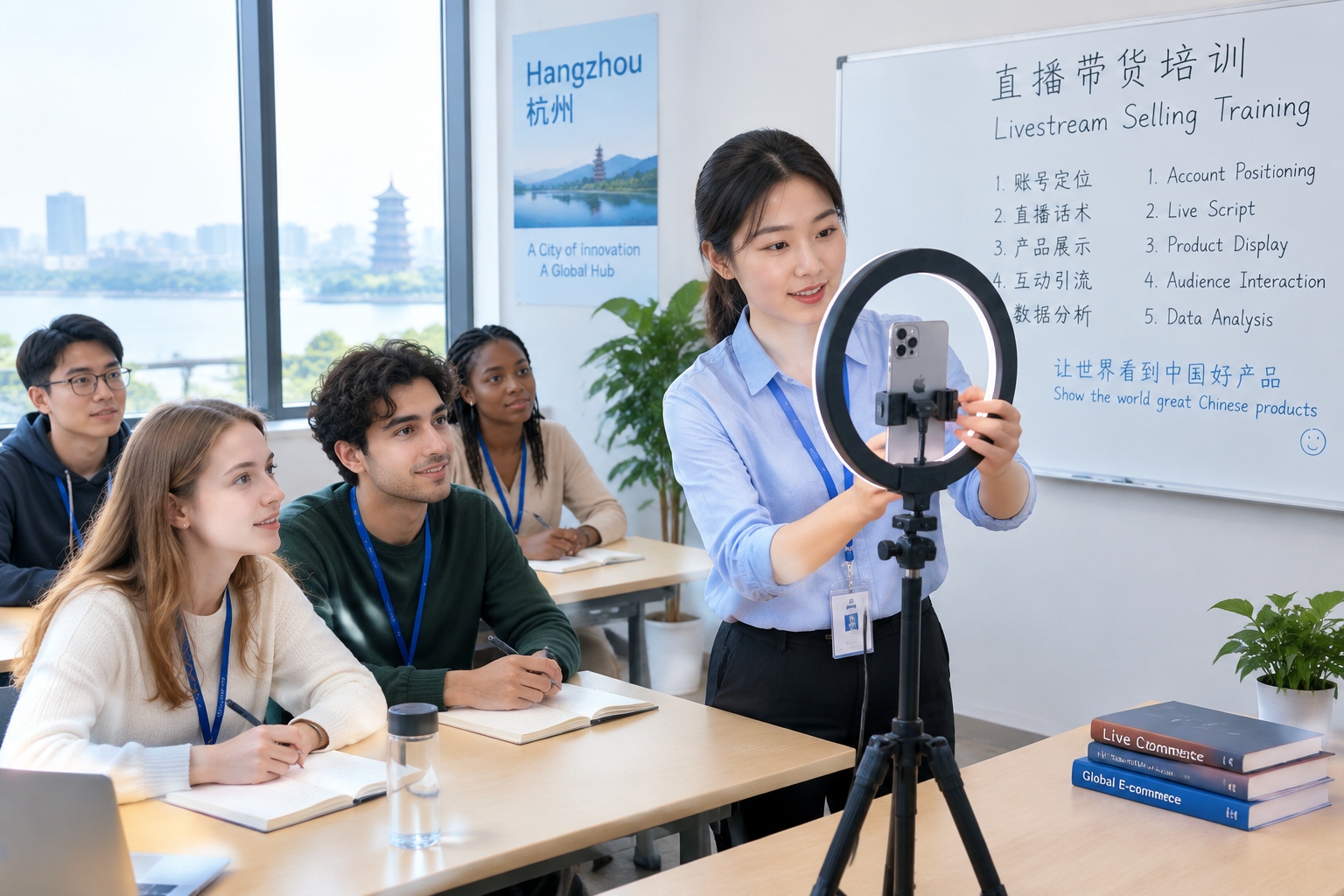

Inside a Hangzhou Classroom, 9 A.M. on a Tuesday
Mariana Costa is holding a phone at chest height, speaking to a ring light. “Three, two, one — live.” She smiles, switches to Chinese-accented English, and starts describing a skincare serum. Behind her, a whiteboard reads: Hook in 3 seconds. Show the texture. Answer the first comment fast.
Costa is 24, from São Paulo, and has run a small beauty shop on Instagram for two years. She is also one of fourteen foreign students in a three-week livestream e-commerce course in Hangzhou, the eastern Chinese city where platforms like Taobao and Douyin built some of the world’s most sophisticated live-selling operations. Most of her classmates are from Brazil, Nigeria, Indonesia, and Uzbekistan. They have paid between $600 and $1,200 for the course, plus flights and a shared apartment.
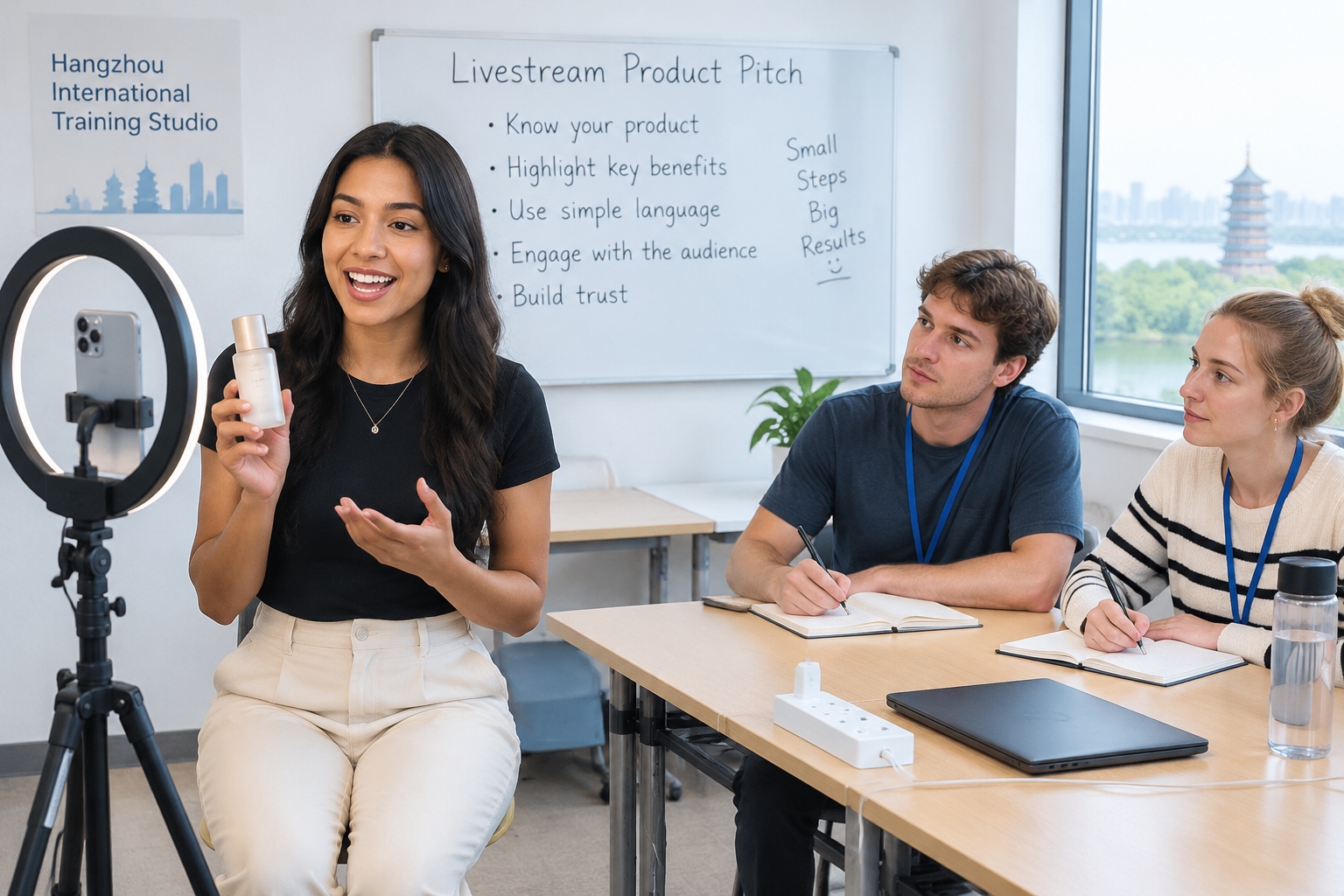
“In Brazil, everyone says ‘go live,’ but nobody teaches you the operational side,” she tells me during a break. “How to pick products. How to read the platform’s rules. What to do when a viewer asks about shipping in the first minute.”
This is not a university exchange program. It is a short, practical training course — one of a growing number of skills-based programs in China designed for foreigners who want to learn things that are hard to pick up elsewhere: how Chinese livestream commerce really works, how to diagnose and repair electric vehicle batteries, how to use AI tools in small-business workflows.
Why China, and Why Now
Two industries sit behind this trend. One is livestream e-commerce, a sector that in China generates hundreds of billions of dollars in annual sales and has produced its own playbook for product selection, audience retention, and real-time customer service. The other is new energy vehicles. China sold more than 9 million electric and plug-in hybrid cars in 2023, and the country’s streets are full of them — taxis, commuter cars, delivery vans. Demand for mechanics who understand high-voltage battery systems, electric control units, and charging infrastructure has grown with them.
For foreign learners, the appeal is practical. A semester at a Chinese university is expensive and long. A short course in Hangzhou or Guangzhou can take three days to four weeks, cost a few hundred to a couple thousand dollars, and focus entirely on hands-on practice. No thesis. No entrance exam. Just skills, tools, and the occasional field trip to a factory or live-commerce base.
What the Livestream Course Actually Teaches
Costa’s course runs Monday to Friday, 9 a.m. to 4 p.m., with a long lunch break. The first week covers product selection and platform rules — which categories work in which markets, how to read traffic data, how to avoid the compliance mistakes that get accounts suspended. The second week is camera work: voice projection, framing, handling negative comments, pacing a 90-minute session. The third week is full simulation, with students running live streams from a mock studio and receiving feedback from instructors who have worked on real Douyin channels.
“The biggest lesson is speed,” says Ayaka Mori, a 26-year-old from Osaka who has a small online shop selling handmade accessories. “Chinese live hosts respond to comments instantly. They change what they’re saying based on what viewers ask. In Japan, my generation is still used to pre-recorded videos.”
Mori paid about $800 for a one-week intensive course in Shenzhen focused on AI tools for e-commerce — product photo editing, short-video scripting, and customer-service chatbots. She found the course through a Chinese friend and arranged a tourist visa for her ten-day stay. “I didn’t need a certificate,” she says. “I needed to see how Chinese sellers use AI in daily operations. That part I could not learn from YouTube.”
Inside the EV Repair Workshop
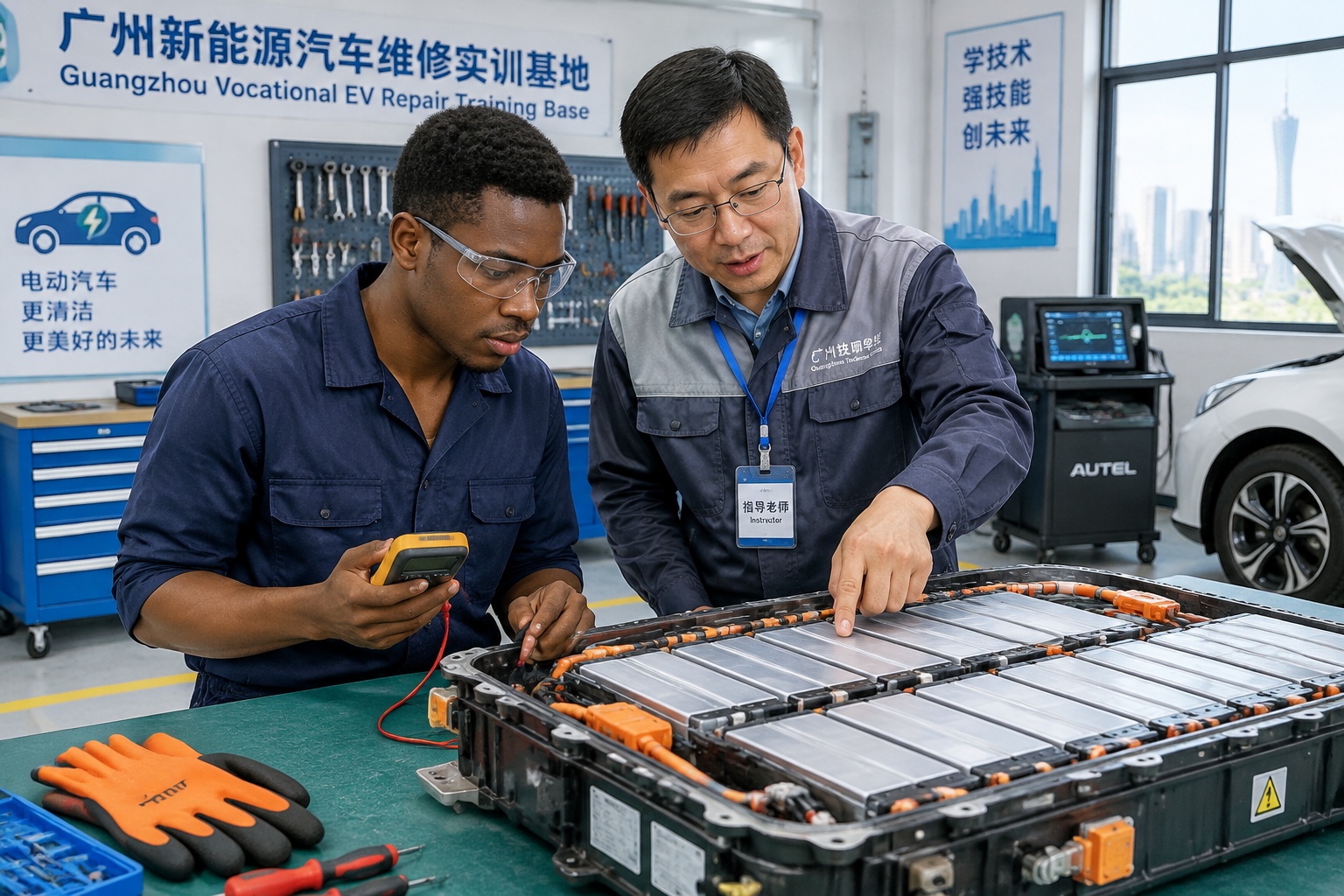
In Guangzhou, a different classroom smells of rubber and solder. Tunde Adebayo, 29, from Lagos, stands beside an open battery pack with a multimeter in one hand. His instructor, a former BYD technician, points to a row of cells and explains how to measure voltage consistency. Adebayo writes down the readings in a notebook, then repeats the process on his own.
Adebayo runs a small motorcycle repair shop in Lagos and has watched electric two-wheelers and three-wheelers multiply in his neighborhood. “Customers bring in electric bikes with battery problems, and I don’t have the equipment or training to fix them safely,” he says. He found a two-week EV maintenance course in Guangzhou through an online forum. Tuition was about $900. He stayed in a budget hotel near the training center, took the metro every morning, and spent his evenings watching Chinese mechanics on short-video platforms.
The course covers battery structure, charging safety, electric motor basics, and diagnostic tools. Students practice on real battery packs, use insulation testers, and learn how to identify thermal runaway risks. They also visit an EV charging station and a bus depot where electric buses are maintained.
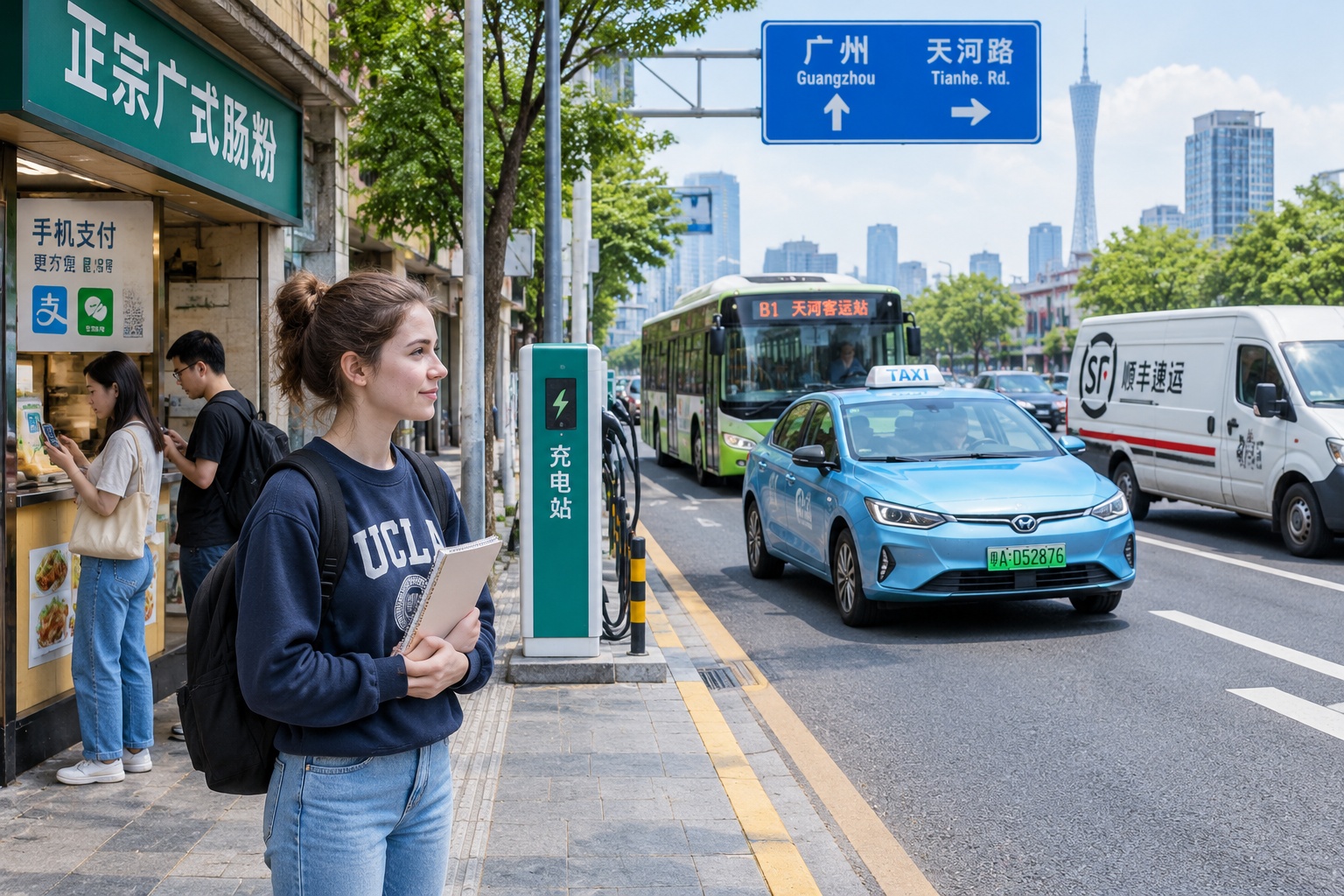
“You read about China’s electric cars,” Adebayo says. “But here you see they are everywhere — taxis, buses, even the small trucks that deliver vegetables. That changes how you think about the repair business.”
Who Comes, and What They Spend
The students I spoke with share a profile: young, self-employed or working for small businesses, digitally fluent, and willing to spend their own money on a short, intensive trip. Most arranged tourist or business visas. A few received referrals from alumni networks or trade associations back home. None expected a formal degree.
Dilnoza Karimova, 27, from Tashkent, took a ten-day e-commerce operations course in Yiwu, the wholesale market city in Zhejiang. She paid about $500 for tuition and shared a two-bedroom apartment with another student. “The language barrier is real,” she says. “The course was in Chinese with a translator. Some technical terms did not translate well. But the hands-on part — going to the market, negotiating with suppliers, photographing products — that I understood very well.”
Weekends look different from a typical study tour. Students take high-speed trains to nearby cities — Shanghai from Hangzhou is less than an hour; Shenzhen to Guangzhou is about 30 minutes — and walk through wholesale markets, electronics malls, or night markets. Adebayo spent one Saturday at a Guangzhou auto parts market, comparing battery cells and asking prices in a mix of English and hand gestures. Mori took a day trip to Dongguan to visit a factory that produces jewelry packaging. “I learned more about supply chains in one weekend than in a year of reading,” she says.
What These Courses Can and Cannot Do
It would be misleading to call these courses a shortcut to success. Language remains a barrier: even with translation apps and bilingual instructors, nuance gets lost. Certificates from private training centers do not carry the same weight as accredited degrees, and regulations vary by country. What works in China’s livestream ecosystem — rapid pacing, aggressive engagement, platform-specific tactics — does not always transfer smoothly to markets with different consumer habits and platform rules.
“In Brazil, the audience is smaller and slower,” Costa says. “I can’t copy everything. I have to adapt the energy and the structure.”
Still, the courses offer something less tangible: a firsthand look at how Chinese businesses operate. Students see the speed of product iteration, the density of supply chains, and the everyday routines that support both. They ride the metro alongside commuters using their phones to pay for everything. They order meals through delivery apps and watch couriers navigate traffic. They see EV charging stations in residential compounds and live-commerce studios in office buildings.

What They Take Home
On her last day in Hangzhou, Costa runs a 30-minute live stream for a class exercise. She sells a fictional face cream to an audience of classmates and instructors. She stumbles once, recovers, and finishes with a five-second product close-up that draws applause.
She will fly home with two notebooks, 40 gigabytes of video, and a list of 15 Chinese suppliers she plans to contact. She is not sure her Brazilian customers will respond to the same fast-paced style. But she now knows what is possible — and what it takes to build a livestream operation from scratch.
“I came for skills,” she says. “I’m leaving with a better sense of how fast things can move here. That is the real lesson.”
Start the discussion at forum.chinacomes.com