

Two o’clock on a Tuesday, and the phones come out
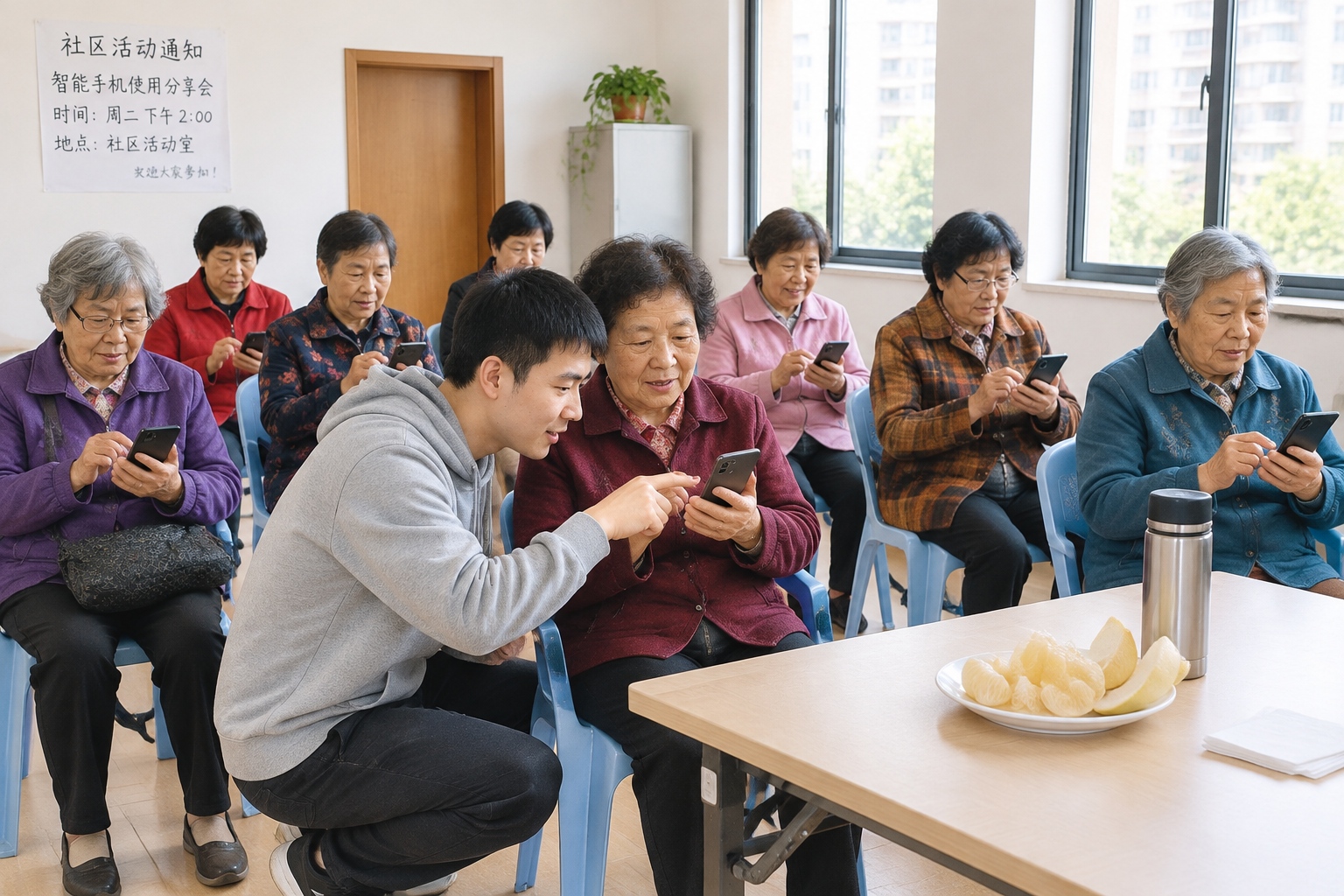
“If you tap the wrong thing, tap the arrow in the top left corner. Nothing breaks.” The instruction came from a 24-year-old in a grey hoodie, and it was addressed to fourteen women whose average age sat somewhere around 68.
It was two in the afternoon on a Tuesday, in a community activity room in Shanghai’s Putuo District. The chairs were the stackable plastic kind that squeak on tile floors. A thermos of tea and a plate of peeled pomelo sat on a folding table at the front. On the wall, a hand-written sign said the room was booked for “smartphone class” until 3:30.
This is what a first lesson in large language models looks like when the students are retired textile workers, a former hospital accountant, and a woman who has been selling vegetables in the same wet market for thirty-one years.
A classroom where the phone is the textbook
The course runs six sessions, ninety minutes each, and it is free. The neighbourhood committee organised it after a survey of residents over 60 turned up the same answer again and again: people owned smartphones, they used WeChat to talk to their children and grandchildren, and they were quietly afraid of everything else.
“They’d say, ‘I only press the green button. If I press anything else, I might lose money,'” said Wang Lei, a community worker in her thirties who helped set the class up. “Then last year they started asking about AI. They’d heard the word on television, or their grandchildren mentioned it, and they wanted to know what it actually was.”
The committee approached a local nonprofit that runs digital-literacy programmes for older residents, found two university student volunteers and a retired maths teacher, and put up a sign-up sheet. Twenty-two people signed. Fourteen came to the first session, which is a good turnout for anything scheduled at two on a weekday afternoon.
What the first lesson actually covers
No one in the room is learning how a neural network works. The volunteer, a computer science student named Li Haoran, opens with one sentence: “Today we’re going to learn how to ask a phone for help, in plain language.”
The first exercise is voice input. Mrs Gu, 71, holds her phone slightly too far from her mouth and asks, in Shanghainese, whether she’ll need an umbrella tomorrow. The assistant answers in standard Mandarin: rain in the afternoon, bring one. She laughs and looks around the room as if someone had done a card trick.
The second exercise is a bus route. The third is a birthday message. Mrs Zhou’s granddaughter turns twelve on Saturday, and Mrs Zhou asks the AI to write something. What comes back is four paragraphs of formal, faintly official prose — the kind of thing you’d read at a company dinner. The room dissolves. Li tells her to say what she wants changed: “Too long. Make it shorter. Say it like a grandmother would say it.” The second version is two lines, and she copies it into WeChat by hand rather than forwarding it.

The last exercise is the one that produces the most noise. Someone has brought a bottle of coenzyme Q10 supplements, the kind sold in boxes of three for several hundred yuan. Can the phone explain what is actually in it? It can — the ingredients, the dosage, and a plain-language summary of what the research says. Li adds the caveat immediately and repeats it twice: the AI can be wrong about anything medical, ask a pharmacist, and never buy from a link an app hands you.
“Will the phone cheat me?”
That question comes up in every session, in some form. It is not naive. Several people in the room have received scam calls; one woman lost 2,000 yuan to a fake delivery notice two years ago and still keeps the screenshot.
So the class teaches AI alongside a set of house rules, printed in 22-point type and taped inside everyone’s handout. Don’t click links from strangers. Don’t tell any app your bank card number. If something asks for a verification code, close it and call your daughter. And a newer one, added this year: an AI can sound completely confident and still be completely wrong, so check anything that matters.
“In the first class they think the AI is a person on the other end,” Li said. “By the third class they’re arguing with it. That’s the moment I know it worked.”
The people behind the class
The teaching is mostly volunteer labour: undergraduates from two nearby universities, a retired maths teacher, and a former telecom engineer in his seventies who is the fastest person in the room at finding settings menus. Between them they’ve rebuilt the curriculum around how older people actually use a phone.
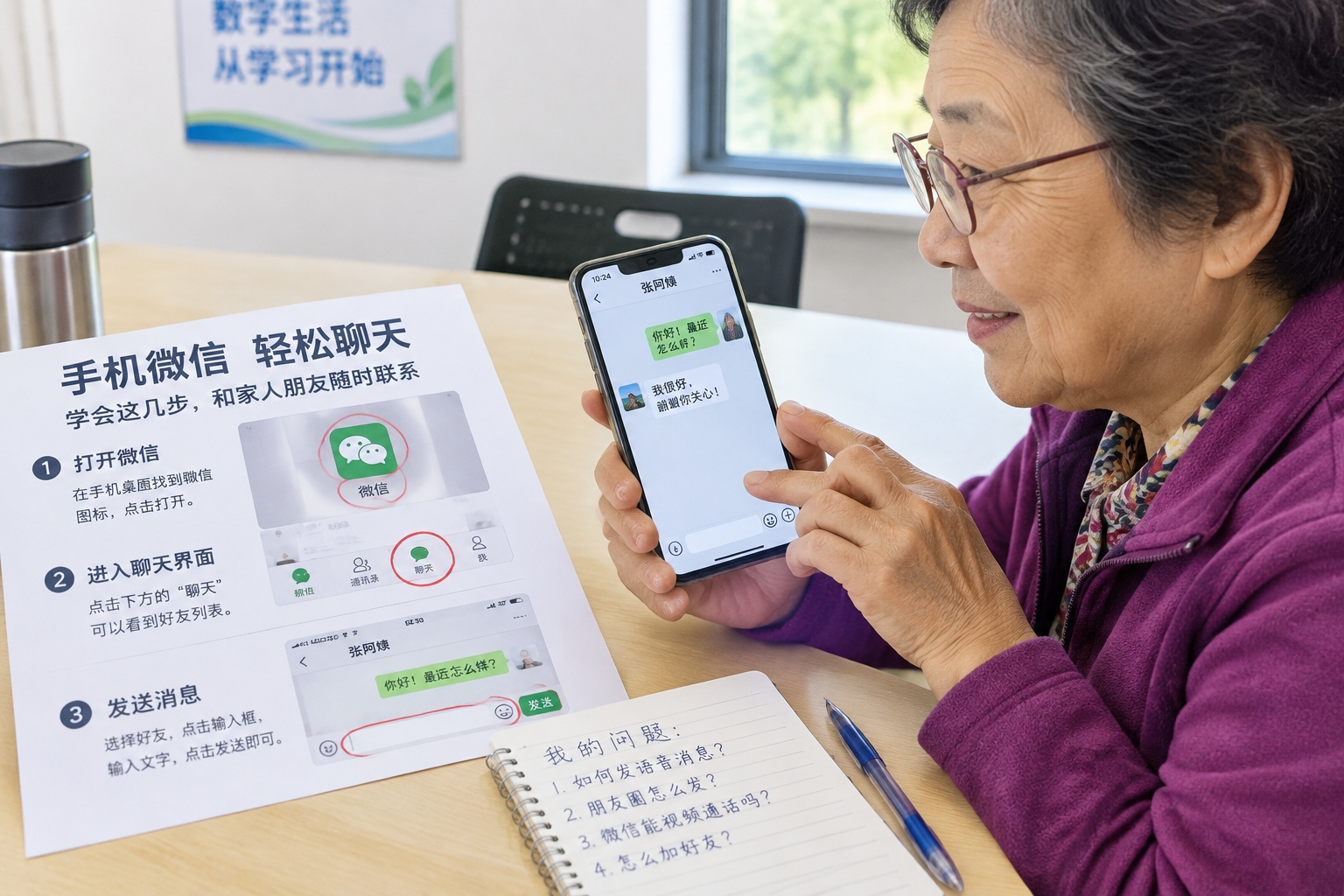
That means one instruction per printed page. Screenshots with red circles drawn on them. No English jargon — nobody says “prompt”; they say “把你想要的说清楚”, say clearly what you want. Shanghainese and Mandarin run in parallel, because half the room thinks faster in dialect and types in Mandarin. Homework is optional and always involves asking the phone one question at home, alone, without a volunteer nearby.
The technology side has become easier in the past two years. Chinese regulators pushed hundreds of apps to build “elder-friendly” versions with bigger fonts and fewer buttons, and the AI assistants themselves went free and voice-first. When DeepSeek’s app shot to the top of Chinese app stores in early 2025, the biggest surprise in the industry wasn’t that young people downloaded it. It was how many people over 60 did.
China has roughly 310 million people aged 60 and over — about 22 percent of the population, according to the National Bureau of Statistics at the end of 2024. Internet use among this group has climbed fast and still trails every younger cohort, which is exactly the gap a ninety-minute class in a tiled room is trying to narrow.
What two hours in a community room changes
Not much, on its own. Fourteen people is fourteen people. Some will forget the shortcuts within a week; two signed up for the follow-up course, and one has already started teaching her neighbour.
But the scene is worth noticing because it’s where technology actually lands. The rollout of consumer AI in China is usually described in terms of model benchmarks and app download charts — a story about companies. The version happening in Putuo District is a story about a woman who spent thirty years working a market stall learning that she can hold down a button, speak in her own dialect, and get a straight answer about whether it will rain.

Mrs Chen, 67, a retired textile worker who arrived fifteen minutes early and took notes in a spiral notebook, stayed behind afterwards to ask Li to put the AI app on her home screen so she wouldn’t have to search for it. She had written three questions in the back of her notebook for next week. All three were about her grandson’s homework.
The question this leaves for everyone else
Every country with an ageing population is about to face the same arithmetic: a technology that speaks fluent, confident language is arriving in the hands of people who were never taught how to interrogate a screen.
The community-class model is unglamorous and cheap. A room, a projector, a printed handout, one patient 24-year-old, and a group of people willing to be beginners in front of their neighbours. It doesn’t scale by itself, and it doesn’t reach the people who never sign up. But it is replicable in a way that most digital-inclusion plans are not, and it treats older people as students rather than as a problem to be managed.
At 3:30 the chairs went back on the stack. Mrs Gu put her phone in her bag, then took it out again to check the weather. “See,” she said to nobody in particular, “it works.”
Start the discussion at forum.chinacomes.com