

Why a 99-yuan course and a 9,999-yuan course sell the same promise
Type “large model” — 大模型, the Chinese shorthand for large language models — into Douyin or Xiaohongshu and the ads arrive within seconds. A young instructor stands at a whiteboard: “Zero foundation to your own AI agent in seven days.” Another holds up a phone showing a spreadsheet that appears to fill itself: “I replaced three hours of work with one sentence.”
The promises sound nearly identical. The prices are not. In the same week, on the same platforms, you can buy a recorded course for 99 yuan (about $14), a live bootcamp for 999 yuan, an advanced project course for 4,999 yuan, and a corporate in-house training package starting at 9,999 yuan. That is a hundred-fold spread for a subject whose core material is largely drawn from the same public documentation.
The gap is a useful map of how AI is actually being absorbed into Chinese working life — not as a research field, but as an office skill that people are buying in a hurry.

The four tiers, side by side
| Price tier | Typical format | Who buys it | What is actually delivered |
|---|---|---|---|
| 99 yuan (~$14) | Recorded video, 5–20 hours, prompt template pack | Students, first-time users, small shop owners | Tool walkthroughs, copy-and-paste prompts, no feedback |
| 999 yuan (~$140) | Live sessions plus a WeChat study group, 4–8 weeks | Career switchers, junior office staff | Weekly assignments, group check-ins, occasional review |
| 4,999 yuan (~$700) | Project-based, 8–12 weeks, certificate and referral promise | Product managers, operations staff, junior developers | Three to five portfolio projects, mock interviews, alumni group |
| 9,999 yuan and up (~$1,400+) | Custom in-house training, one to three days or a multi-week cohort | Companies — HR, L&D and department heads | Industry case studies, private deployment advice, follow-up consulting |
The tiers are not simply better and worse versions of one another. They are different products sold to different anxieties.
Tier one: 99 yuan buys a library card, not a teacher
At the bottom of the market, the buyer is usually someone outside the tech industry. A graduating student in a humanities major. A logistics coordinator who has heard that her company is “going digital.” A noodle-shop owner who wants to write better listings for a delivery app.
What they get is a package of recorded videos, often resold across several platforms under different titles, plus a folder of prompt templates: how to write a Xiaohongshu post, how to summarise a contract, how to draft a customer-service reply. The information is real, but it is one-directional. Nobody checks the work. Nobody answers the question that actually stops most beginners — why the output is wrong, and what to change.
Completion rates at this tier are low, and sellers know it. The economics work because production costs are near zero after the first recording. Many of these courses function as a funnel: the 99-yuan purchase is an email address, and the real pitch is the 999-yuan upgrade.
Tier two: 999 yuan buys structure, and a group chat
The middle tier sells accountability. Live evening classes, a study group with daily check-ins, an assignment due each Sunday. The marketing language shifts from “learn prompting” to “build your own agent” or “set up a personal knowledge base” — tasks that sound concrete and can be demonstrated on screen in a few minutes.
In practice, most students build a chatbot that answers questions about a PDF, using an open-source framework and a cloud account. It works. It is also roughly what a motivated person could assemble in a weekend by following the framework’s own documentation. What they are paying for is the deadline.
The honest version of this tier is genuinely useful for people who need momentum and a group to ask questions in. The dishonest version is a 99-yuan course with a livestream attached and the same template folder inside.
Tier three: 4,999 yuan buys projects, certificates and introductions
This is where the buyers become professionals — product managers told to “add AI features,” operations staff whose KPIs now include automation, and junior developers whose employers expect them to integrate a model API. The course promises three to five portfolio projects, a certificate, and often “referral opportunities” to partner companies.
Some of it is substantive. A well-constructed project brief, reviewed by someone who has shipped a real system, teaches things documentation does not: how to handle failures, how to evaluate whether an output is good, how to estimate cost per thousand calls. The courses that build a working evaluation loop for a small task are worth the money.
Other parts are packaging. A certificate issued by the training company itself carries little weight with employers, who mostly ask what you built. “Referral opportunities” frequently means a shared spreadsheet of job listings. The certificate is a receipt, not a credential.
Tier four: 9,999 yuan and up — what companies are actually buying
Corporate buyers behave differently. They are not shopping for knowledge; they are trying to close a gap between a mandate from senior management and a workforce that has used a chatbot a handful of times.
When DeepSeek’s free model went mainstream in early 2025, it did something price cuts had not: it put a capable model in front of employees who had never opened one. Within weeks, HR and IT departments across manufacturing, retail, banking and logistics were asked a version of the same question — what should we actually do with this?
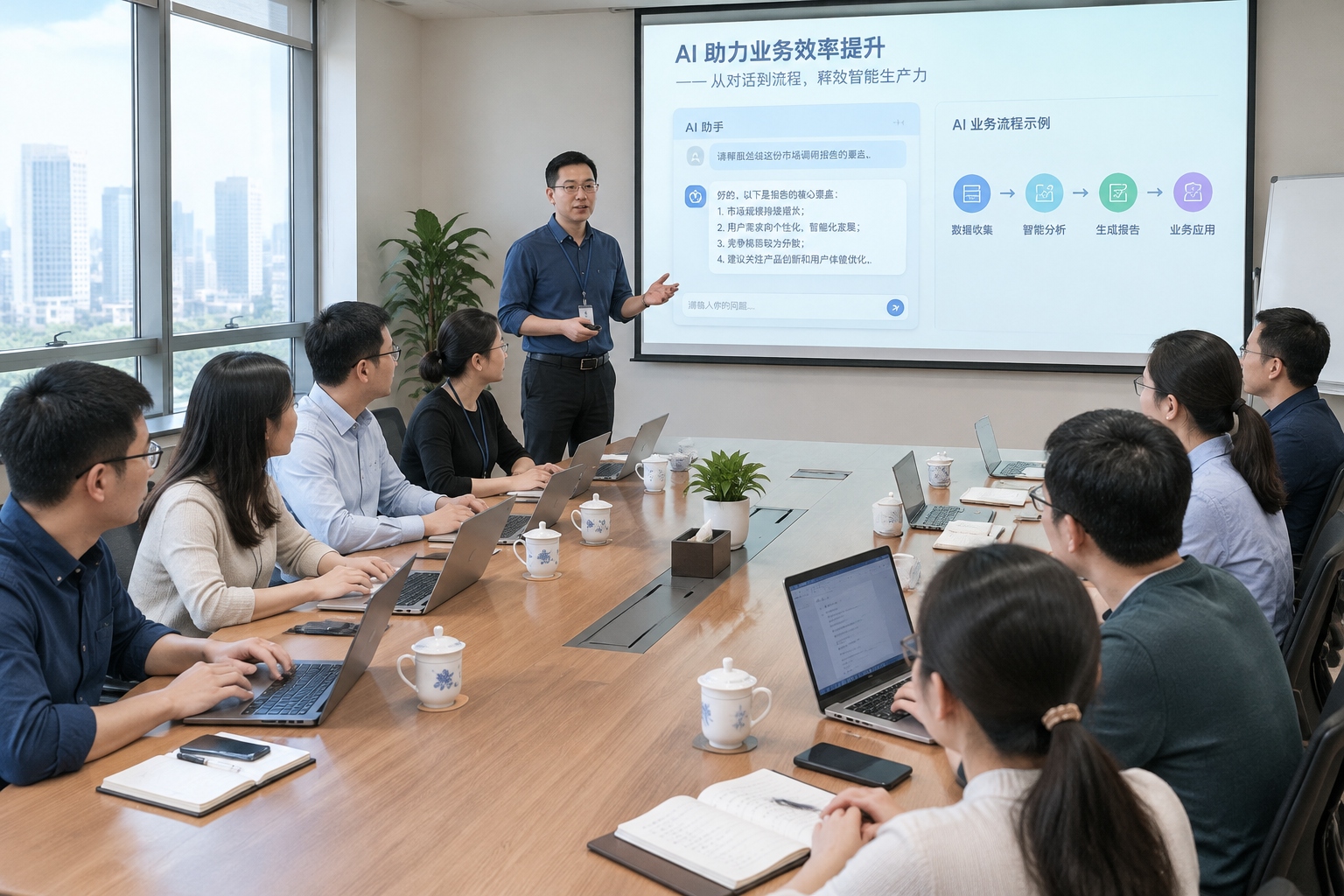
A typical corporate package includes a half-day or two-day workshop, industry-specific case studies (contract review for legal, quality-report summarisation for factories, customer-service triage for retailers), and guidance on deployment. That last item matters most to the buyer. Chinese companies are often reluctant to send internal documents to an overseas API, so sessions on running open-weight models on local servers — 私有化部署, private deployment — carry real weight.
Pricing in this tier is loose. The same 9,999-yuan figure can mean per session, per seat in a twenty-person cohort, or a day rate for a trainer. That ambiguity is itself a feature of a young market: there is no standard unit to compare against.
Who is standing at the front of the room
Instructors fall into roughly four groups: independent creators on knowledge platforms such as Geekbang and Bilibili, small training companies built specifically around AI, agencies that used to sell digital-marketing courses and rebranded, and genuine practitioners from larger tech firms who teach on weekends.
The credential problem is real. “Former big-tech AI engineer” can mean five years building recommendation systems, or three months on a contract. A useful filter: look for the instructor’s public work — a GitHub repository, a published product, a technical blog with dates on it — rather than the biography on the sales page. If the only proof of expertise is the sales page itself, that is the answer.
The anxiety underneath the price list
China will produce around 12.2 million university graduates in 2025, on top of a job market where white-collar hiring has been cautious. At the same time, employers in almost every sector have started writing “familiar with AI tools” into job descriptions — sometimes as a preference, increasingly as a filter.
That combination explains the price ladder better than any technology trend. The 99-yuan buyer is hedging. The 999-yuan buyer is hoping for a signal on a résumé. The 4,999-yuan buyer is trying to convert a job title into a slightly more durable one. The 9,999-yuan buyer is a manager trying to look prepared in front of a director.
None of these are irrational. They are the ordinary behaviour of a labour market adjusting to a new tool faster than its training institutions can.
Two people, two verdicts
The same course produces opposite reviews, and both are usually accurate.
A customer-service supervisor at an e-commerce company in Guangdong took a 999-yuan course and got her money back in usefulness within a month. Her team handled routine refund requests by hand; she built a simple workflow that drafts replies from order data, and a human still approves each one. It is unglamorous, and it saved her team hours a week. She never built an “agent.” She learned enough to stop being afraid of the interface.
A designer in Chengdu paid 4,999 yuan for an advanced course and calls it 水 — “watery,” Chinese slang for padded and insubstantial. The first three weeks re-taught material he already knew. The “real project” turned out to be a template with the variables renamed. The certificate sits in a folder. He is not wrong, and neither is the supervisor. The courses differ in quality, but the more important variable is the student’s starting point and whether they arrive with a task they actually need to finish.

If you are going to pay, ask five questions first
For readers considering a Chinese-language AI course — or any equivalent in their own market — five checks do most of the work.
1. What will I be able to do on day one after the course ends?
If the answer is “understand the principles,” a free document will do. If the answer is “automate the weekly report I currently build by hand,” you have a real target to measure the course against.
2. Can I see the actual project brief before paying?
Reputable providers will show one project in full, including the grading criteria. Vague screenshots of a dashboard are not a project.
3. Who reviews my work, and how often?
Recorded courses plus a group chat is a 99-yuan product regardless of the price tag. Human feedback is the expensive part; that is what you are buying.
4. What is the refund policy in writing?
Chinese consumer-protection rules give online course buyers room to cancel, and platforms such as Taobao and Douyin enforce it unevenly. Ask before payment, in the chat, so there is a record.
5. Does the certificate matter to anyone but the seller?
Usually not. Employers ask what you built. Treat the certificate as a receipt.
What the price list doesn’t show
The most effective AI users I have met in China did not pay 4,999 yuan. They paid attention. A factory quality inspector who spent two weeks feeding defect reports into a free model and correcting its summaries learned more than most course graduates, because she had a real problem and immediate feedback on whether the output was right.
The price ladder is not a quality ladder. It is a map of how urgently different people want to be seen as ready. For a few thousand yuan, a course can give structure, a deadline, a group to ask questions in, and permission to spend time on something new. That is worth something. It cannot substitute for the part that actually transfers: a specific task, done repeatedly, with someone or something telling you when you got it wrong.
The market will thin out. Prices will fall, the weakest providers will close, and “AI training” will stop being a category of its own, the way “Excel training” did. What will remain is the ordinary office reality already visible in Chinese companies today — a colleague who quietly automated a tedious task, and everyone else asking her how.
Start the discussion at forum.chinacomes.com