
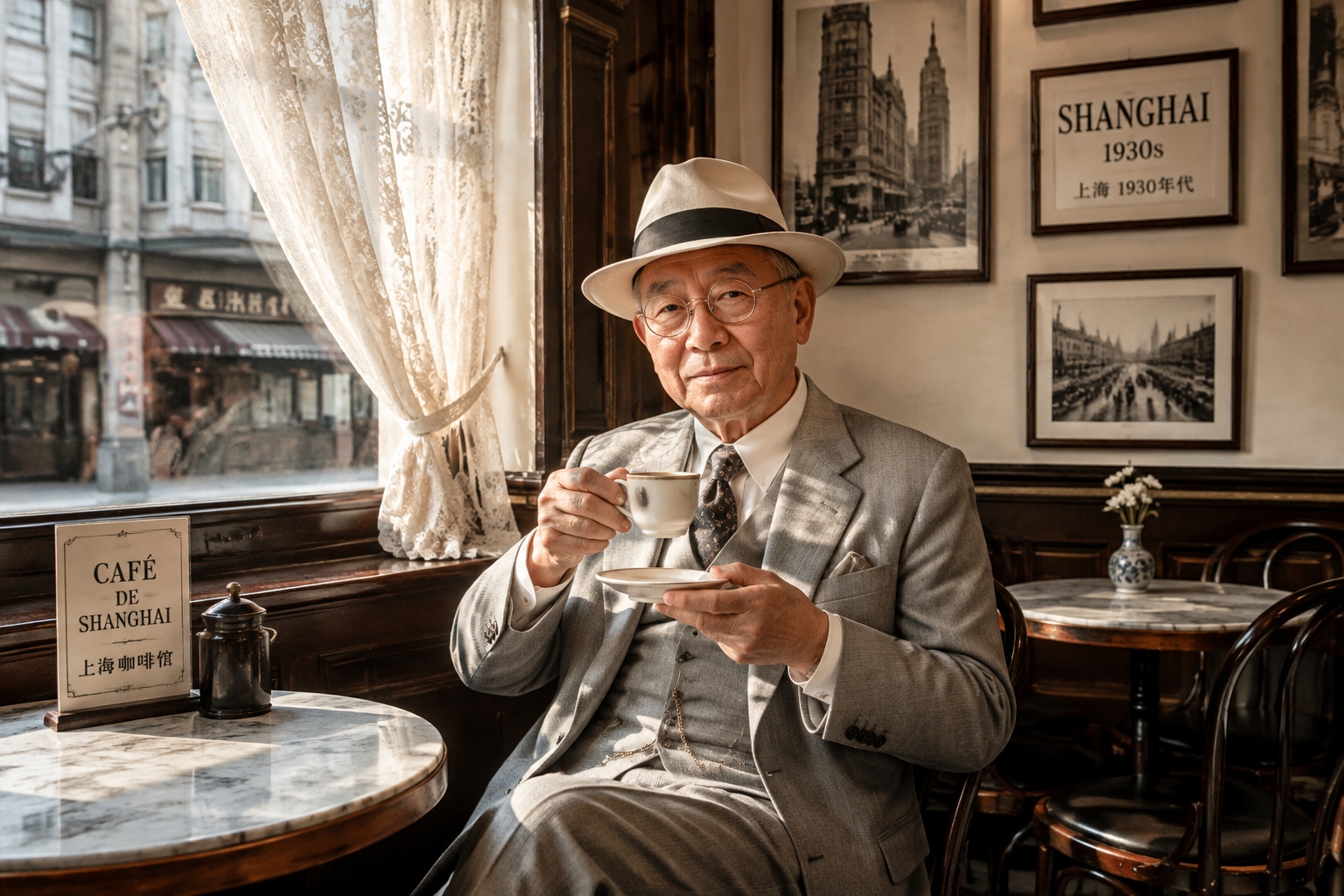

The late afternoon light is a soft amber, falling through the lace curtains of Donghai Café on East Nanjing Road. I’m sitting by the window, nursing a cappuccino, when an elderly man walks in. He is thin, straight-backed, wearing a light gray blazer, a silk pocket square, and a fedora in his hand. He nods at the waiter, who brings him a small cup of black coffee without being asked. The man is 85-year-old Wang Mingliang, a so-called “old clerk” (lǎo kè lè). For the next hour, we talk about coffee, old Shanghai, and why a city that never stops changing still needs a place to remember.
Who Are the “Old Clerks”?
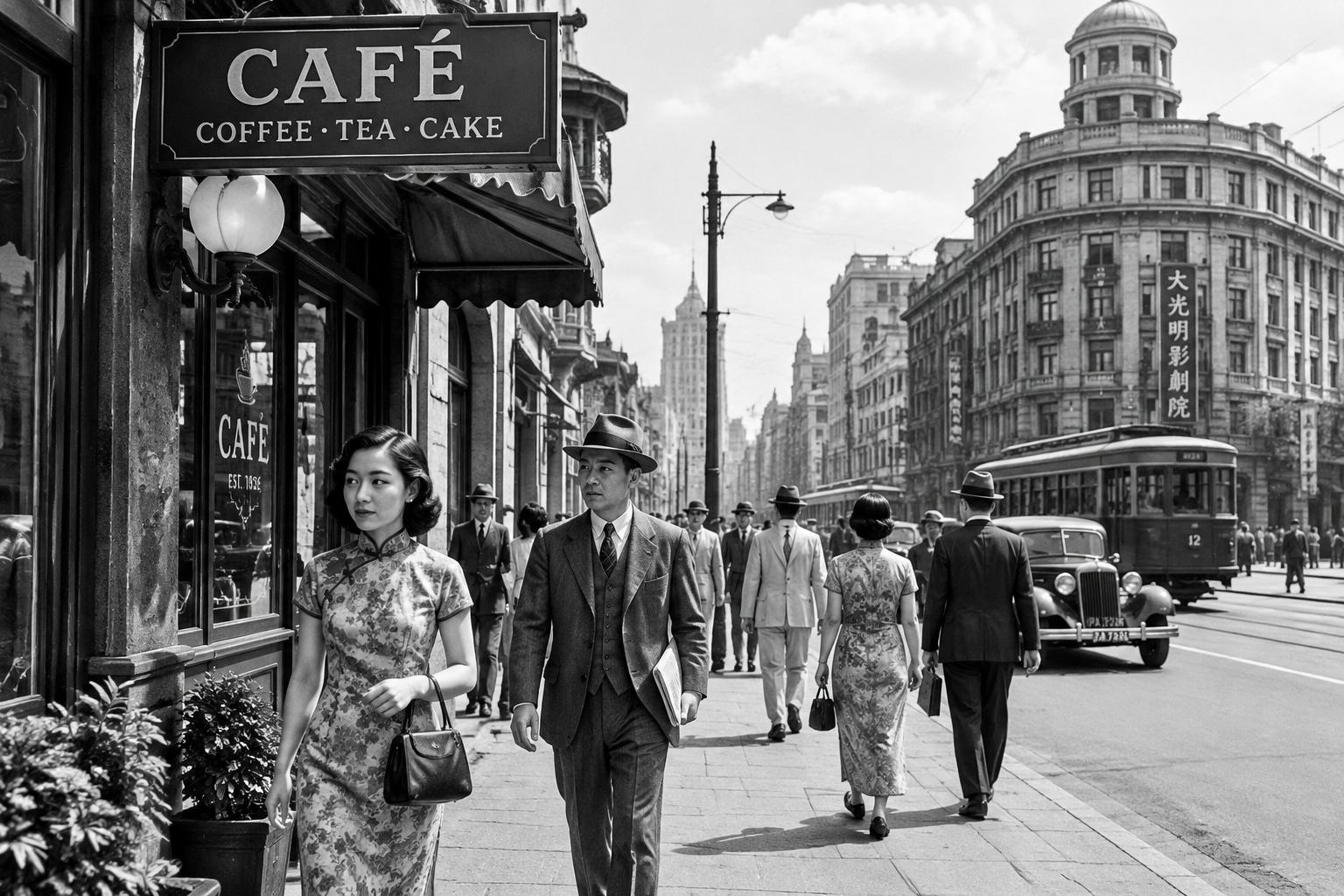
The term lǎo kè lè comes from the English word “clerk” but has a richer meaning. In the 1920s, a well-dressed Chinese man who spoke English and worked for a Western company was seen as the height of modernity. He would be hired by a British or French firm as a comprador, translator, or manager. Socially, he mixed with foreigners at banquets and dances, and he acquired a taste for black coffee, cigars, and tailored suits.
These men were the backbone of what became known as “haipai” (Shanghai style) culture – a blend of East and West that gave the city its distinctive character. Wang Mingliang was born into this world. His father worked for a British trading firm and passed down an obsession with personal grooming and manners. “My father used to say, ‘A man must be as well-ironed as his trousers,’” Wang laughs.
But the old clerks also had a serious side. Many were well-read and helped introduce Western science, literature, and political ideas to China. Some participated in the early labor movements. The café was their parliament: a place where they debated everything from poetry to economic reform.
A Café Built on Memory
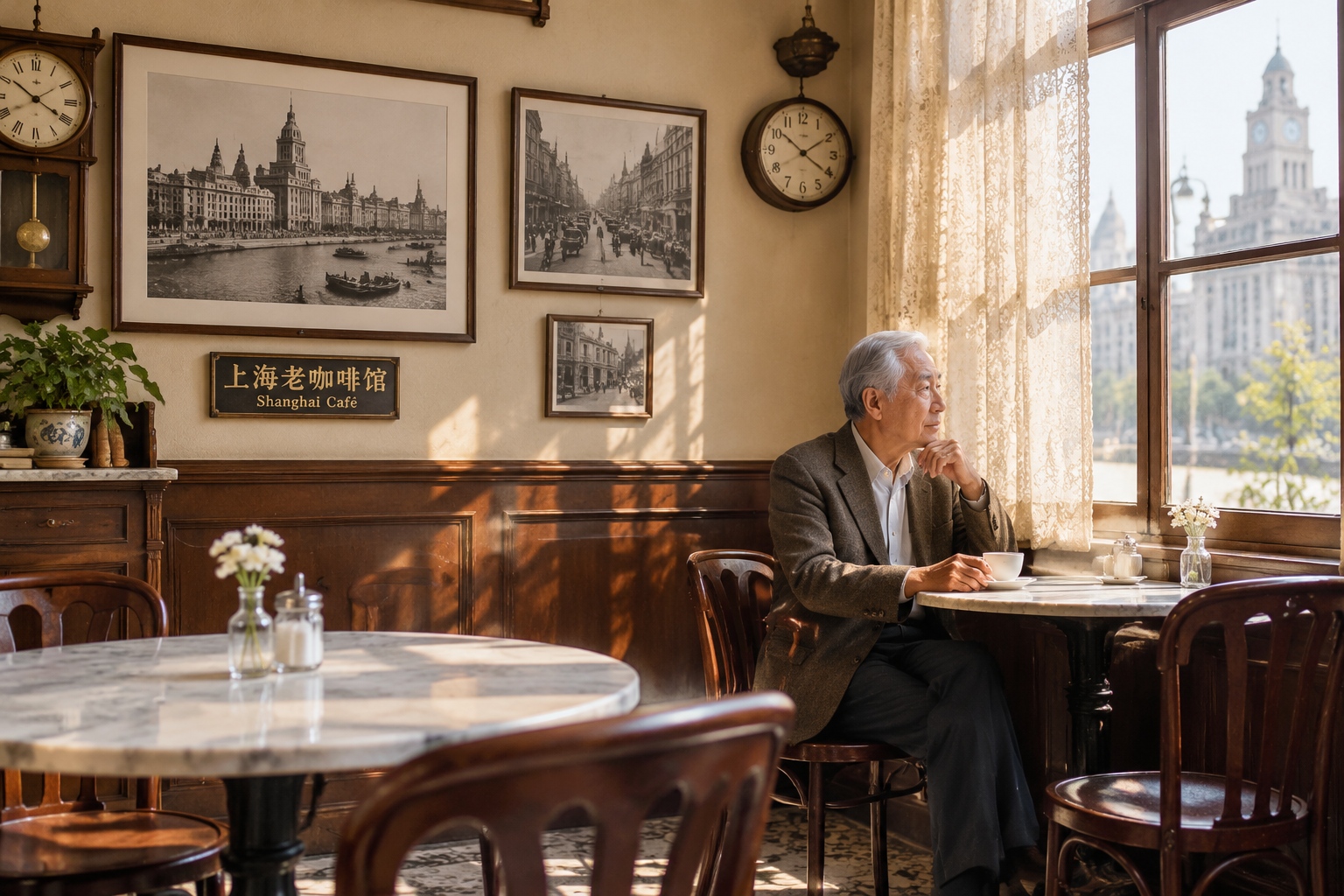
Donghai Café opened in 1934. For decades, it was a meeting point for neighborhood intellectuals and businessmen. The interior remains largely unchanged: dark oak panelling, marble tables, and an old clock that still ticks. A long counter in the back displays glass jars of coffee beans and biscuits. The smell of roasted coffee is thick enough to taste.
Wang explains that the café went through dark times. During the war in the 1940s, coffee was rationed. Later, during the 1960s and 1970s, such places were labeled as signs of a decadent, imperialist culture, and many were shut down. “For about ten years, the door was locked,” he says quietly. “When it reopened in the 1980s, we found the floor still had the same wood grain. It was like seeing an old relative after a long illness.”
The Art of Sipping
For Wang, coffee is a ceremony. He takes a linen napkin, spreads it on his knee. He lifts the cup with both hands, supporting the saucer with his fingertips. He sniffs the aroma, takes a sip, and closes his eyes for a second. “Coffee,” he says, “is a mirror. If you are restless, it tastes sour. If you are calm, it tastes sweet.”
He has a favorite ritual: he always stirs the coffee twelve times clockwise before drinking. “It’s not a superstition,” he says. “It’s a way of making sure the cream is fully mixed with the coffee. In the old days, our English colleagues would teach us to stir it seven times, then twelve. I forgot why, but I kept the number.”
He also tells me about his late wife, whom he met at that café in 1962. “She came in with her mother, and she was wearing a red wool jacket. I knew she would be my wife after I saw her pour her tea with a steady hand. Later I learned she was just as steady in her opinions.” He smiles and looks away.
The Coffee Boom That Changed Everything
Today, Shanghai has more than 8,000 coffee shops, more than any other city in mainland China. According to a 2023 industry report, per-capita coffee consumption has tripled since 2015. Most of the new growth comes from people under 30, who see coffee as a functional beverage or a social prop.
Wang doesn’t judge the new generation. One time, his granddaughter brought him to a modern café where the staff served iced coffee in a plastic bag. “I thought it was a joke,” he says. “But then I tried the coffee. It was surprisingly good. Maybe young people don’t need a silver spoon and a starched napkin. They just need a reason to pause for twenty minutes.”
He still believes that a proper café is a place to be, not just a place to pass through. “If you drink coffee while scrolling your phone, you might as well be alone at home,” he says. “A café is for conversation. That’s why I come here. The espresso machine is just an excuse.”
The Younger Generation Finds Its Own “Old Clerk”
Perhaps the old clerk is not a relic but a blueprint. Across the city, there is a quiet movement to revive the elegance of old Shanghai. Vintage boutiques sell cashmere coats and leather gloves. In some restored lanes, you’ll find “old Shanghai style” tea rooms that serve coffee on porcelain. A few young people even take ballroom dancing lessons.
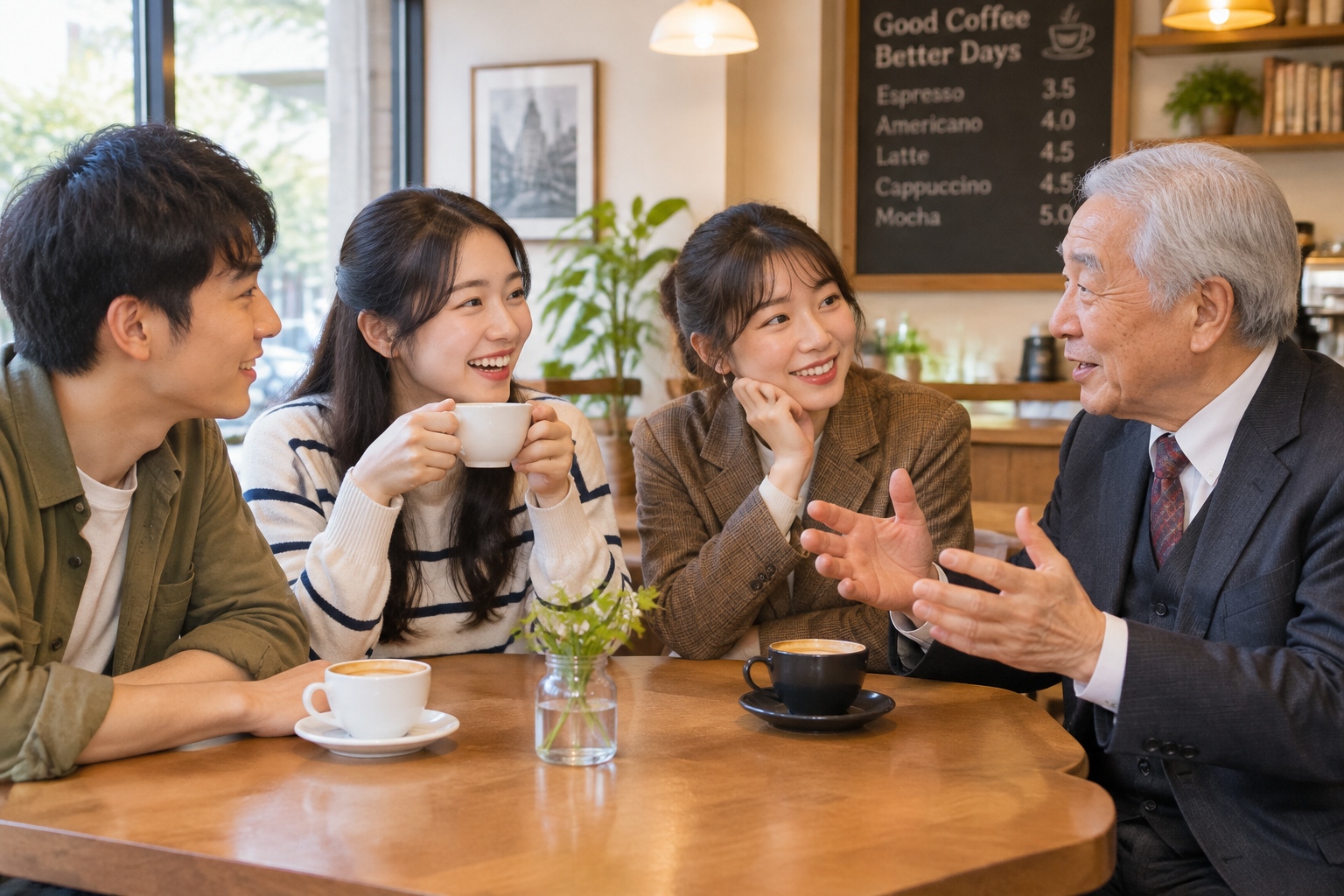
One of Wang’s companions at the café is 27-year-old Zhou Lin, a software engineer. She is part of a group of young regulars who gather on weekends to learn about Shanghai’s history. Wang gives them tips on how to act in a restaurant and how to judge a good cup of coffee. “He treats us like grandchildren,” Zhou says. “It’s not about being polite. It’s about being grounded. When you live in a city that changes this fast, you need someone who remembers what it was like before.”
The City’s Quiet Continuity
As the afternoon turns to evening, the café starts to empty. Wang orders one last sip, then folds his napkin. He says that Shanghai is very different from the city he knew as a child, but he doesn’t feel lost. “The old clerks taught us that style is not about the past. It’s about knowing how to stand in the present without tipping over.”
He puts on his fedora and stands. “I’m going to Fuxing Park to stroll. The leaves are turning red next week. You are welcome to join me.” I decline, but I imagine walking among the plane trees with a man who has seen history in the bottom of a coffee cup.
The door closes behind him. The café hums with low conversation and the clatter of porcelain. In a city that glitters with new towers, the old places still remember. And for a few hours on an afternoon, they let the rest of us remember, too.
Start the discussion at forum.chinacomes.com