
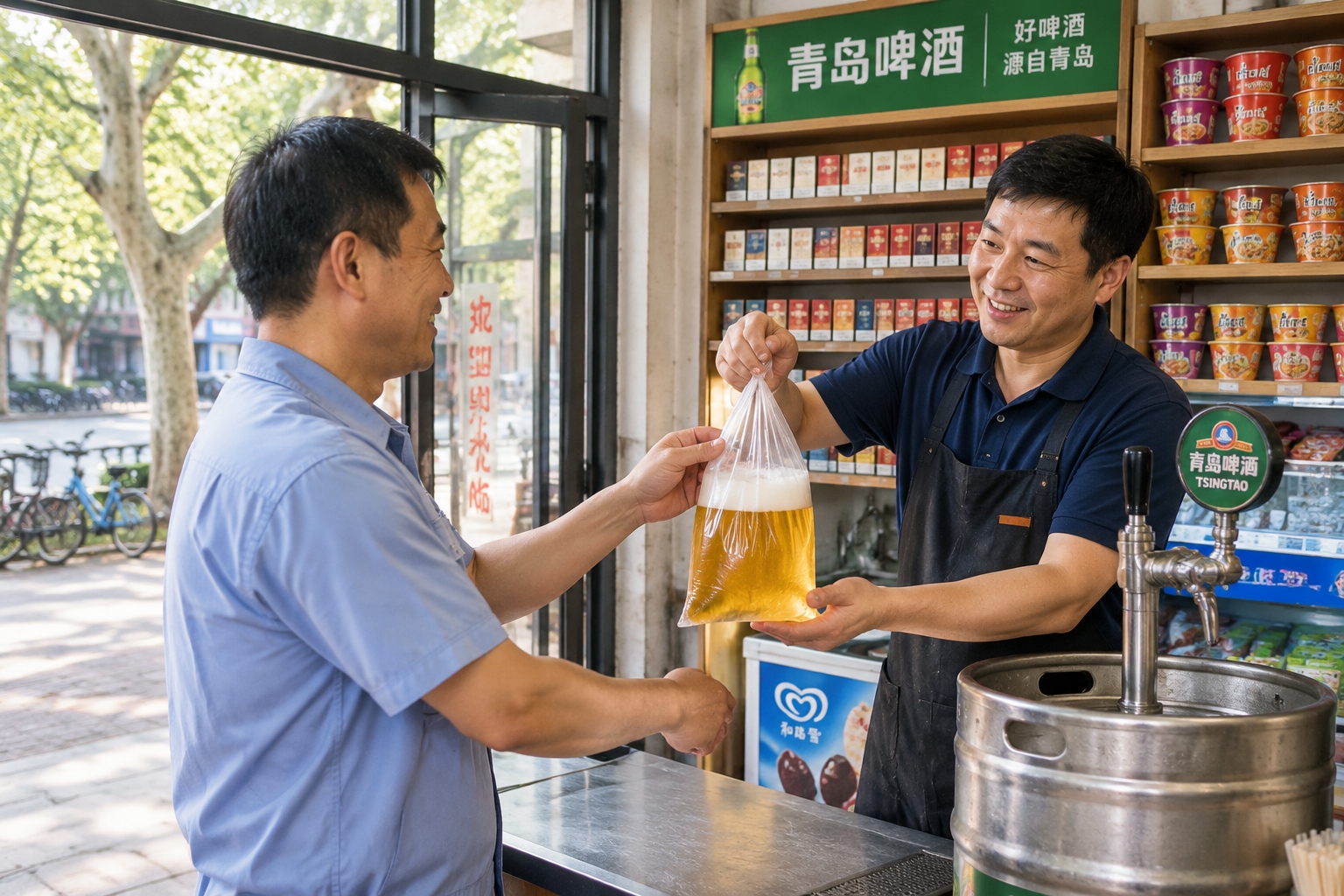

At a corner shop on Huangxian Road, in the older part of Qingdao, the evening rush has its own soundtrack. First the click of a keg tap. Then a soft, rising thump as a plastic bag swells and settles, the way a paper bag does when you blow into it.
The man at the counter is still in his work shirt. He does not say much. Ten yuan changes hands, he takes the bag by the knot, pushes a straw through the plastic and walks off downhill towards home, drinking as he goes.
Nobody in the shop turns to look. This is not a stunt laid on for visitors and it is not a viral clip. It is how a lot of people in this city buy beer on a Tuesday.
What is actually in the bag?
In Chinese it is called san pi — loose beer. Not a brand, not a novelty: the everyday word for draft beer sold by weight straight from a keg.
Shops sell it by the jin, which is 500 grams, a little more than a pint by volume. Prices usually land somewhere between five and twelve yuan a jin, depending on the shop, the season and the beer inside. A standard bag holds one or two jin. Households and dinner tables go bigger, and in July you will see people walking home with five jin swinging from one hand.
What is in there is unpasteurised draft, brewed nearby and delivered in pressurised kegs, often daily once the weather warms up. It is served cold, lightly carbonated, and usually weaker than the bottled lager most foreign visitors know — often around 3.5 to 4.5 percent alcohol. It also does not keep. Left overnight, it goes flat and stale. That one fact explains almost everything about how bagged beer gets bought: in the evening, in the amount you can finish, on the same day it arrived.
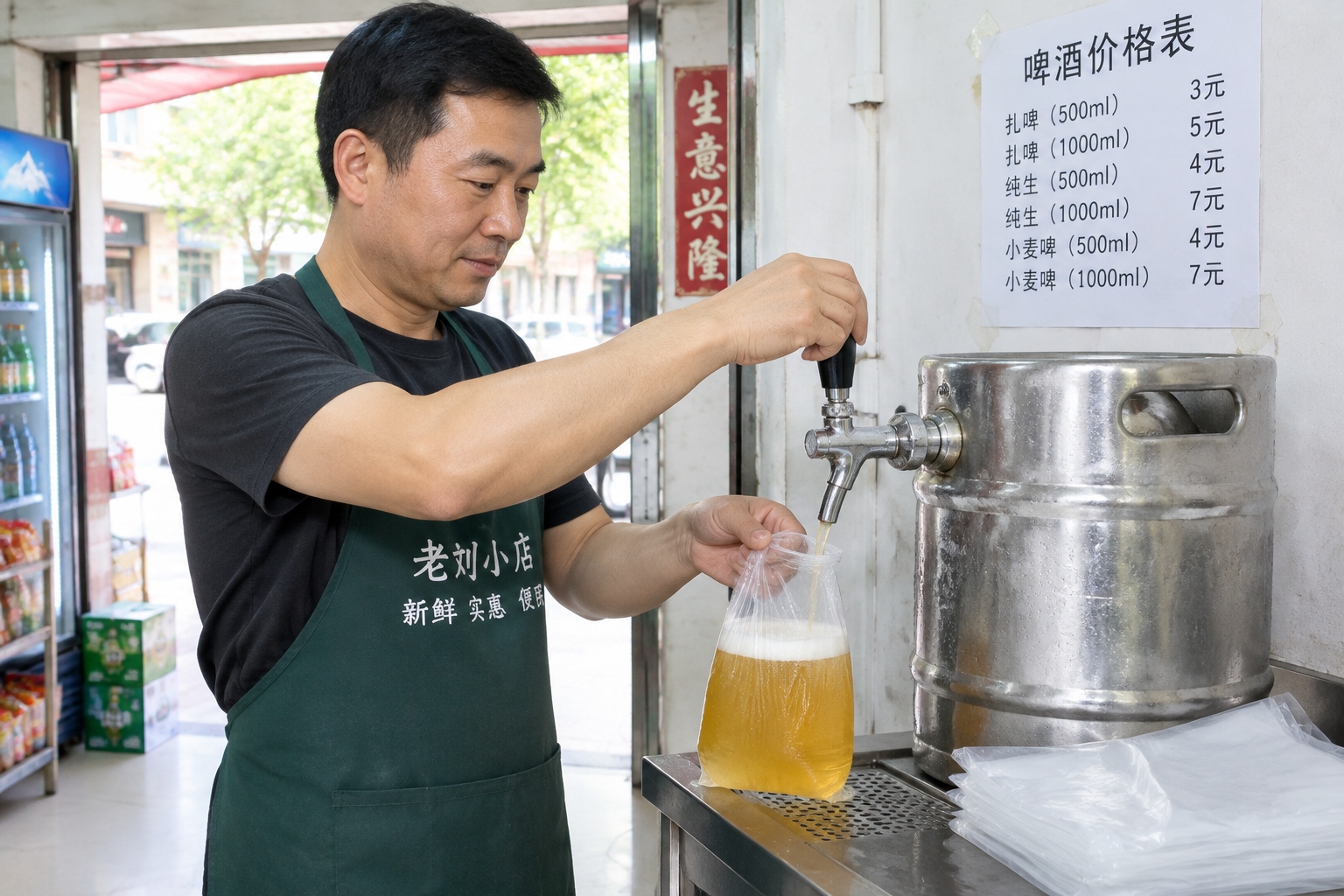
The bags are made for the job — food-grade polyethylene, sometimes printed with the shop’s name and phone number. Filling one takes about ten seconds. The bag collapses as you drink, which keeps the beer from sloshing flat the way it would in an open cup, and it fits in a bicycle basket, a rucksack or a mesh shopping bag.
Why a bag and not a bottle
Bottles and cans exist here too, in every convenience store, and they are not expensive. The bag survives for a few practical reasons.
Cost comes first. A bottle is money — glass, a cap, a label, a fridge shelf, and in theory a deposit and return system that hardly anyone bothers with any more. A bag costs the shop a few cents. That saving goes into the price, and the price is the point: fresh draft beer here is often cheaper per litre than a mid-range coffee.
Space comes second. Most of these shops are two metres wide and four deep, wedged into the ground floor of a 1980s apartment block, with one fridge and no cellar. A keg sits in the corner. A crate of bottles takes up room a shop like this does not have.
Habit comes third. Selling liquids by weight is old in China — soy sauce and vinegar were ladled out of crocks into whatever vessel the customer brought. Beer followed the same route, and when thin plastic bags became ubiquitous in the 1980s and 1990s, the container changed and the transaction did not. The brewery itself was founded in 1903 by German and British settlers, and the northern European habit of drinking beer fresh from the barrel rather than from a sealed bottle never really left this coastline.
Who drinks it, and when
The most common purchase happens on the way home. Someone stops at the shop at the corner of their block, buys a bag, and finishes part of it before reaching their building. You see bags on the back of electric scooters, in bicycle baskets, hanging from handlebars, resting in the front basket of a delivery rider’s bike while he waits for an order.
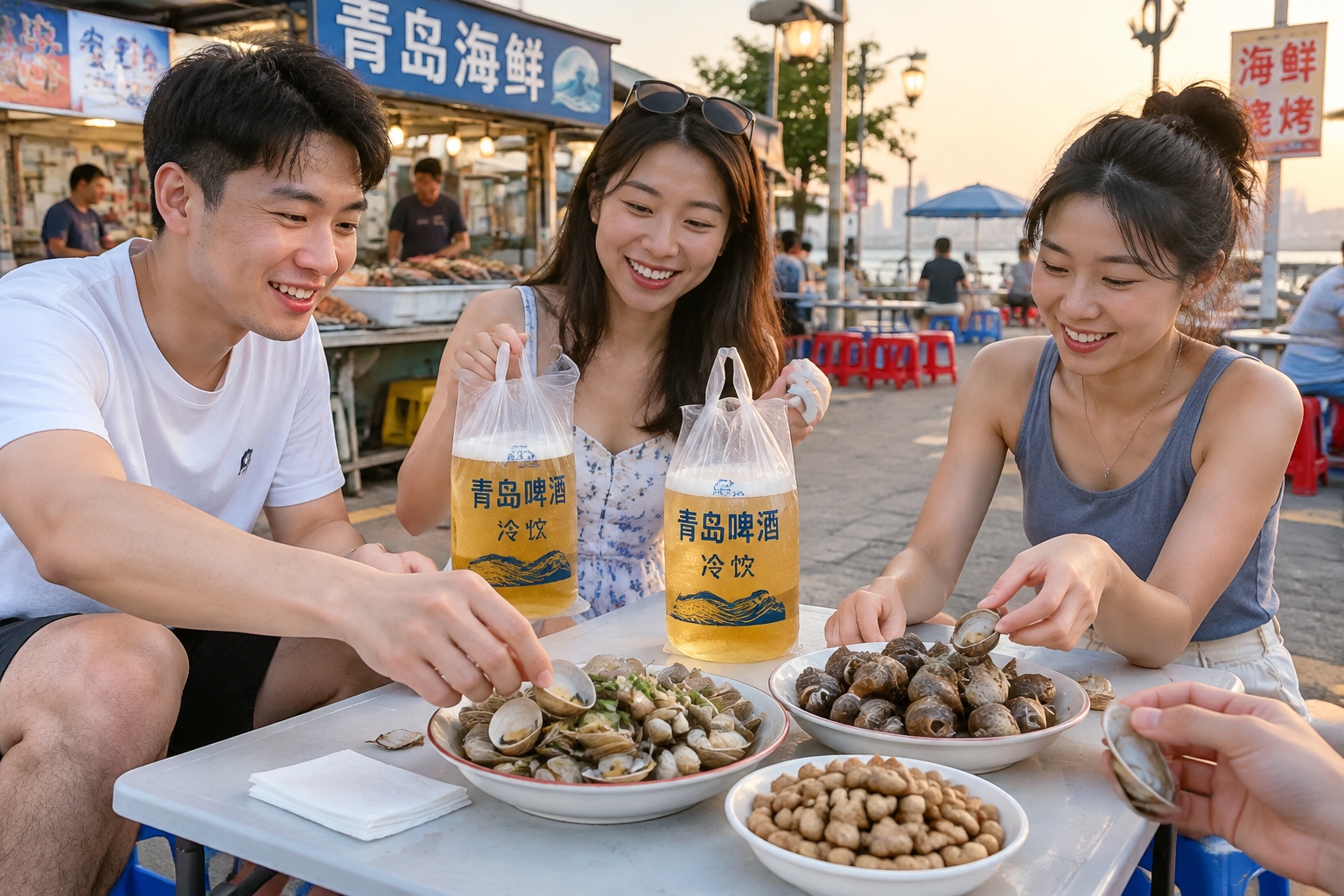
The second setting is the seafood stall. Qingdao’s summer street food is clams, sea snails, grilled squid, spiced peanuts and smashed cucumber, and the beer carries as much of the meal as the food does. Along the small streets of Shinan and Shibei there are pijiuwu — beer rooms — where you can bring your own seafood from the market next door and pay ten or twenty yuan a dish to have it cooked. The beer arrives in a bag and gets poured into glasses or, quite often, drunk straight from the bag with a straw.
At home, the bag lands on the table next to the tomatoes and the fried fish, and children get sent downstairs with an empty bag and a ten-yuan note. In this small way, the errand network of a neighbourhood still runs through its children, who are, technically, carrying alcohol home for the family.
August brings the city’s international beer festival, now held out in Laoshan and loud with stages and tents. It is a fine party and almost entirely separate from daily life. Locals who want to drink beer do not need a festival; they need a shop within two minutes of the door.
The question visitors always ask
Foreigners tend to ask two things. Is it clean? And why would anyone drink out of a bag?
Fair questions. Here is an honest answer: this is a fresh, unpasteurised product handled quickly, and it is not sterile — in the same way that a pint pulled at a pub is not sterile. What matters is turnover and temperature. Beer sitting warm in a keg for days tastes bad, and people here are fussy about it. A shop with a queue outside is a shop with fresh beer, and regulars know exactly which tap on their street is worth walking past the others for.
The kegs are kept cold, the lines are cleaned, the bags are single-use, and market supervision officers do inspect these places. Nobody is pretending the inspections are the reason the beer is good. The reason is that these shops sell out.
A lot of the unease comes from appearance rather than substance. A plastic bag reads as informal, and informal reads as careless. But the glass in a bar is also just a container, and the bag has one clear advantage: you watch it being filled in front of you, so you know exactly what you are getting and how long it has been sitting there.
The corner shop as a living room
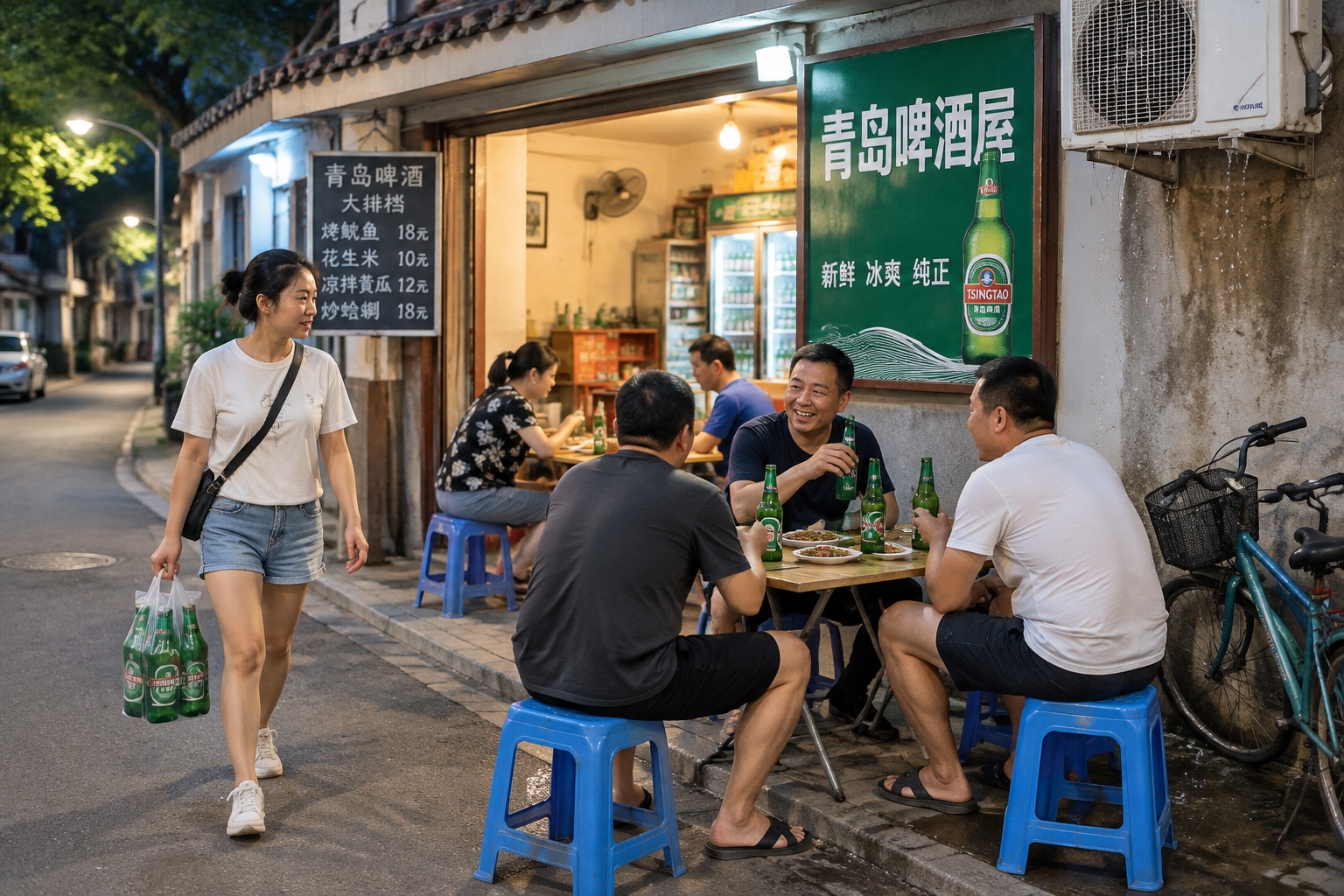
Walk through a Qingdao residential district after eight in the evening in July and you will find the street doing the work a living room does elsewhere. Folding tables come out of the shop. Plastic stools appear. Someone is grilling squid on a cart, someone’s grandmother sits on a chair watching, two men play cards on top of a beer crate.
The shop itself is a hinge. It sells cigarettes, ice cream, phone credit, laundry soap, lottery tickets and beer, and the owner knows which customer takes one jin and which takes five. This is not nostalgia for a lost communal life. It is a working system in a city of about ten million people, and it runs because the summers are warm, the streets are narrow, a metre of pavement is cheap and people would rather be outside than in.
What is changing, and what is not
Quite a lot, on the surface. The city now has a genuine craft beer scene, with bars brewing pale ales and stouts a short walk from shops still selling five-yuan draft. Delivery apps will bring a can to your door in twenty minutes. China’s overall beer production peaked more than a decade ago and has been falling since, as younger drinkers move towards coffee, tea, wine and lower-alcohol drinks, and drink less overall than their parents did.
The bag has adapted rather than disappeared. Some shops now pour craft beer into one. Visitors photograph it constantly, and the image has become one of those things that circulates online as proof of how quirky this city is — which locals mostly find funny, because to them it was never quirky.
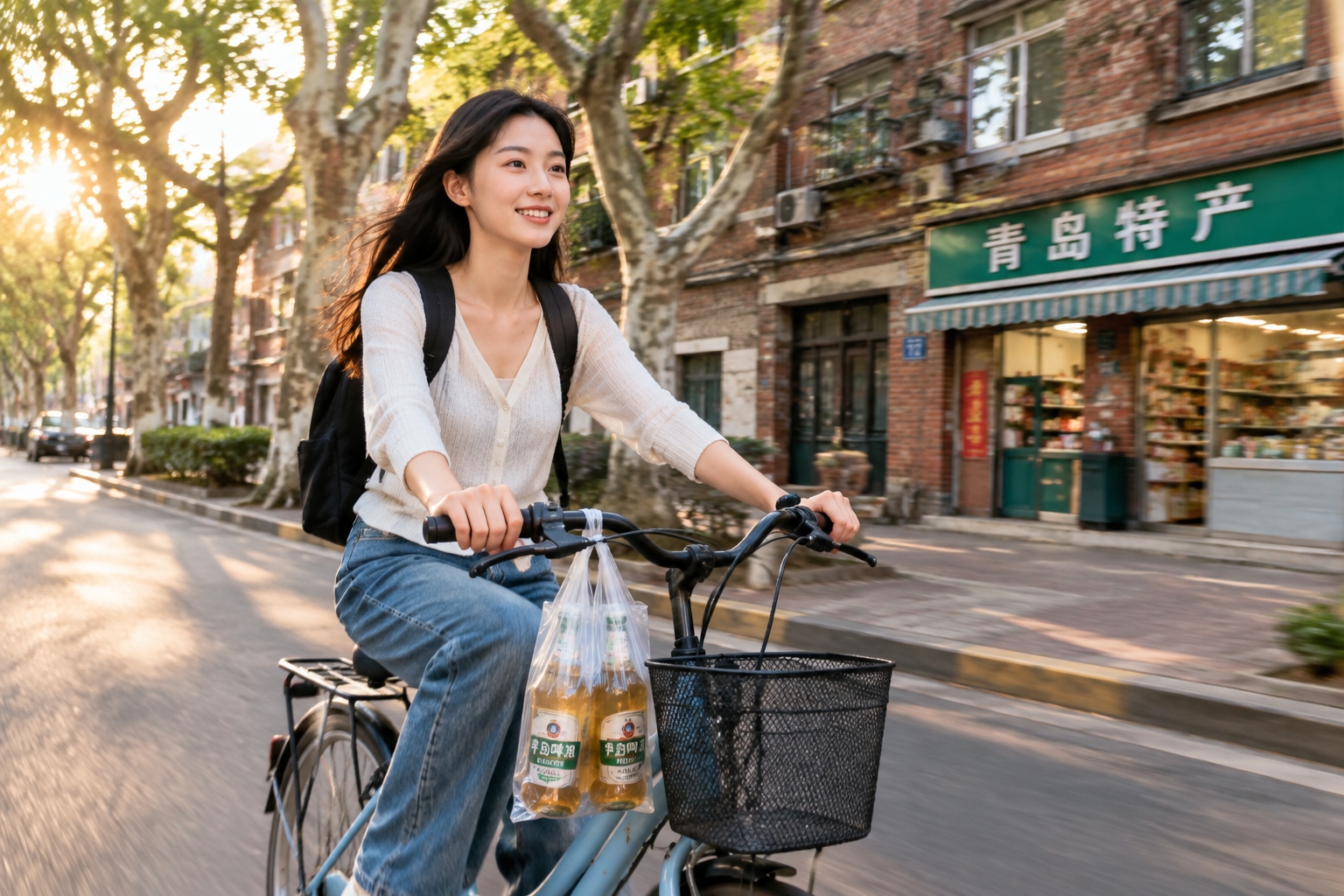
What keeps it alive is not tradition. It is price, freshness, and the fact that a bag of cold draft at the end of a hot day is a genuinely good idea.
One bag, one walk home
Back on Huangxian Road, the man with the straw is already most of the way up the hill. The bag is half empty, the street smells of grilled fish and diesel, and somebody’s air conditioner is dripping onto the pavement. In ten minutes he will be home, and the bag will be folded once and put in the bin, or rinsed and reused for something else entirely.
Every city has an informal container like this — chips in a paper cone, mango in a plastic cup with a straw, a slice folded in half and eaten standing up. They look strange from outside because they were never designed to be looked at. They were designed to get something good and cheap into a person’s hands on the way home. Qingdao’s version happens to be beer, and once you have carried one up a hill in July, the plastic bag stops looking like a mistake.
Start the discussion at forum.chinacomes.com