
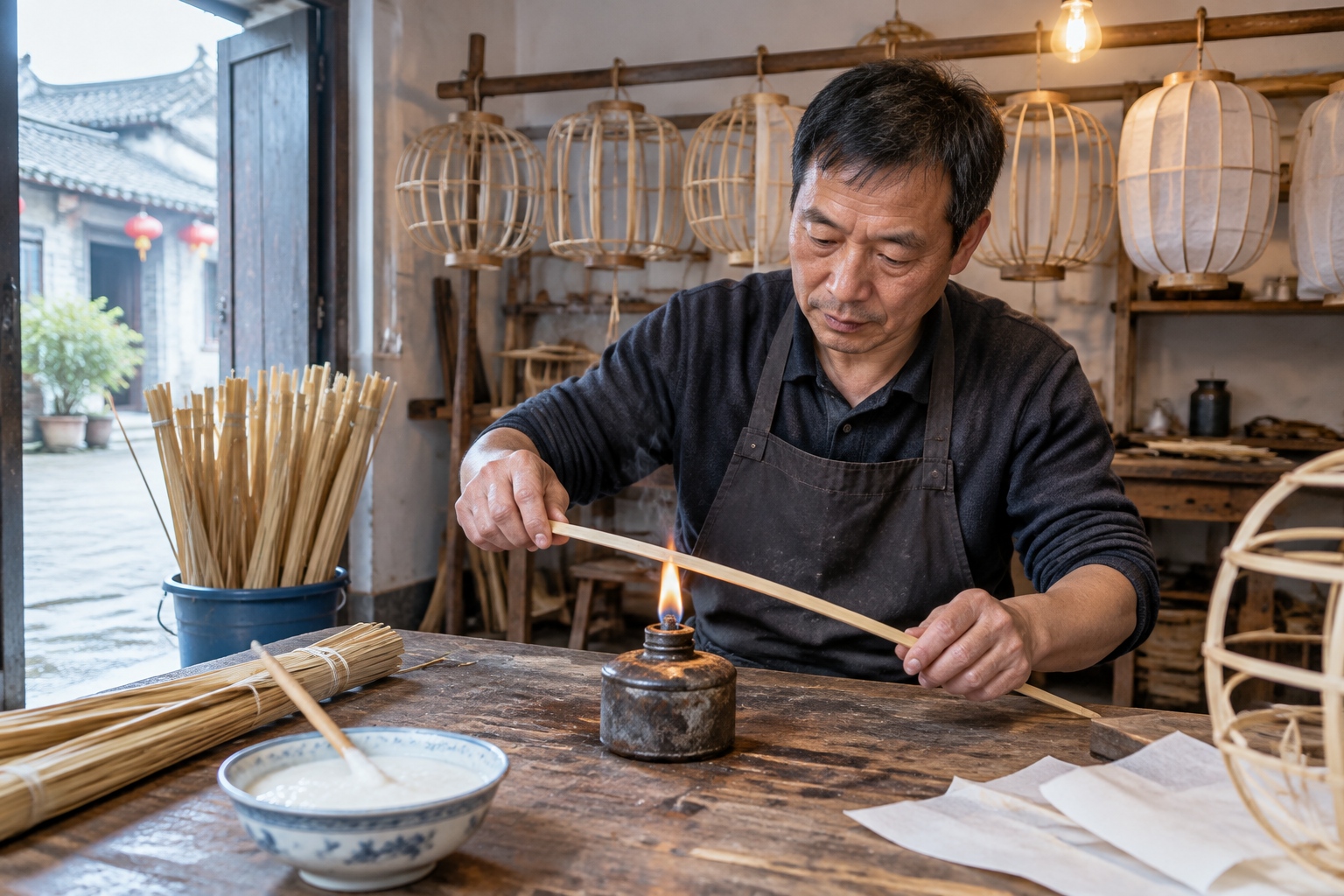

7:40 a.m., a side lane in Quanzhou
The workshop door is open, but the room has not warmed up yet. A bundle of bamboo splints sits in a bucket of water by the entrance, and a craftsman named Lin is already at the table, his fingers working. He lifts a thin splint over the flame of an alcohol burner, bends it through a soft angle, and lets it go. It does not spring back. Five or six bends later, a square frame about the size of a dinner plate stands flat on the wooden table, all four corners touching at once.
He presses each corner with his palm, pushes in, and runs a fingernail along one edge to check whether it is straight. A small bowl of paste sits beside him — rice flour and water cooked until thick. It smells less like glue than like a bowl of cooled porridge.
Outside, someone parks a scooter carrying a crate of steamed buns and walks off. Inside, Lin takes a roll of thin paper and begins pasting a panel, moving with the steady, unhurried certainty of a person papering a window.
If a foreign visitor wandered into this lane — a few do now — the first question is nearly always the same: are these lanterns still made by hand?
In Quanzhou, the honest answer is: the frames, yes. The panels, mostly. The giant installations people crowd around at night, largely no.
Where the Lantern Festival sits in an ordinary year
The Lantern Festival falls on the 15th day of the first lunar month, the last night of the Spring Festival period. For most Chinese families it is the closing of the holiday: one final reunion dinner, a last round of fireworks from the kids, and then everyone goes back to work.
The lanterns are the point. In Quanzhou, a coastal city in Fujian, that tradition is unusually visible. On the night itself, crowds walk the old pedestrian street to the Confucius Temple, where the whole route turns red. In recent years the city has hung a wall of lanterns along Zhongshan Road, starting around the 24th day of the twelfth lunar month and running past the festival.
This kind of public staging is also where the phrase feiyi — intangible cultural heritage — has entered ordinary conversation. China lists well over 100,000 officially recognised heritage items, from local opera to bamboo weaving and lantern making. For most residents that is not an abstract idea. It means seeing a local artisan’s advertisement on WeChat before the festival, or a free class in a city square, or a lantern-making kit in a gift shop. The policy sits in the background. The light is out front.
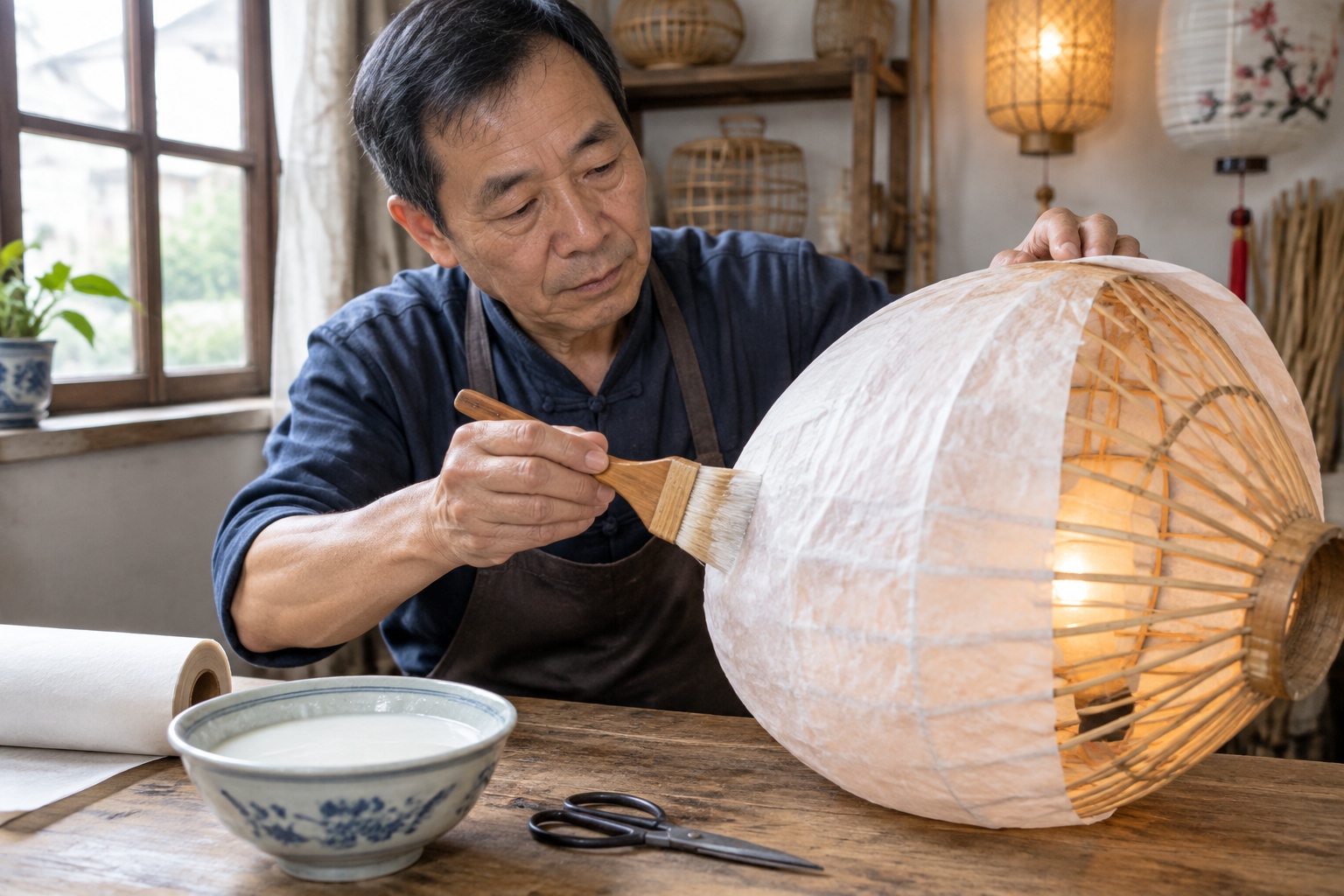
How a flower lantern is actually built
Lin’s work runs in four stages, and the rhythm barely changes from year to year.
1. Splitting bamboo thin enough to bend
Bamboo is the skeleton. He chooses culms with wide spacing between the nodes, because otherwise the splints refuse to curve. He splits them down, shaves them to less than a millimetre at the thinnest point, maybe five millimetres wide, and soaks them so the fibres soften. Each splint then gets passed over the flame until it goes pliable, bent fast, and held until it cools into shape. A single panel takes four splints; a mid-sized lantern takes twenty to forty, depending on the silhouette. No drawing is involved. Only hands and eyes.
2. Pasting the paper
He uses his own rice paste rather than glue, for a practical reason: paper ages and tears, and a pasted lantern can be opened and re-covered. The brush follows the paper from the centre outward, pressing it tight against the bamboo. No bubbles at the seams. A bubble looks fine until light hits it. Pasting and drying take several hours. In dry weather he moves the lantern to a shaded wall rather than direct sun, which wrinkles the paper.
3. Painting and pinpricking
Some lanterns carry painted motifs — peonies, cloud patterns, opera figures — drawn with a fine brush. Others are zhenci lanterns, where thousands of tiny holes are pricked through paper or silk with a needle. This is the slow part: a 50-centimetre round pinprick lantern can take one or two full days of punching alone. The precision is the selling point. When lit, the pattern shows through the holes. One slip of the hand leaves a dark dot that never disappears.
4. Lighting and testing
Candles used to sit inside. Open flame is now banned indoors and at crowded events, so nearly everything runs on small LEDs. He fits the light, moves it, adjusts it until the glow spreads evenly, with no dark corner and no hot spot. He often turns the bulb a few times, steps back, and looks again.
Time is the real cost. A simple small lantern takes two or three days. A mid-sized lantern with painted and pricked detail takes about a week. The materials are cheap — a few yuan of bamboo, some paper or silk — but the labour is not, which is why a handmade lantern sells for a few hundred yuan on the street and a complex one can pass a thousand.
The things that cannot be changed
Lin has worked with designers and event companies for more than a decade. Over that time he has developed a short list of things he will not touch.
Proportion. A lantern’s proportions have to stay, he says. The thickness of the bamboo and the size of the body belong together. Make the splints heavier and the lantern sags; shave them thinner and it will not hold. If a designer stretches the shape on a screen, the physical object stops reading as a lantern and starts reading as a sign.
Weight. A paper lantern has to be light enough to carry in one hand. That is not nostalgia; it is how the object has always been used. Lanterns travel. People walk with them.
Light through paper. Machine-made paper glows white and flat. Pasted paper varies. The glow has soft unevenness, and that unevenness is what makes it feel alive. Lin says he can spot a machine-made lantern across a room because it looks “too pretty.”
Imperfection. He argues that the lantern must carry evidence of a person. A stamped or moulded pattern repeats exactly; a hand does not. When a client insists on standardisation, he tries to keep the painting step — the cheapest part, and the most visible.
When designers walk into the workshop
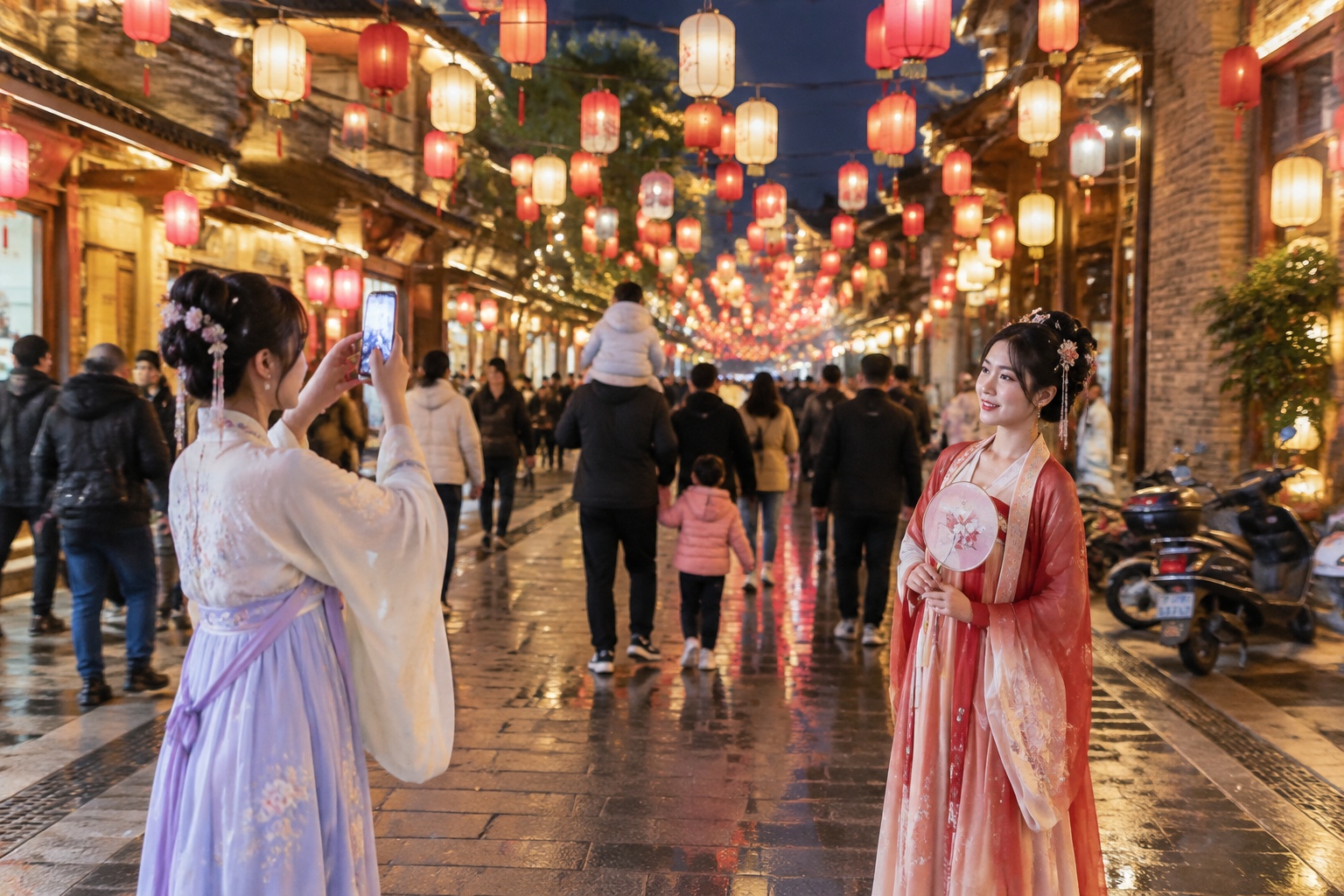
Zigong, the other great lantern city, in Sichuan, has turned this collaboration into an industry. Its annual winter lantern festival, built around a lake and running into early spring, includes installations the size of buildings — ten metres or taller, with motors inside and silk stretched over steel. Sharp, geometric, computer-drawn shapes need steel, wire and LED strips; traditional methods alone cannot produce them. The division of labour is clear: designers own the silhouette and the lighting programme, workshops own assembly, skinning and repair. Many of those pieces look machined from the outside and are still bent by hand on the inside.
Quanzhou works smaller. Cut-paper and pinprick patterns turn up on pendant lights in shopping mall atriums. Small objects — a pinpricked box, a tabletop lantern, a kit — use the same steps at reduced scale. What gets recombined is obvious: acrylic replaces paper, LEDs replace candles, flat-pack structures replace bamboo. What stays is the pattern and the hole. Those are also the two things most buyers notice when they hang it in a room.
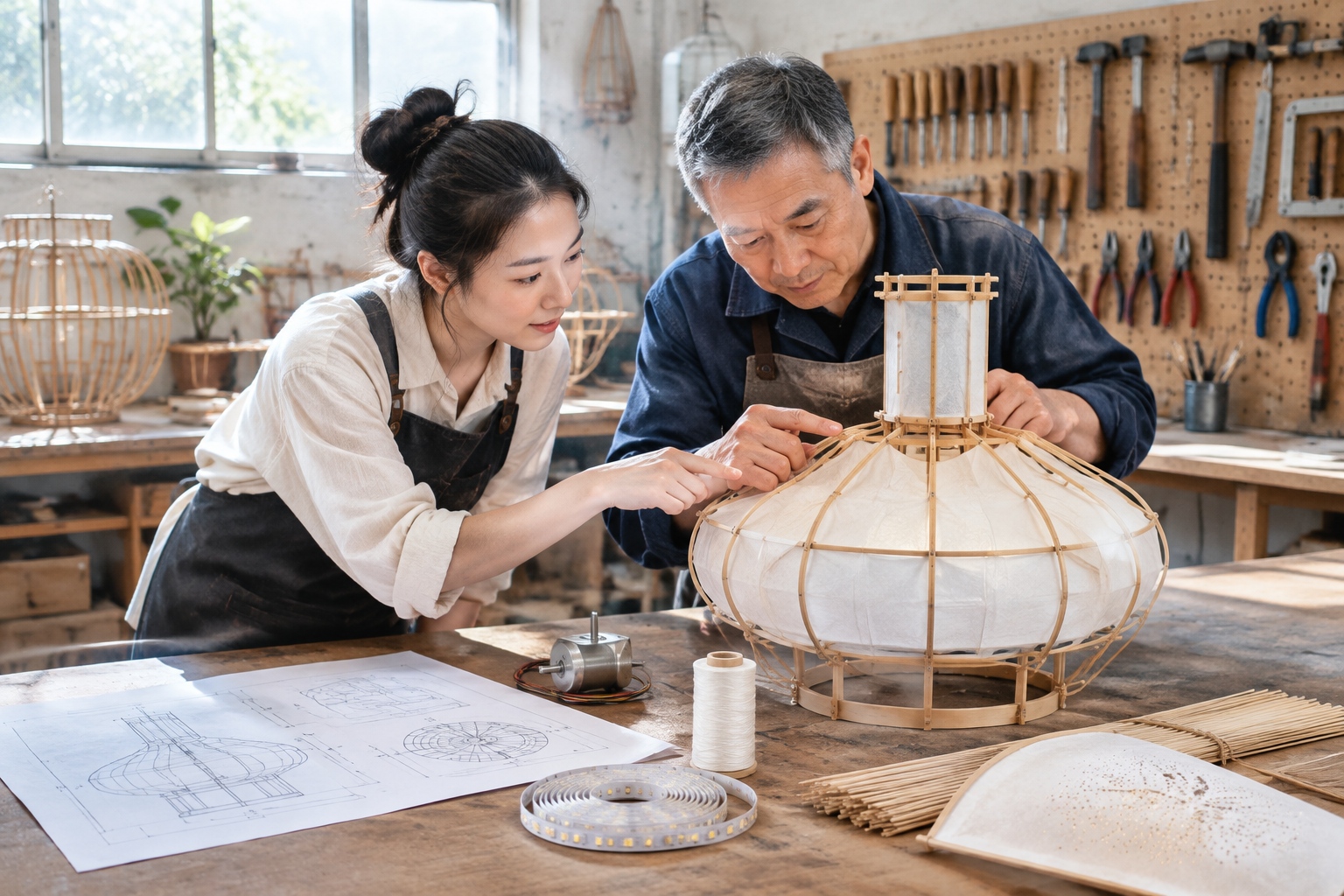
The crowd’s side of it
On the nights around the festival, Quanzhou’s pedestrian street runs from about six in the evening until well past ten. Young couples come in hanfu to photograph each other, phones held up against the hanging lanterns. Parents carry children on their shoulders. Someone buys a small lantern from a pop-up stall for 30 or 60 yuan, or a kit for about 80 yuan to make one at home.
None of this is exotic. Anyone who has been to a winter festival in any Asian city — the lanterns of Kyoto, the floating krathong of Thailand, the light festivals of Seoul — will recognise the feeling: a slow shuffle of people, light coming down from above, the smell of fried food at the edge of the crowd. What differs is what is on the street, and who is selling it. In Quanzhou, many sellers are the makers. You are standing in front of a workshop, not a warehouse.
The hard parts of the business
Start with the calendar. Almost every order lands between the tenth lunar month and the festival itself. Lin says people who make lanterns work through the night in winter; by March the workshop goes quiet. That rhythm is brutal for apprentices. You cannot learn steadily when the work only exists for one season a year.
Costs are rising and hands are scarce. Good bamboo has to be split by hand. Among the people he hires, only two or three can handle the pinprick work to a sellable standard. A young person can study for three years and still not produce a clean pinprick lantern, and the pay during those years is low. Many leave halfway.
Then there are the safety rules. Open flame is no longer allowed at public events, and materials often need fire-retardant treatment. Paper lanterns for indoor use have to be treated or replaced with treated stock. It is one of the most concrete changes of the past two decades, and completely invisible to anyone standing in the crowd.
One lantern, still lit
At seven in the evening, Lin switches off the workshop light and turns on the lantern he finished that afternoon. The glow comes through the pricked holes and the pattern opens across the wall in patches. He stands beside it, waits a few seconds, and rotates it once.
“This one,” he says, “is a lantern that wants to be made by hand.” He does not elaborate.
The question is not whether traditional lanterns survive. They come back every year, demanded by residents, by shopping centres, by city governments, by event companies. The question is what remains of them once they have become something else — a centrepiece, a souvenir, a photograph. The bamboo still bends at the same angle. Whether that counts as a soul is something the next person to pick one up will have to answer.
Start the discussion at forum.chinacomes.com