


At 4,410 meters, a photon arrives
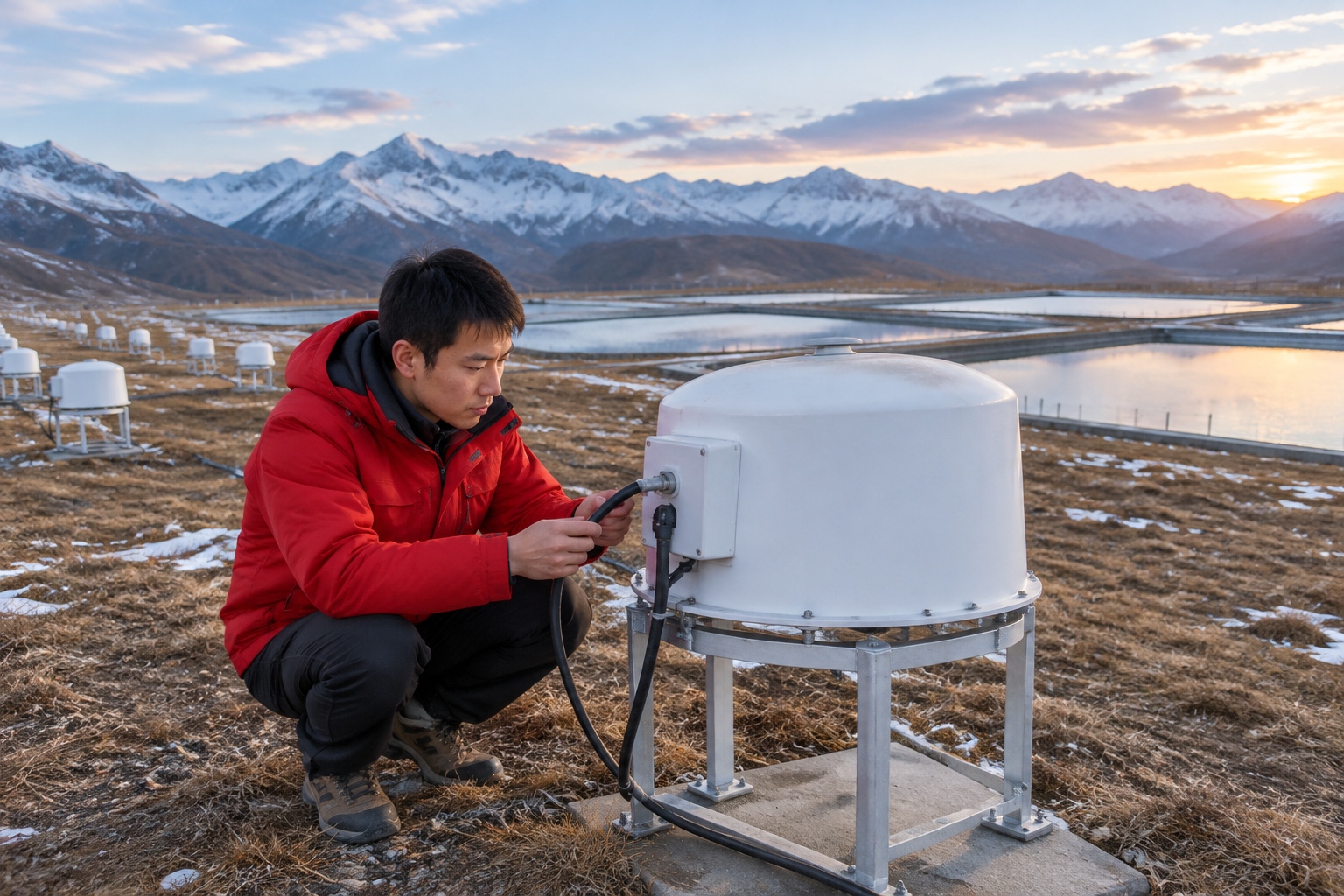
The road from Daocheng in western Sichuan climbs through rocky pastures and patches of snow. At 4,410 meters, the air holds roughly half the oxygen of sea level. Passengers on the bus to the LHAASO observatory often fall quiet, not from awe but from the altitude. Outside, rows of white detector stations and rectangular ponds of water sit in a broad valley. Yaks graze at the edge. A technician in a red winter jacket opens a metal cabinet and checks a cable.
This is where a photon with an energy of about 1.4 quadrillion electron volts was caught. It arrived from the direction of the Cygnus region, a crowded part of our Milky Way. The number sounds like science fiction. It is a measurement, published in 2021 by the LHAASO collaboration, and one of the strongest clues yet that our galaxy contains natural particle accelerators far beyond anything humans have built.
What 1.4 quadrillion electron volts actually means
An electron volt is tiny. A visible-light photon carries about 2 to 3 electron volts. A dental X-ray photon carries tens of thousands. The protons in the Large Hadron Collider beam reach about 6.5 trillion electron volts. The LHAASO photon had more than 200 times that energy, packed into a single particle of light. It is roughly 500 trillion times more energetic than a photon you can see.
One way to hold the number: 1.4 PeV is 1,400 trillion electron volts. The incoming gamma ray is a photon, a packet of light. The energy refers to that photon, not to the total energy of the cascade it creates in the atmosphere. The cascade contains many particles and carries more total energy. This distinction matters. Headlines sometimes blur photon energy and particle energy; the physics does not.
Why the sky needs a detector the size of a village
Cosmic rays are mostly charged particles. When they travel through the Milky Way, magnetic fields bend their paths. By the time they reach Earth, their arrival direction no longer points cleanly back to their source. Gamma rays are different. They are neutral, so they travel in nearly straight lines. If you catch a very high-energy gamma ray, you have a chance to trace it back.
The problem is rarity. At PeV energies, the flux is absurdly low. A detector the size of a desk would wait forever. LHAASO spreads thousands of particle detectors and several large water ponds over about 1.3 square kilometers. When a high-energy photon hits the atmosphere, it produces an air shower, a cascade of particles that spreads out as it falls. At 4,410 meters, the shower reaches the ground before it fades. The array samples the particles, measures their timing, and reconstructs the incoming direction and energy.
It is less a telescope in the traditional sense than a trap for invisible rain. The ponds detect Cherenkov light. The white stations measure charged particles. Wide-field telescopes watch the faint flashes. All of it has to work in cold, thin air, with snow, wind, and a power grid maintained far from the nearest city.
The 2021 result: a map with a very energetic dot
In 2021, the LHAASO team reported a set of ultra-high-energy gamma-ray sources. The most energetic photon reached about 1.4 PeV. It was not a photograph of a star. It was a direction, an energy, and a probability. The event was recorded as an air shower; software reconstructed the photon’s path. The source region was in Cygnus, a part of the sky rich with massive stars, gas, and compact objects.
The result mattered because it pushed gamma-ray astronomy into the PeV range with a sensitive, wide-field instrument. The term for a source that can accelerate particles to PeV energies is a PeVatron. For decades, researchers suspected the Milky Way contained them. LHAASO gave the field a map with candidates and, for the first time in this energy range, a wide view of several sources at once.
This does not mean the source is identified. A gamma-ray direction is not a name tag. The Cygnus region contains several possible accelerators, and the photon could have been produced in different ways: by protons colliding with gas, or by electrons scattering low-energy light. The 1.4 PeV photon tells us that something in that direction can reach extreme energies. It does not yet tell us exactly what.
What could accelerate particles that hard?
The short answer: nobody knows for certain. The short list is still exciting. Supernova remnants can drive strong shocks. Pulsar wind nebulae, powered by rapidly spinning neutron stars, can create intense electric fields. Young star clusters can host collective winds and shocks. The center of our galaxy is another crowded, violent place. Active galactic nuclei, powered by supermassive black holes, are the extreme extragalactic option.
For the 1.4 PeV photon, a Galactic source is the favored bet. At these energies, extragalactic gamma rays are attenuated as they cross intergalactic space, interacting with background light. That does not make an extragalactic origin impossible, but it makes a nearby, Galactic accelerator more likely. The exact object remains unresolved. The Cygnus region is a good place to look because it contains several plausible PeVatrons within a small patch of sky.
The next step is multiwavelength work. Radio, X-ray, and optical observations can show what is inside the source region. Neutrino detectors can look for the signature of proton acceleration. If a PeVatron is making gamma rays through protons, it should also make neutrinos. If electrons are doing the work, the neutrino signal will be weaker. That is a clean, testable difference, and it is why the result is not just a curiosity.
China’s plateau, many countries’ data
The LHAASO site is in China, but the result is not a solo story. The observatory is led by the Institute of High Energy Physics of the Chinese Academy of Sciences, with researchers from several countries involved in construction, calibration, software, and analysis. The data are discussed in a global community. Follow-up observations by other instruments, from space telescopes to ground-based gamma-ray arrays, are part of how the field checks its claims.
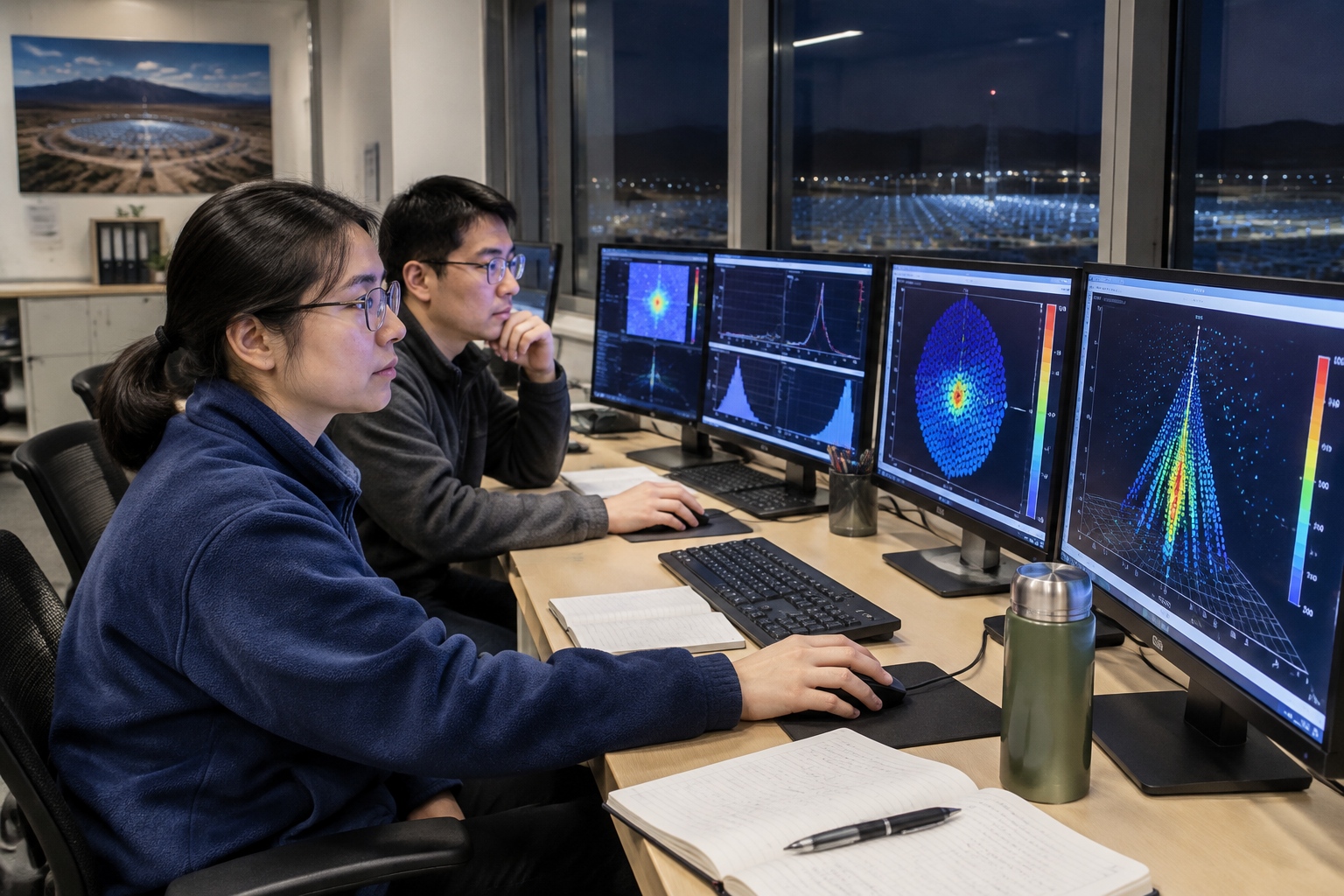
The location matters. The plateau offers high altitude, dry air, and a large open valley. It also requires real infrastructure: roads, power, oxygen, winter logistics, and local workers who keep the site running. In a control room at night, the scene is ordinary in the way science often is. People in fleece jackets stare at screens. A thermos sits next to a notebook. Outside, the array waits for the next shower.
Why this is not a new phone battery
It is fair to ask what a 1.4 PeV photon does for daily life. The honest answer is: not much directly, and not soon. This is basic physics. It does not improve a phone battery, a delivery route, or a medical scan. The return is a better map of how nature works at energies we cannot reproduce on Earth.
There are indirect effects. Large observatories push photodetectors, timing electronics, data processing, and remote operations. Scientists learn to run delicate equipment in harsh places. Those skills can spill over. But the main product is knowledge: the location and behavior of the universe’s most powerful accelerators. If you are waiting for a consumer product, you will be waiting a long time. If you are waiting for a better question, it is already here.
What to watch next
The next round of results will not be a single dramatic number. It will be more events, better angular resolution, and better separation between protons and electrons. Researchers will compare the LHAASO map with radio and X-ray images. They will look for neutrinos from the same directions. They will ask whether the sources are steady or flaring. Each answer narrows the list of possible accelerators.
The 1.4 PeV photon is already a useful landmark. It says that the Milky Way can produce particles far beyond the reach of the Large Hadron Collider, and that a detector on a Chinese plateau can catch the evidence. The universe’s accelerators have not yet been named. But they have been located, one air shower at a time.
Start the discussion at forum.chinacomes.com