

Morning in Fuzhou: The Fish Ball Shop and the Guobianhu Stall
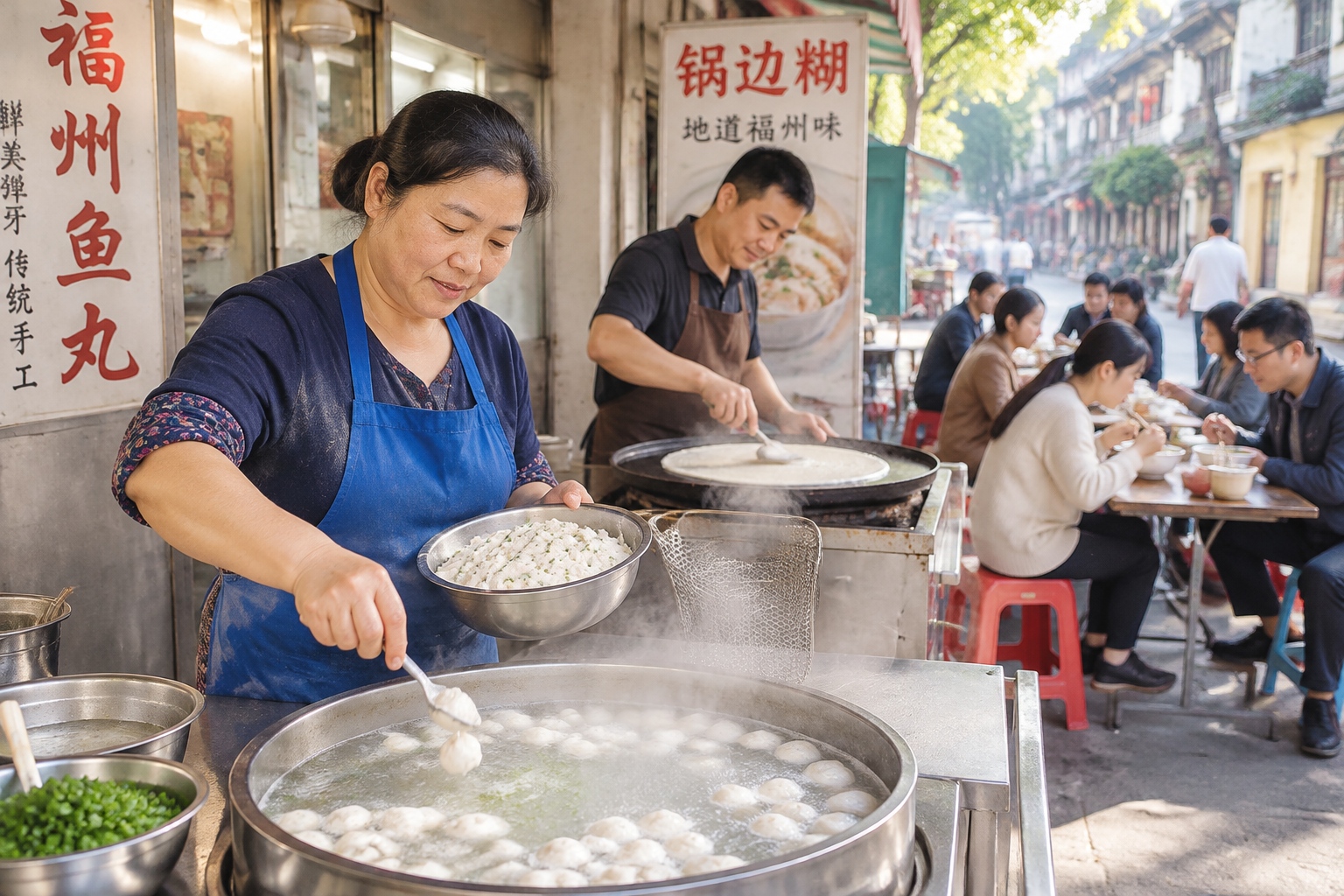
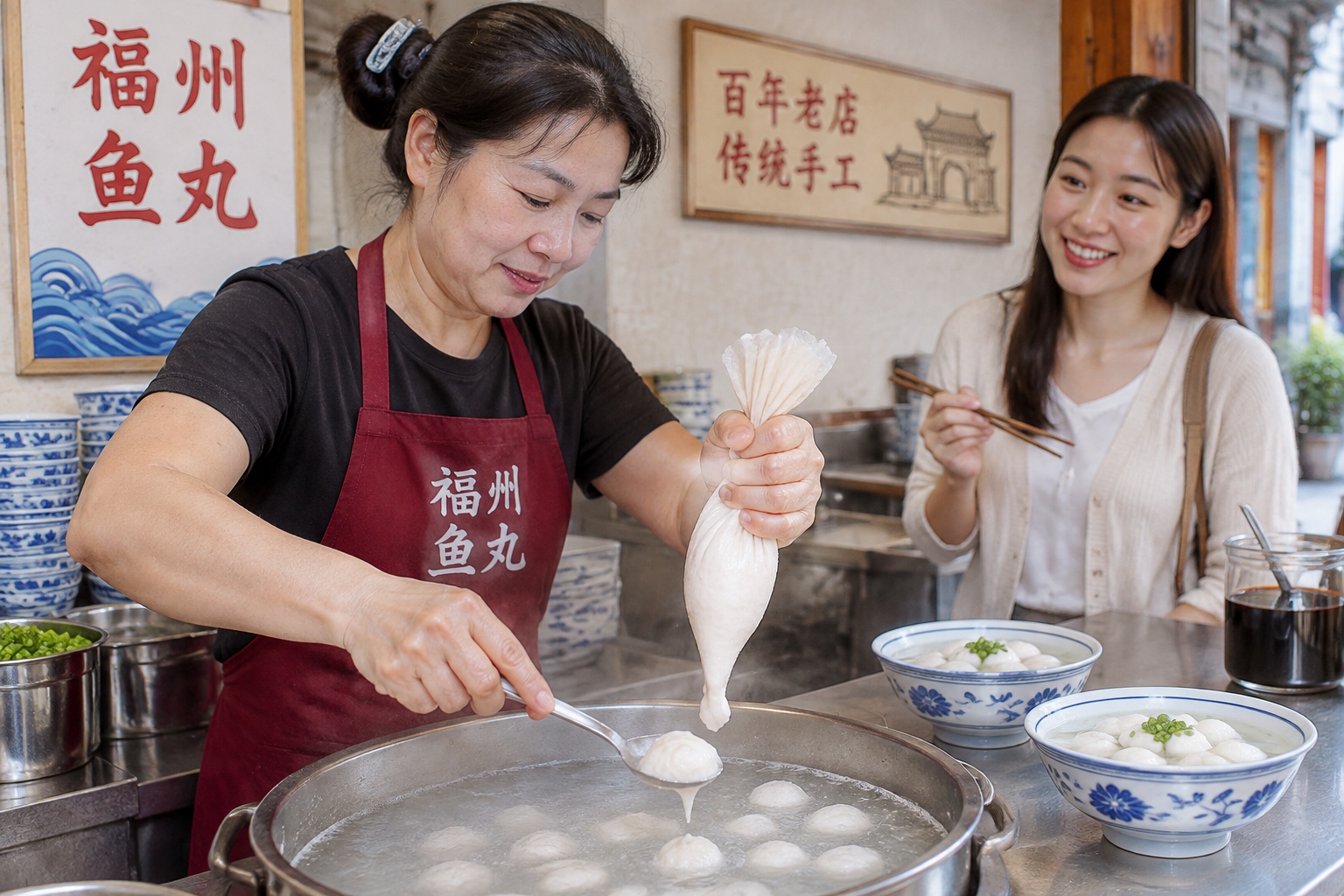
At 6:30 a.m., the narrow alley off Fuzhou’s Shangxiahang historic district smells of simmering pork bone broth and fresh fish. A woman named Lin Meifang, 54, stands behind a stainless steel counter, her hands moving faster than the eye can follow. She scoops a pale, sticky paste of minced eel and sweet potato starch, squeezes it through her thumb and forefinger, and drops perfect spheres into a pot of boiling water. They float within seconds — the sign of a good fish ball.
Fuzhou fish balls are not the rubbery, uniform spheres you might find in a supermarket freezer. They are soft, slightly irregular, and filled with a small nugget of seasoned pork. The first bite releases a burst of savory juice. Locals eat them in soup with a splash of vinegar and a sprinkle of chopped scallions. A bowl costs about 12 yuan (roughly $1.70).
Next door, a guobianhu stall is doing equally brisk business. Guobianhu — literally “pot-edge paste” — is made by spreading a thin batter of rice milk around the rim of a hot wok. The cook, a man in his sixties wearing a blue apron, uses a metal scraper to peel the cooked sheet into the simmering broth below. It takes about 40 seconds per bowl. The result is silky, slightly chewy, and deeply comforting.
What strikes a foreign visitor is the choreography of it all. Customers don’t queue silently. They call out their orders, ask about each other’s families, and argue good-naturedly about which stall has the best broth. A retired teacher named Chen tells me he has eaten here every morning for 11 years. “The taste doesn’t change,” he says. “That’s the point.”
If you come from a Western city where breakfast is often a rushed granola bar or a drive-through coffee, Fuzhou’s morning food culture feels almost ceremonial. But it is not a performance for tourists. It is simply how people eat, socialize, and start their day. The fish ball shop and the guobianhu stall are not attractions. They are infrastructure.
Quanzhou: Floral Headwear and the Xunpu Women
An hour south by high-speed rail, Quanzhou feels like a different world. This is one of China’s oldest port cities — Marco Polo called it one of the greatest ports in the world in the 13th century. Today, its narrow lanes in the Xunpu neighborhood are famous for something more colorful: zanhua, or floral headwear, worn by the Xunpu women.
The tradition is simple but striking. Women, many of them in their 50s, 60s, and 70s, arrange fresh flowers — usually jasmine, roses, and baby’s breath — into elaborate crowns and pin them into their hair. They wear these crowns not for festivals or photo shoots, but for everyday life: going to the market, cooking, chatting at the temple entrance. The flowers are replaced every few days. A crown costs between 20 and 40 yuan, depending on the season and the variety of flowers.
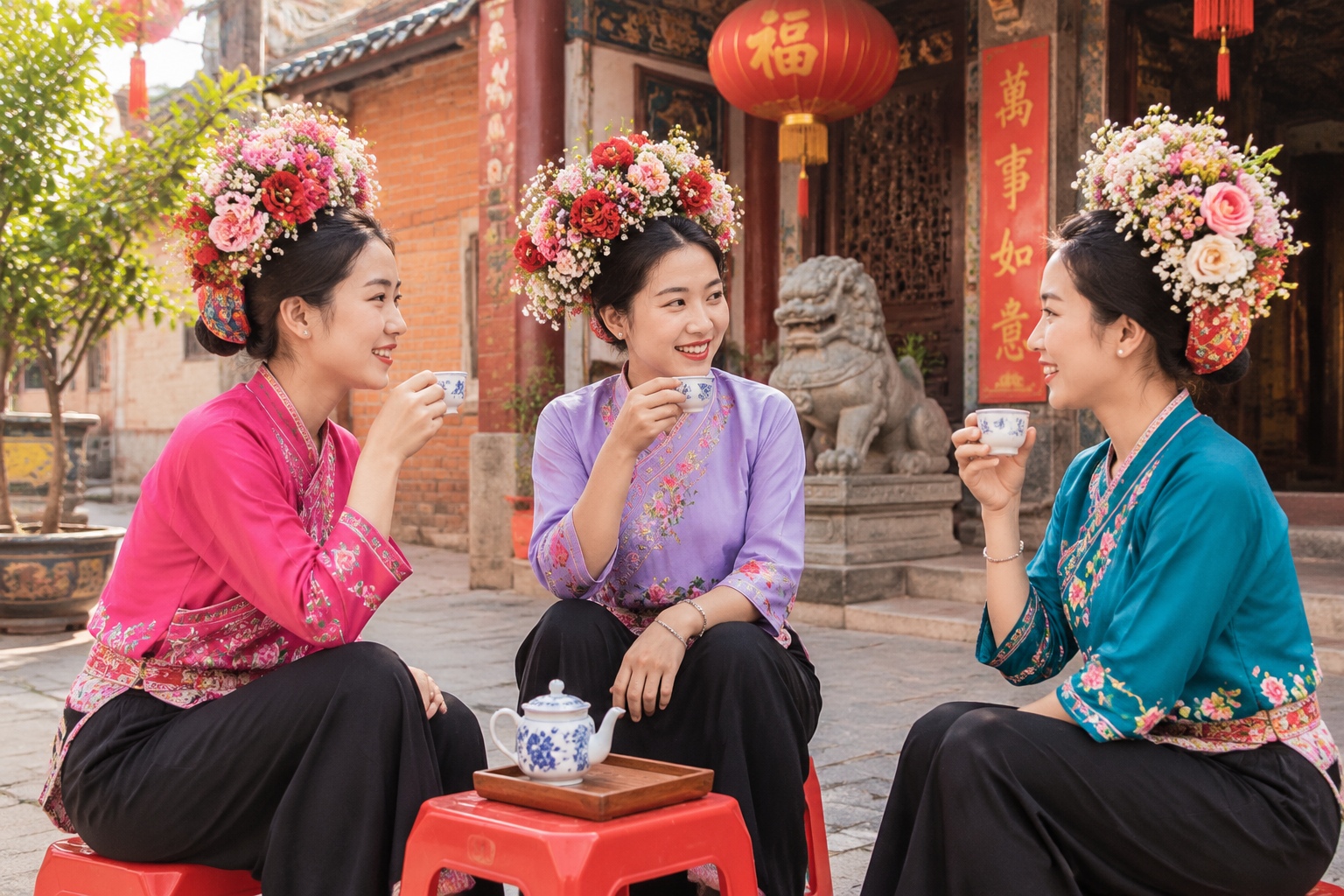
I meet a woman named Huang Xiuyu, 67, sitting on a plastic stool outside a small temple. She is weaving a new crown while her neighbor drinks tea from a tiny porcelain cup. “When I was young, everyone wore flowers,” she says. “Now young people take photos and post them online. That’s fine. But for us, it’s just getting dressed.”
For a Western reader, the closest comparison might be the floral crowns worn at summer music festivals — but imagine if those crowns were worn daily by grandmothers, not as a fashion statement but as a habit passed down through generations. The Xunpu women are not performing tradition. They are living it, adapting it, and occasionally monetizing it through small tourism businesses that have sprung up in the past five years.
Tea at the Temple Entrance: Religion, Clans, and the Sea
To understand Fujian’s coastal culture, you need to understand two things that are often invisible to outsiders: clan networks and Mazu worship.
In many parts of China, the concept of a “clan” (zongzu) has faded. But along the Fujian coast, especially in Quanzhou, Zhangzhou, and Xiamen, it remains a living social structure. A clan is an extended family — sometimes hundreds of people — that shares an ancestral hall, a genealogy book, and a set of mutual obligations. If a cousin needs money for surgery, the clan helps. If a temple needs renovation, the clan organizes the fundraising. If a young person wants to start a business, the clan provides the first loan.
This is not so different from the way immigrant communities in the West — Italian, Jewish, Greek, Vietnamese — have historically pooled resources. But in Fujian, it never stopped. The clan is not a nostalgic memory. It is a functioning credit union, welfare system, and social network rolled into one.
Mazu, the goddess of the sea, is the spiritual glue. Her temples dot the coastline. Fishermen and sailors have prayed to her for centuries. Today, her worship connects Fujian to Taiwan, Southeast Asia, and overseas Chinese communities around the world. Every year, millions visit her temples, especially during her birthday in the third lunar month.
At a temple entrance in Quanzhou, I watch a group of men in their 70s play Chinese chess and drink tea. They are all members of the same clan. One of them, a retired fisherman named Wu Jinshui, tells me his great-grandfather sailed to Malaysia and never returned. “We still have his name in the genealogy book,” he says. “Every few years, his descendants come back to visit. They don’t speak our dialect anymore, but they know where they come from.”
The Video Call: How Emigration Shaped Everyday Life
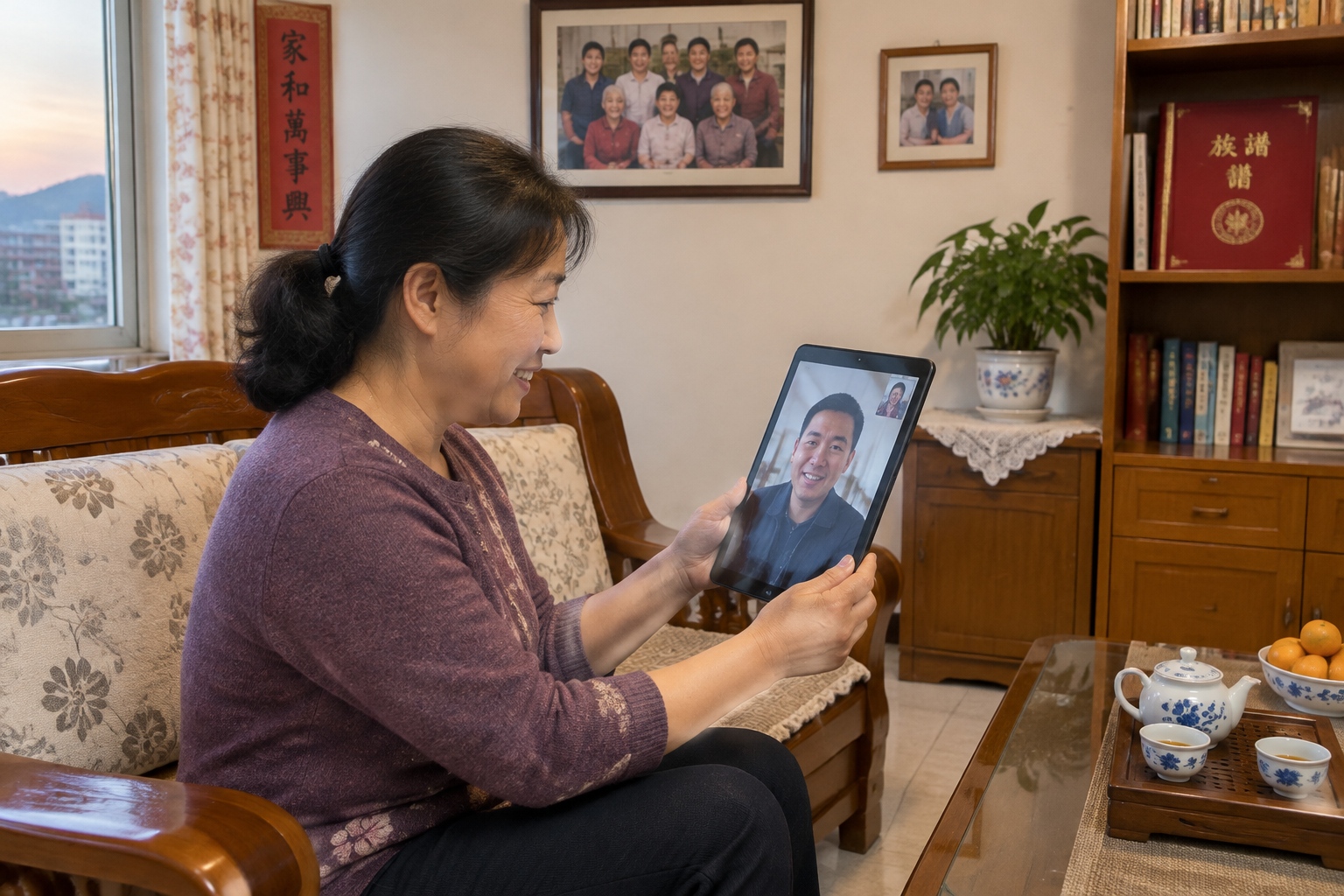
That evening, I sit in the living room of a family in Jinjiang, a city known for its shoe factories and its diaspora. The mother, a woman in her 40s named Cai Lihua, is holding a tablet. On the screen is her brother, who has lived in Manila for 20 years. He runs a small grocery store. His children speak Tagalog and English at school and Mandarin at home.
The video call is not a special occasion. It happens every Sunday. They talk about the weather, about a cousin’s wedding, about the price of shipping containers. Cai’s brother complains about the traffic in Manila. Cai complains about the price of pork in Jinjiang. Then they laugh and hang up.
This is the quiet reality of Fujian’s emigrant culture. The province has sent millions of people overseas over the past two centuries. Today, there are more people of Fujian descent living outside China than inside the province itself. They send money back, build houses, fund schools, and maintain the temples. The clan network stretches across oceans.
For a Western reader, the closest analogy might be the Irish diaspora — the way Irish-American families still identify with counties their ancestors left 150 years ago. But in Fujian, the connection is more immediate. The video calls are weekly. The remittances are monthly. The return visits are annual. The clan genealogy is updated every generation.
What This Means for Visitors
If you visit Fujian, you will notice the food first: fish balls, guobianhu, peanut soup, oyster omelets, and the famous Buddha Jumps Over the Wall, a complex soup that takes two days to prepare. You will notice the floral headwear in Quanzhou and the temples that smell of incense and sea salt.
But if you stay a few days, you will notice something else: the way people talk about family. They do not say “my cousin.” They say “my cousin on my mother’s side, the one whose grandfather built the ancestral hall.” They do not say “my hometown.” They say “the village where my surname comes from.”
This is not nostalgia. It is a working system — one that has survived wars, revolutions, and rapid modernization. It is not better or worse than the individualistic model familiar to many Western readers. It is simply different. And it is still changing.
Young people in Fuzhou and Quanzhou are just as likely to work in tech startups, order bubble tea on their phones, and complain about housing prices as their peers in Shanghai or Shenzhen. But when they get married, they still invite 300 relatives. When they have children, they still consult the genealogy book. When they open a business, they still ask the clan for advice.
The fish ball shop, the floral crown, the temple tea — these are not relics. They are the everyday texture of a region that has been global for centuries. For a visitor, the invitation is simple: eat breakfast slowly, talk to the women with flowers in their hair, and listen when someone tells you about their great-grandfather’s voyage. You will learn more about China than any museum can teach.
Start the discussion at forum.chinacomes.com