

A City That Buys the Night
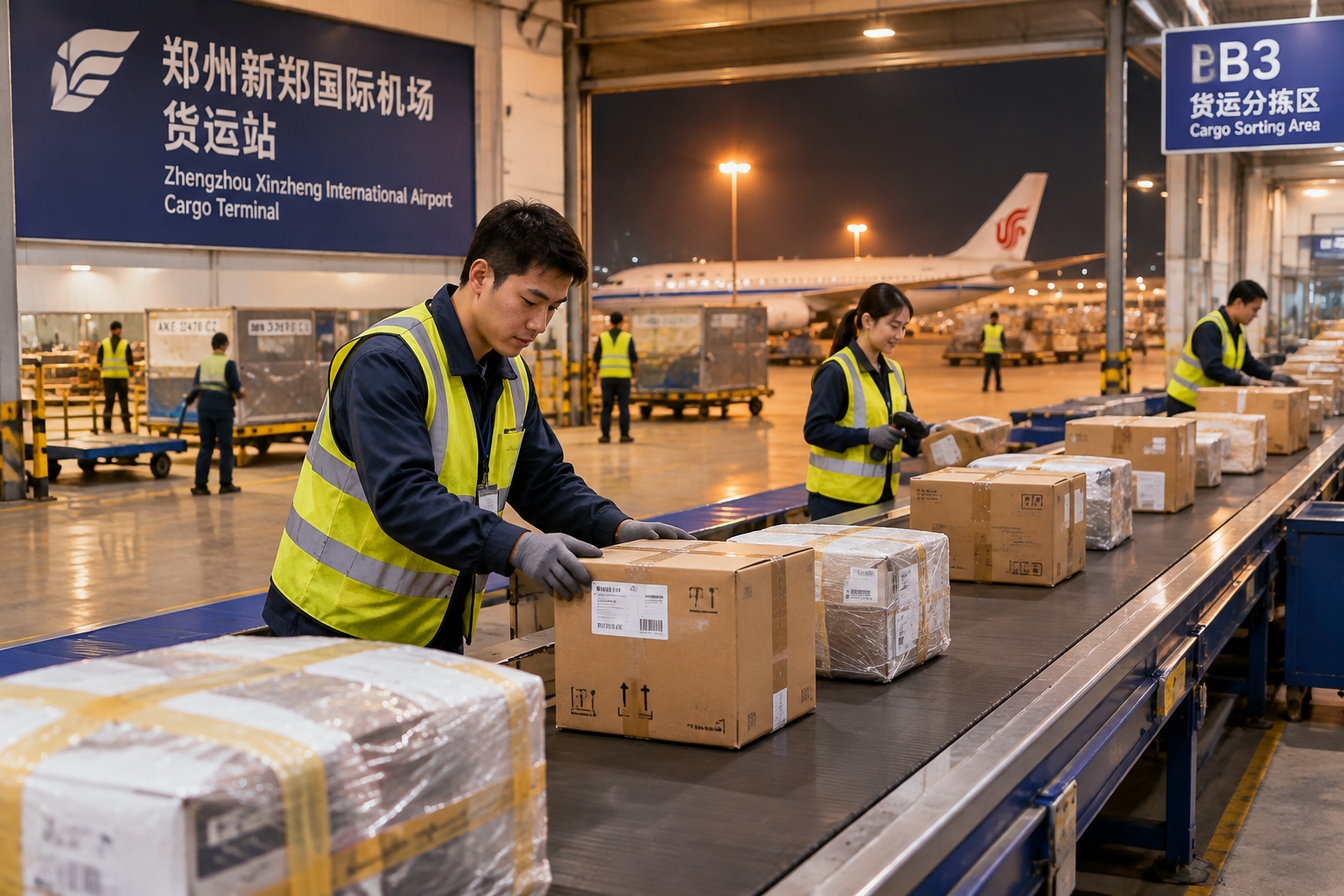
At 11:30 p.m., the cargo terminal at Zhengzhou Xinzheng International Airport is waking up. Orange light spills across rows of metal shelves. Conveyor belts hum, and the blinking red beams of barcode scanners paint the dark as packages slide down plastic chutes. A young man in a reflective vest lifts a box, reads the label, and tosses it onto a moving belt. Inside that box is a pair of winter boots from a factory in Guangzhou, ordered that afternoon by a shopper in Paris. In about 30 hours, if nothing goes wrong, it will be dropped at an apartment door on the Rue de Rivoli.
Zhengzhou is not the first city people think of when China’s air cargo comes to mind. Shanghai, Shenzhen, and Guangzhou usually top the list. But over the past five years, this inland city in Henan Province has quietly become one of the busiest overnight sorting centers for cross-border e-commerce. Every night, hundreds of thousands of parcels from factories in Guangdong, Zhejiang, and Shandong arrive by truck and domestic flight. They are processed, consolidated, and loaded onto wide-body freighters that take off after midnight for destinations like Luxembourg, Chicago, and Kuala Lumpur.
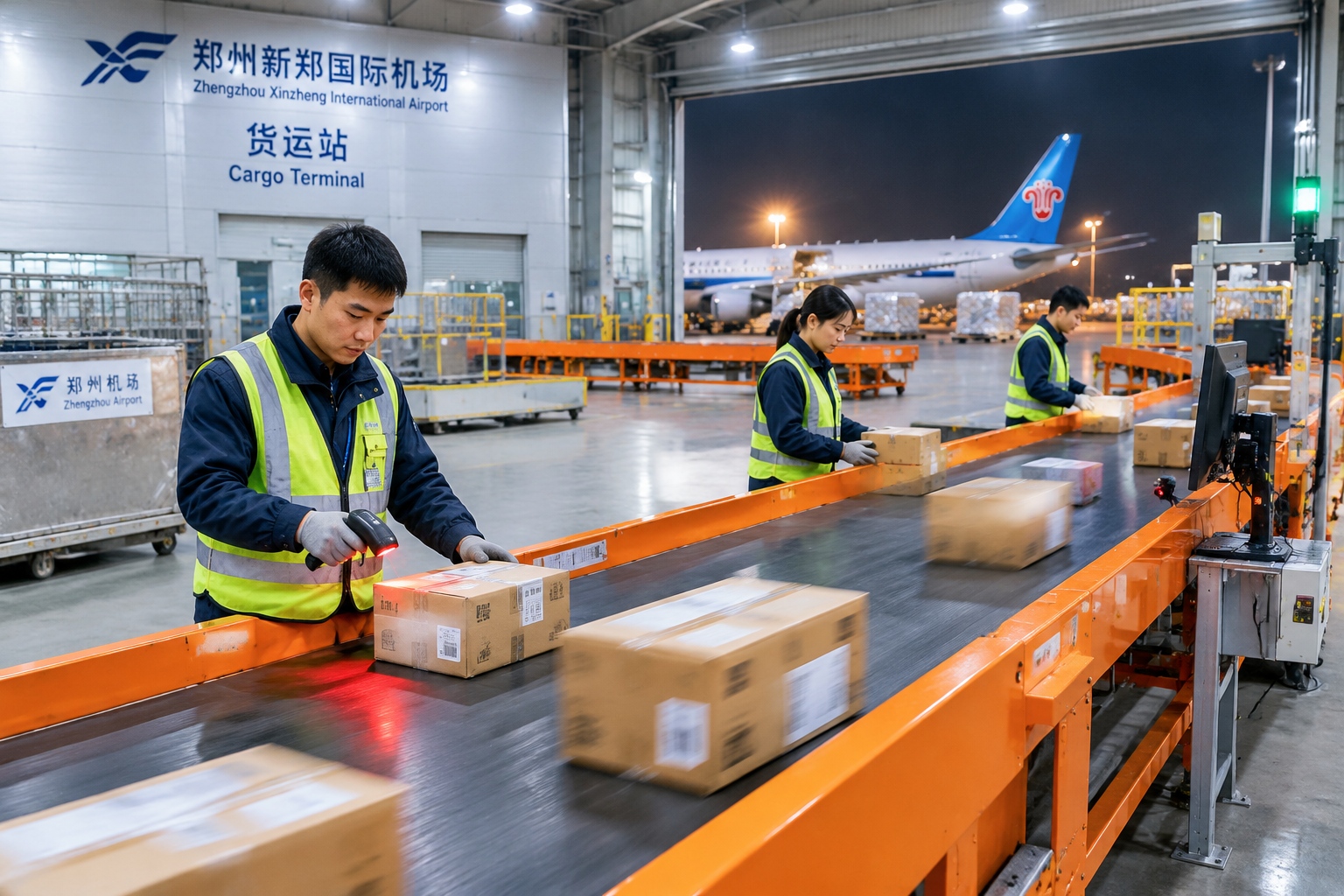
Zhengzhou’s aviation story began more than a decade ago, when the provincial government decided to turn Henan from a traditional farming region into a logistics hub. They called it the Airport Economic Zone. Cargo airlines such as Cargolux were invited to open routes. Customs streamlined clearance for e-commerce goods. Alibaba’s logistics arm set up a bonded warehouse at the airport. Today, Zhengzhou handles around 600,000 tons of cargo a year, a large share of which is cross-border e-commerce. The real scale shows at night. While the passenger terminal shuts down after the last landing, the cargo area comes alive. Trucks line up at loading docks, drivers hand over bills of lading, and workers move with practiced efficiency. A skilled sorter can process about 1,500 parcels an hour, according to a supervisor we spoke with. The busiest window is from 11 p.m. to 4 a.m., when most of the day’s online orders have reached the airport and need to catch the early-morning flights.
The Journey of a Small Box
To understand what happens here, follow one box. It might be a phone case, a synthetic wig, or an LED light strip. It arrives at the airport in a semi-trailer truck that has been on the highway since the previous evening. The driver backs into a dock at one of the warehouses. Workers unload the truck in a steady rhythm, sliding parcels onto a conveyor. The first stop is an X-ray machine inside a tunnel. Customs officers watch the images on screens in a glass-walled office.
“Most packages are fine,” says Liu Gang, a 28-year-old customs officer who has worked the night shift for three years. “We only open the ones the system flags.” In the past, clearing customs required forms, stamps, and occasional manual checks. Now, an intelligent system compares package data with public risk lists, allowing low-risk shipments to pass automatically. On a normal night, 99% of parcels are cleared without physical inspection.
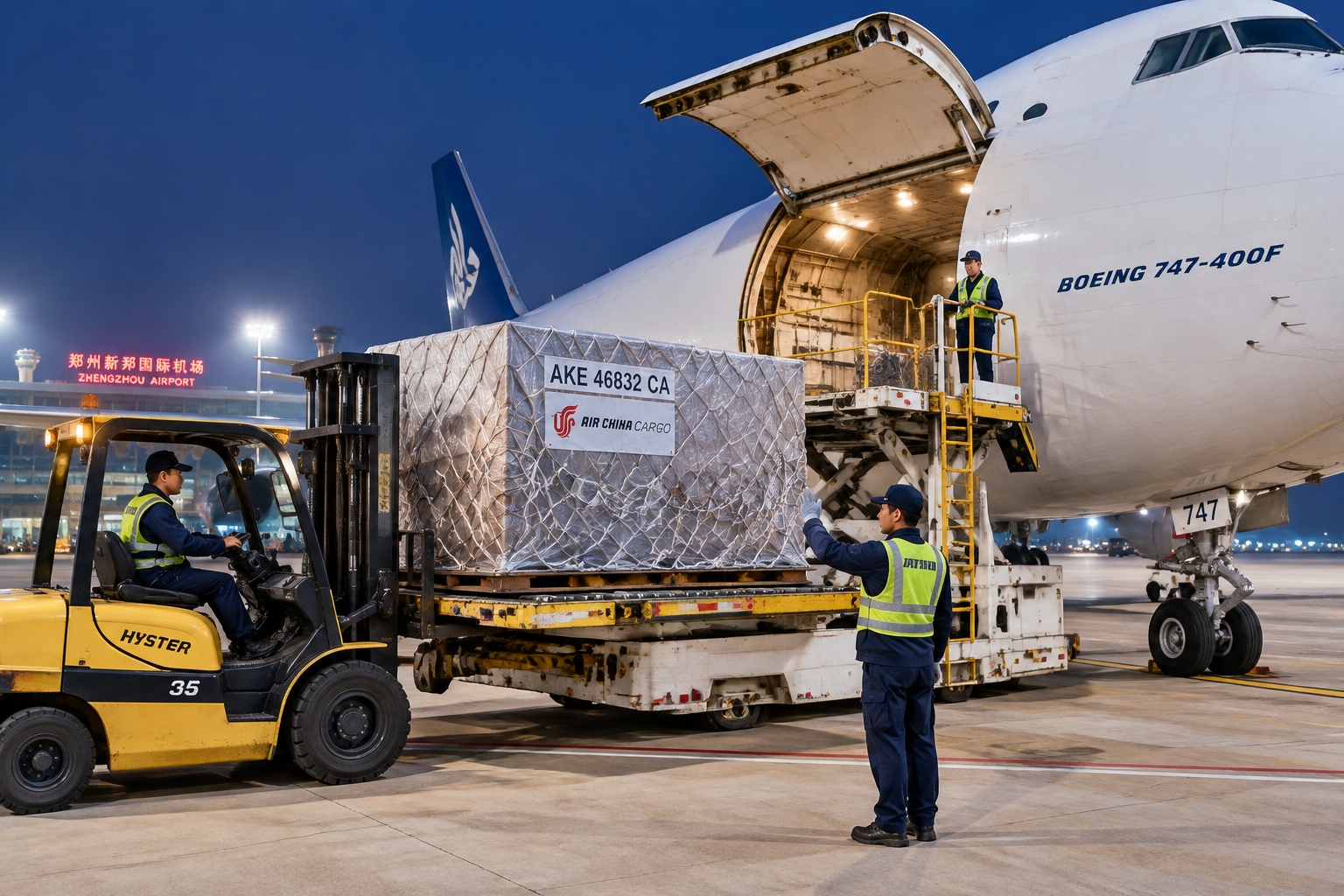
After customs, the box is sorted by destination and shipping method. Automatic arms swing packages into chutes, but humans still play a key role. A group of workers in yellow vests stands along the belt, pulling bags that curl around a turn. At the end of the line, another worker places each parcel into a huge canvas container, filling it to the brim like a Tetris game. The container is called a unit load device, or ULD, and it will soon be loaded into the belly of a plane. By 2:30 a.m., the first batch of ULDs is ready. Forklifts drag them across the apron to a waiting Boeing 747. The plane has been converted to a freighter, its windows painted over, its belly open wide. The ULDs slide into a cargo hold that smells of fuel, rubber, and cardboard.
Why Zhengzhou? Geography and Speed
Zhengzhou sits near the geographic center of China, making it a natural crossroads for the national highway and rail network. Trucks can reach the airport from the manufacturing belts of the east and south in a day. This matters for e-commerce, where time is more valuable than rubber. A seller in Shenzhen can ship to a global buyer via Zhengzhou instead of flying from nearby Hong Kong, often at a lower cost due to the dense capacity. The airport is also one of the few places in the world with dedicated infrastructure for air-road-rail cargo. The nearby Zhengzhou International Road-Rail Transport Hub connects to the Europe rail network, though for speed, air remains dominant for small parcels. In 2023, cross-border e-commerce exports through Zhengzhou Airport grew by double digits, thanks in part to platforms like SHEIN and Temu, which have turned this ancient city into a launch pad for cheap, fast-moving goods.
Humans in the Machine
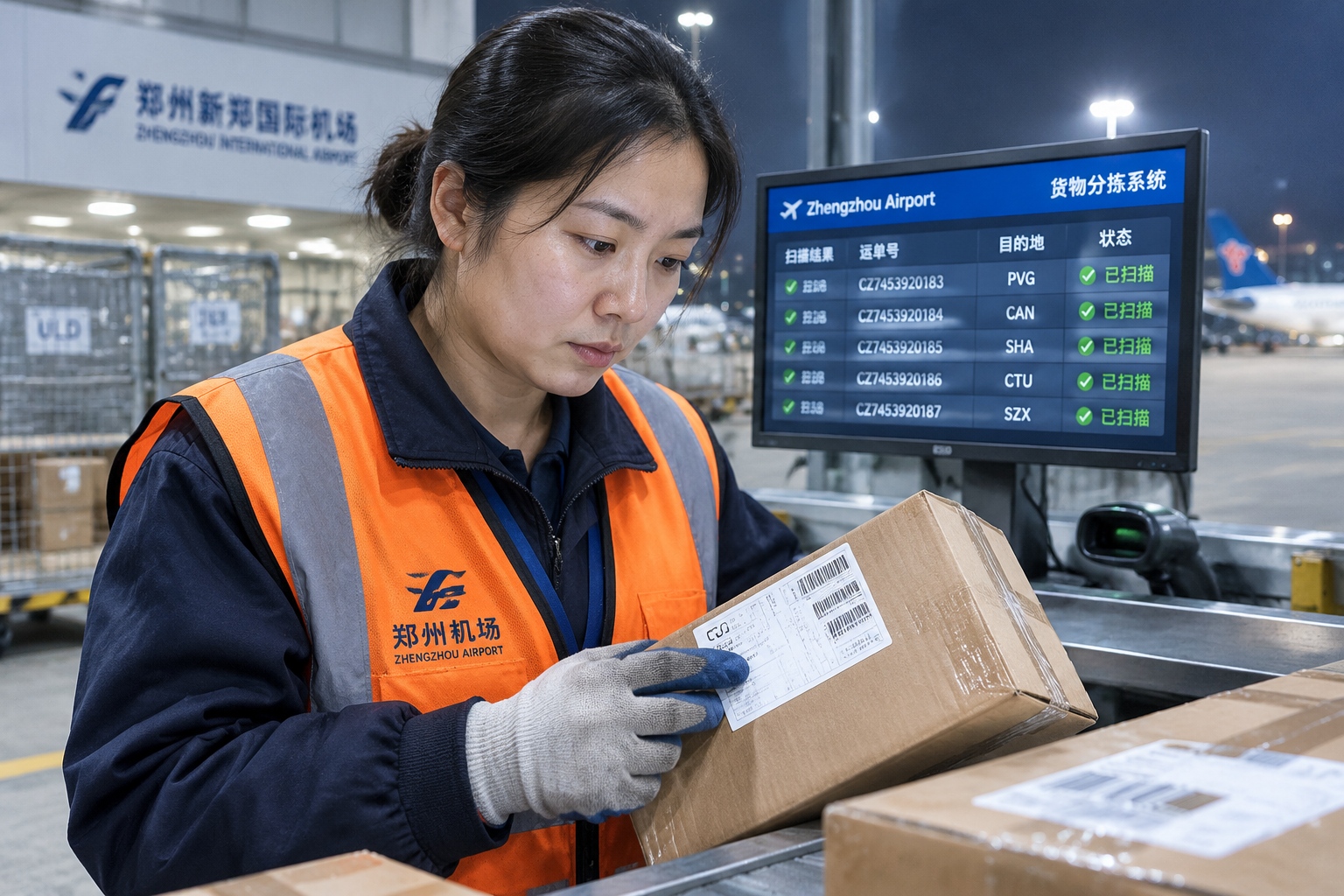
Technology drives efficiency, but the human body still runs the operation. In a corner of the sorting hall, Wang Dan, a 32-year-old mother of two, takes a short break. She shifts her weight from one foot to the other. “My feet hurt, but you get used to it,” she says. Wang normally works from 9 p.m. to 5 a.m. during peak season. She checks labels, counts boxes, and sometimes fixes tangled belts. Most nights she drinks a cup of strong tea from a thermos. Her kids have gotten used to seeing her sleep in the morning.
Not far away, a group of men lift packages from a truck again. The team of 12 unloads about 4,000 parcels an hour. They take turns, picking one box every two seconds, throwing it onto a slide. “The rhythm matters,” says the team lead, 45-year-old Zhao Ping. “If you pause too long, boxes pile up and stop the whole line.” He does not worry about missing a parcel. A camera above the belt reads every bar code, so even if a box lands in the wrong chute, the system knows.
Night-Time Pressures
The operation is not always smooth. During shopping festivals such as the June 18 sale and Double Eleven in November, the volume can double. Warehouses run out of space. ULDs are stacked in spare alleys. Flights are delayed due to weather, and a single thunderstorm can force everything onto the ground. Then the packages accumulate, filling every empty corner until the next clear night. “We have plans for every case,” says a logistics manager, “but flexibility is the real skill.”
Fatigue is another constant. Night shifts mean working against the body’s clock. Workers rotate through 12-hour shifts, and agency staff often handle peaks. Some have been working here for six years, some only a few weeks. The pay is competitive but not luxurious. A sorter earns about 6,000 to 8,000 yuan a month, plus overtime and free meals during peak nights. It is a tired, noisy, but necessary job.
Final Takeoff
At 3:40 a.m., the last cargo door of a Cargolux 747 closes. The ground crew pulls away, the plane begins to taxi, and the engines roar louder than the noise of the sorting line. The jet turns into the runway, pauses for a heartbeat, then accelerates into the black sky. In the cargo hold, the boots ordered in Paris are riding alongside phone cases and inflatable pool toys. No one sees the takeoff from the ground, but thousands of people will see the package in their front door two days later.
Zhengzhou’s night does not end with the flight. A new batch of trucks is already pulling into the docks. The conveyor belts never stop. The city has found its place in the invisible network of global e-commerce, not as a showpiece, but as a machine that runs on coffee, flickering screens, and the hands of people who keep the night alive.