

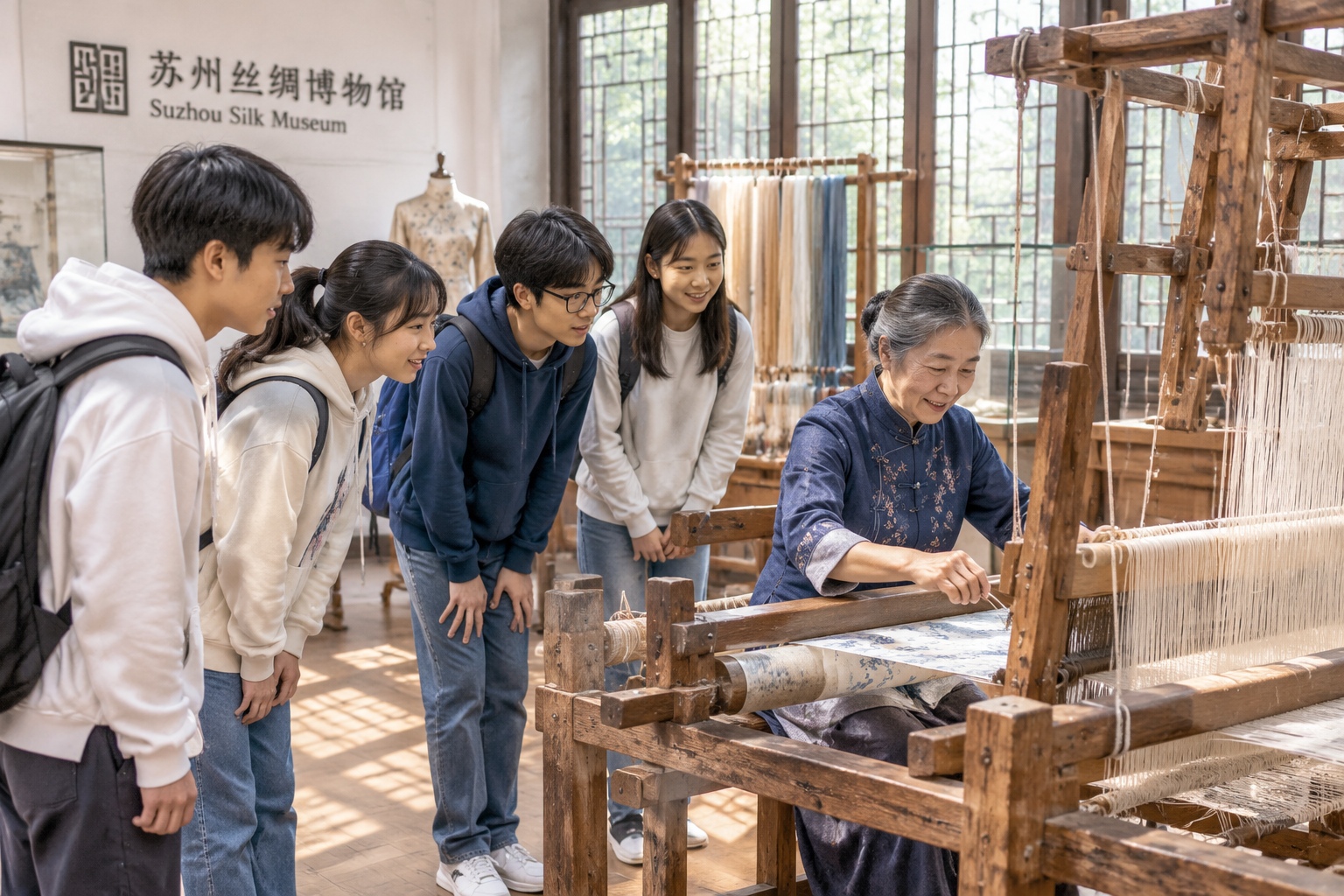
At 9 a.m., the air inside the Suzhou Silk Museum smells of wood and old cotton. An elderly weaver, Wang Qinfang, steps onto a wooden platform and begins moving the heddles of a late-Qing loom. The shuttle slams back and forth, beating the weft into a pattern of peonies. A crowd of high school students, many wearing smartwatches, watch as a thread of life from 300 years ago comes alive. Outside the window, the city of Suzhou hums with electric bikes and construction cranes. Inside, Wang’s hands, gnarled but precise, have been repeating this motion for over forty years.
This scene captures the paradox of Jiangsu province, China’s textile heartland for four centuries. Here, ancient silk traditions coexist with factories that produce smart fabrics capable of heating, cooling, and even harvesting body heat. Jiangsu’s textile story is not just about industry; it is about how a region’s identity was woven, unbroken, from handlooms to high-tech looms, and how everyday people—farmers, workers, engineers, designers—continue to shape one of China’s most vital economic and cultural threads.
A Silk Roads Origin
Jiangsu’s textile history begins with silkworms. As early as the Han Dynasty (206 BCE–220 CE), the region’s warm climate and mulberry trees made it a natural home for sericulture. By the Ming Dynasty (1368–1644), Suzhou and Nanjing became imperial weaving centers, producing luxurious silks for the emperor and his court. The famous “Silk Brocade of Nanjing” and “Song Brocade of Suzhou” were prized across Asia and later Europe, traveling the ancient Silk Road caravans. In the Qing Dynasty, Jiangnan (the lower Yangtze region) was dotted with thousands of looms, many housed in village homes where entire families, from grandmothers to children, turned cocoons into thread and thread into cloth. A local saying from the era captures this: “Raising silkworms is like raising a daughter—they require endless care, but they repay with riches and warmth.”
The craft was meticulous. Silkworm cocoons were boiled, the silk filaments unwound by hand, dyed with plant-based colors, and woven on wooden looms. These were not just products; they were status symbols and expressions of artistry. At the Nanjing Cloud Brocade Museum today, you can still see weavers using a two-story loom where two workers, sitting above and below, coordinate to create raised patterns that seem to float in the fabric. It takes a full day to weave just two inches of this intricate cloth—a testament to the patience that defined Chinese textile culture for centuries.
The Leap to the Factory Age
Everything changed in the late 19th century when the industrial revolution reached China’s shores. Zhang Jian, a scholar and entrepreneur from Nantong, Jiangsu, founded the Dasheng Cotton Mill in 1895. His vision was to build a modern industrial base in his hometown, moving textiles from cottage workshops to mechanized factories. Zhang’s mill, with its British-made spinning machines, became the model for modern Chinese industry. It attracted thousands of workers from rural villages, offering salaries and, importantly, schooling for their children—a radical idea at the time.
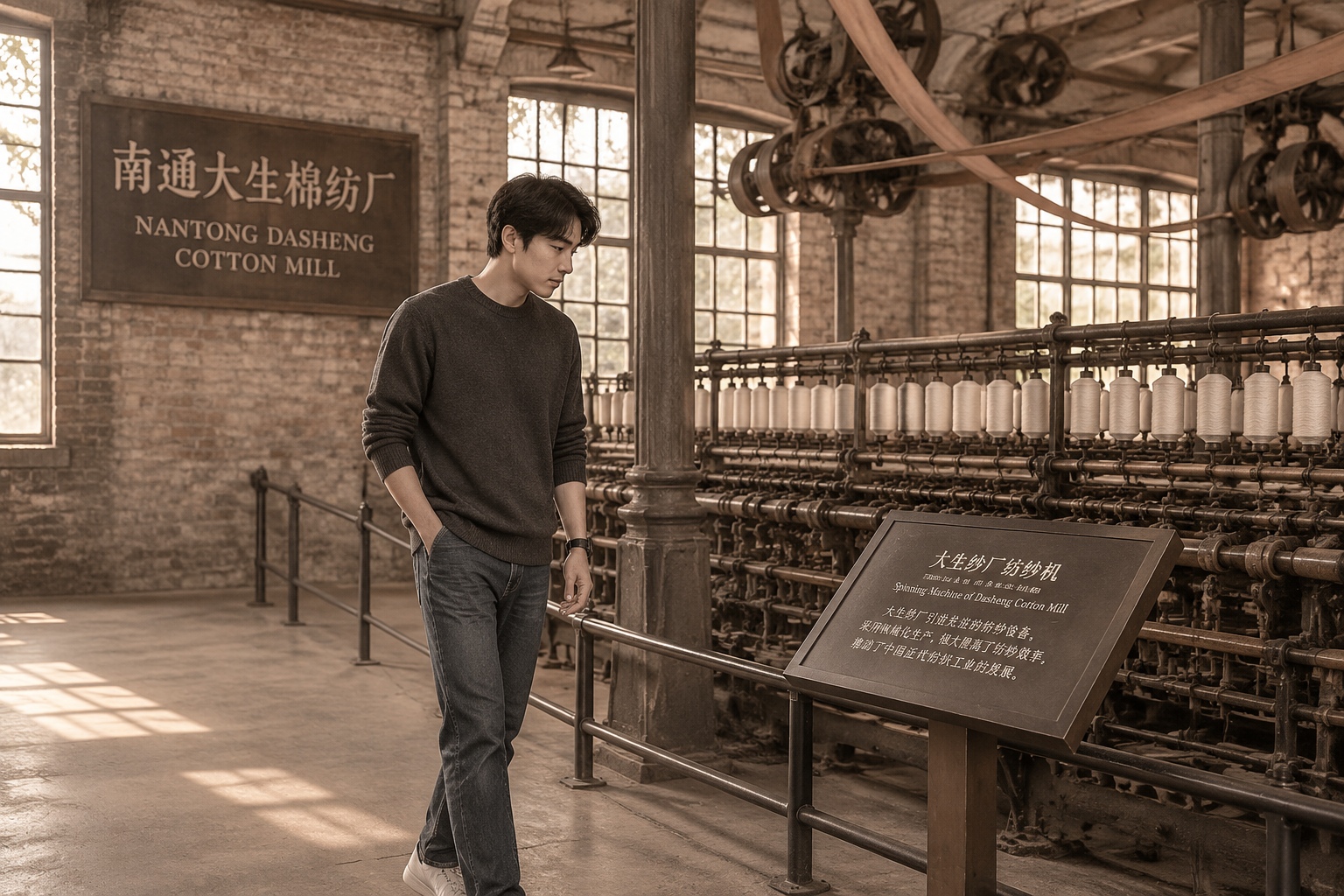
The factory floor was a sensory shock: the rhythmic thud of steam engines, the hiss of bobbins, and the constant slap of leather belts driving shafts overhead. Workers, many of them young women, learned to tie broken threads with jaw-dropping speed, their fingers moving faster than eyes could follow. Nantong’s textile industry grew rapidly, and soon nearby Wuxi and Changzhou followed, earning Jiangsu the nickname “the Manchester of the Orient.” By the 1930s, cotton yarn and cloth from Jiangsu were sold across China and exported to Southeast Asia and even Europe, laying the foundation for the province’s manufacturing dominance that continues to this day.
But the factory age also brought labor struggles and social change. Workers fought for shorter hours and safe conditions, and the textile mills became breeding grounds for early labor unions and revolutionary ideas. The story is not just about machines; it is about people who left their farms to become part of a new industrial working class. These streets, now lined with restored mill buildings and museums, still echo with the footsteps of those who built modern China.
From Shuttles to Software
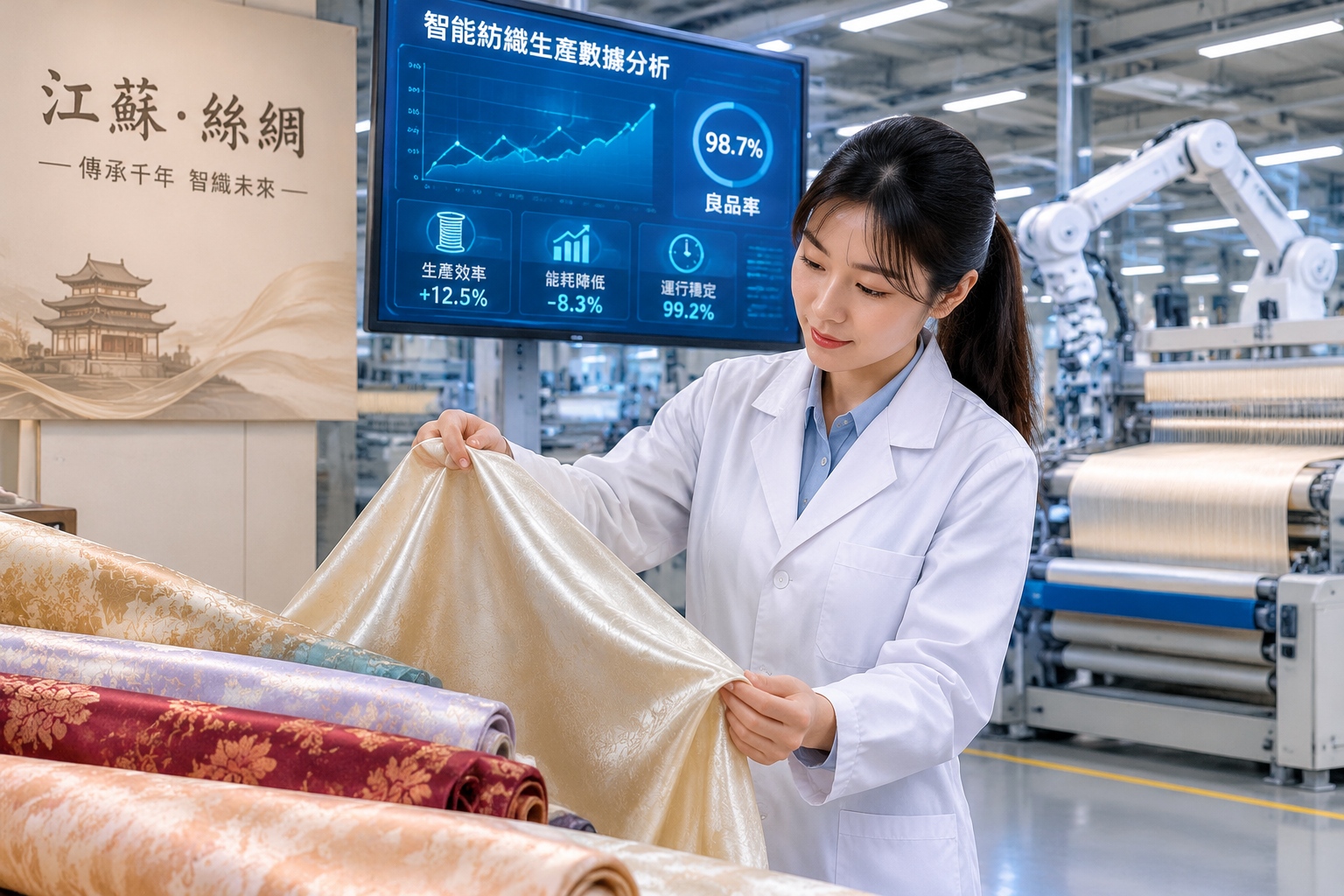
Today, in Shengze, a town in southern Jiangsu known as “China’s Silk Capital,” the textile business has undergone another transformation. On the outskirts of town, a modern facility belonging to a company called Winshare Textiles looks more like a tech lab than a factory. Inside, engineers in clean-room suits monitor panels of digital sensors that track every stage of fabric production. One production line is turning out a “smart cooling fabric” that responds to body heat by opening micro-pores in the fibers. Another is weaving silver-coated threads into a cloth that can charge a phone through a pocket.
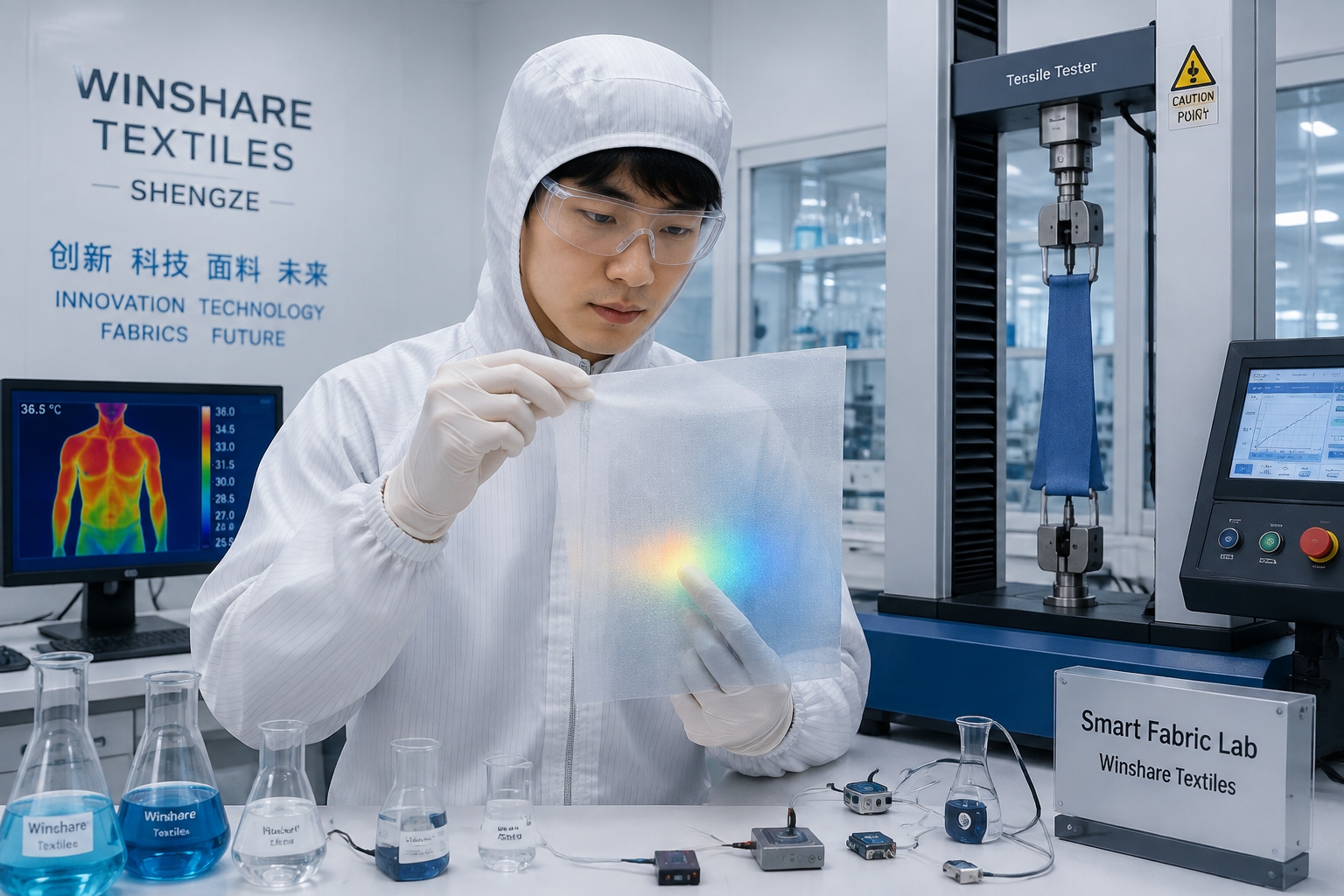
The shift is driven by both technology and market demand. Traditional textiles had huge margins in the past, but competition and rising labor costs forced Jiangsu’s factories to innovate. Provinces and cities pumped funds into R&D, encouraging universities and private firms to collaborate. The result is a new generation of functional fabrics: self-cleaning suits, military uniforms that neutralize chemical agents, and even fabrics that generate electricity from movement. In 2022, Jiangsu’s textile industry exported over $80 billion worth of products, a quarter of which were “high-performance textiles,” according to the Jiangsu Textile Industry Association.
This technological leap has also changed the workforce. Workers now need to understand digital interfaces and read data analytics, not just operate sewing machines. Zhang Ming, 32, a textile engineer at Winshare, explains how he ended up in this industry: “I grew up in a family that spun cotton in a village near Wuxi. My grandfather installed a spinning machine in our living room in the 1980s. He used to say, ‘Thread is our fate.’ But now, fate is coded into the threads. I studied polymer science, and I still think of what my grandfather said—but now we design the very molecules that make the thread intelligent.” Zhang’s words highlight a deeper change: textile production in Jiangsu is no longer a low-skill, manual labor business. It is a high-tech sector drawing on chemistry, software, and design—yet it remains rooted in a landscape of mulberry groves and cotton fields.
Weaving Lives Together
For ordinary people in Jiangsu, textiles are not just abstract industrial statistics; they are the fabric of family memory. Take Li Xiaoyan, a 56-year-old woman who lives in Suzhou. Her grandmother raised silkworms every spring, filling their yard with the scent of mulberry leaves and the sound of silkworms munching. Her mother worked at a state-run silk factory in the 1980s, bringing home sample swatches that Li used as book covers. Now, Li runs a small dress shop that blends traditional Song brocade with modern cuts, sourced from local workshops that employ artisans using techniques passed down for generations.
On weekends, the Suzhou Silk Museum offers workshops where children can learn to spin thread on a wooden spindle or weave a simple bookmark. The goal, says curator Shen Jing, is to keep the tactile world of textiles alive. “When you touch silk, you feel history. But when you wear a smart jacket, you feel possibility. Both are part of Jiangsu’s story.”
In Nanjing, a group of young fashion designers is reinterpreting ancient brocade patterns with 3D printing and digital printing. One designer, Chen Yu, shows me a jacket embroidered with a digital recreation of a Ming Dynasty cloud pattern, but woven with aluminum-coated threads that make the garment reflect body heat back to the wearer. “We’re not just preserving heritage; we’re making it functional for modern life,” she says.
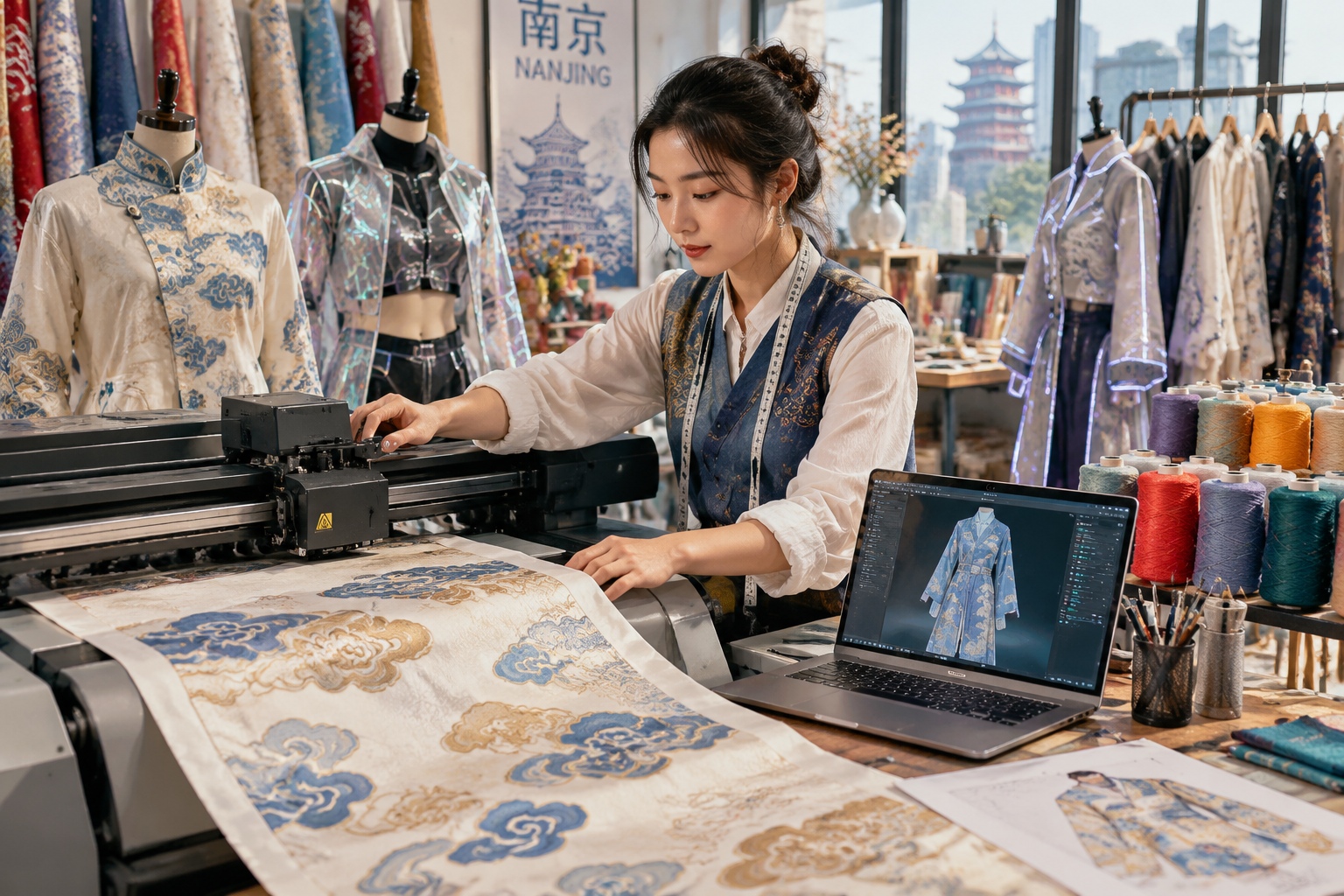
This blend of old and new is visible in the region’s urban streets. In Wuxi, a former cotton mill has been converted into a creative park, its red brick walls and steel trusses now housing startup offices and design studios. Older workers who once tended spinning frames now guard the park at night, while their grandchildren work inside—writing algorithms for fashion apps or designing 3D-printed accessories. The texture of the past and the fabric of the future are inseparable.
Preserving the Thread
With all this modernization, there is a strong effort to preserve the intangible heritage of traditional Jiangsu textiles. Song Brocade, a silk weave with a history of over 1,000 years, is now a UNESCO-listed intangible cultural heritage. Weavers undergo years of apprenticeship to master its intricate patterns. Zhu Jianjun, a national-level inheritor, runs a workshop in Suzhou where he and six apprentices make brocade exactly the way it was made in the Song Dynasty (960–1279). “The machines can imitate the pattern, but they can’t replicate the soul of a handwoven piece,” Zhu says. “When you weave, you are in dialogue with the person who will wear it, and with history itself.”
Museums like the Nanjing Cloud Brocade Museum and the China Silk Museum in Hangzhou, though not all in Jiangsu, draw visitors who want to understand the region’s past. But in Jiangsu, the most vivid preservation happens in everyday life. Local communities hold silk festivals, schools organize visits to factories, and brands collaborate with artisans to produce limited editions. The line between “heritage” and “innovation” is often blurred, and that, perhaps, is the most authentic reflection of Jiangsu’s textile tradition—it evolves without losing its thread.
A Fabric of the Future
Standing at the edge of a modern textile plant in Shengze, the contrast is striking. To the north, a row of ancient mulberry trees marks an old sericulture farm. To the south, a solar-powered factory drives robotic arms that pick up swatches of fabric and test them for stretch, strength, and thermal conductivity. The province has set a target to boost the output of “green textiles” by 30% by 2030, including fabrics made from recycled waste and biodegradable materials. Jiangsu is already a global leader in producing recycled nylon from plastic bottles, and several companies are pioneering plant-based dyes that reduce chemical runoff.
The people I met on this journey—Wang, the weaver; Zhang, the engineer; Li, the shop owner; Zhu, the inheritor—are not separate stories. They are chapters of one ongoing narrative. Each generation has picked up the thread from its ancestors, twisted it with new knowledge, and handed it forward. From the silkworm to the sensor, from the handloom to the high-speed loom, the four-century arc of Jiangsu’s textile industry is a tale of resilience, adaptation, and human connection. It shows that even in an age of automation and AI, the textile world remains, deeply and wonderfully, about people.
For anyone who has ever touched a piece of silk or worn a smart jacket, a small part of Jiangsu is already with you. That fabric carries not just the labor of hands and machines, but the hopes of a region that still believes thread can bind past, present, and future together.