
Five in the morning, and nobody is steering
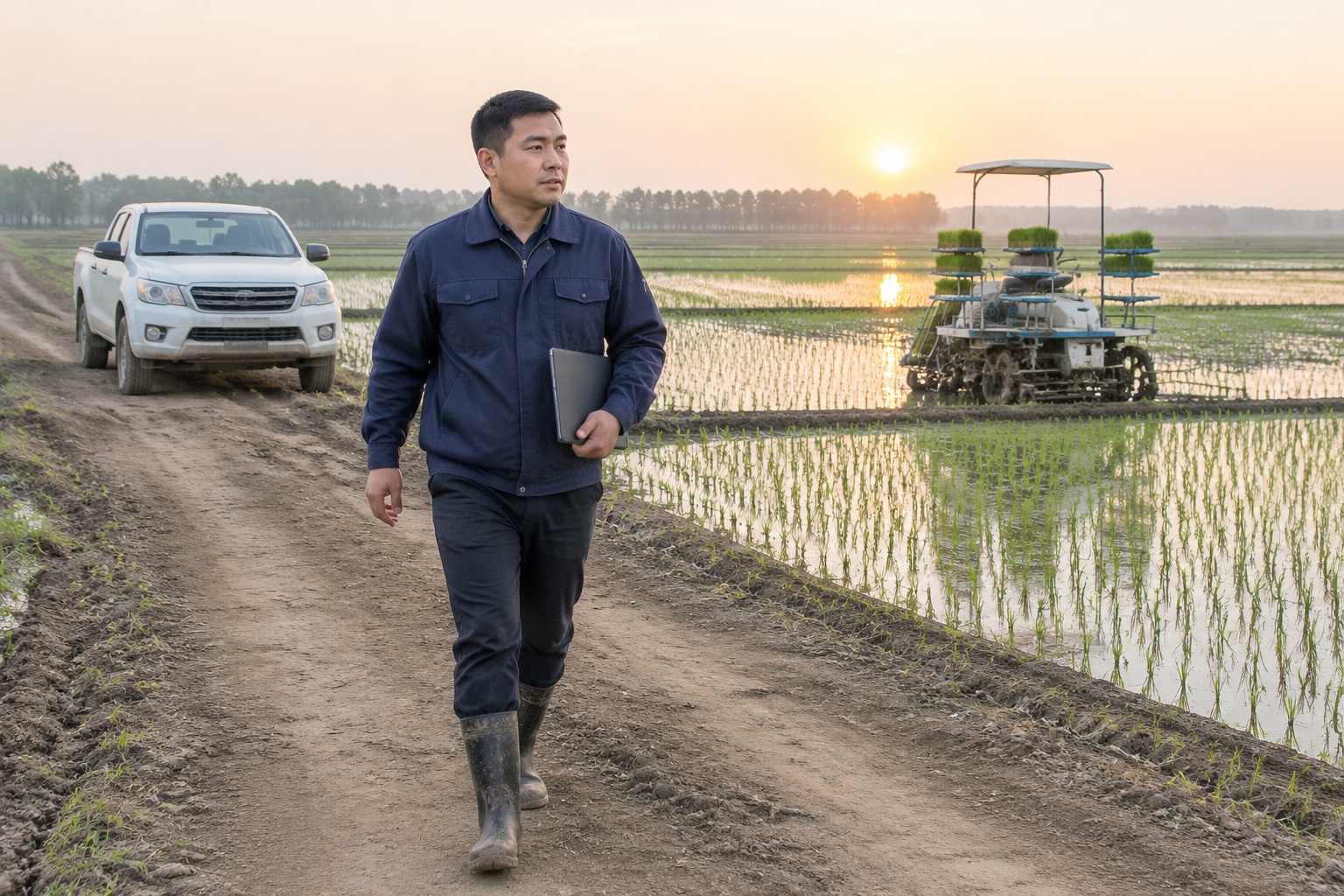
It is a little after five in early May, a few kilometres outside Fujin, a grain town in eastern Heilongjiang. The air is around 5°C and the water in the paddies is colder. A tractor is crossing a flooded field, and the cab is empty.
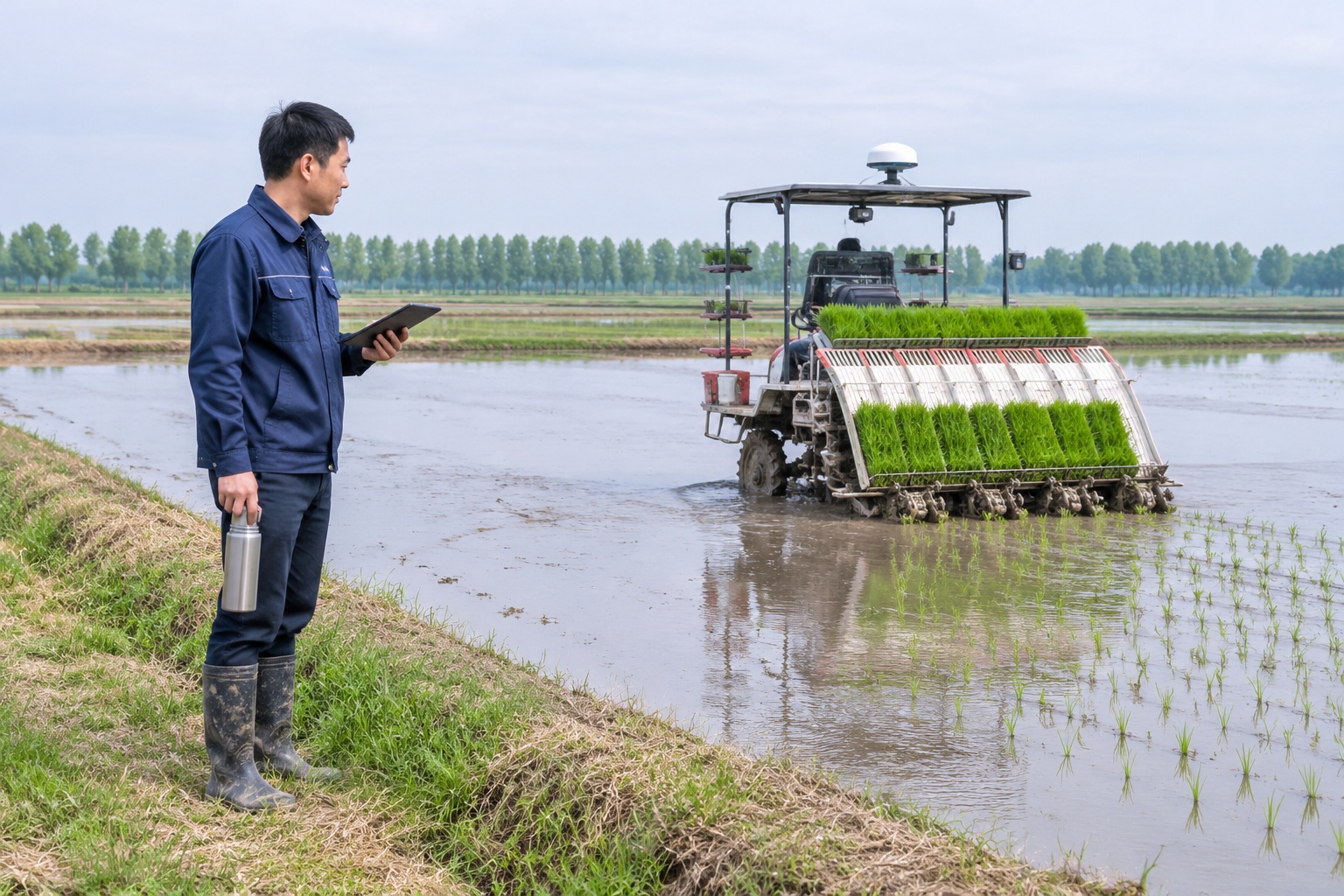
Behind it, a transplanter drops rows of pale green rice seedlings into the water. On the roof, a small white dome — a BeiDou satellite receiver — holds the machine to a line that is straight to within a couple of centimetres. At the end of the field it lifts, turns, and comes back down the next row with no hand on the wheel.
The person in charge stands on the ridge about a hundred metres away: a man in his mid-thirties in a navy work jacket and rubber boots, a tablet in one hand, a thermos in the other. He is not driving. He is watching, refilling trays, and waiting for something to go wrong. He has three machines out this morning.
Why Heilongjiang goes first
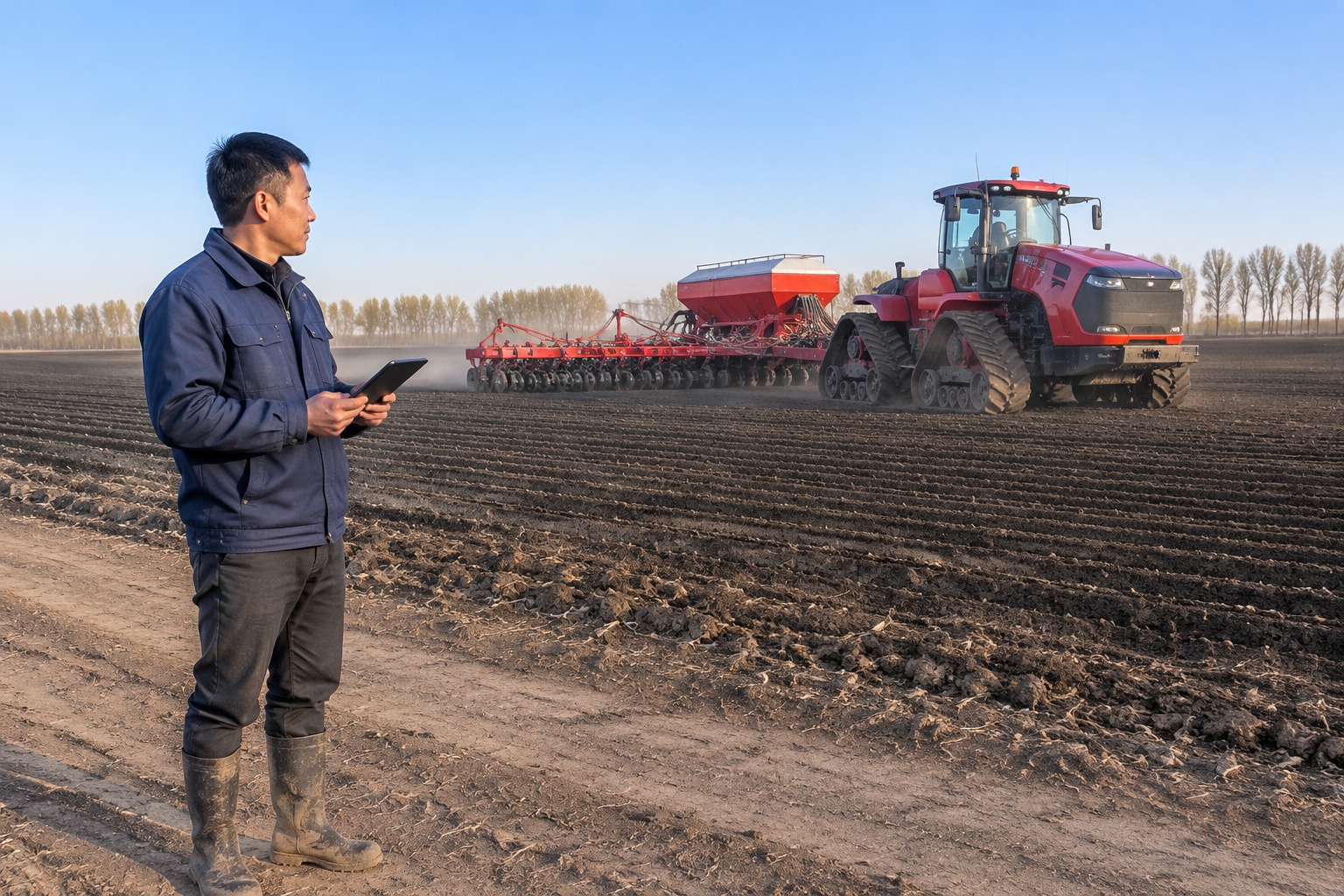
Heilongjiang is China’s far northeast province, wrapped around the Russian border. It is cold, it is flat, and it is enormous. It farms more land than any other province and has produced over 150 billion jin of grain — roughly 75 million tonnes — every year for more than a decade. That is close to a ninth of the country’s total harvest, from a province of about 30 million people.
Two physical facts make it a natural test bed. The fields are huge and rectangular. On the state farms around Jiansanjiang, a single plot can run 500 metres to a kilometre without a curve, which is close to ideal geometry for satellite steering: few turns, few obstacles, little to correct.
The other fact is the soil. Heilongjiang sits on black earth — thick, dark, and sticky when wet. It made the province a grain basket, and it makes spring work heavy and slow.
The labour facts push in the same direction. The people who know how to run a transplanter are mostly in their fifties and sixties now. Their children left for Harbin, Qingdao or Shenzhen and mostly did not come back. Rice transplanting has a window of about ten days to two weeks in May; miss it and yield falls. Hiring help costs 200–300 yuan a day and gets harder every spring.
So the pressure behind the technology is not that robots are exciting. It is that there are fewer hands and still the same ten days.
What is actually automated, and what isn’t
The core of it is not exotic. A receiver on the roof pulls positioning signals from BeiDou, China’s satellite navigation system; a correction feed from a nearby base station narrows that down to a few centimetres. A motor on the steering column turns the wheel on command. The operator teaches the machine the field boundary once — either by driving the perimeter or by tapping it out on a screen — and the software plans the passes.
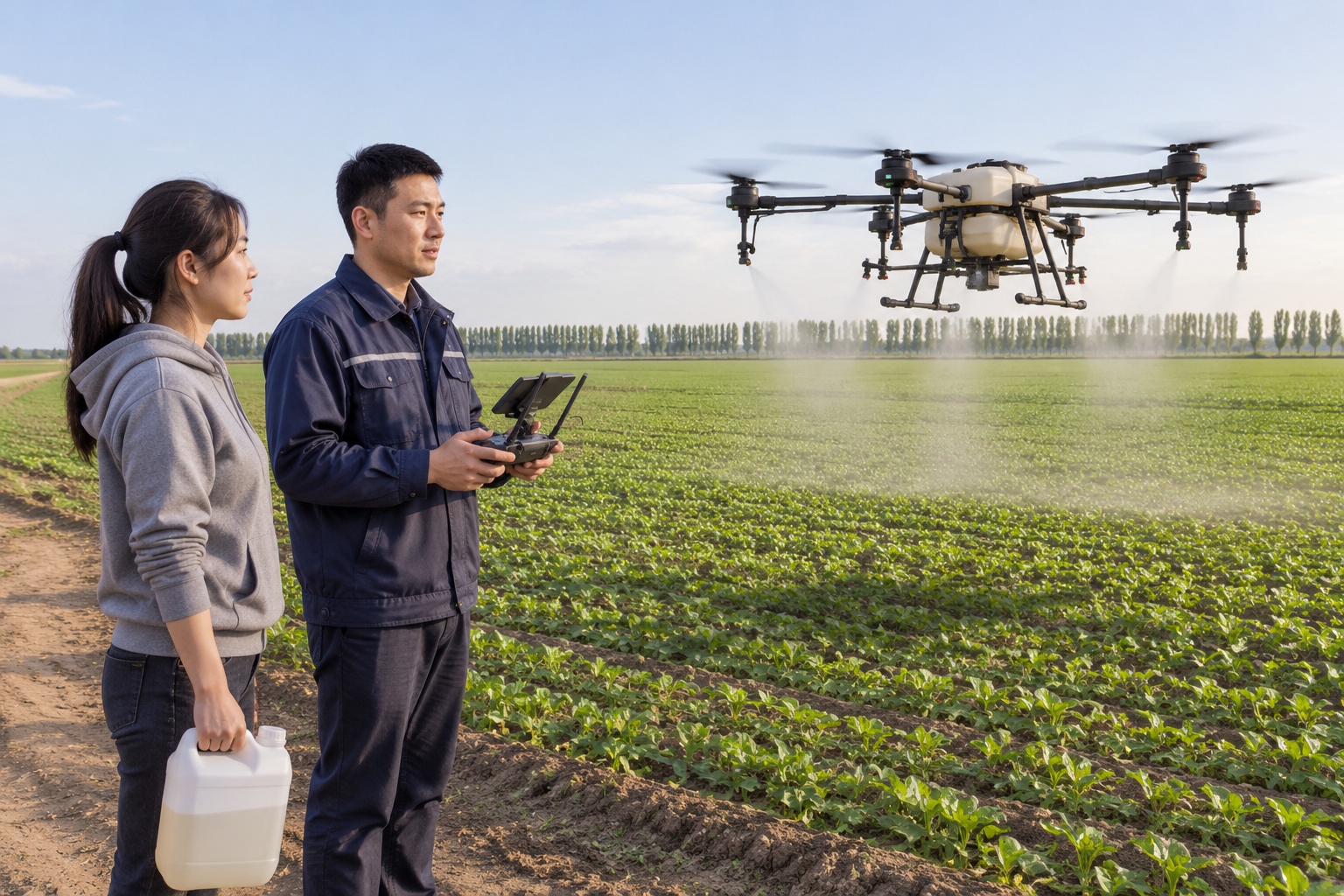
The most widely used piece of smart farming in China is not a tractor. It is a drone. A plant-protection drone with a 20-litre tank costs roughly 40,000–70,000 yuan, and a service team will spray a field for 8–15 yuan per mu (one mu is about 667 square metres, or one-fifteenth of a hectare). A drone covers in an hour what a person with a backpack sprayer struggles to finish in a day, and nobody has to walk through wet rice in a chemical suit. This is the part of the technology that small households already meet — usually by paying someone else.
Tractors and transplanters now steer themselves down the row. But someone still loads the seedling trays. Someone still stands at the back and watches for gaps where the seedlings failed to drop. “Unmanned” in practice means no hands on the wheel inside a field the machine already knows, with a human nearby for the exceptions.
Where the data side is genuinely impressive: combines that log yield metre by metre, soil-moisture sensors, variable-rate fertiliser spreaders that cut dosage on poor patches. Where the machines are still stubbornly manual: mud. A transplanter that drifts into soft ground needs a person, a spade and twenty minutes.
The job changed shape
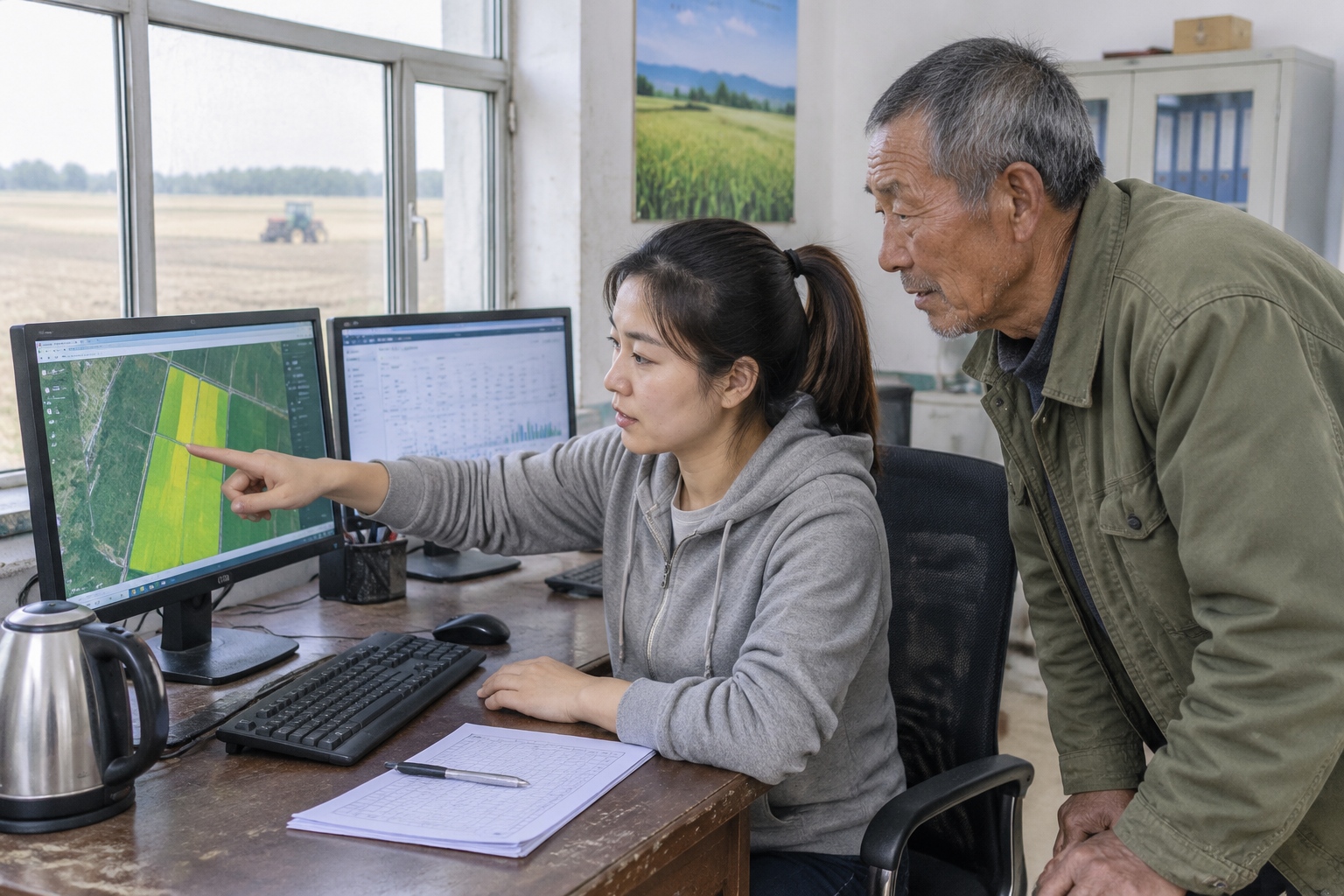
A decade ago, an operator sat in a cab for twelve hours, breathing dust, watching a marker stick, and going home with a sore neck. Today the same person walks the field more, drives a pickup between blocks, and spends time staring at a screen that shows three machines as coloured rectangles.
It is easier on the body and harder on the attention. Machines do not get tired, so people run them longer. The old skills — judging a line by eye, feeling when the soil is too wet — have not disappeared. They have moved to a different part of the job: deciding when to switch the automation off and take over.
Whether young people are coming back because of this is an open question. Some are, but mostly as technicians rather than as farmers: drone pilots, equipment operators, people who can fix a sensor and argue with a dealer. A drone pilot can earn by the mu across several villages in a season, which looks more like a job than like farming.
Where smart farms still stumble
It would be easy to make this sound like a fully automated future. It isn’t.
Signal is mostly fine on the plain and patchy at the edges of a field — which is exactly where a machine has to turn. Wet springs, and Heilongjiang has plenty, put machines into mud they cannot handle alone. Straw left on the surface, increasingly common under conservation-tillage rules, can clog a seeder in ways no algorithm predicts.
Repairs are the quiet cost. A tractor with autosteer has sensors, hydraulic valves, wiring harnesses and software that a village mechanic cannot fix with a wrench. If the nearest dealer is 100 kilometres away and the planting window is ten days, one failed sensor is expensive.
Training matters more than the brochures suggest. Many operators are in their fifties, and a touchscreen in bright sunlight with small buttons is not a friendly interface. Cooperatives that do well tend to have one patient person who learns the system properly and teaches everyone else.
Then there is data. Different brands do not talk to each other. Field maps, yields and machine logs sit in a dealer’s cloud in a format nobody else can read. Farmers are starting to ask who owns that, and what happens when the service contract ends.
The arithmetic a cooperative actually runs
For a large operator, the numbers work. An autosteer kit runs roughly 10,000–30,000 yuan per machine depending on the level of automation, and some provincial programmes cover part of it. The payback comes from three places: less overlap, so less seed, fertiliser and diesel wasted on the same strip; fewer hired hands; and longer working hours, because a machine with a satellite on the roof can keep going after dark.
A cooperative cropping several thousand mu typically finds a two- to three-season payback. It also finds new costs: depreciation, annual correction-service fees, a technician’s wage, and the risk that a machine stops in the middle of the ten-day window.
For a household with 20 mu, none of this adds up, and nobody pretends it does. What reaches them is the service layer: hiring a drone for spraying, paying a cooperative a fixed fee per mu for land management, or renting a machine by the day. Nationally, land trusteeship — where a service organisation farms your plot for a fee and shares the harvest — now covers hundreds of millions of mu. The smallholder does not buy the technology. They buy its output.
The change is slower than the demo
What is happening in Heilongjiang is not a robot takeover. It is a gradual reallocation of attention. In the ten tight days of May, a cooperative that once needed forty drivers now needs twelve people and a mechanic — and works longer hours than it used to, because the machines do not need sleep.
The questions left open are the interesting ones. Can the technician model scale beyond the big state farms and the well-run cooperatives? Does farm data become a new kind of dependency, rented back to the people who generate it? Do small farms end up paying more for services than they save in labour? And does any of this make a 25-year-old in Harbin want to go home in May?
Outside Fujin, the sun is up by six. The thermos is empty. The transplanter has covered another stretch of paddy, straight as a ruler, and the man on the ridge is already walking back to the pickup to check on the second machine.