

A Morning at Dishui Lake
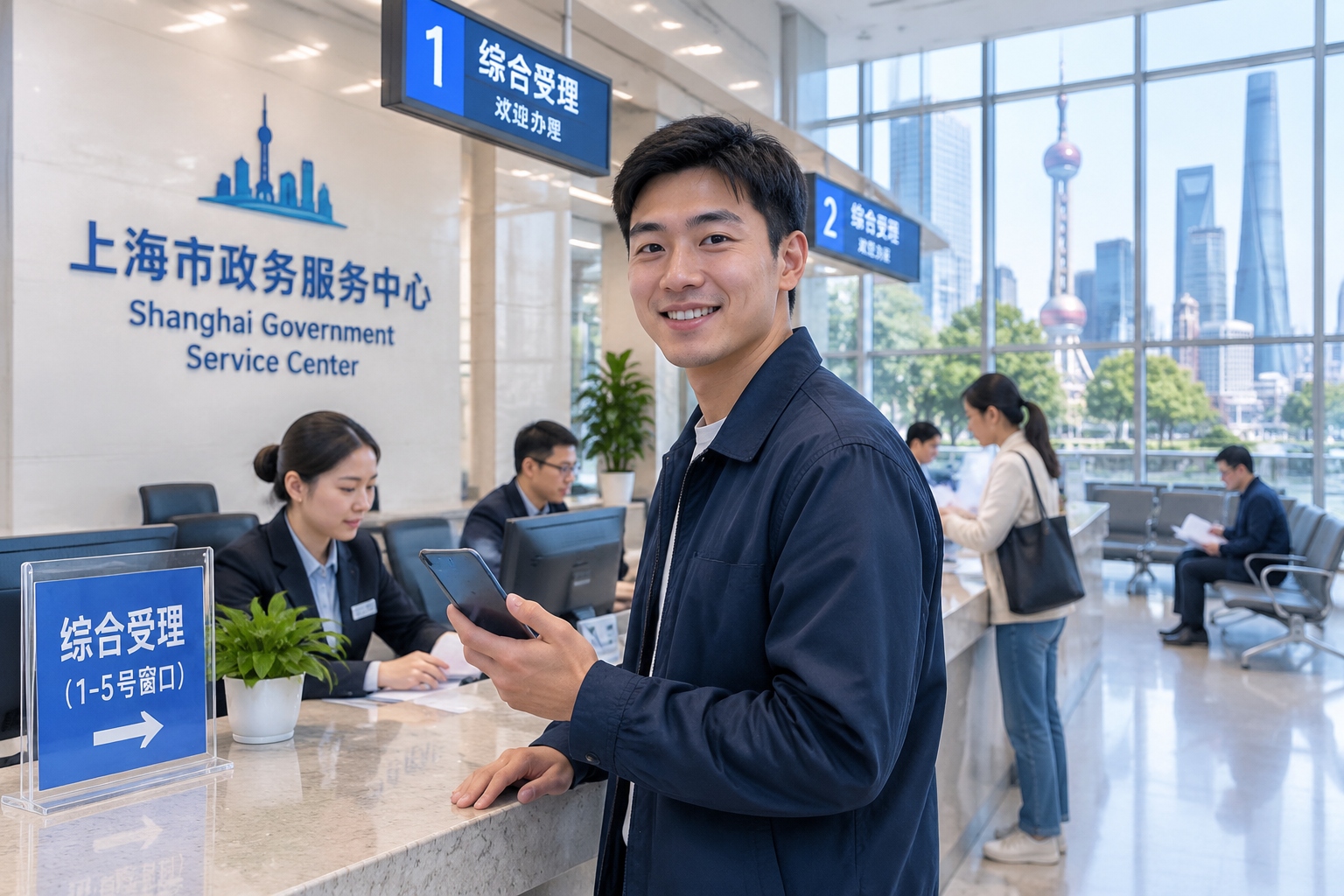
It is 8 a.m. on a Tuesday in Lingang, and the fog is still sitting on Dishui Lake. Zhou Yu parks his electric scooter outside the Lingang Administrative Service Center, checks his phone, and walks in.
He is 29, wearing a navy jacket, and runs a small logistics software company that serves freight forwarders in Shanghai and Ningbo. He registered the business here three months ago. Today he needs to update one line on its business scope — the kind of paperwork that, in his experience, eats a morning.
He is back on his scooter at 9:12.
“Last time I changed the legal representative, it took ten minutes at the counter,” he says. “When I registered in another district a few years ago, I queued for half a day just to submit the papers.”
This is what “institutional innovation” looks like at eye level. Not a white paper. A guy on a scooter with time left over.
Where Is Lingang, Exactly?
If you are reading this outside China, picture Shanghai not as a single dot but as a city that keeps spilling outward. Follow Line 2 of the subway east from the Bund, transfer at Longyang Road to Line 16, and stay on it for about an hour. The train eventually runs above ground through farmland and new apartment blocks. You get off near the sea.
Lingang sits at the southeastern tip of Shanghai, roughly 70 kilometers from the city center, where the Yangtze River meets the East China Sea. Its centerpiece is Dishui Lake, a perfectly round artificial lake about 2.5 kilometers across, dug in 2002 as the anchor of a planned new city.
The Shanghai Free Trade Zone started in 2013 as a much smaller experiment — about 28 square kilometers in Pudong. In August 2019, Beijing carved out a new piece: the Lingang New Area, covering 873 square kilometers, including the existing Nanhui New City. Think of it as a free trade zone with its own rulebook, not just a warehouse district with tax breaks.
The pitch is simple. Lingang gets to test policies that are not yet allowed elsewhere in China — freer cross-border data flows, easier movement of foreign capital, faster approvals for foreign talent. If a policy works here, it may be copied. If it doesn’t, the damage is contained.
What “Institutional Innovation” Means at the Counter
Walk into the service center and it looks less like a government office than a bank branch. There is a ticketing machine, rows of chairs, and a screen that calls numbers. About 40 windows handle company registration, tax, social insurance, and foreign trade filings.
The reform most people notice first is the “single window.” Instead of going to five different agencies, a business owner submits one set of documents. For straightforward registrations, the license can be issued the same day. The city government says more than 90 percent of business registration matters in Lingang are now handled online or at one window.
A second change is the “commitment system.” For certain low-risk licenses — a food service permit, for example — a company can submit a signed commitment that it meets the standards and open while inspectors check later. It shifts the burden from waiting to being accountable.
“The old model was: prove everything before you start,” says a staff member at the center who asked not to be named because she is not authorized to speak to media. “Now it’s: start, and we will check. If you lied, you lose the license and face penalties.”
For foreign investors, the negative list matters more. Sectors not on the list are open by default. Lingang’s version is shorter than the national one. In practice, that has meant faster setups for foreign-owned logistics, shipping services, and some financial firms.
The Factory Floor and the Job Board
Drive ten minutes west of Dishui Lake and you hit the Tesla Gigafactory Shanghai. It broke ground in January 2019, delivered its first cars that December, and now produces more than 750,000 vehicles a year. More than 20,000 people work there, many of them living in Lingang or the neighboring towns.
It is not the only employer. The district has been pushing four clusters: integrated circuits, biotech, artificial intelligence, and civil aviation. SMIC, the country’s largest chipmaker, has a fab nearby. Junshi Biosciences makes antibodies. SenseTime has an office. The local government lists more than 1,000 high-tech companies in the new area.
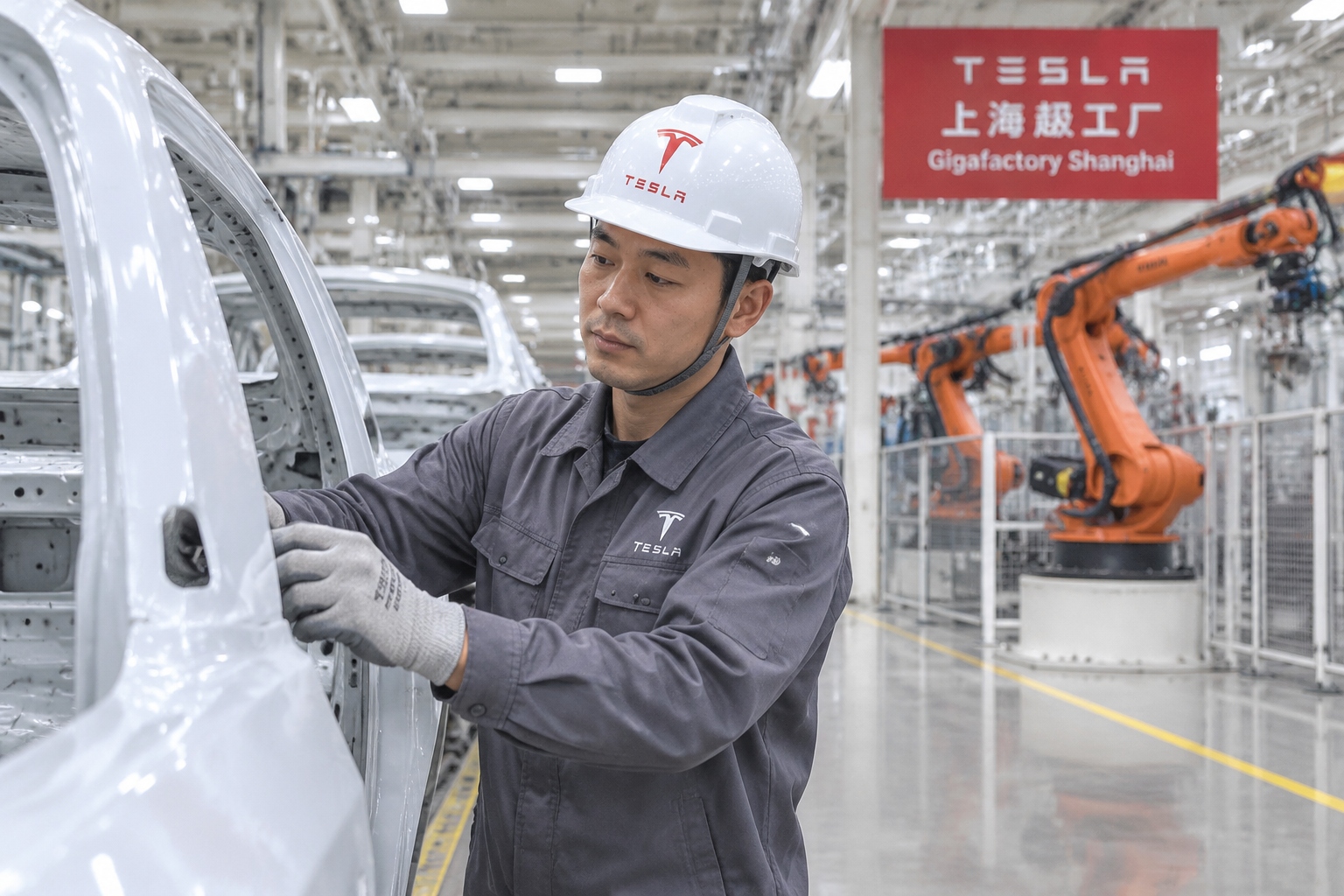
What does that mean for a 25-year-old with an engineering degree? Salaries in Lingang run slightly below central Shanghai for equivalent roles — maybe 10 to 15 percent lower — but rent is far cheaper, and the commute is a bike ride. Companies run shuttle buses from Line 16 stations. The local government offers housing subsidies for recent graduates who sign a two-year lease.
“I moved here because I could afford a one-bedroom by myself,” says Li Wen, a 26-year-old process engineer at a chip equipment firm. “In Zhangjiang, I was sharing a flat with two people.”
Living Here: The Apartment, the School, the Wait
Lingang’s talent apartments are the most tangible benefit. The government leases blocks of new buildings and rents them to qualified workers at below-market rates — typically 1,500 to 3,500 yuan a month for a one-bedroom, compared with 5,000 or more in central Shanghai. The catch is eligibility: you need a job in the new area, a certain education level or skill certificate, and a waiting list that can run months.
Public services have improved fast, though unevenly. Shanghai High School’s East Campus and Jianping Lingang are considered strong local schools. The Sixth People’s Hospital East Branch is a full general hospital. There is a large shopping mall near the lake, a supermarket, a cinema.
What’s missing is the texture of an old city. The street food is sparse. The bars close early. If you want a decent bowl of noodles at 10 p.m., you may need to drive.
The Lake, the Sidewalk, the Saturday
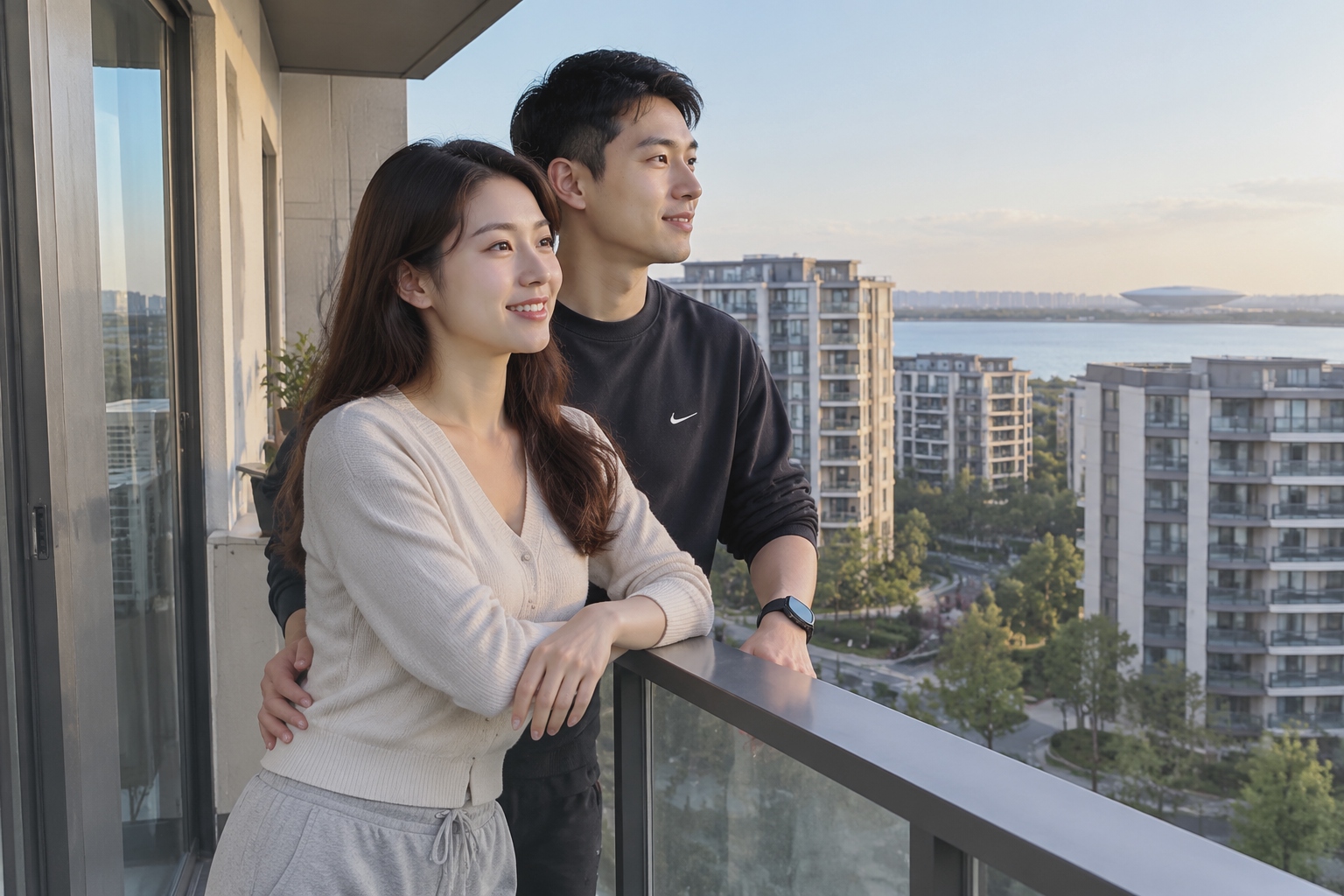
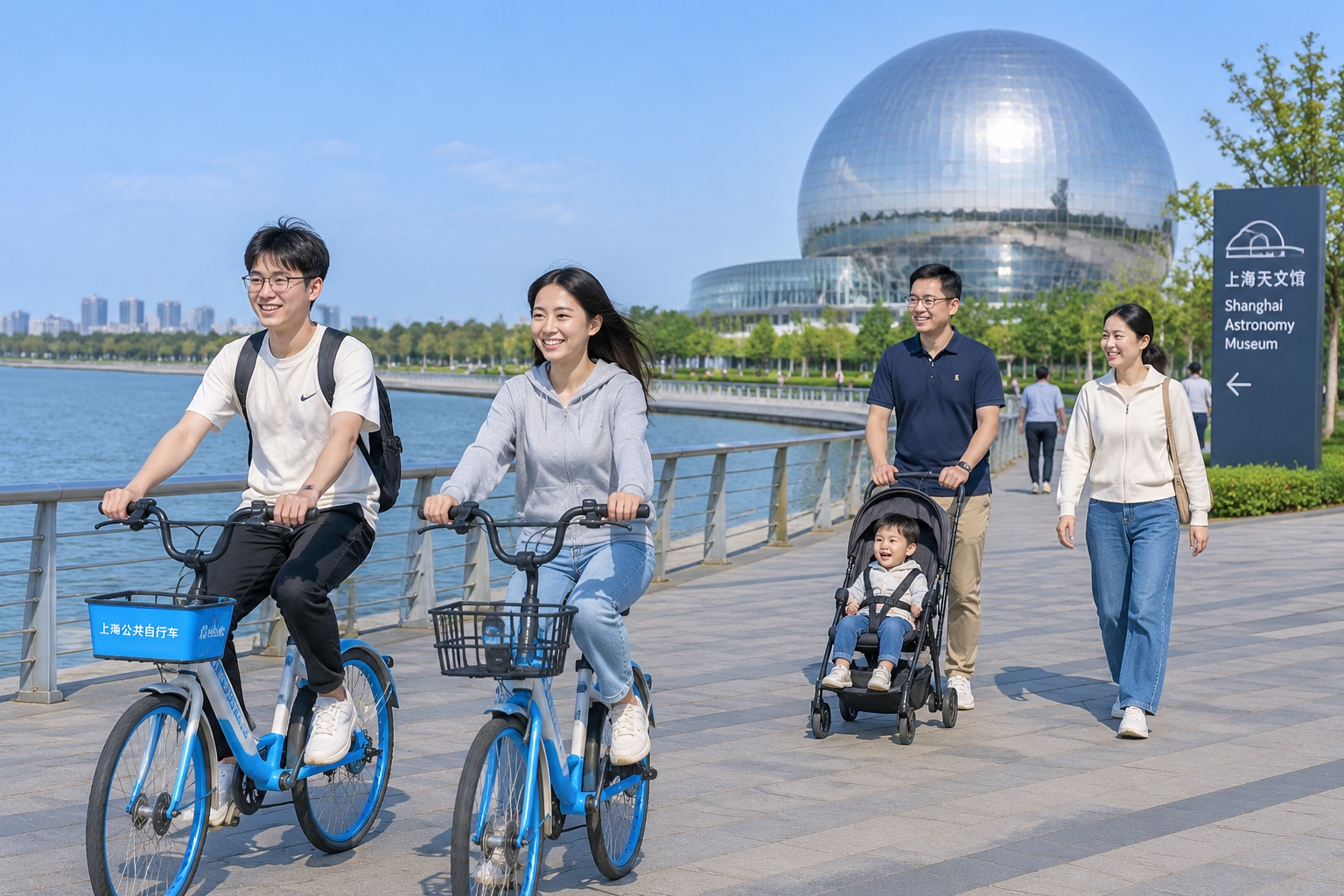
On weekends, Dishui Lake fills up with cyclists. The loop road is about 8 kilometers around, flat and car-light. Families push strollers. Teenagers on shared bikes race each other. The Shanghai Astronomy Museum — a stunning stainless-steel sphere that opened in 2021 — sits on the western shore, and the line for tickets on a Saturday can stretch around the block.
This is the part of Lingang that surprises visitors. It doesn’t feel like a factory town. It feels like a new city still figuring out what it wants to be, with wide sidewalks and too few coffee shops.
Yangshan Port: Where the Connection Becomes Visible
Thirty kilometers offshore, connected by the 32.5-kilometer Donghai Bridge, sits Yangshan Port. Its fourth-phase terminal, opened in 2017, is fully automated. Container cranes lift boxes off ships without a human in the cab. Driverless AGVs — flat, boxy robots — carry containers to the yard. The terminal can handle 6.3 million TEU a year with a fraction of the staff of a conventional port.
For a consumer in Europe or the US, this is the invisible end of the supply chain. For a freight forwarder in Lingang, it is a text message: “Your box loaded at 14:20.” The port runs 24 hours. The customs clearance for most goods happens electronically before the ship docks.
What’s notable is not just the robots. It’s the rules that let the robots work — a customs regime that allows goods to move between the port and the factory without repeated inspections, and a data system that lets companies track containers in real time.
The Honest Part
Lingang has real problems. The biggest is distance. Line 16 is crowded at rush hour and takes about an hour to reach central Shanghai. If your friends live in Xuhui or Jing’an, you will see them less.
The commercial scene is still thin. The new area has around 400,000 residents, but the planning target is 2.5 million by 2035. That gap shows up in empty storefronts and quiet streets after 9 p.m.
Institutional innovation also has boundaries. Many of Lingang’s policies are pilot-only. A rule that works here cannot simply be copied to another city — it needs national approval, and sometimes it conflicts with existing laws. Cross-border data flows, for example, are still limited to specific industry scenarios. Foreign investors sometimes find that the “one-stop” service works well for registration but less well for complex licensing.
“The reform is real, but it’s incremental,” says a foreign trade consultant who has advised clients in Lingang since 2020. “Don’t expect a different country. Expect a place where the paperwork is faster.”
Back to the Morning
Zhou Yu is back at his office by 9:30, coffee in hand. His company has grown to 14 people. He is hiring two more developers and looking at a small warehouse lease near the port.
He doesn’t talk about “institutional innovation.” He talks about time. The time he didn’t spend in a queue. The time he spent instead with a customer. The fact that his foreign partner could open a bank account in three days instead of three weeks.
That is the test, really. Not whether Lingang becomes a model for the world, but whether a 29-year-old on a scooter can get back to work before the fog lifts.