

A Switch in a City Kitchen
At 6:40 on a January evening, a rice cooker clicks on in a fifth-floor kitchen in Beijing. The window is fogged. A phone charges on the counter. Nothing about the scene feels like a story about energy.
Yet the electricity in that apartment may have begun several hundred kilometres north, on a grassland in Inner Mongolia, where a wind turbine with blade tips reaching about 200 metres was turning in the same cold air. Or it may have come from a solar farm in the Kubuqi Desert, where rows of panels stand on sand that was long considered useless.
Inner Mongolia is not the first place outsiders associate with modern China. It is known for grasslands, coal and distance. That is changing. In 2024 the region became the first province-level area in China to pass 100 gigawatts of installed new energy capacity, overwhelmingly wind and solar. Its wind base has been the country’s largest for years. The land is enormous — about 1.18 million square kilometres, roughly three times the size of Germany — and the population is only around 24 million. Very few people live near the wind and the sun.
For readers outside China, the interesting question is not the size of the numbers. It is what this looks like on the ground, how the power reaches the cities that use it, and what actually changes for the people who live among the machines.
What You Can See on the Grassland
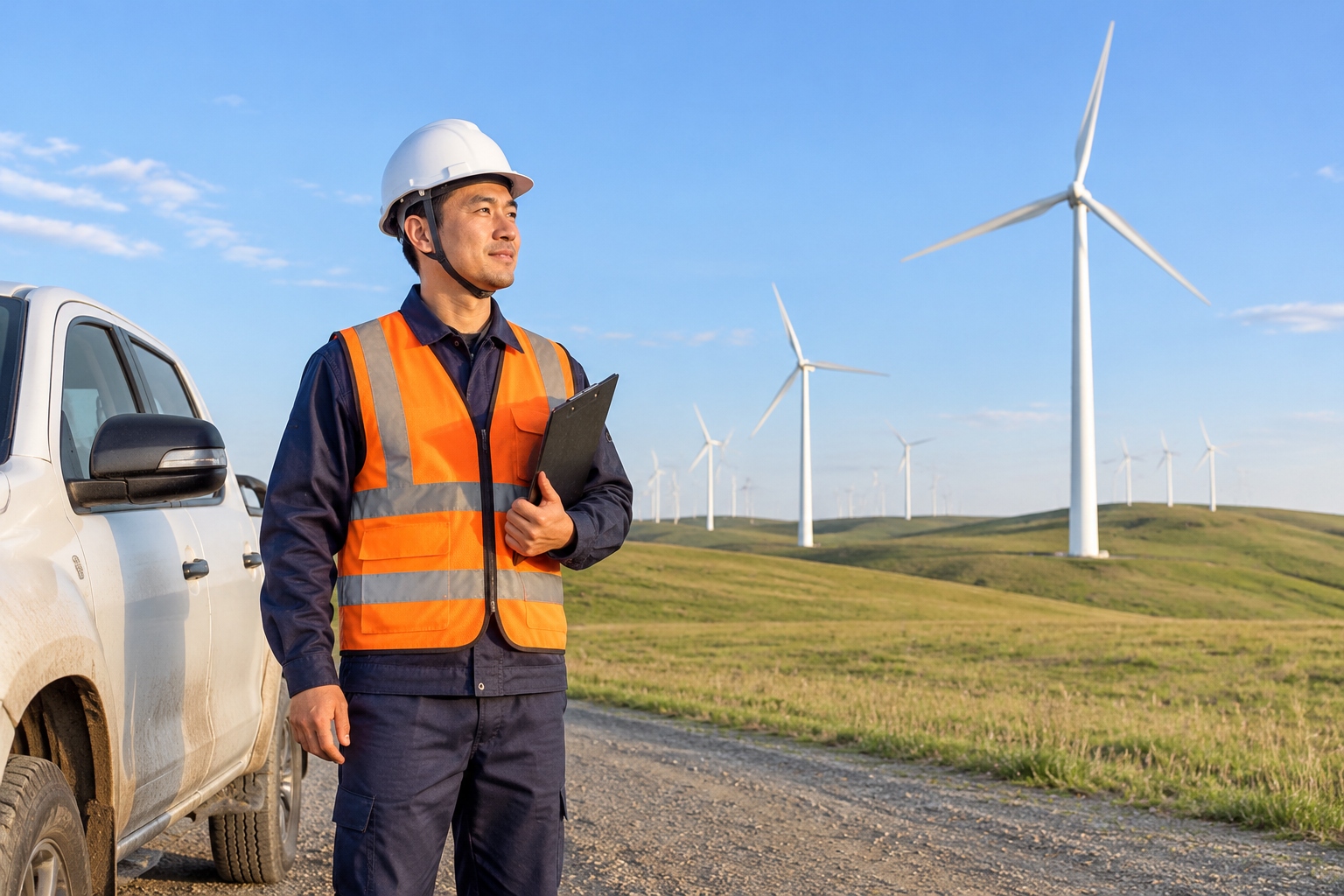
Drive north from Ulanqab, a city in central Inner Mongolia, and the landscape opens into low hills and pale grass. The turbines appear before you notice the roads that serve them: white towers in long rows, each with three blades turning slowly or standing still. Up close, the scale is different from the photographs. A modern onshore turbine can stand 100 to 120 metres at the hub, with blades 60 to 70 metres long. A 5-megawatt machine running at full output for one hour produces 5,000 kilowatt-hours — roughly what one or two Chinese urban households use in a year.
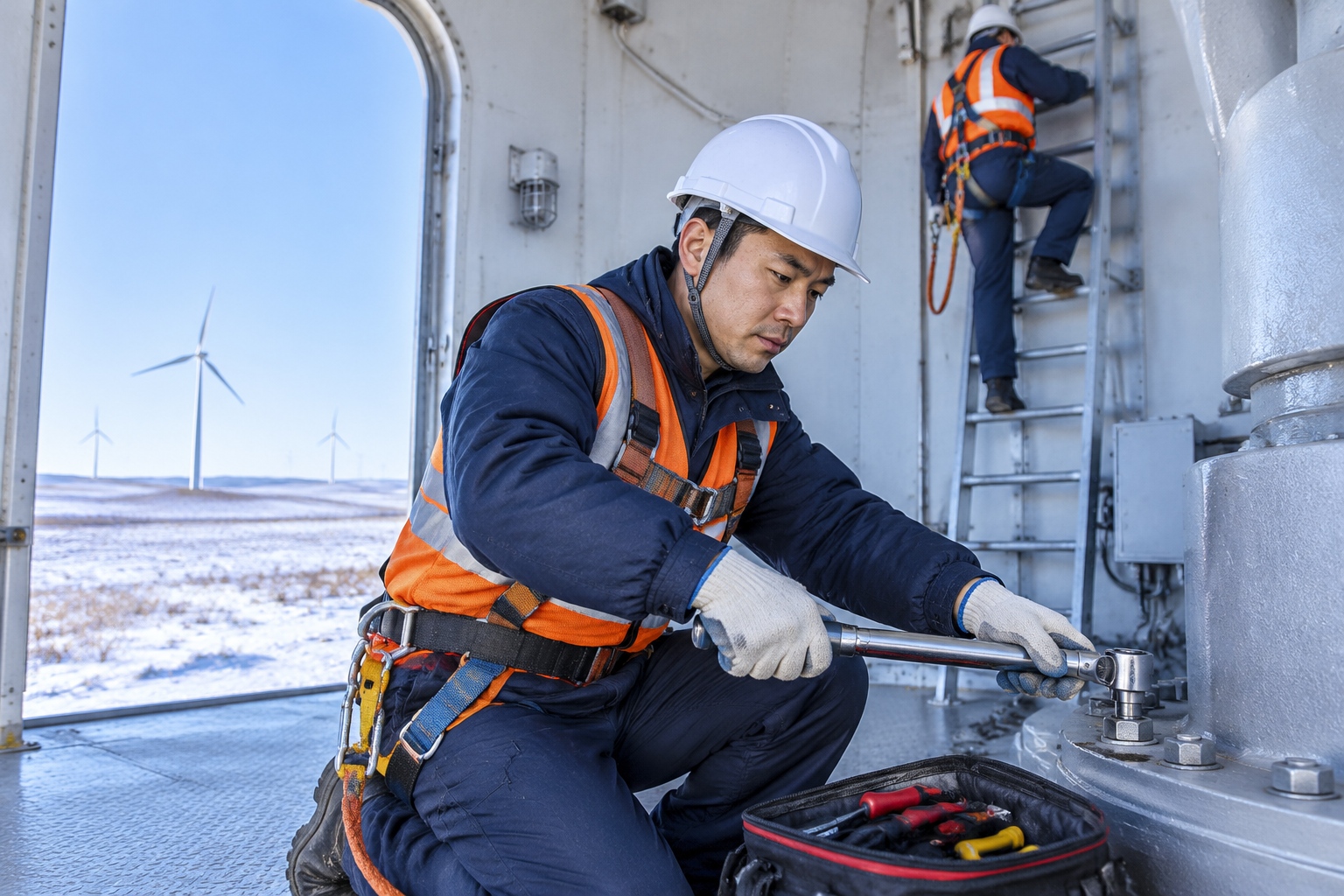
Ride along with a maintenance crew and you meet technicians like Li Wei, 36. His day starts at seven with a briefing and a pickup truck loaded with tools. He checks three or four turbines, climbing the steel ladder inside the tower, stopping at the gearbox to check oil levels, bolt torque and blade cracks. In winter the temperature can sit at minus 20 Celsius; phones lose their charge, and metal sticks to gloves. The work is not romantic. It is repetitive, physical and highly skilled.
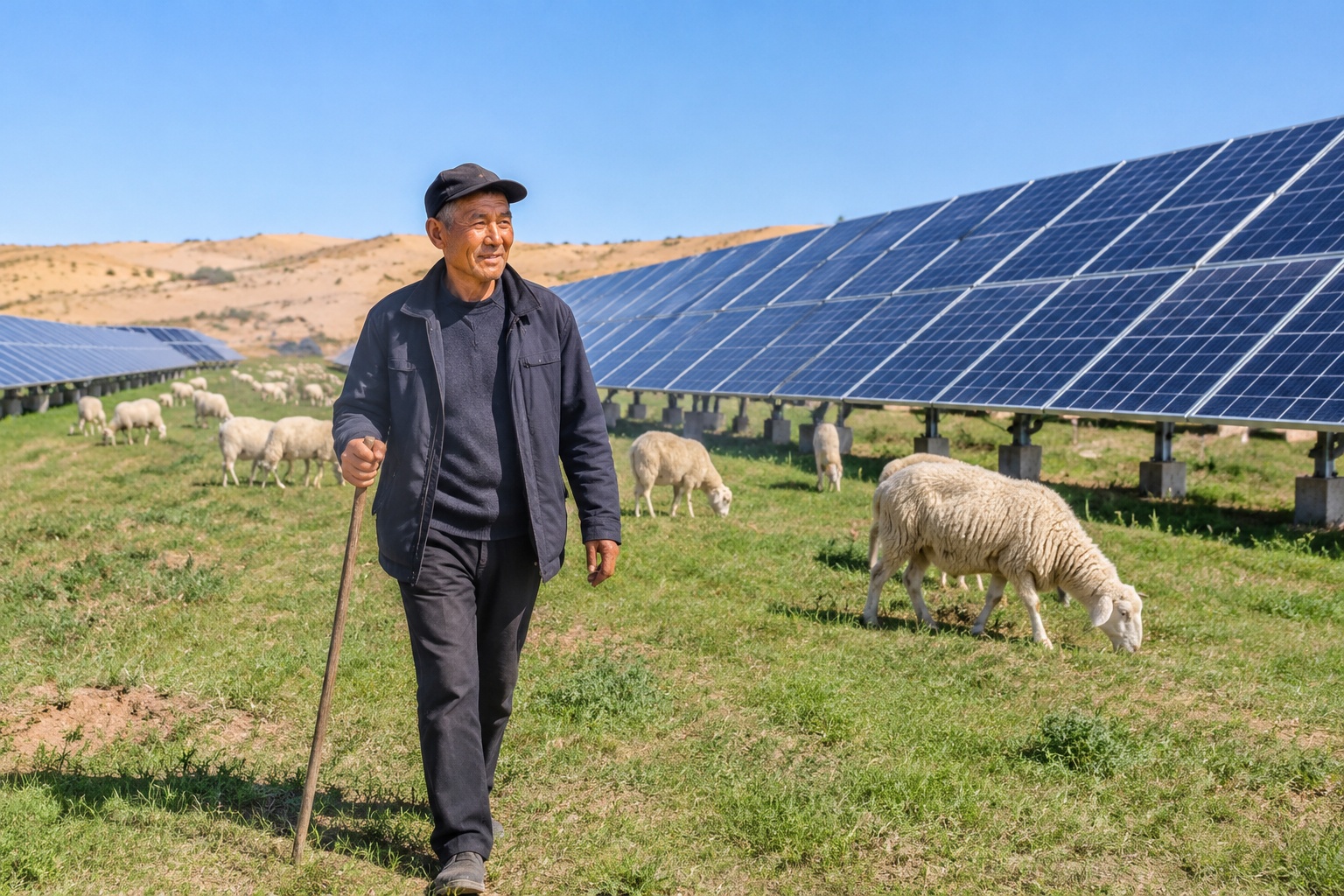
Solar looks different. In the Kubuqi Desert, panel arrays are laid in long rows across the sand. Between the rows, grass is planted and sheep are brought in to graze. The sheep keep the vegetation down, which reduces fire risk and the cost of mowing; the panels shade the soil and reduce evaporation. Herders walk along the edge of the arrays, and the occasional panel is washed with water or dry-brushed to keep dust off the glass. This is not a postcard of nature untouched. It is a managed landscape, with people, animals and machines sharing the same ground.
The Journey: Step Up, Send Out, Balance
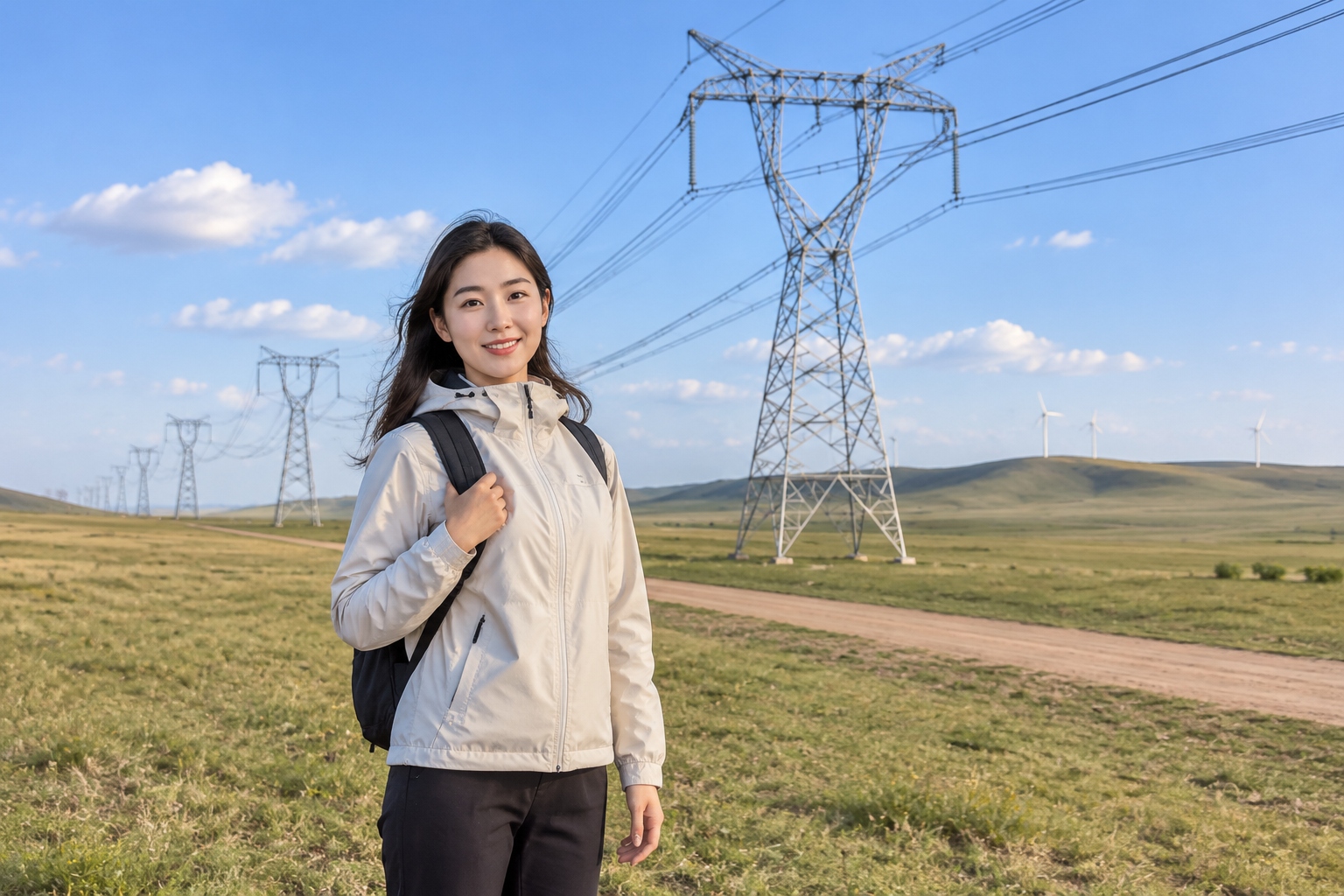
A wind farm is not a power plant in the old sense. Its output rises and falls with the weather, and it is usually far from the factories and apartments that need the electricity. So the power has to be collected, raised to a much higher voltage, and moved long distances.
At the site, cables gather electricity from each turbine at around 35 kilovolts and feed it to a substation, where transformers step it up to 220 or 500 kilovolts. From there it can enter the ultra-high-voltage network: 1,000-kilovolt alternating-current lines such as the Mengxi–Tianjin South link, or 800-kilovolt direct-current lines such as Zhalute–Qingzhou. A single ±800-kilovolt DC line can carry around 8 gigawatts, roughly the output of eight large coal plants. The analogy is simple: low-voltage lines are local roads, ultra-high-voltage lines are motorways. Moving power at high voltage reduces losses and makes long distances economical.
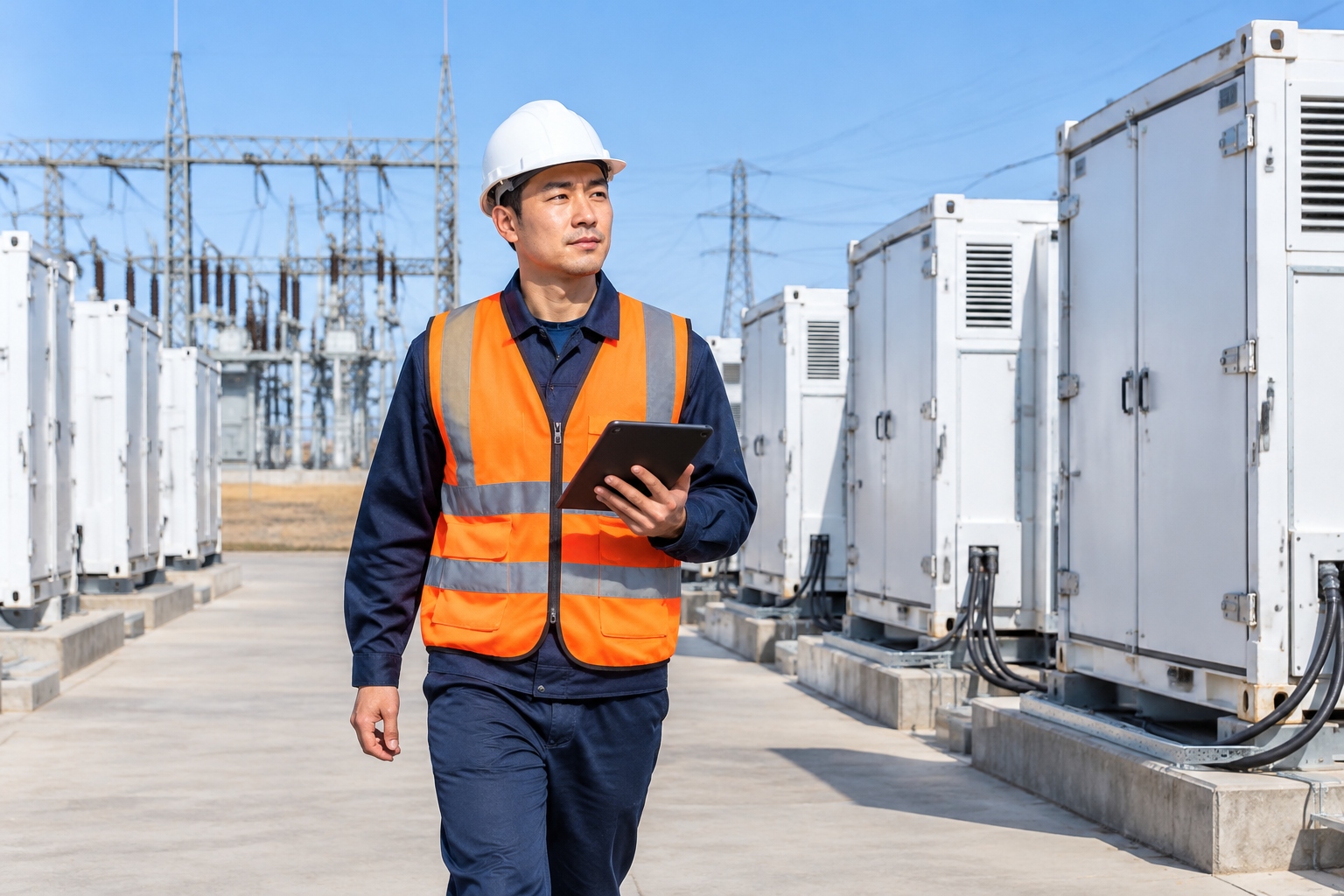
Then comes the hardest part, which is invisible to most users. Electricity has to be balanced second by second. Grid dispatchers forecast wind and solar output, schedule coal and gas plants to ramp up and down, and call on storage. Pumped hydro stations, including a 1.2-gigawatt plant near Hohhot, pump water uphill when there is surplus power and release it when demand peaks. Battery containers beside substations do a similar job on a smaller scale. The industry phrase for the whole chain is ‘generate, transmit, consume’. If any link is weak, the others do not help.
What It Means for Herders and Small Towns
Money arrives in several ways. Wind and solar projects lease land from herders and villages. The footprint of a turbine is small, but access roads, collector lines and tower foundations take up grazing land, and rents are paid annually. The amounts vary and are rarely enough to make anyone rich, but they are stable. Construction brings temporary jobs; operation brings a smaller number of permanent ones.
Those permanent jobs matter more than the headline figures suggest. A wind farm may employ only 20 to 40 people, and a solar plant fewer, because much of the operation is remote and automated. But the jobs require certificates, training and discipline. Local governments run short courses for electricians, safety staff and panel cleaners. Wages for technicians in the region often fall in the range of 5,000 to 7,000 yuan a month, which is above what many local service jobs pay, though below what the same worker could earn in a big city.
Some young people come back. A 28-year-old from Siziwang Banner, south of Ulanqab, told a local newspaper that he returned from Hohhot to work in a solar plant’s monitoring room, closer to his parents and his family’s sheep. Not everyone returns, and not everyone benefits. The better-paid engineering jobs often go to people from outside. Herders who lose access to parts of their grazing land sometimes see the trade-off differently from those who receive rent.
Roads and mobile coverage have improved. Service roads built for turbines become shortcuts for herders in winter; telecom towers installed for the projects bring better phone signals. These are side effects, not the purpose of the projects, but they change daily life in places where distances are long.
The Parts That Don’t Work Smoothly
Wind does not blow on schedule. In Inner Mongolia, the strongest winds often arrive on winter nights, when demand is relatively low. Solar output peaks at midday and falls in the evening. When the grid cannot absorb the power, turbines are curtailed — stopped or slowed down — and the energy is lost. Nationally, China’s wind utilisation rate was around 97% in 2023, but local and seasonal curtailment still happens.
The reasons are not mysterious. Local industry is limited, so most power has to be sent out. Ultra-high-voltage lines take years to plan and build, and cost billions. Storage is improving but still expensive, especially for long periods. Pumped hydro needs mountains and water; batteries are better for short shifts. Coal plants are being retrofitted to run more flexibly, but they still provide the backup that keeps the grid stable.
There are ecological costs too. Turbines kill birds and bats, and change the landscape for people who value open views. Solar farms alter the ground beneath them: panels change temperature and moisture, and washing dust off glass uses water in a dry region. The Kubuqi model of grazing between panels is promising, but it depends on rainfall, soil and management. It is not a universal solution.
Prices add another layer of uncertainty. New wind and solar projects now sell much of their output through market contracts rather than fixed tariffs. Prices move. Green certificates and direct green power trading give developers extra income, but the volumes are still small relative to the total.
Why a City Dweller Should Care
Most urban residents never see this system. They notice a blackout, and there is none. The connection is indirect but real. Electric buses and taxis charge on power that increasingly includes wind and solar. Factories that export to Europe are buying green power to lower the carbon footprint of their products, especially as the EU’s carbon border adjustment mechanism phases in. Multinationals such as Apple and BMW require their Chinese suppliers to use more renewable electricity. A wind farm in Inner Mongolia can therefore end up in a smartphone or a car sold in another country.
For readers abroad, the comparison is useful. German households pay roughly 0.40 euros per kilowatt-hour, and American households around 0.17 dollars. Chinese households pay about 0.5 to 0.6 yuan, or roughly 0.07 to 0.08 dollars, with commercial and industrial users paying more. The gap is not only a market outcome; it reflects policy choices and cross-subsidies. China’s grid is state-owned and dispatch is centralised, which makes it easier to build lines quickly, though it also means prices do not fully reflect costs. The model is different from Europe’s, and it comes with its own trade-offs.

Back to the Kitchen Light
By nine o’clock, the rice cooker is off and the kitchen light is still on. Out on the grassland, the turbines keep turning, their red lights blinking through the dark. Between them and the kitchen is a chain of steel, copper, software and people: technicians on ladders, dispatchers in control rooms, herders who signed land contracts, engineers who built lines across the steppe.
Green power is often described in slogans. Seen from the ground, it is less tidy and more concrete. It is a machine that needs maintenance, a line that needs a corridor, a market that needs rules, a landscape that carries both benefits and costs. The change is real because it has become ordinary — a default part of how the country keeps its lights on, rather than a label on a poster.