
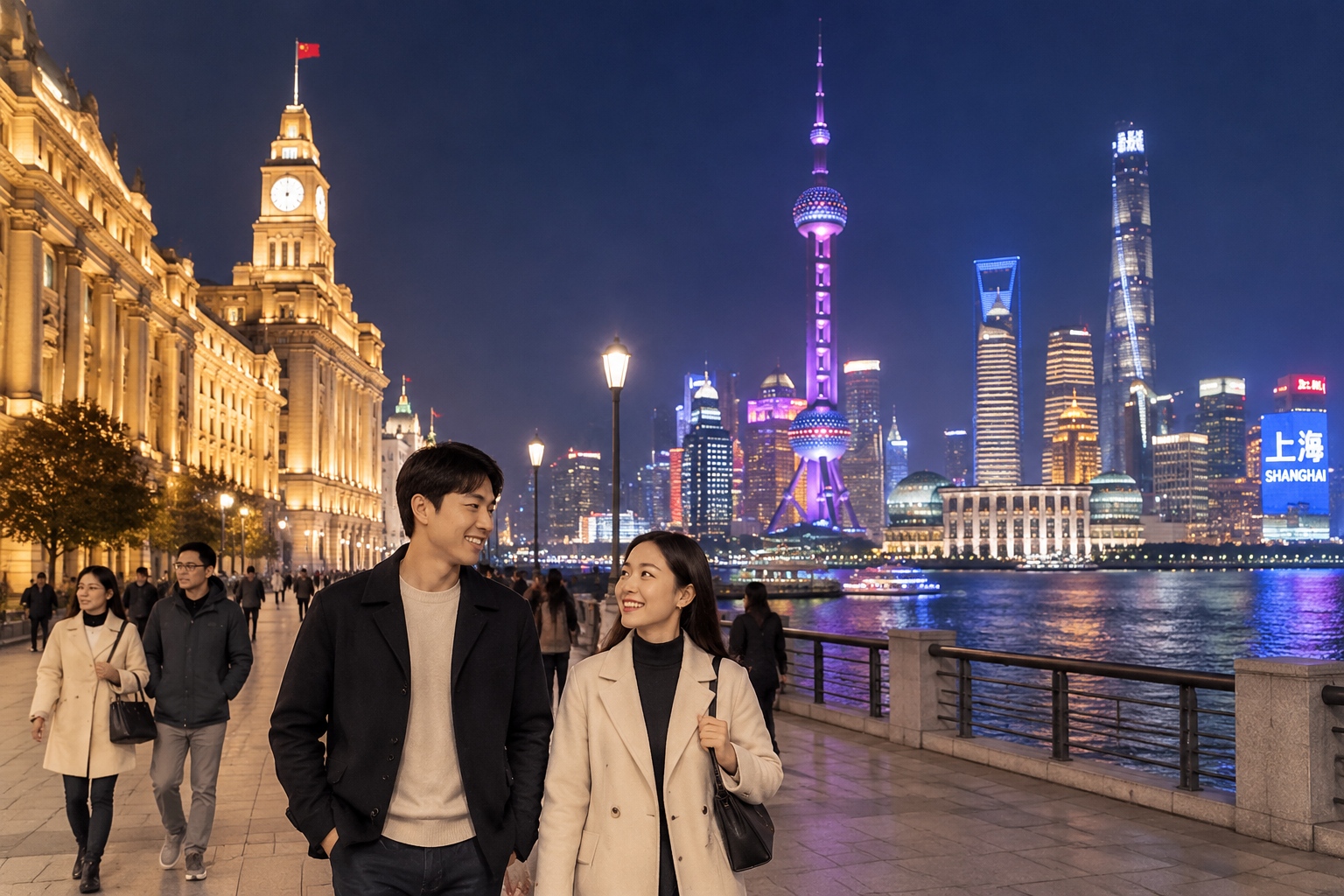

Welcome to the cities of 2050
Shanghai, Chongqing, Shenzhen — with an optional Hong Kong stop. Nine days, and a chance to redefine what the word “China” means to you.
If your mental image of China is still the Great Wall, kung fu and bicycles, this route may make you doubt your memory by day three.
Six scenes to start with
- 1 a.m. on the Bund: 1920s stone banks on your left, a tower more than 600 meters tall on your right.
- A light-rail train in Chongqing passes through the sixth floor of a residential building. The noodle shop owner downstairs does not even look up.
- Hongya Cave at night: eleven floors of stilt houses light up like a golden building set on fire.
- The maglev slips past farmland at more than 400 km/h. Eight minutes later you are at Pudong Airport.
- In Shenzhen, a drone fleet rises into the sky, hundreds of lights forming a whale, then scattering into a line of text.
- Red hotpot broth bubbles by the river. At the next table, people order and pay by scanning a QR code, without saying a word.
These six scenes are not future concepts. They happen every night.
Three reality checks
The first: you think China is “ancient.”
Then you see Shanghai Tower at 632 meters — China’s tallest building — with elevators rising 20 meters per second, enough to make your ears pop. You see Lujiazui at night like a lit circuit board. You also see art museums, boutiques and craft beer bars that feel no different from any world city, only newer, faster and bigger.
The second: you think a city should be flat.
Chongqing takes that idea apart. Roads are layered: you think you are on the ground floor, walk out, and you are on the 22nd. Your navigation says go straight 200 meters — vertically. A monorail passes through a residential building. Interchanges have five levels, each leading somewhere different. There is no second city like this; it is not built on flat land, it is folded.
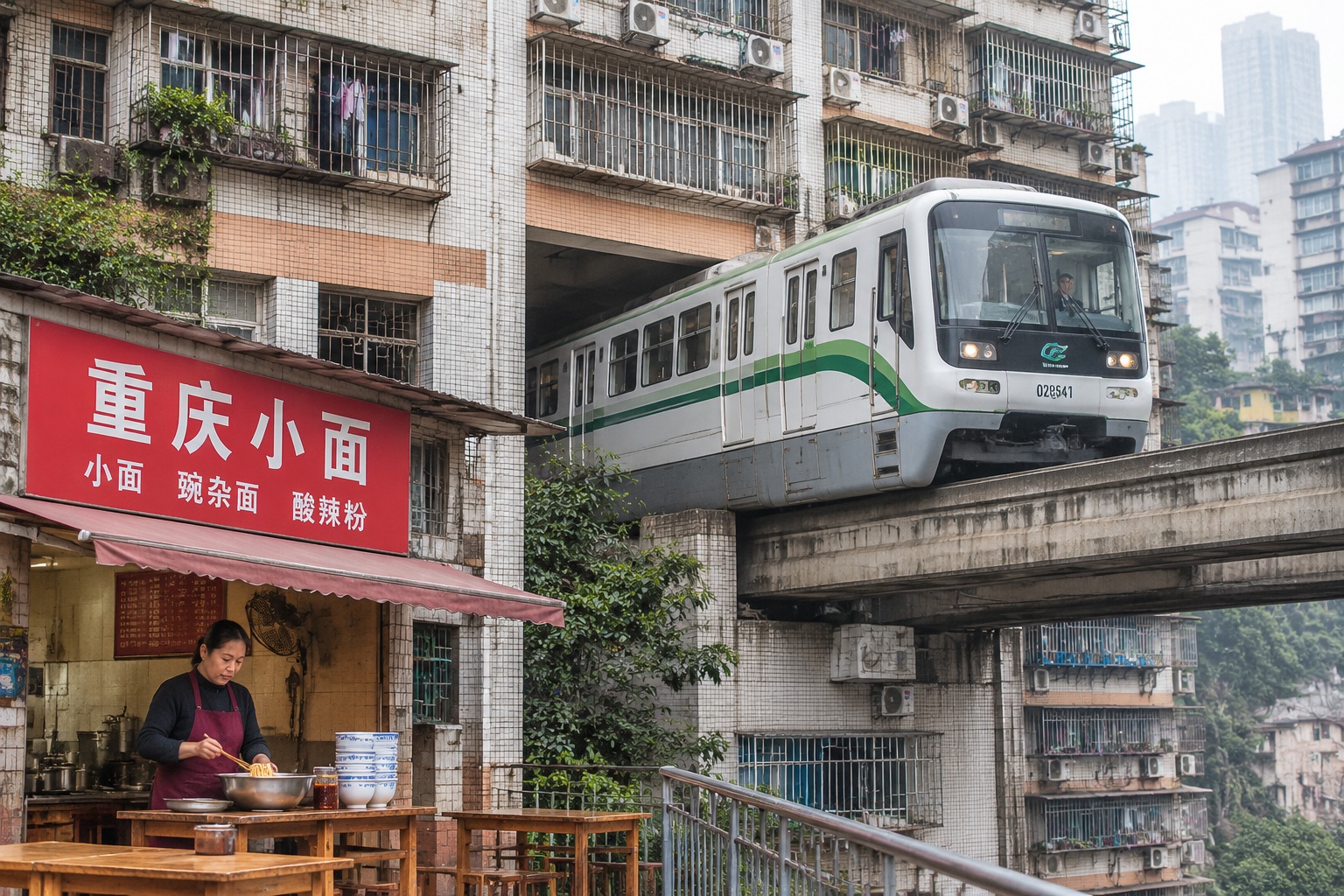
In Chongqing, the monorail does not avoid the apartment block. It goes through it.
The third: you think “the future” is still ten years away.
QR payments, unmanned delivery, robotaxis and face-scan station entry are not demo projects in China. They are daily life. In parts of Shenzhen you can hail a car with no driver; takeout can arrive at an office rooftop by drone; convenience stores stay open at 3 a.m. because people really do come at 3 a.m.
The best part of this route: it does not ask you to “visit” the future. It lets you live inside it for nine days.
Nine days, from 1930 to 2050
Day 1 — Shanghai: land, then look at the lights
Go straight to the Bund in the evening and walk from north to south: Waibaidu Bridge, the green copper roof of the Peace Hotel, the clock on the Customs House. Then look across the river at the Lujiazui light show, when whole blocks of towers change color together. Do not plan anything else for this night.
Day 2 — Shanghai: speed and slow streets
In the morning, ride the maglev to Pudong Airport and back. Eight minutes, a top speed of 431 km/h — the cheapest “future experience” on this route.
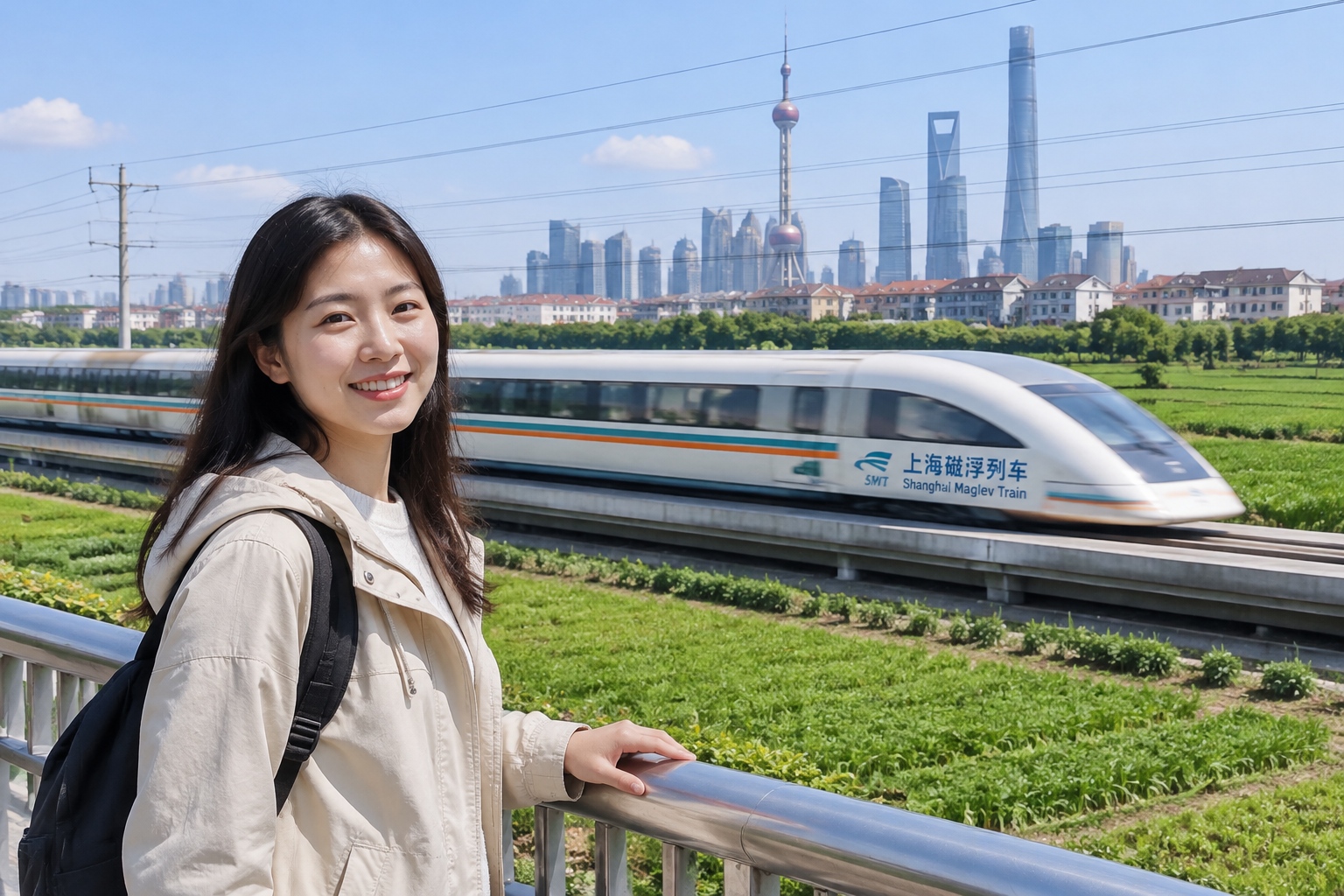
Eight minutes on the maglev can feel like a small preview of the future.
In the afternoon, go up one of the Lujiazui trio — Shanghai Tower, Shanghai World Financial Center or Jin Mao Tower — and look down at the tops of the other two. In the early evening, see an exhibition at West Bund or M50.
Day 3 — Shanghai: old city below, future above
Morning at Yu Garden: a Ming dynasty garden, the zigzag bridge, xiaolongbao for lunch. In the afternoon, disappear into the plane-tree streets around Wukang Road and Anfu Road: old villas, independent coffee shops, bookstores. Within one kilometer you can drink at three different cafés. At night, find a rooftop bar and watch the lights spread from your feet to the horizon.
Day 4 — Chongqing: a different set of physics
Fly to Chongqing, about 2.5 hours. In the late afternoon, go to Hongya Cave: eleven floors of stilt houses hang on the cliff, and after dark the whole site turns gold. The best viewpoint is from Qiansimen Bridge on the opposite bank. Foreign visitors often call it a real-life Spirited Away.
Day 5 — Chongqing: through buildings, across the river, into hotpot
In the morning, go to Liziba and wait for Line 2 to pass through the middle of a residential building. The building came first; the track was added later. Residents still live there. Then take the Yangtze River Cableway across the water. At night, eat hotpot along Nanbin Road: beef tallow broth, tripe dipped seven times up and down, duck intestine, crunchy aorta, and a cold beer.
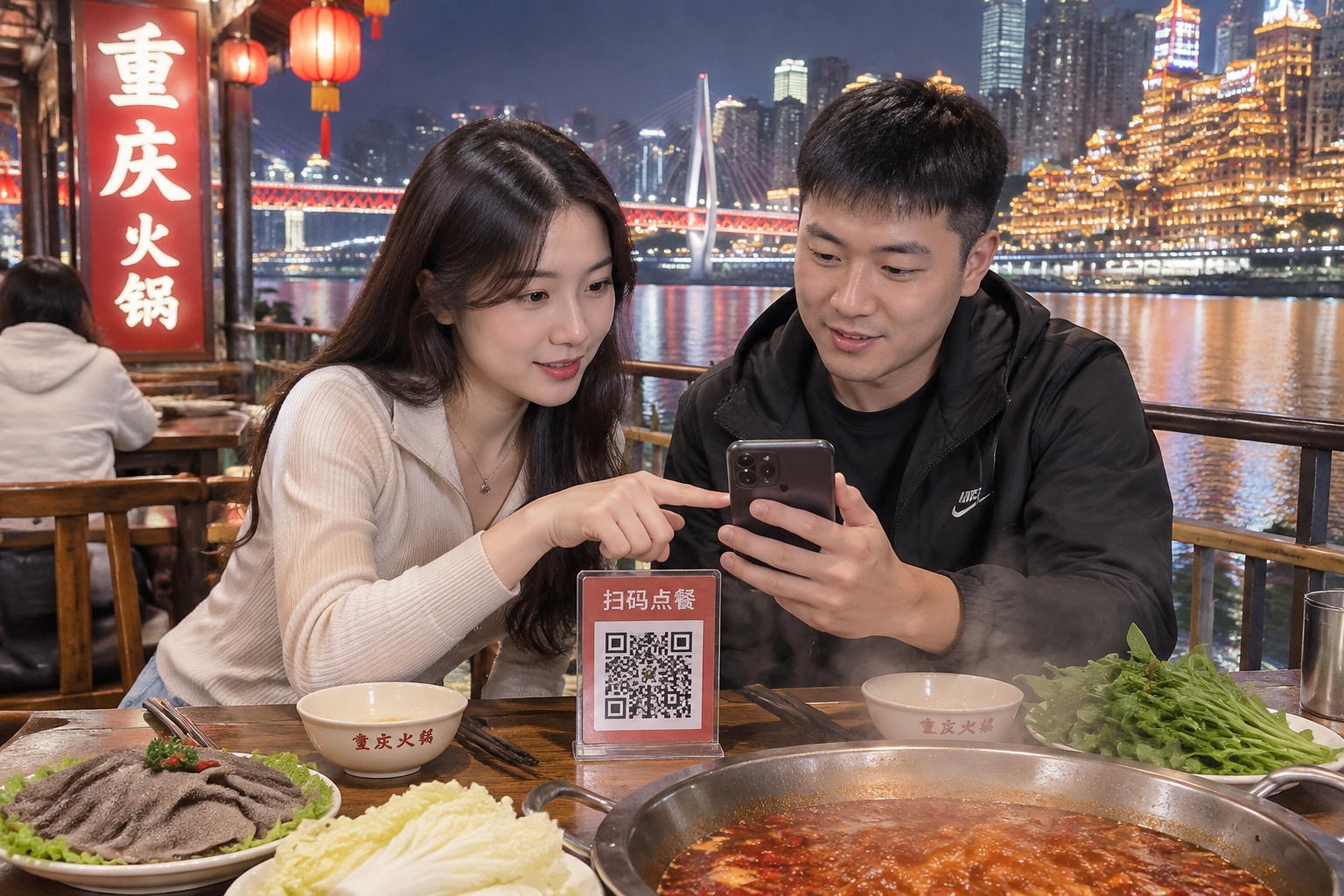
Hotpot, river air and a QR code: old habits and new payment systems share the same table.
Day 6 — Chongqing: maze and night cruise
Morning at Ciqikou old town, quieter early in the day: stone slabs, twisted dough snacks, the old wharf. In the afternoon, walk the mountain city trails and choose unnamed stairways. The pleasure of Chongqing is getting slightly lost: you think you are in a dead end, turn a corner, find an elevator, press a button, and come out on a rooftop street. At night, take a two-river cruise and look up at the city from the water.
Day 7 — Shenzhen: a city of forty years
Fly to Shenzhen, about 2 hours. Forty-odd years ago it was a fishing village; today it is one of the hardware hearts of the world. In the afternoon, look at the headquarters towers in Nanshan Science Park. At night, go to Shenzhen Bay or Happy Harbor — on weekends there are often drone shows or light displays, though schedules are not fixed, so ask before you go.
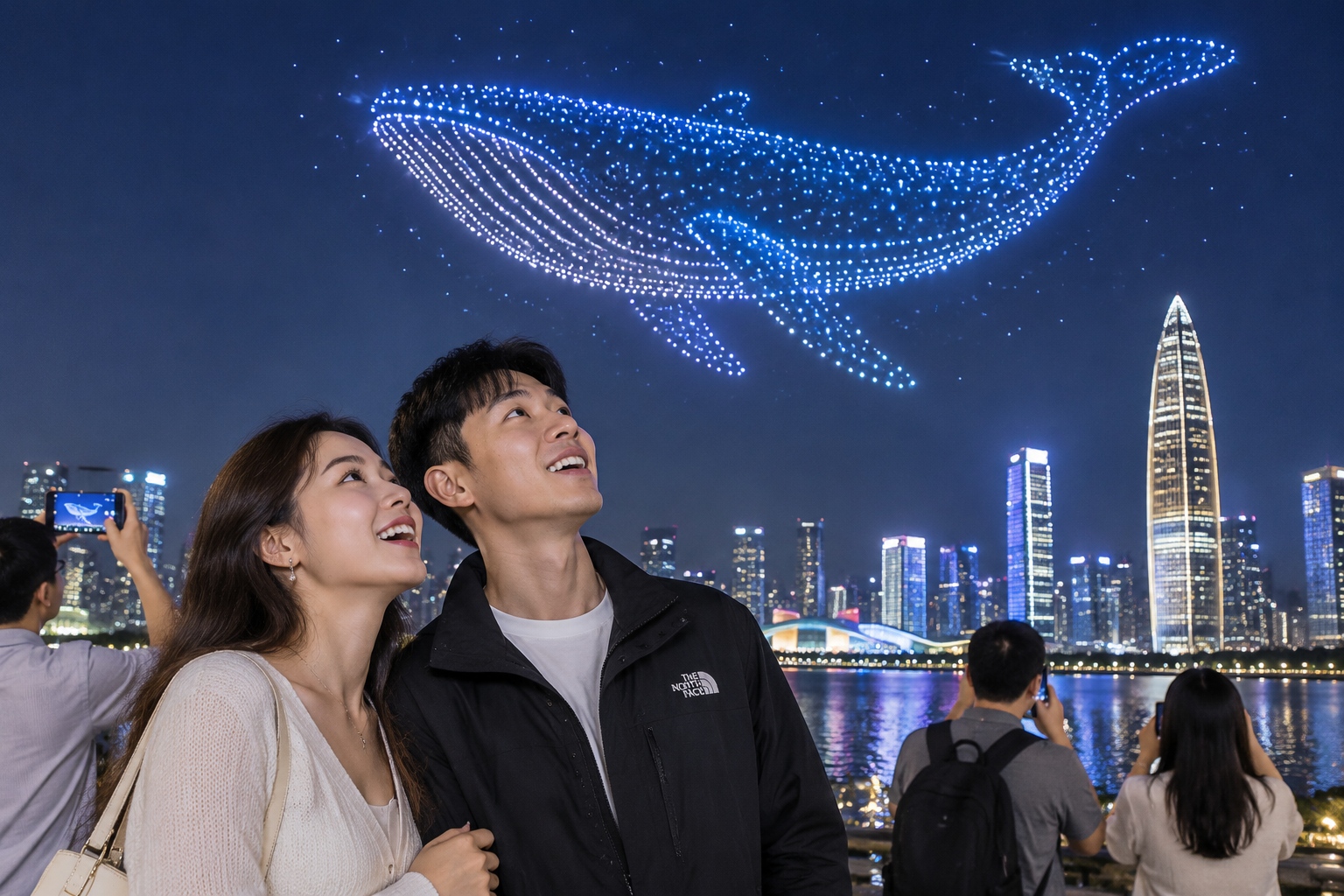
In Shenzhen, a drone show can turn the night sky into a temporary screen.
Day 8 — Shenzhen: buy the world inside one building
Huaqiangbei: inside one mall you can find every part of a phone, and behind the counters people are soldering circuit boards. In the afternoon, cycle along Shenzhen Bay. Hong Kong is just across the water.
Day 9 — Hong Kong, optional: fifteen minutes, another system
From Futian or Shenzhen North, the high-speed train to West Kowloon takes just over ten minutes. Victoria Harbour at night, the Star Ferry, the slopes of Central and its cha chaan tengs — one day is enough to feel what “one country, two systems” means in concrete terms. You can also leave directly from Shenzhen Airport.
A practical future-city handbook
- Your phone is your wallet. Alipay and WeChat Pay can link foreign bank cards for buying things, taking the metro and renting power banks. You may finish nine days without using cash once.
- Taxis and metro. Didi has an English interface and shows prices. Metro stations have English names, and you scan a code to enter.
- Robotaxis. Commercial driverless taxis already operate in parts of Shenzhen, Beijing and Wuhan, and can be booked in app. If you want to try one, say so in advance so the route can include an area where they are available.
- Internet and language. Hotel Wi-Fi is usually fast; bring international roaming or a local data card. Metro, airport and major attraction signs are mostly in English. For ordering food, a translation app plus photos is enough.
Who this route suits
It suits people who are hooked on a sense of the future; people who love cities, architecture, night views and tech products; people who want a steady stream of things to post on social media; and returning visitors who have seen China once and want to see another side.
It does not suit people who want quiet nature; people who dislike crowds, queues and noise; or people with zero interest in popular photo spots. If that is you, some places may feel overhyped.
What you take home
Not “I have seen China,” but “I lived in China for nine days, and I realized my imagination had stopped twenty years ago.”
More specifically: the three seconds when the Bund lights came on and everyone around you went quiet; the automatic tilt of your head when the monorail came out of the building above you; the smell of hotpot oil drifting down a whole street; and the moment you understand that all of this in Shenzhen did not exist forty years ago.
Nine days, three cities, and a country you will no longer be able to see with old eyes.