
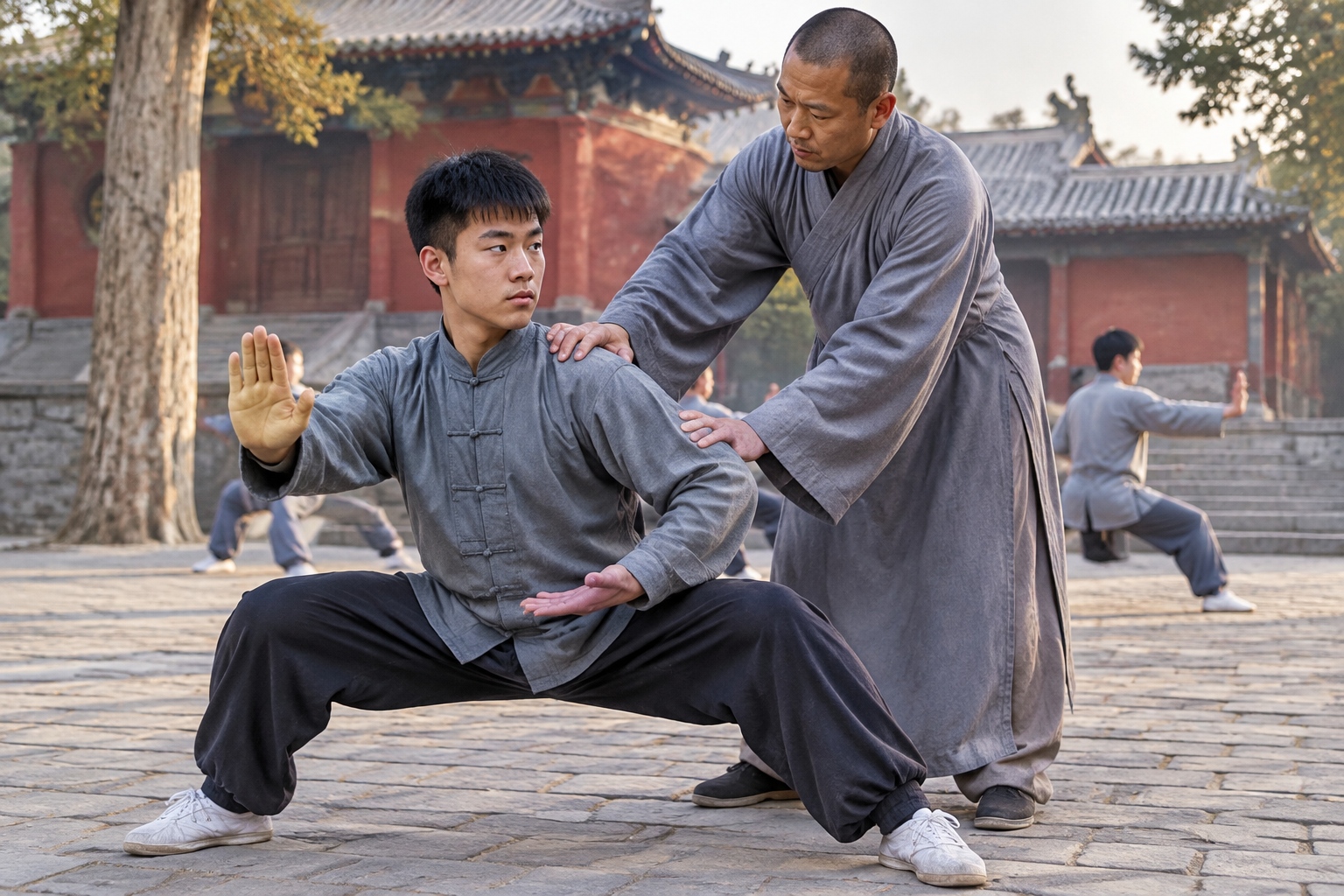

At Shaolin, the floor tells the first story
At Shaolin Temple, most visitors stop at the stone steps and take the same photograph. Walk farther, into Thousand Buddha Hall, and look down. The floor has 48 shallow pits, worn into hard brick by Qing dynasty martial monks. You do not need to know kung fu to read them. A body repeated the same movement for years, and the building gave way.
That is the idea behind this eight-day route through central China: Zhengzhou, Dengfeng, Luoyang, Kaifeng, Huashan. Seven movements — look, stand, walk, look up, join palms, sit, climb. The places are famous, but the point is not to stand outside the railing. The point is to use your own body at each stop, badly and honestly.
Three symbols, one connected line
Kung fu, Buddhism and ancient capitals are three of China’s most recognizable exports. Here they are not separate postcards. Zen moved from White Horse Temple in Luoyang to Shaolin. Behind White Horse Temple lies the Han-Wei Luoyang city site; farther east is Bianliang, the Northern Song capital that is now Kaifeng. High-speed rail links are short: the longest transfer is about an hour and a half.
Two things are less common. You can learn a little martial arts, and you can sit in meditation — not watch, but stand in horse stance and see what your shoulders do. At Longmen, Chinese stone carving reaches a high point and, in a sense, stops there. You look up at a face designed to look back.
Prologue: Zhengzhou, seeing the body on old brick
Day 1 | Arrival and Henan Museum
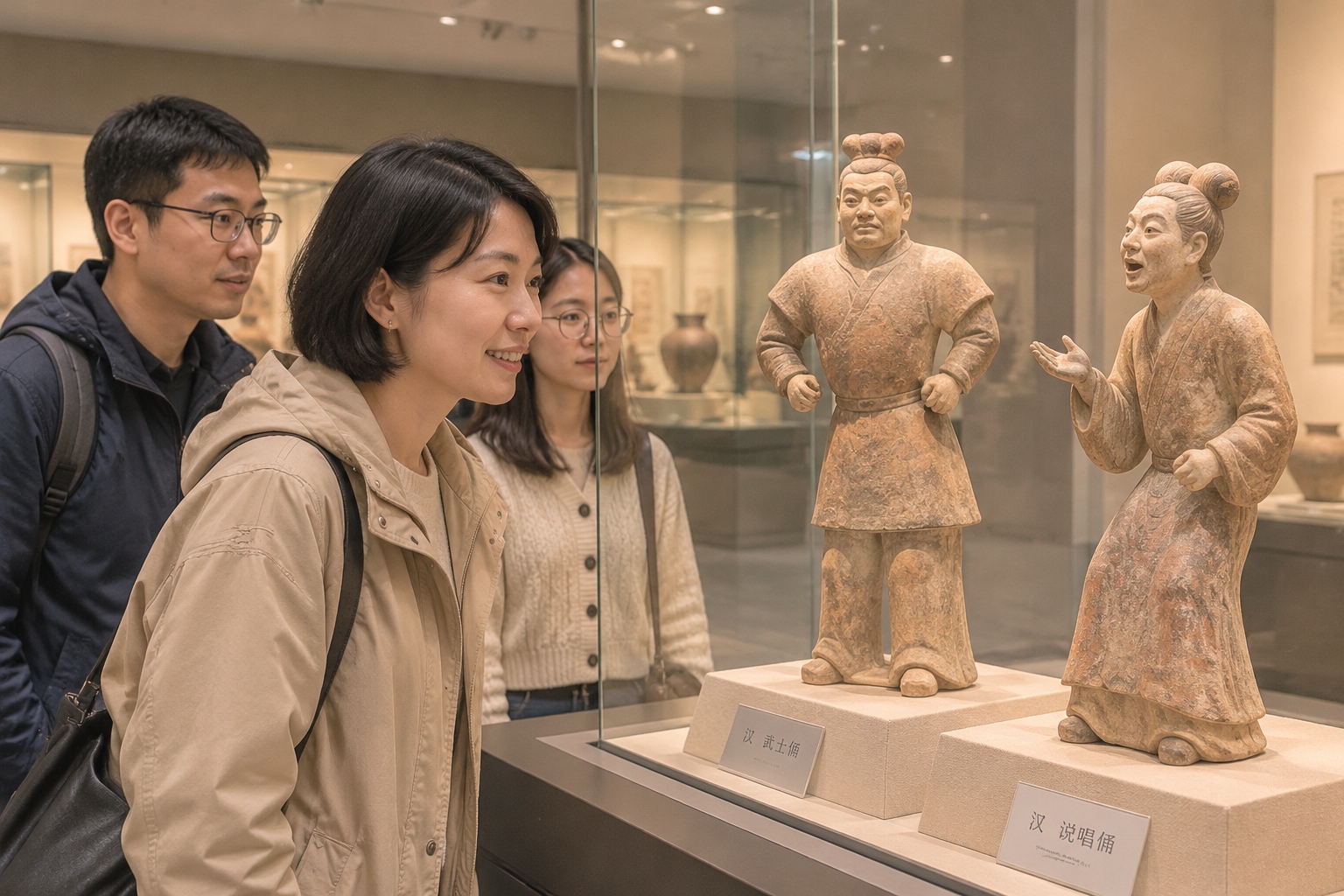
Start at the Henan Museum in Zhengzhou. The Jiahu bone flute is about the length of a chopstick, made from a crane’s wing bone with seven holes. It is eight or nine thousand years old and can still be played. Nearby, Han dynasty pottery figures show bodies in motion: a warrior has heavy shoulders; a storyteller has a collapsed waist. The postures the teacher will ask you to hold tomorrow were already being held two thousand years ago.
For dinner, eat mutton stewed noodles, hui mian, with a clove of sweet garlic. It is plain and filling, and it sets the tone. This is not a tasting menu of dynasties. It is ordinary meals and physical reminders.
1. Look: Shaolin Temple
Day 2 | Dengfeng, Shaolin Temple and Pagoda Forest
Take a car from Zhengzhou to Dengfeng, about an hour and a half. From the parking lot to the gate you pass a long commercial street; arrive an hour early and the stone steps are still empty.
Inside, the worn floor of Thousand Buddha Hall is the first real lesson. West of the temple, the Pagoda Forest holds more than 240 pagodas from the Tang through Qing dynasties, the largest of its kind in China. They are not arranged like a museum. They are a record of generations of monks, each with a different shape and story.
In the afternoon, watch a martial arts performance. Times change by season, so check the board at the entrance. Watch two details: the performers’ center of gravity barely rises and falls, and when they land, the whole foot presses down. The next day you will discover how hard that is.
2. Stand: the first minute of horse stance
Day 3 morning | Shaolin martial arts class
The class begins with a fist-and-palm salute: left palm over right fist, palms inward. The old explanation is “stop the spear” — I have a fist, but I put it away. Then comes horse stance. Knees bend, but not past the toes; thighs come close to horizontal.
The first minute feels like nothing. The second minute, your legs shake. The teacher does not shout “hold on.” He taps your shoulder and says, “Relax your shoulders.” You thought your legs were holding you up. Actually your shoulders are fighting the whole thing.
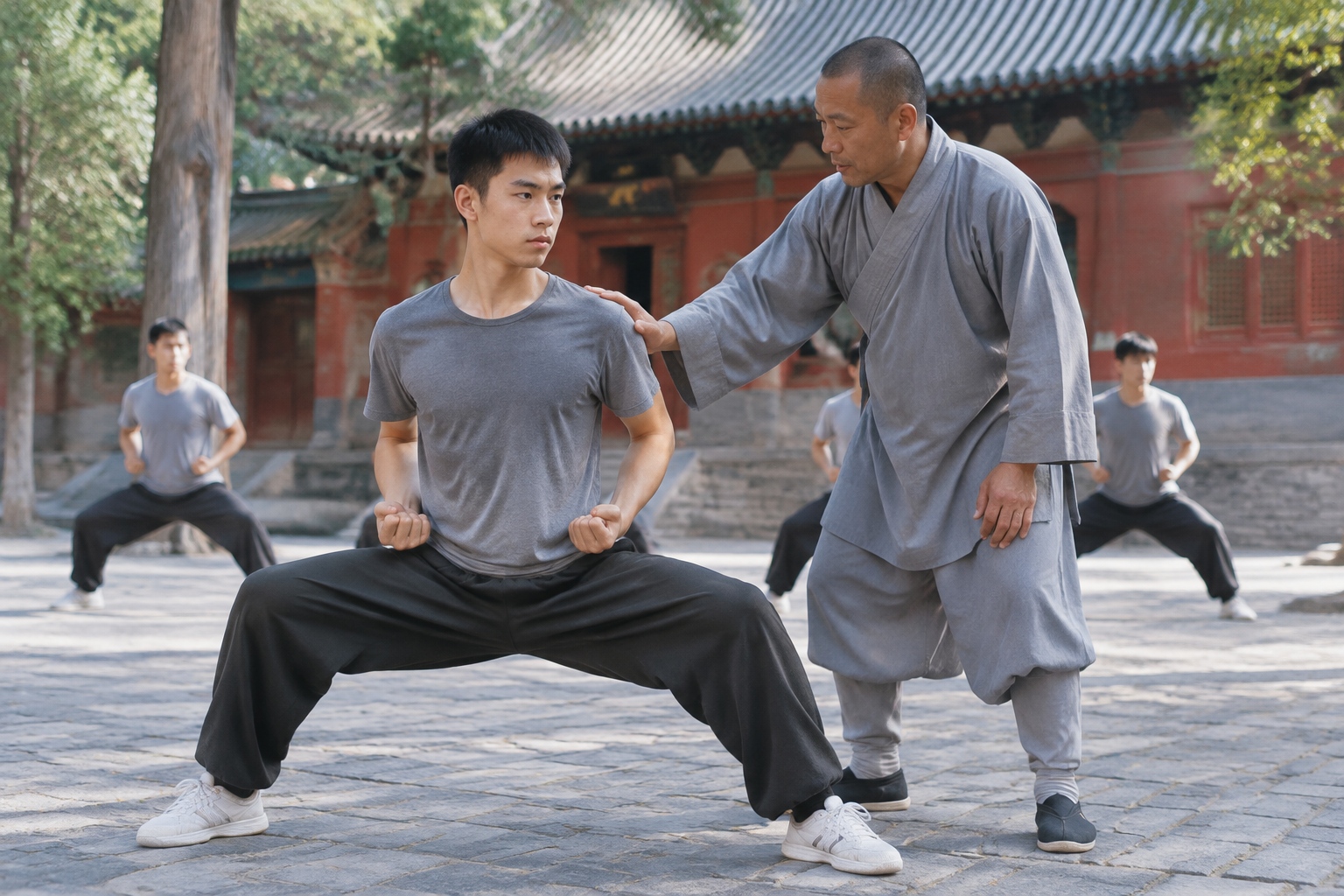
For a slower version, add a taiji class or join the temple’s morning chanting. It starts around four in the morning and needs booking ahead. It is not a performance. It is a working religious schedule, and you are a guest.
3. Walk: the stone steps of Songshan
Day 3 afternoon | Songshan hiking and Songyang Academy
Standing practice is stillness; hiking is movement. One trains stability, the other endurance. The Sanhuangzhai route in Songshan is the most walkable and the most photogenic: a plank walk hugs a vertical cliff, with a valley several hundred meters below. The full walk takes four to five hours; if you run out of energy, take the cable car and cut it in half.
On the way down, stop at Songyang Academy. Two ancient cypresses are said to have been named “General” by Emperor Wu of Han. The trees are much older than the title. The landscape usually outlasts the politics.
4. Look up: the face at Longmen
Day 4 | Luoyang, Longmen Grottoes
The high-speed station is called Luoyang Longmen; from there it is about ten minutes to the grottoes. Over more than four hundred years, craftsmen carved more than 2,300 caves and niches and over 100,000 images. Start with the elegant slim-bone style of the three Binyang caves, then the Ten Thousand Buddha Cave with its 15,000 small figures, and finally Guyang Cave, the earliest major excavation.
Then comes Fengxian Temple and the giant Vairocana Buddha. It is 17.14 meters tall. The head is four meters; an ear is 1.9 meters. Legend says Empress Wu Zetian donated twenty thousand strings of cosmetic money, and people have long said the face resembles her.
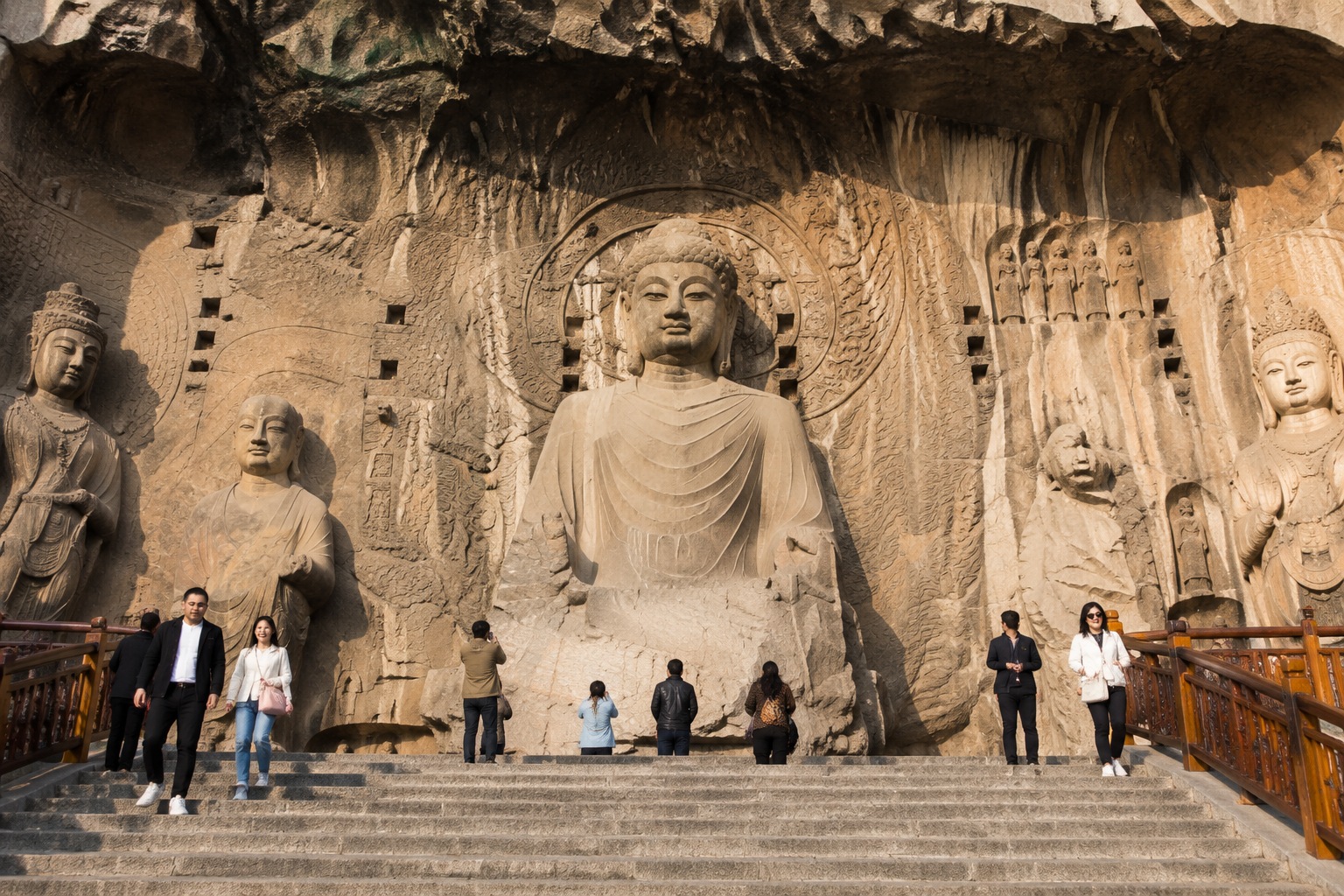
What makes it powerful is the angle. You walk down the steps and must look up. Your chin lifts, and your eyes land exactly on the Buddha’s eyes. This was calculated more than 1,300 years ago. At that angle, a person can only receive the gaze. In the evening, cross to the east bank of the Yi River and look back. The whole mountain becomes a silhouette of cave mouths. There are many steps; wear shoes you can walk in.
5. Join: the two hands at White Horse Temple
Day 5 | Luoyang, White Horse Temple and water banquet
White Horse Temple was built in 68 CE, the first officially sponsored Buddhist temple in China. The name comes from the white horse that carried sutras from India. This is where Buddhism formally landed in China. Learn one simple movement: join your palms at the chest. You do not need to make a wish or understand the ritual. The gesture means gathering yourself back in. After four days of learning to exert force, it is useful to put it away.
In the evening, try the Luoyang water banquet: twenty-four dishes, eight cold and sixteen hot, served one after another, cleared and replaced like water flowing past. The first dish, peony bird’s nest, is shredded radish steamed to look like bird’s nest. Taste two bites of each. Do not fill up on the first dish.
6. Sit: the night market in Kaifeng
Day 6 | Kaifeng, Millennium City Park and Drum Tower night market
Take the high-speed train from Luoyang to Kaifeng, about half an hour. Under Kaifeng, six cities are stacked one on top of another. The Yellow River buried one; people rebuilt. Millennium City Park is a reconstruction based on Zhang Zeduan’s painting Along the River During the Qingming Festival. There are folk performances by day and, in season, a nighttime lake show called The Great Song: A Dream of Dongjing. Check the schedule.
Then go to the Drum Tower night market. People in Kaifeng do not say “stroll the night market.” They say “sit the night market.” Find a low table, sit down, and eat from stall to stall. For soup dumplings, the method is: lift gently, move slowly, open a window, then sip the soup. If you bite straight in, you will burn your tongue and ruin your shirt at the same time.
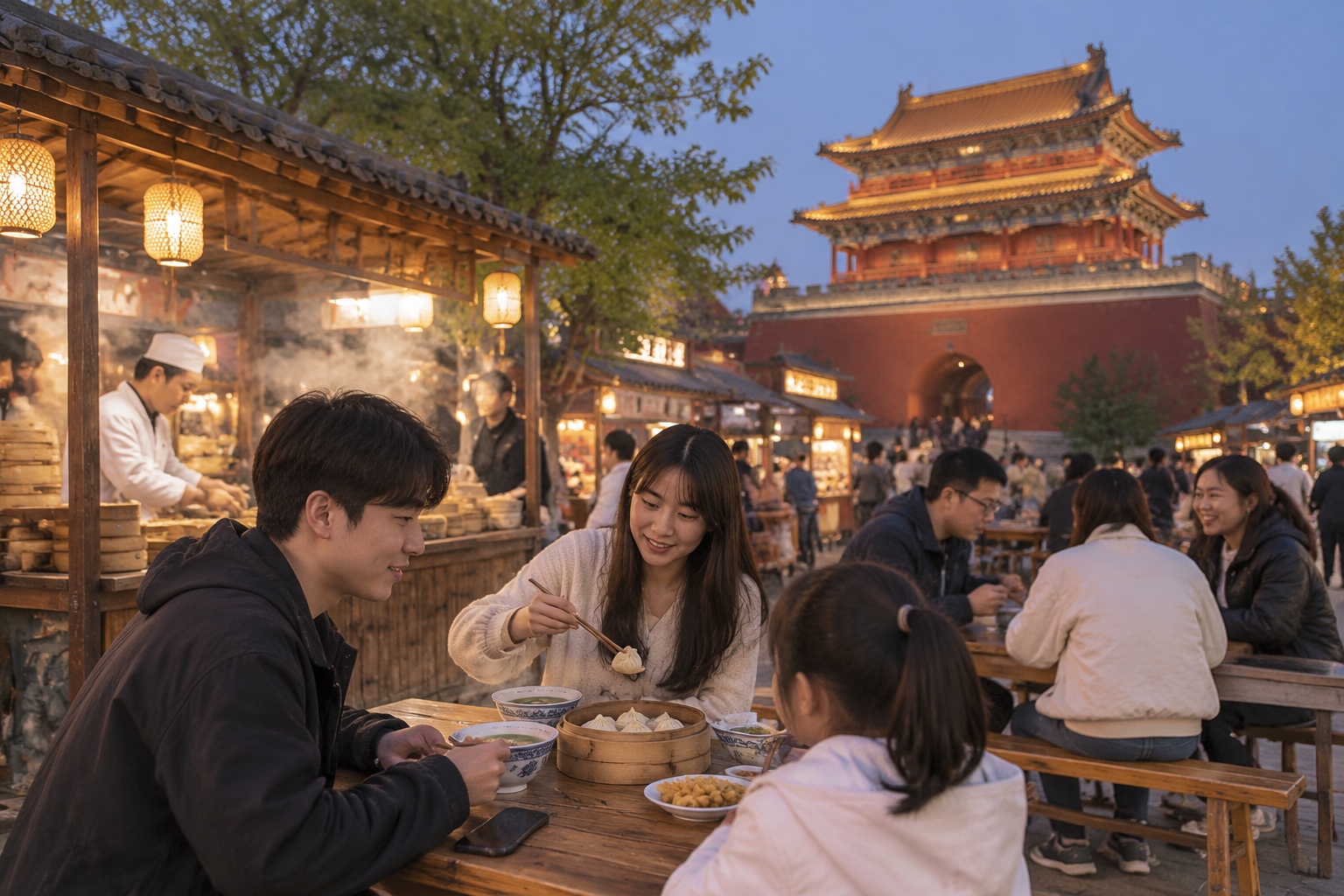
This is not a night for a proper dinner. Treat the whole market as the meal.
7. Climb: Huashan asks for your hands
Days 7–8 | Huashan and departure from Xi’an
From Luoyang, the high-speed train reaches Huashan North Station in about an hour. For the first six movements, your feet were on solid ground. Huashan asks for your hands. The south peak is the highest of the five, at 2,154.9 meters. The usual route is up by the west peak cable car and down by the north peak cable car, linking the five peaks in a loop. Allow six to eight hours.
The famous parts are the dangerous paths. The Plank Walk in the Sky is on the east side of the south peak: wooden boards nailed to a vertical cliff, with a separate safety harness rented on site. The Sparrowhawk Turnaround is on the east peak and requires turning sideways around a rock. You can skip both. The point of going up is not conquest. It is to see what your legs do when they are scared, and then laugh at yourself.
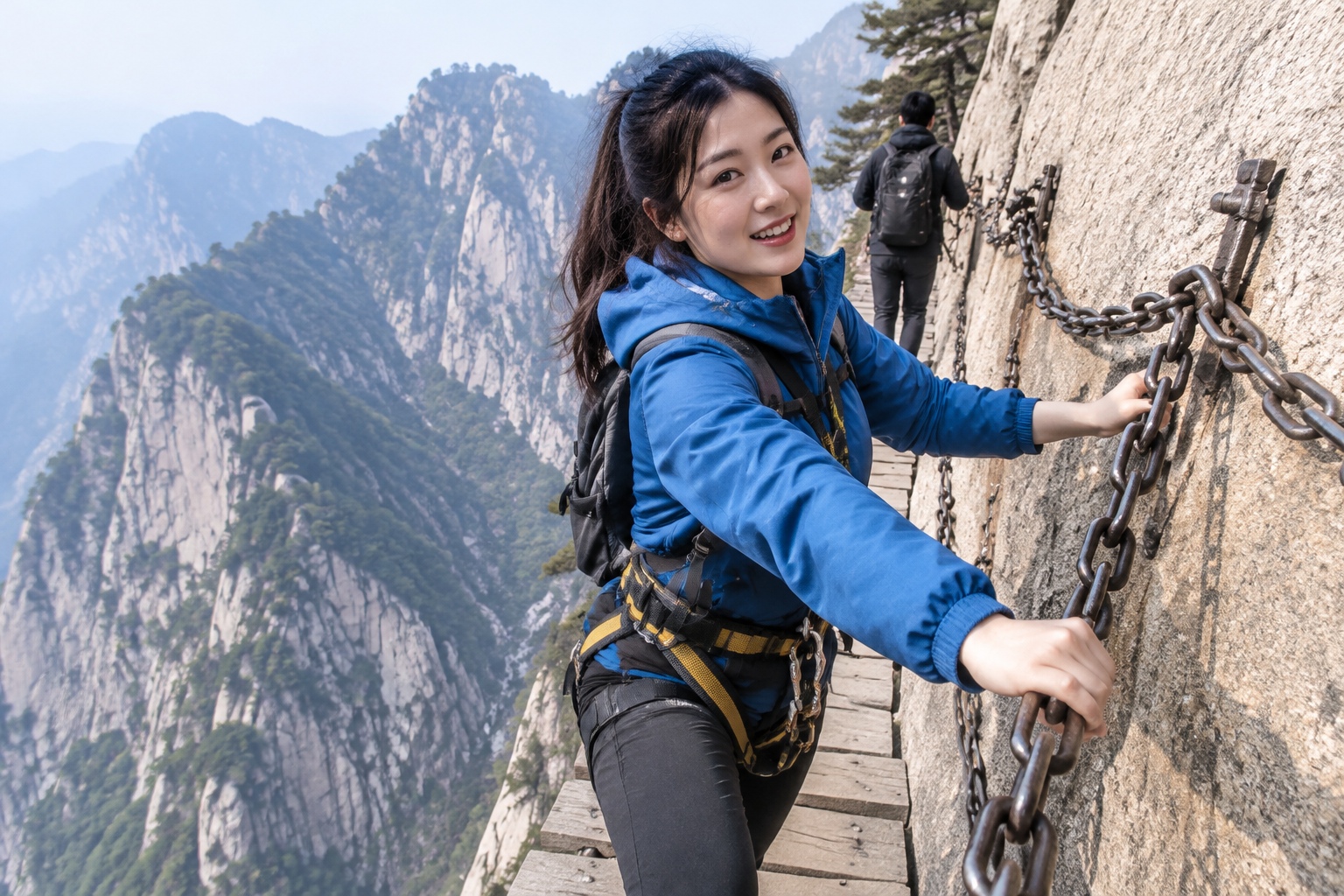
It is eight to ten degrees cooler on the mountain than below. On day eight, take the train from Huashan North to Xi’an North in half an hour and fly out from Xi’an.
Seven things to know before you go
- Transport. Fly into Zhengzhou. Zhengzhou to Dengfeng by car is about 1.5 hours. Zhengzhou to Luoyang and Luoyang to Kaifeng are each under an hour by high-speed rail. Luoyang to Xi’an is about 1.5 hours, and Huashan North Station is on that line.
- Shaolin is commercial. The commercial street is real. Visit the temple first, shop on the way back.
- A performance and a class are not the same. Watch the performance for extreme athleticism. Take the class for basics.
- Temple etiquette. Remove your hat inside halls, do not point at statues, walk clockwise around pagodas, and ask before photographing monks. No photos during morning chanting.
- Fitness. Longmen involves about two kilometers of walking each way. The dangerous paths at Huashan all have bypasses. If you have heart problems or severe vertigo, the cable car is enough.
- What to bring. Shoes with grip, a light layer for the mountain, and a willingness to look awkward in a martial arts class.
- Book ahead. Morning chanting and some classes need advance arrangement, especially in peak season.
Who this route is for — and who it is not
This route is for people with a real interest in martial arts, Buddhism, calligraphy or old architecture. It is for people willing to sweat and willing to sit and listen to someone explain a gesture. It works for families who want children to see kung fu as something other than a movie.
It is not for people who only want photographs. Half of the route asks for physical participation. It is not for anyone who cannot manage stairs. And it is not for people looking for an untouched ancient temple. Shaolin is a living religious site and a major tourist destination, with tens of thousands of visitors on a busy day. Both things are true at once.
What you take home
Not the plastic sword at the gate. You take home the 48 foot pits in Thousand Buddha Hall; the shake in your thighs in the second minute of horse stance; the sound of wind bouncing off the cliff on the Sanhuangzhai plank walk; the eyes of the Vairocana Buddha, which are on you the whole time you look up; the warmth in your palms after joining them at White Horse Temple; the first sip of soup from a Kaifeng dumpling; the sole of the shoe of the person ahead of you as you grip a chain on Huashan and look up.
Eight days. Look once, stand once, walk once, look up once, join once, sit once, climb once. How big China is, you learn by moving through it. What China feels like in the body, you learn by doing it.