

Why this route feels like an open-air museum
Most old Chinese buildings were made of wood. A fire, a rebellion, or a change of dynasty could erase them. That is why most surviving wooden structures from before the Yuan dynasty are in Shanxi: a dry climate, mountain walls, relatively less war—and one underdiscussed reason, poverty. For centuries, many local towns could not afford to tear old buildings down and rebuild.
This seven-day route runs from Datong and Mount Wutai to Taiyuan and Pingyao. It crosses four dynasties and three materials: stone carved for gods, wood built for ancestors, and brick and paper left for people.
Three world-class sites sit on one line: the Yungang Grottoes, the Hanging Temple, and Pingyao Ancient City. Visitor numbers are still far below comparable places elsewhere in China. You can look quietly. That is the route’s most valuable luxury.
Pingyao’s walls, lanes, draft banks, county office, and escort agency are still in place. You do not enter a stage set called “the ancient city”; you walk inside a working old town. And then there are the Jinshang, the Shanxi merchants. Two hundred years ago, a group of Shanxi men turned a piece of paper into a nationwide money business. That story feels more like a “China story” than any single temple.
Stone for gods
Day 1: Datong, city wall and Huayan Temple
Start with the city wall. To be honest: today’s Datong wall was restored in recent years according to Ming dynasty form, and the bricks are new. What you are looking at is the scale of a northern military town, not old brick.
The truly old things are inside the city. Huayan Temple was rebuilt in the Liao dynasty in 1038. It has something you will not see in many Chinese Buddhist temples: the main hall faces east. The Khitan people worshipped the sun, so the temple faces east.
In the Bodhisattva Hall, a Liao dynasty bodhisattva stands with palms together and teeth showing. People call her the “Oriental Venus.” In the evening, eat lamb offal and oat noodles.
Day 2: Yungang Grottoes and the Hanging Temple
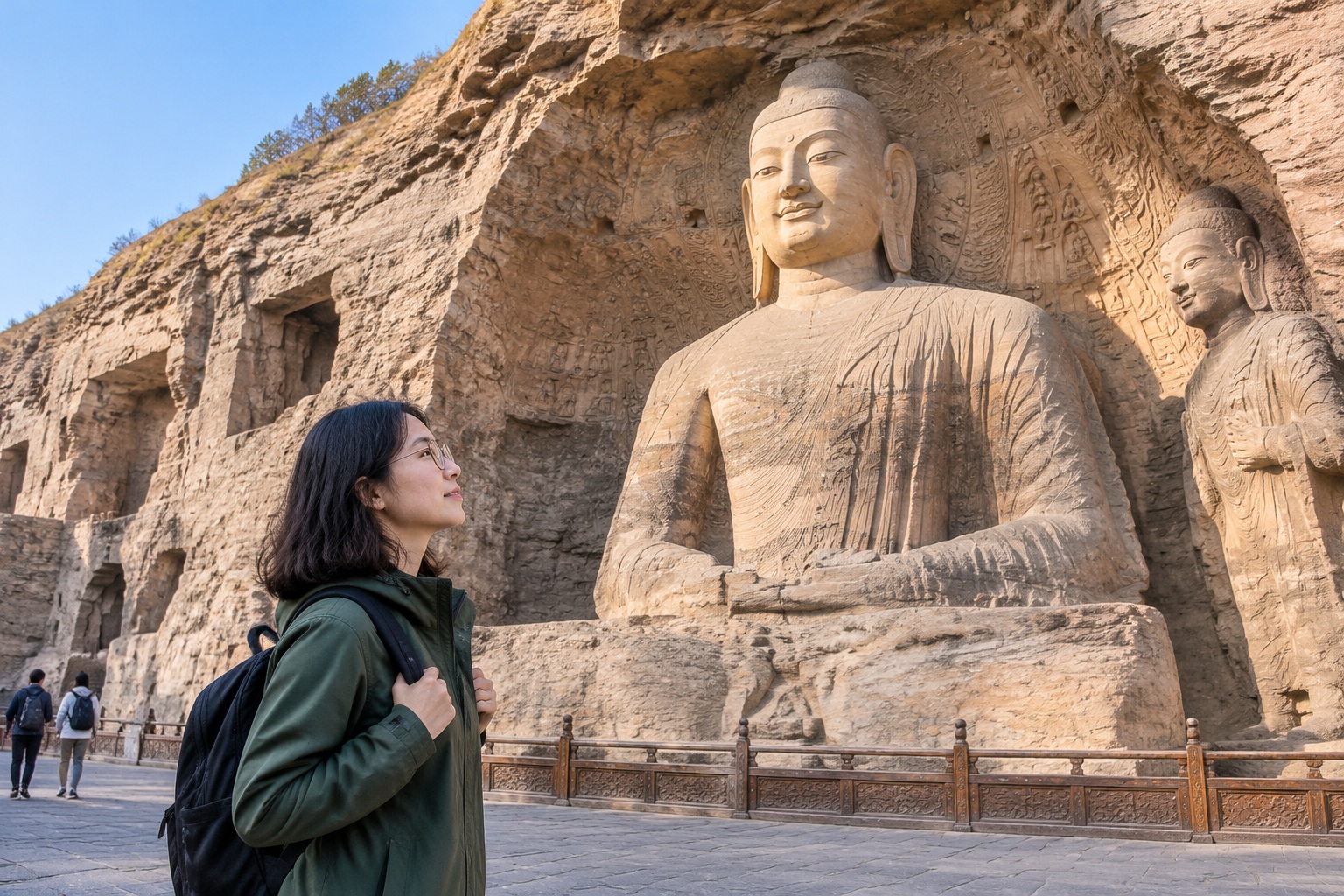
Yungang was carved from the Northern Wei period under Emperor Wencheng. The monk in charge was Tan Yao. The first five great caves are generally understood to correspond to five Northern Wei emperors. Carving emperors into Buddhas was politics as much as faith.
Cave 20’s open-air Buddha is 13.7 meters tall. Its front wall collapsed a thousand years ago, and the figure has sat exposed ever since, becoming the face of Yungang. Go in with the first morning group; light sweeps across the Buddha’s nose from the east.
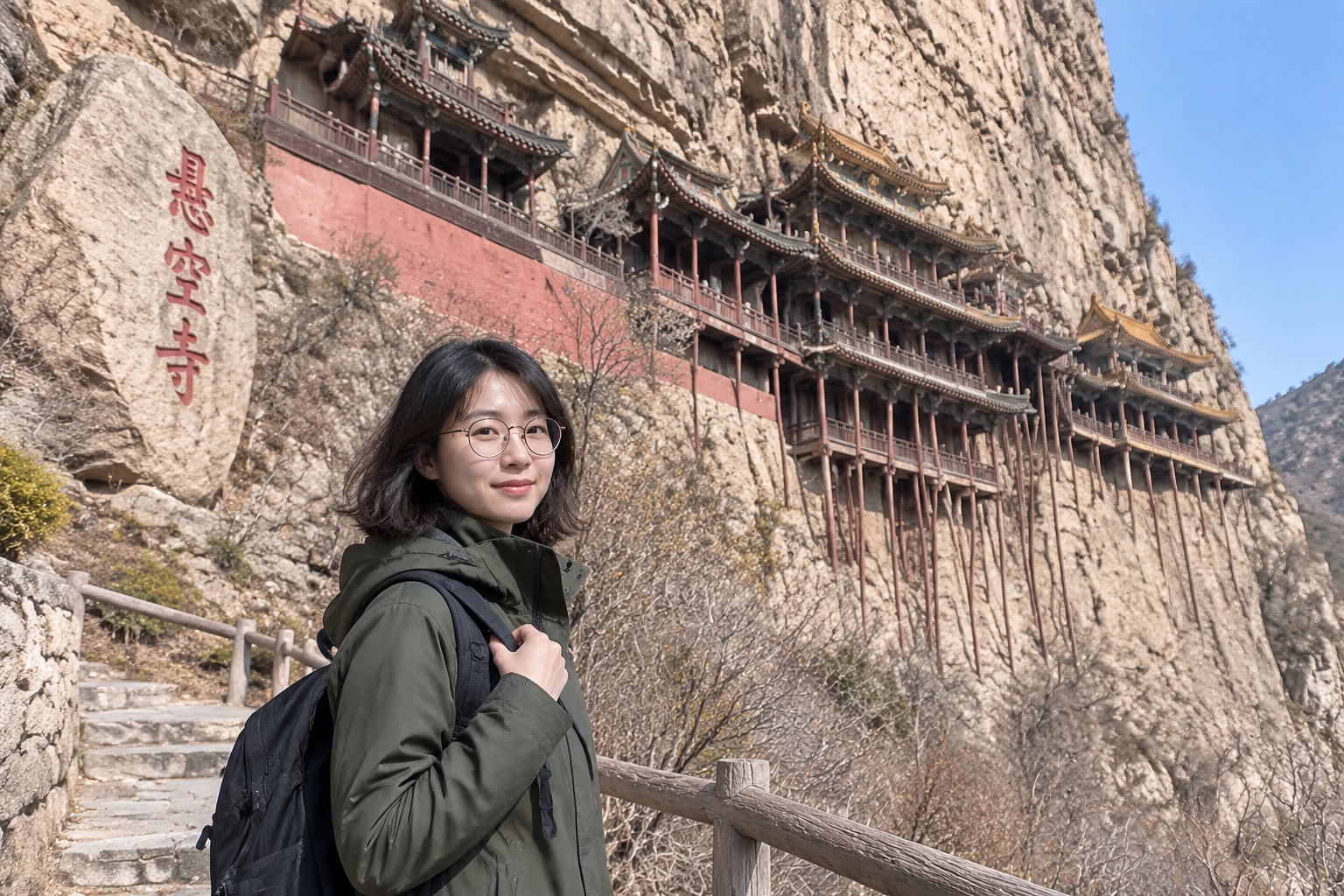
In the afternoon, drive about 90 minutes to the Hanging Temple in the Golden Dragon Gorge of Mount Heng, Hunyuan. It clings to a cliff. It was first built in the Northern Wei period; the present structure was rebuilt in the Ming and Qing.
Why does it not fall? Not because of the thin wooden poles below. The real load is carried by beams inserted into the rock, using leverage to pin the temple to the cliff. Most of those lower poles do not bear weight. They are there for the eye.
Day 3–4: Mount Wutai, Xiantong Temple and Dailuoding
From the Hanging Temple, hire a car south for three to four hours to Taihuai, the town at the center of Mount Wutai. The altitude is around 1,700 to 1,800 meters. Even in summer, you may want a jacket in the morning and evening.
Xiantong Temple was first built in the Eastern Han Yongping period, around the same time as the White Horse Temple, which makes it one of China’s earliest Buddhist temples. The halls you see now are Ming and Qing. This is the fate of wood: on the same ground, buildings replace one another, while incense continues.
Mount Wutai has another rare sight. Xiantong is a blue temple, or Han Chinese Buddhist; Bodhisattva Peak above is a yellow temple, or Tibetan Buddhist. On the same street, two kinds of monk robes pass by. The white stupa at Tayuan Temple is Nepalese in form, 50 meters tall, and the landmark of the mountain.
On Day 4, climb Dailuoding. The 1,080 steps are called the Road of Great Wisdom, matching the 108 afflictions in Buddhism. The Five Manjusri Hall at the top lets you pay respects to the Manjusri of all five peaks at once, a “small pilgrimage.” There is a cable car if you are tired, but those who walk up tend to turn around halfway and look back at Taihuai.
Wood for ancestors
Day 5: Taiyuan, Jinci, Shanxi Museum, knife-cut noodles
Jinci is the place I most want you to stand in a little longer. It was founded before the Northern Wei and honors Tang Shuyu, the younger brother of King Cheng of Zhou. This is an ancestral shrine, not a temple. The offerings are for ancestors.
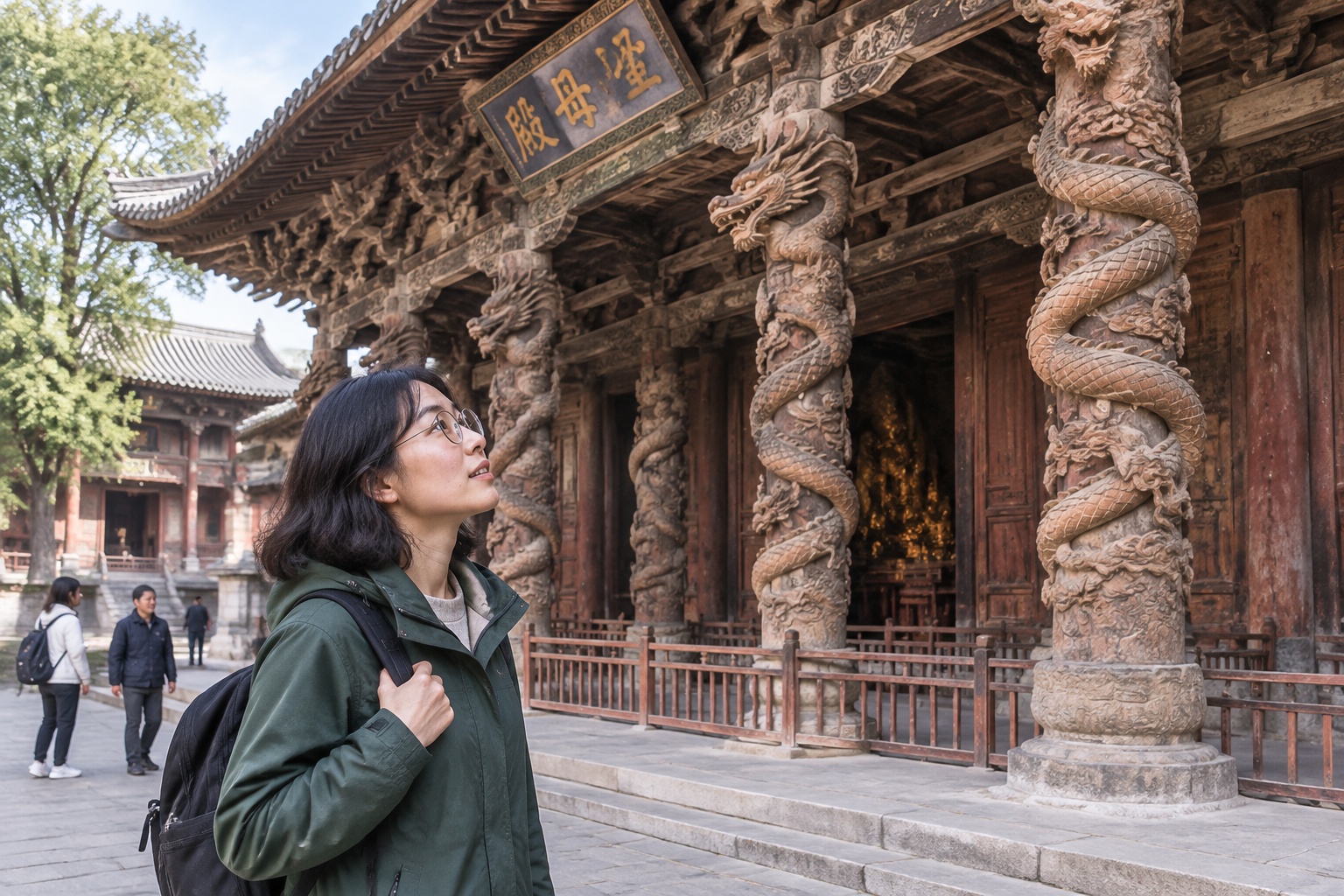
The Sacred Lady Hall was built in the Northern Song Tiansheng period, nearly a thousand years ago. The eight carved wooden coiled-dragon columns in front are original Northern Song work, the earliest surviving of their kind in China. You can still count the scales. Inside are 43 Song dynasty painted sculptures; each attendant has a different character.
Do not miss two more things: the Fish Pond Flying Bridge, a cross-shaped bridge that is the only surviving example of its kind in China, and the Zhou Cypress, measured at roughly 3,000 years old. Standing under it, a concrete thought arrives: when this tree was alive, the Shang dynasty had not yet ended.
In the afternoon, go to the Shanxi Museum. Its signature bird zun is a phoenix-like bird looking back with a small bird on its back. After you see it, the stone, wood, and clay of the previous four days connect.
For dinner, eat knife-cut noodles: willow-leaf shaped, thick in the middle and thin at the edges, smooth outside and chewy inside. Add a spoonful of vinegar. The high-speed train from Taiyuan to Pingyao takes about 40 minutes.
Brick and paper for people
Day 6: Pingyao, city wall, Rishengchang, night streets
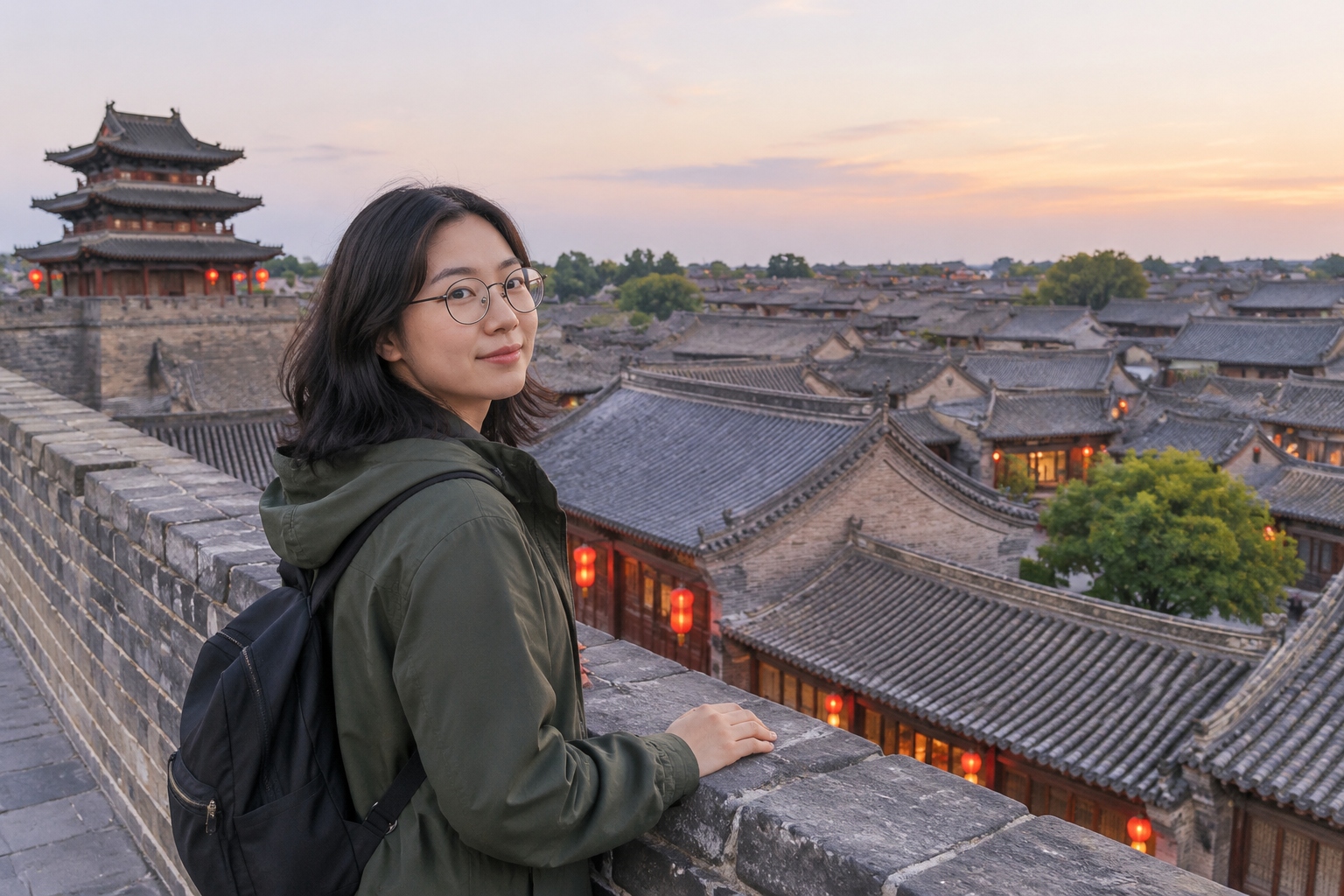
Pingyao’s wall was faced with brick in the third year of Ming Hongwu, 1370. It runs six kilometers, with 72 watchtowers and 3,000 crenellations. The numbers correspond to Confucius’s 72 disciples and 3,000 students. A county town built Confucian numbers into its fortifications.
Walk a section in the morning. The skyline below still has the height of 600 years ago. In the afternoon, visit Rishengchang. Founded in 1823, it was China’s first draft bank. Before it, merchants moving silver hired armed escorts for hundreds of miles; if they met bandits, the money was gone. Rishengchang did something simple: you deposited silver here, took a piece of paper, and collected the money a thousand miles away.
How did the paper prevent forgery? Through a secret code. Chinese characters stood for dates, amounts, and branches. An outsider could hold the paper and still not read it. In an age without internet or telegraph, that paper could be redeemed across the country because of credit and a set of rules that only insiders understood.
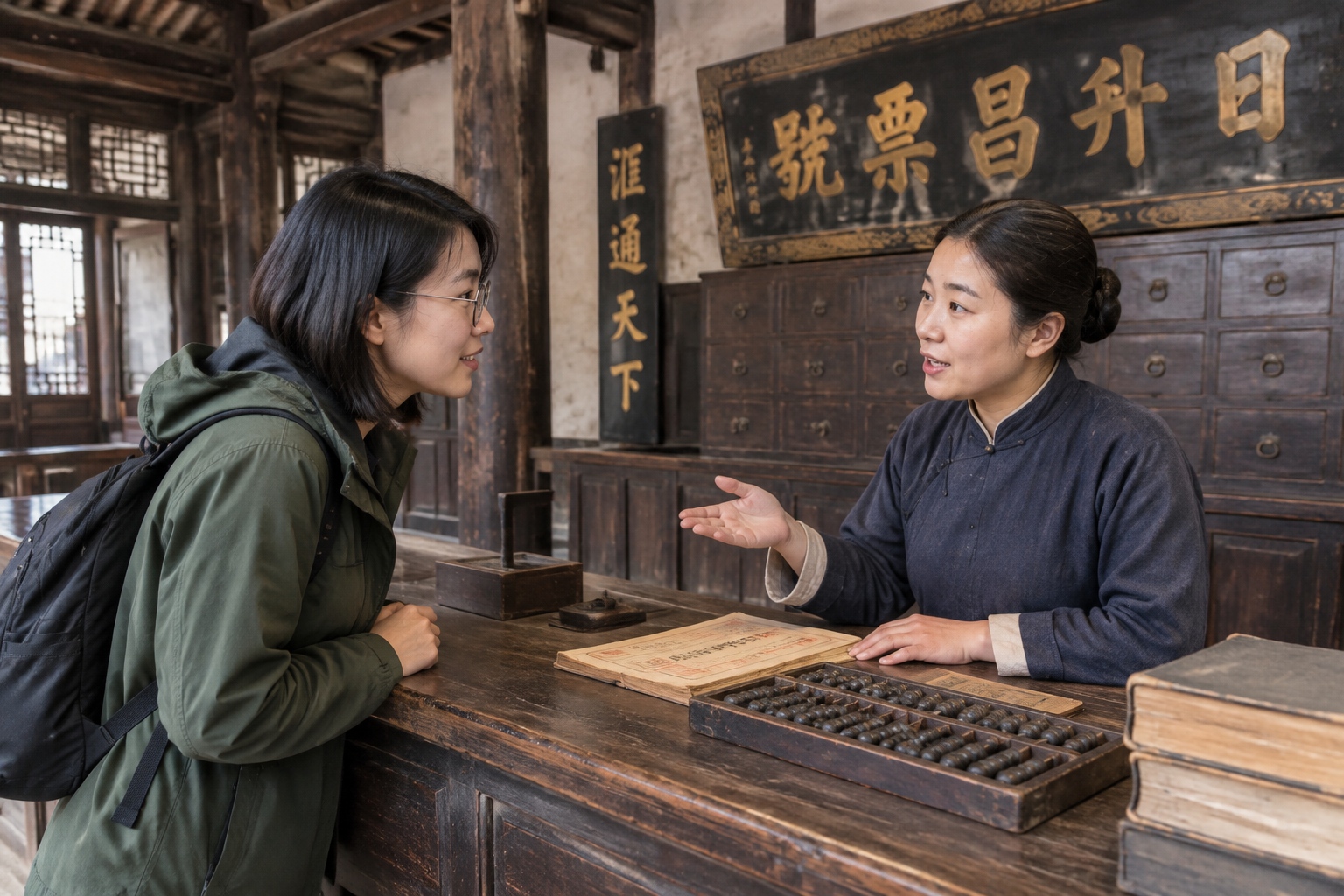
At night, see See Pingyao Again. The audience walks with the performance rather than sitting in a theater. Book ahead.
Day 7: Qiao Family Compound and departure
The Qiao Family Compound is in Qiaojiabao, Qixian. It was first built under the Qing Qianlong emperor and expanded under Tongzhi and Guangxu. There are six large courtyards, 20 small courtyards, and 313 rooms. From above, the layout forms the character for double happiness.
What is really worth seeing is why a merchant built his home like a castle. The outer walls are high, windows are few, courtyards connect by passages, and the roofs can be walked. The Jinshang did business across several provinces; at home they wanted a strongbox they could defend.
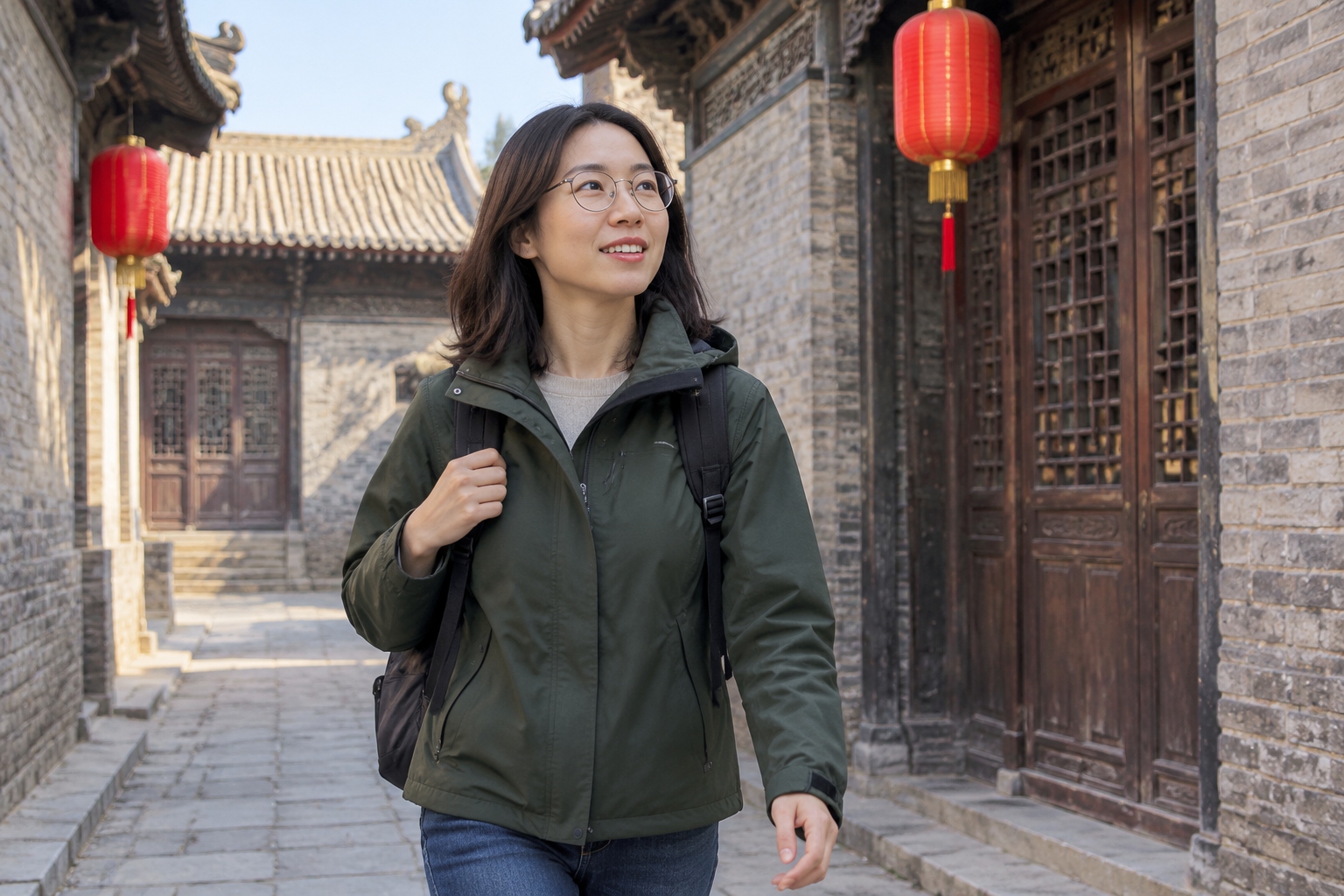
Afterward, return to Pingyao and walk a night street with lanterns on, or go straight to Taiyuan for departure.
Five things to know first
- Transport. Entering from Beijing is easiest. Beijing to Datong by high-speed rail takes about two hours; Datong to Taiyuan about two hours. Hire a car for the Hanging Temple and Mount Wutai: Datong to Mount Wutai is about three hours, Mount Wutai to Taiyuan about three hours. Taiyuan to Pingyao by high-speed rail is about 40 minutes. Leave from Taiyuan by plane or train.
- Book ahead. Yungang and the Hanging Temple both require advance booking. The Hanging Temple limits entry by time slot; in peak season, book a week ahead.
- An honest note. Datong’s wall is a recent restoration, and some Pingyao lanes have been repaired. Original material is at Huayan Temple, Jinci, Yungang, and Xiantong Temple.
- Season and energy. May to October is best. Mount Wutai can snow in October. Dailuoding has a cable car. The Hanging Temple passage is narrow; you will need to duck.
- Etiquette. Mount Wutai is a living religious site. Circle stupas clockwise, do not photograph inside halls, and ask before photographing monks.
This route suits people who like architecture, sculpture, and religious art; travelers who have seen Beijing and Shanghai and want to move into central China; and anyone who hates queues. The crowds may surprise you. It does not suit people looking for “shocking big pictures.” Shanxi’s beauty is in detail, not scale. It also does not suit people who refuse explanations. Half the value here is in why things were built this way.
What you take home
Not vinegar and lacquerware, though you may buy them. You take home the smiling Liao bodhisattva at Huayan Temple; the stripe of light on the nose of Cave 20’s Buddha; the thin wooden poles under the Hanging Temple that carry almost no weight; the glance back at the white stupa halfway up Dailuoding; the bark of the Zhou Cypress, so thick that two hands cover only half its width; the worn shine on Rishengchang’s counter; the hundredth “longevity” character on the Qiao family’s screen wall.
Seven days, from Northern Wei stone to Qing paper. Shanxi is not loud. It simply sets 1,500 years down in front of you and waits for you to walk over.