

Fujian, Shaped Like a Circle
Most China itineraries are lines: city to city, landmark to landmark. This one has a shape. For the first three days you go around an island. Then you step inside a house that has folded itself into a circle. On day six you reach a city whose door faces the sea. By the last two days, the circle has loosened into a bend in a river. Eight days, four circles, each larger than the last, and the final one is no longer a circle at all.
This is not the Fujian of a quick checklist. It is a route for people who want to feel a place change under their feet: sea wind, rammed-earth walls, incense, wet stone, tea steam. The pace is deliberately easy. You do not need to sprint.
Why This Route Works
The tulou are a UNESCO World Heritage site, and there is no second example quite like them anywhere. They are not simply old buildings that look unusual. They are a whole way of living together, built in earth and wood and defended by a single door. The route also strings together four different rhythms: island, Hakka architecture, old port city and tea mountain. Each one gives you a break from the last.
Then there is taste. Satay noodles, oyster omelet, a small pot of gongfu tea. In southern Fujian, daily life is not only in the sights. It is in the bowl in front of you.
The First Circle: Surrounded by Sea, Days 1 to 3 in Xiamen
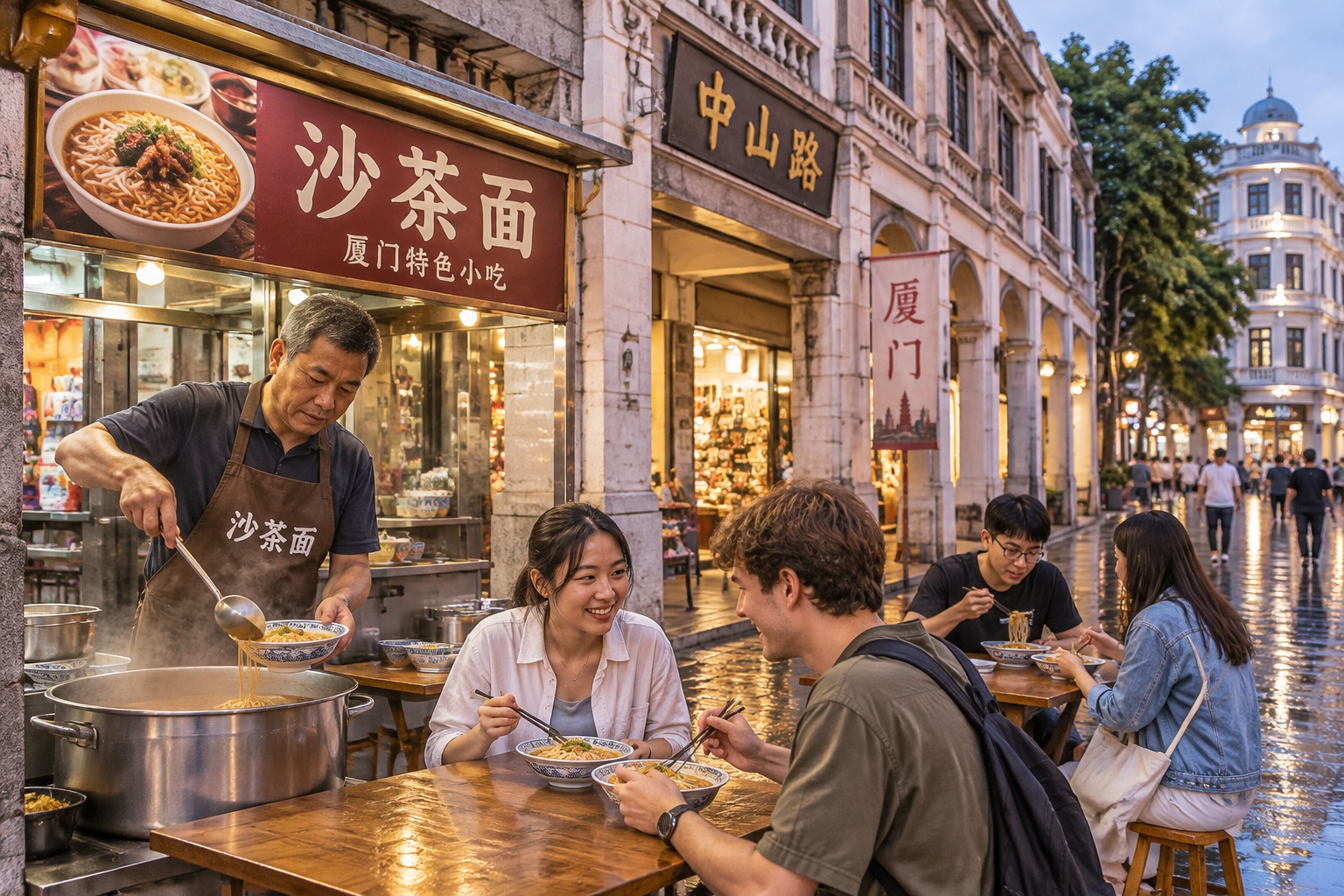
Day 1: Zhongshan Road and the First Bowl of Satay Noodles
Land in Xiamen and go first to Zhongshan Road. The qilou arcades here have a Southeast Asian feel: columns hold up a covered walkway on the second floor, so on a rainy day you can walk a whole street without getting your shoes wet. In the evening, walk toward the sea. Across the water, Gulangyu shows a row of lights, and the wind is warm.
For your first meal, order satay noodles. The broth is made with peanuts, dried shrimp and satay sauce. It is thick, slightly sweet, and carries a small kick of heat.
Day 2: Gulangyu, an Island Without Cars
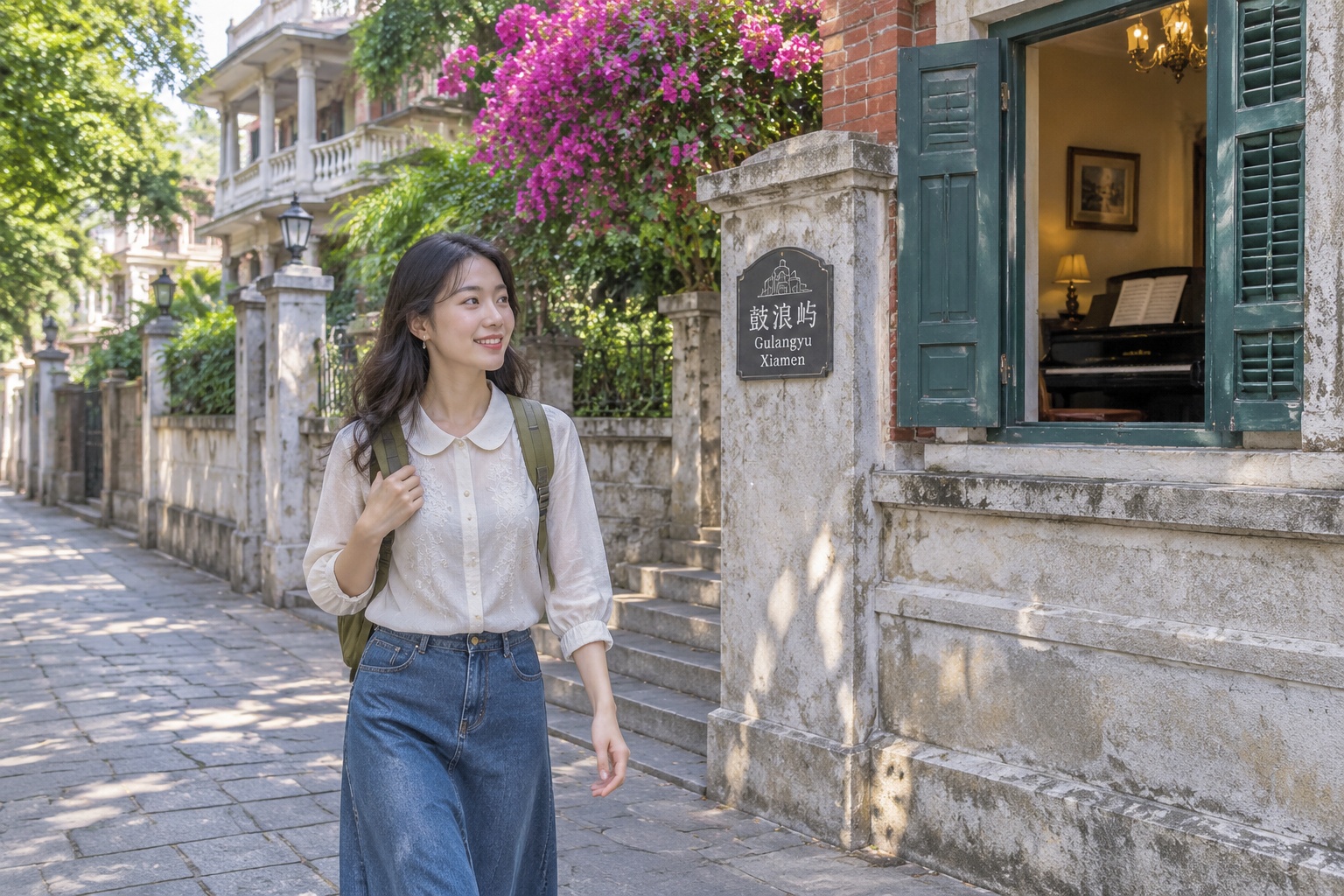
Take the ferry from Dongdu Cruise Terminal. The crossing takes about twenty minutes. Gulangyu is only 1.88 square kilometers, and there are no cars on the island, only electric carts and hand-pulled delivery wagons. What you hear is footsteps, birds, and occasionally a piano drifting out from behind a window. There is even a piano museum on the island.
The houses are the first surprise of the trip. Consulates, churches, villas and the homes of Southeast Asian merchants crowd a few sloping lanes. In 2017 the whole island was listed as a UNESCO World Heritage site. Climb Sunlight Rock for the view: red roofs, blue water, and the whole island spread out below. Shuzhuang Garden borrows the sea into its design, and the Forty-Four Bridge curves just above the water.
Day 3: Zengcuoan and the Island Ring Road
Zengcuoan was once a fishing village. Now it is a cultural and creative village: crowded, noisy, but with a very high density of snacks. In the afternoon, rent a bicycle and ride the Island Ring Road. Sea on one side, hills on the other. The best time is after 5:30 p.m., when the sun drops toward the water and the wind finally cools down.
The Second Circle: A House That Wraps Around Itself, Days 4 to 5 in Nanjing and Yongding
Day 4: Tianluokeng at Dawn
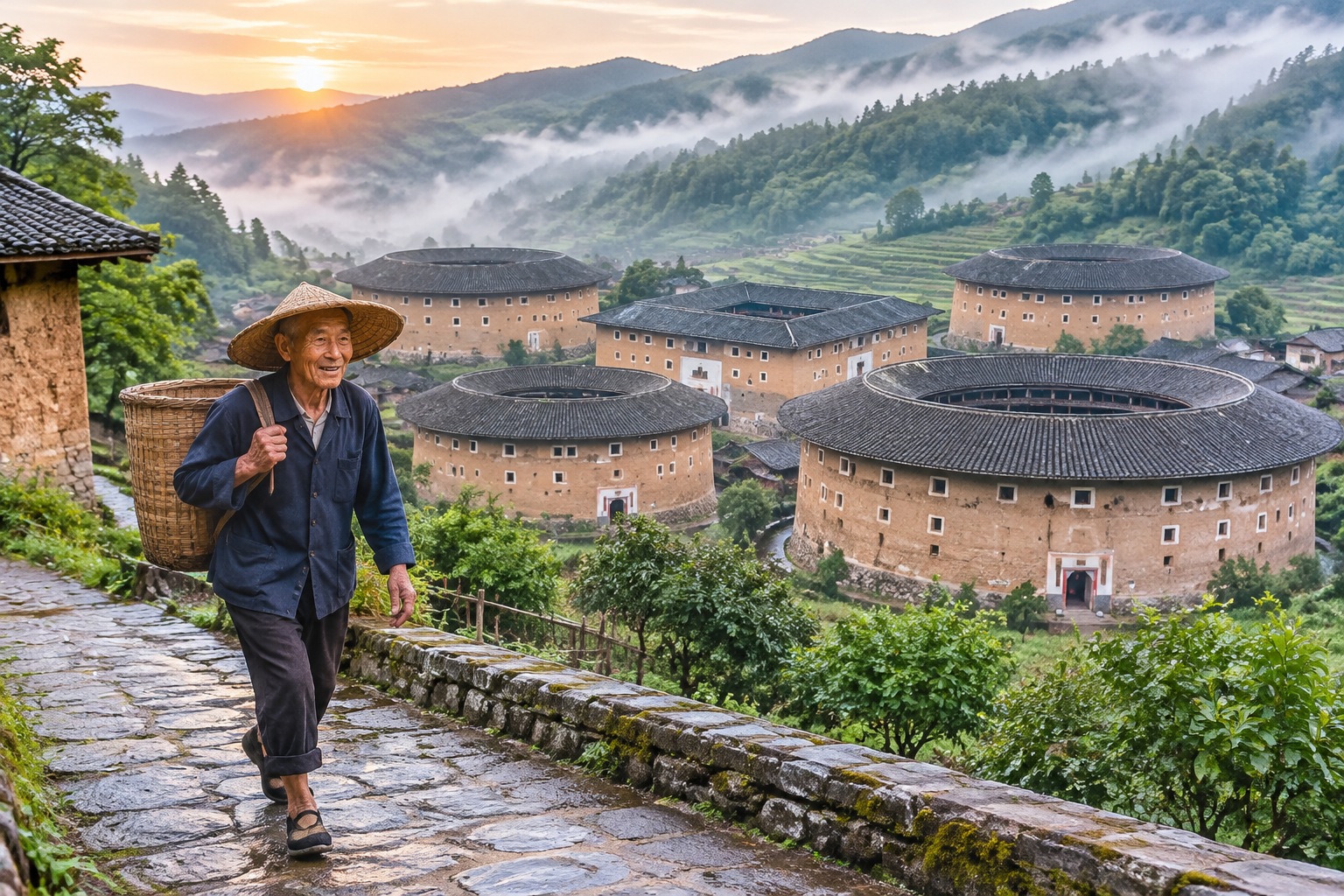
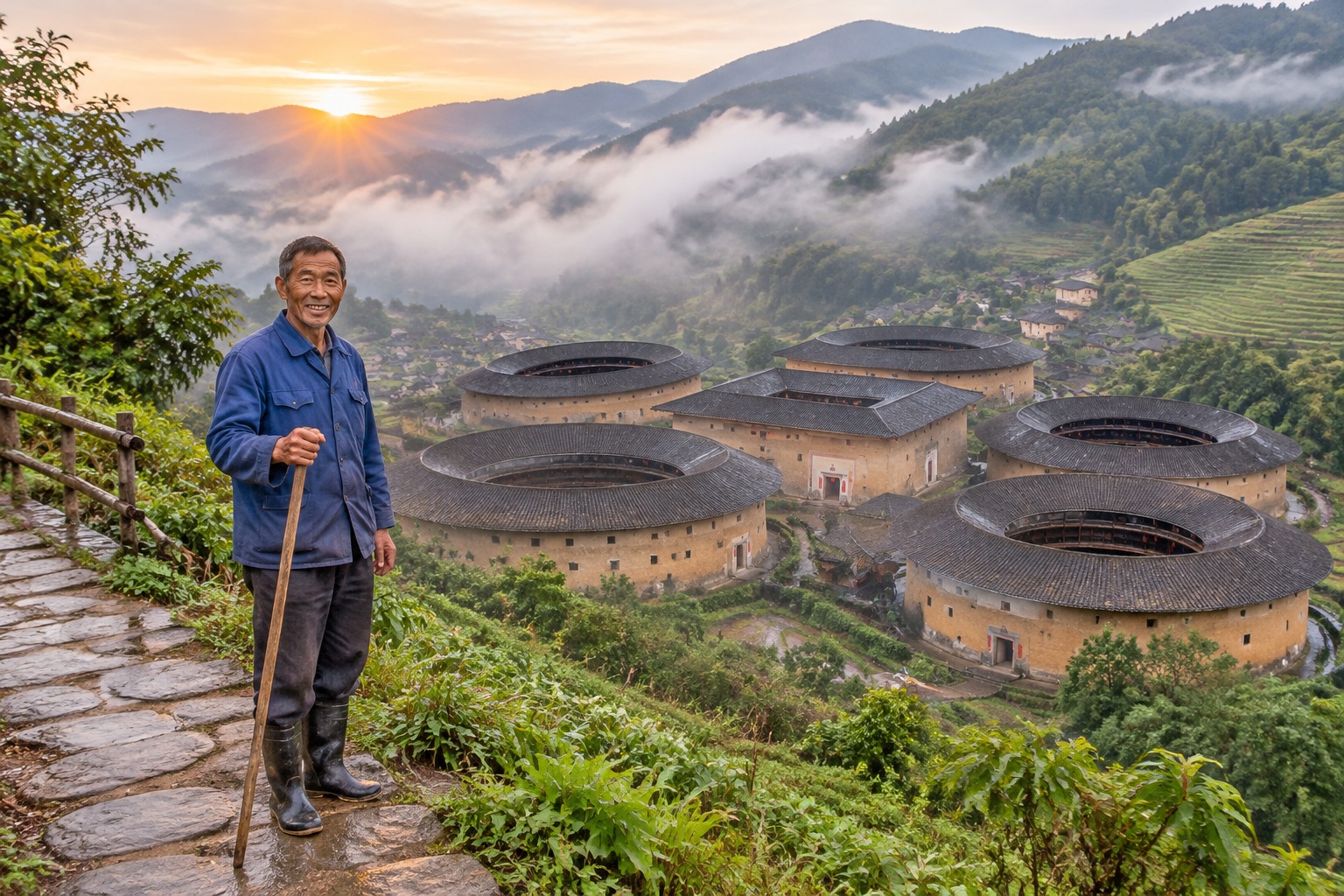
Take the high-speed train to Nanjing, then hire a car up the mountain. Tianluokeng is four round tulou surrounding one square one. From the hillside viewing point, the Chinese nickname for the layout makes immediate sense: ‘four dishes and one soup.’ See it in the early morning, when mist rises from the valley and the five roofs float above it, as if they have just been set on the table.
Only when you walk close do you understand what a tulou is. The rammed-earth walls are one to two meters thick. The first floor holds kitchens, the second floor stores grain, and people live above that. The whole building has one main gate, its doors covered in iron plate, with a water trough above the entrance. If attackers tried fire, defenders could pour water down from above. The round shape is not for looks. A circle has no dead corners, it resists wind and earthquakes, and over centuries quakes have cracked these walls without bringing them down.
Day 5: Yongding and a Night Inside a Tulou
In Hongkeng village, Zhencheng Lou was completed in 1912 and laid out according to bagua, the eight trigrams. People call it the ‘prince of tulou.’ Chengqi Lou is the ‘king’: more than seventy meters across, once home to as many as eight hundred people, all sharing the same well, the same courtyard, the same gate.
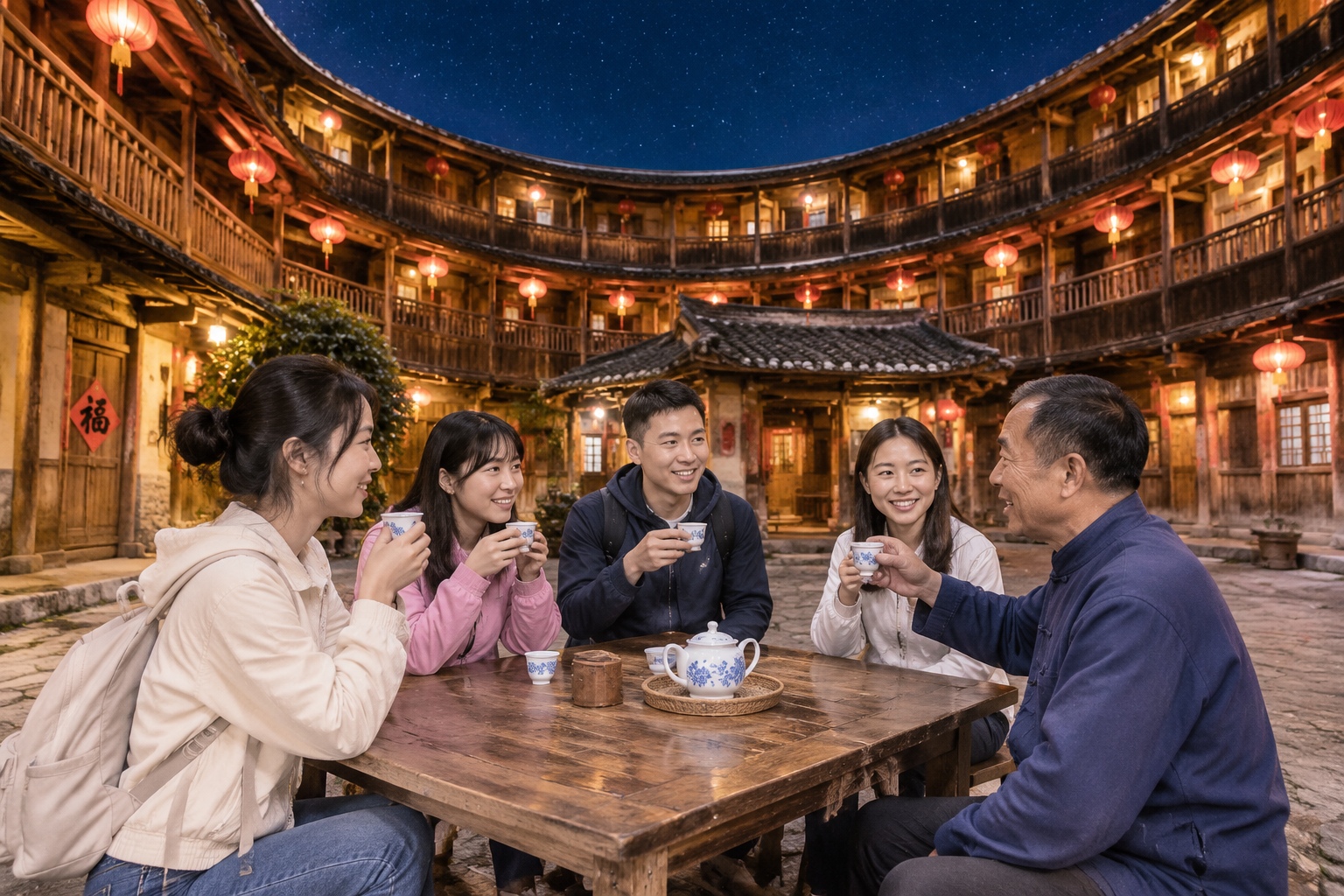
Stay inside a tulou that night. To be honest: the floors are wooden, soundproofing is poor, and you can hear someone turn over upstairs. Bathrooms are often shared. This is not a hotel. But at night you look up from the courtyard and see a ring of stars. In the morning, a rooster wakes you. You are not staying in a room. You are staying in a courtyard that hundreds of people have shared.
The Third Circle: A Door Open to the Sea, Day 6 in Quanzhou
One hour by high-speed rail brings you to Quanzhou. In 2021 the old city was inscribed as a UNESCO World Heritage site under the theme of Song-Yuan China’s world maritime trade center. Twenty-two heritage sites are scattered through the lanes.
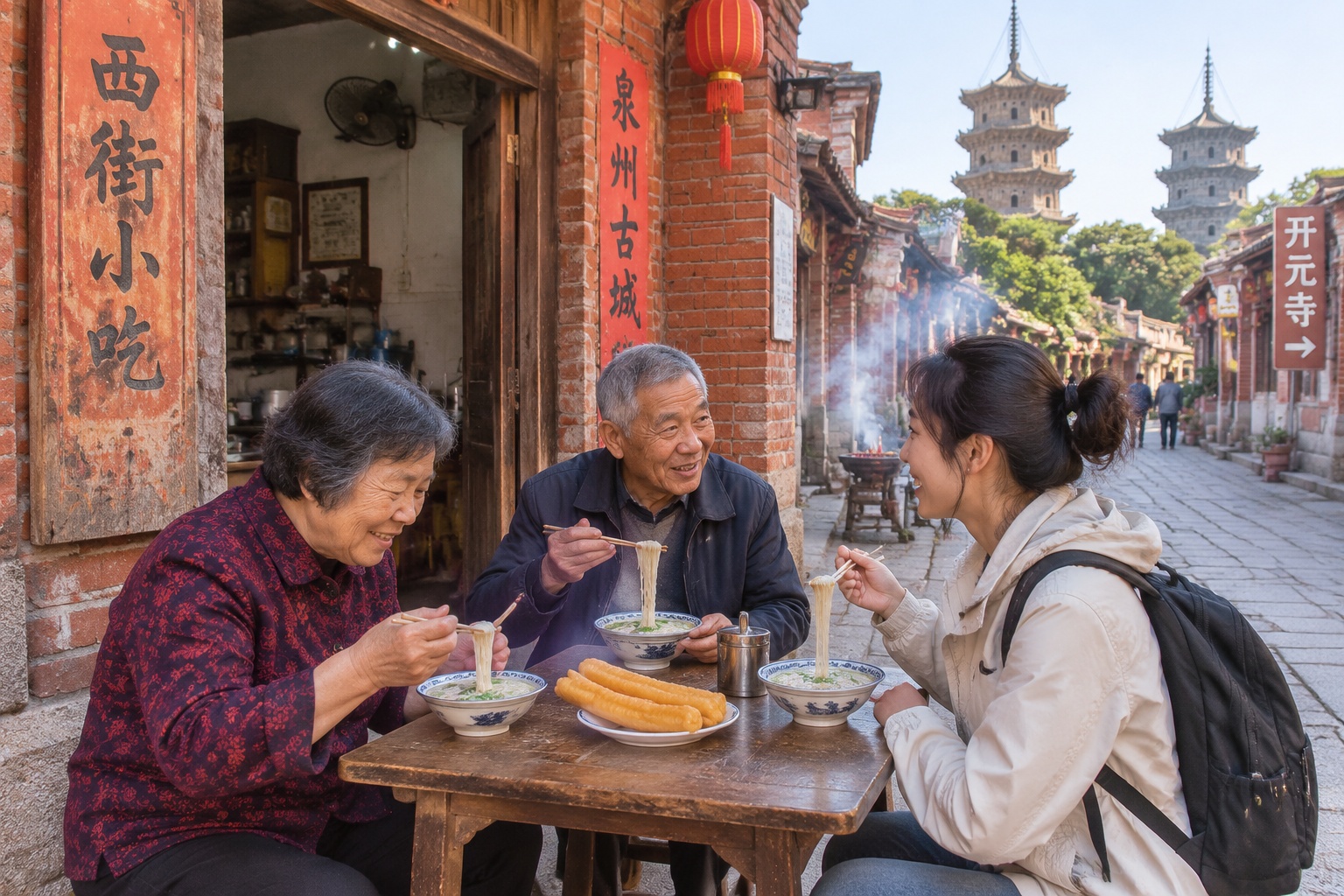
Kaiyuan Temple is essential. The two stone pagodas east and west are original Southern Song structures, more than forty meters tall, built from stone eight hundred years ago. Behind the main hall, the pillars carry Hindu mythological carvings. A Buddhist temple using Hindu stone columns shipped in by sea: Quanzhou’s ships came back on those routes. Inside the hall, twenty-four flying musicians perch on the beams, with wings and Nanyin instruments in their hands.
Walk West Street from the temple gate to the clock tower. Order misua paste with a fried dough stick. Try runbing, a soft roll filled with shredded carrot and crushed peanuts. Ginger duck simmers in clay pots. Within a few hundred meters you pass a Buddhist temple, a mosque, a Mazu temple and a Guandi temple. This city has so many gods because it once had so many ships.
The Last One Is Not a Circle, Days 7 to 8 in Wuyishan
Day 7: A Bamboo Raft on the Nine-Bend River
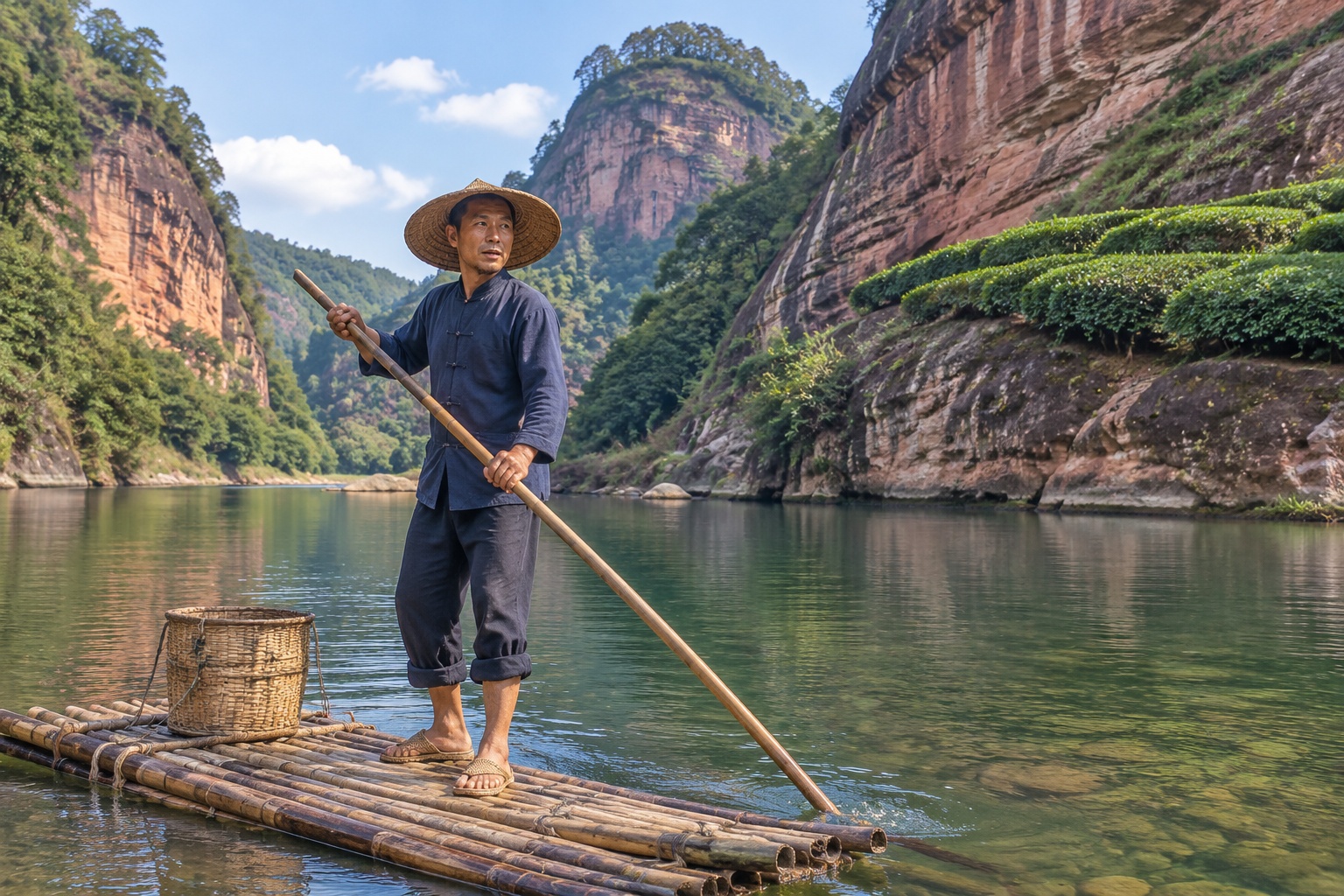
Another three-plus hours by rail takes you to Wuyishan. In the afternoon, get on a bamboo raft. The Nine-Bend River curves nine times through the mountains, and the raft ride takes about one and a half to two hours. The raft worker punts with a bamboo pole and tells you what the cliffs look like: this rock is a turtle, that peak is a thoughtful man. The local saying is ‘thirty percent resemblance, seventy percent imagination.’ After he explains, you really do see it.
The water is quiet enough to show the pebbles and fish below. On both sides are red Danxia cliffs, and tea bushes grow in the cracks.
Day 8: Mother Tea Trees and a Lesson in Gongfu Tea
Go to Jiulongke to see the six mother tea trees. The Da Hong Pao mother trees grow on a cliff and are more than three hundred years old. Picking stopped in 2006. What you drink now comes from their descendants. Walk through the tea gardens in the morning. At midday, learn to make gongfu tea: a small pot, three tiny cups arranged in a triangle, water just off the boil, the first rinse poured away, and the tea poured in a circle so every cup is equally strong.
In the afternoon, leave from Wuyishan by high-speed rail or by air.
In Fujian, Eating and Drinking Are the Same Thing
Satay noodles are breakfast and late-night food in Xiamen. The broth decides everything. Oyster omelet is made with sweet potato starch, oysters and egg, fried into a pancake with a crisp edge and a soft center, served with sweet chili sauce. Tusun dong is a cold jelly made from sandworms. It looks like aspic and tastes like the sea. Whether you try it is a small test of courage.
In Quanzhou, misua paste needs a fried dough stick. In Wuyishan, rock tea wants a piece of guangbing, a simple baked biscuit. Gongfu tea is not a performance. It is the default way to welcome a guest. When the host pours for you, tap two fingers lightly on the table to say thank you. The gesture works across southern Fujian and Chaoshan.
Six Things to Know Before You Go
- Book Gulangyu ferry tickets ahead. Tourists board at Dongdu Cruise Terminal during the day. Tickets are real-name, and in peak season they often sell out days in advance. No cars on the island, so pack light.
- The tulou night is an experience, not a comfort stay. Bring earplugs and avoid a large suitcase; you will carry it up wooden stairs.
- Quanzhou is a living old city. Remove your hat in temple halls and do not photograph monks. At Qingjing Mosque, wear long trousers; women should carry a scarf.
- Reserve the bamboo raft. Water levels affect sailings, and heavy rain can stop them. There is no shade for two hours on the raft, so bring a hat and sunscreen.
- July to September is typhoon season. Flights and boats can be canceled, so leave some slack in the itinerary.
- Transport is easy. Xiamen to Quanzhou is about one hour by rail. Quanzhou to Wuyishan is three hours or more. Xiamen to the tulou means high-speed rail plus a hired car. Wuyishan airport and rail station both connect onward.
Who It Suits, and Who It Doesn’t
It suits people who like architecture and real life, second-time visitors to China who do not want another big-city loop, and anyone willing to walk two streets for a good bowl of noodles. It also works with children: a tulou is basically a castle you can explore.
It does not suit people who want a fully luxury resort trip. The tulou night is not that. It is hard for anyone who cannot walk much: Gulangyu is all on foot, and the Island Ring Road is for cycling. And if you cannot stand heat and humidity, come in another season. In summer it can be 35°C with eighty percent humidity. Ten minutes outside and you are soaked.
What You’ll Bring Back
Not tieguanyin tea or lacquerware, but these: a piano behind a wall in a Gulangyu lane, the player invisible; dawn mist sliding slowly off four round roofs at Tianluokeng; a ring of sky seen from a tulou courtyard; a bowl of misua paste and a fried dough stick eaten squatting at a doorway on West Street; the ninth bend of the Wuyishan raft, when the raft worker suddenly stops talking and there is only the sound of the pole touching water.
After four circles, one thing becomes clear. The walls were built to keep the people inside safe. The door has always opened toward the sea.