

A Hotel That Moves With the River
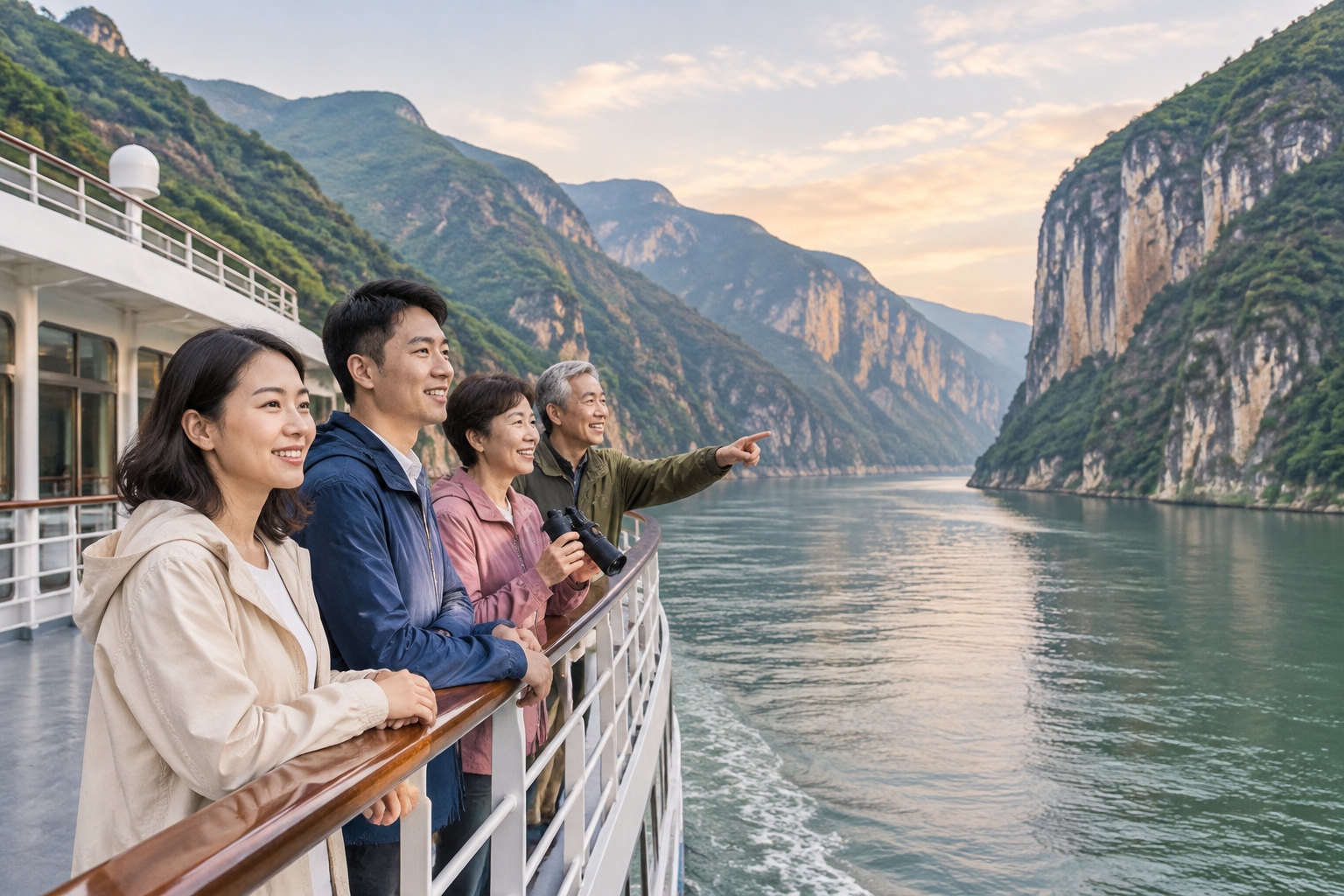
On the third evening, the ship pulls away from Chongqing after dark. The buildings on the bank recede one layer at a time; the lights come on one window at a time. You stand on deck for a few minutes. The river wind is cool, the water is black, and the only thing pushing forward is the beam from the bow.
This is the Yangtze Three Gorges cruise line. It is not a single landmark you visit and photograph. It is a nine-day journey in which your hotel moves with you for four nights, and every morning you open the curtains to a different mountain.
Why This Route Works
Three reasons make it different from most long itineraries in China.
First, you do not change hotels every day. For anyone traveling with parents, that is almost decisive. You unpack once. The room follows you.
Second, the Three Gorges are a natural scale; the Three Gorges Dam is a human scale. They appear in the same frame. You do not have to choose between landscape and engineering.
Third, you eat your way along the river: Chongqing hotpot, three meals a day on the ship, and Wuhan hot dry noodles at the end.
Before Boarding: Chongqing, Days 1–2
Day 1: Hongyadong at Night
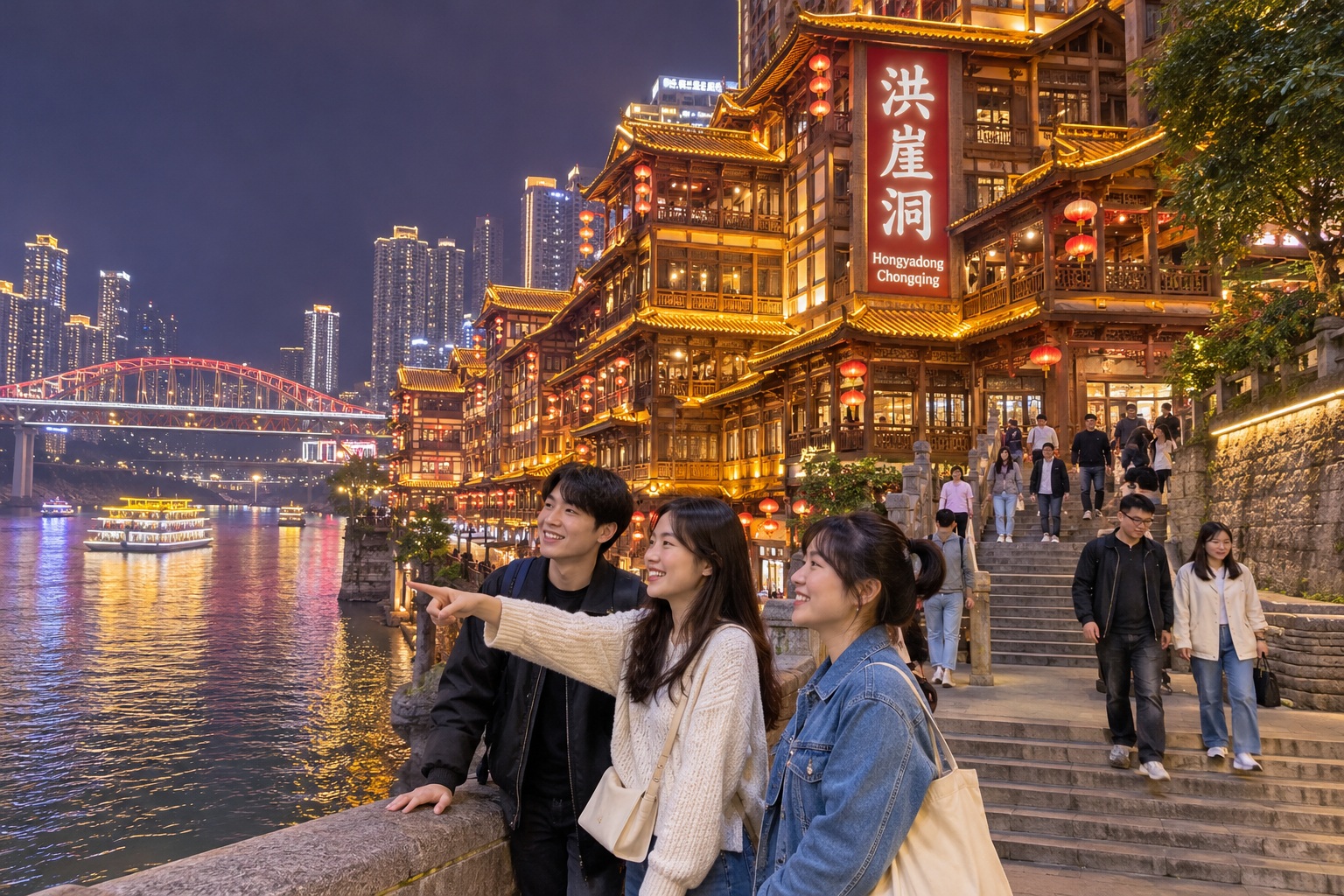
Land in Chongqing and go to Hongyadong in the evening. Eleven floors of stilted buildings hang on the cliff. When the lights come on, the whole cliff turns gold. It sits right by the river. If you walk from the bottom floor to the top, you have climbed eleven floors—that is Chongqing: two points on a map may be 80 meters apart in height.
Day 2: Jiefangbei, Ciqikou, and Hotpot
Jiefangbei is the center of the city, surrounded by shopping malls. Ciqikou is an old wharf quarter; twisted dough sticks are fried on the spot, and the whole street smells of chili. In the evening, have hotpot properly: a nine-grid pot, with the center grid boiling hardest. Beef tripe goes in for seven up-and-down dips, about ten seconds; duck intestine curls and you lift it out. Chongqing people drink soy milk with hotpot, not the broth.
Twenty Kilometers an Hour: Four Days on the Boat (Days 3–6)
Day 3 is boarding day. Departure is at dusk. The buildings on both banks retreat layer by layer, and lights come on one by one. Stand on deck for a while at night: cool wind, black water, one beam of light pushing ahead.
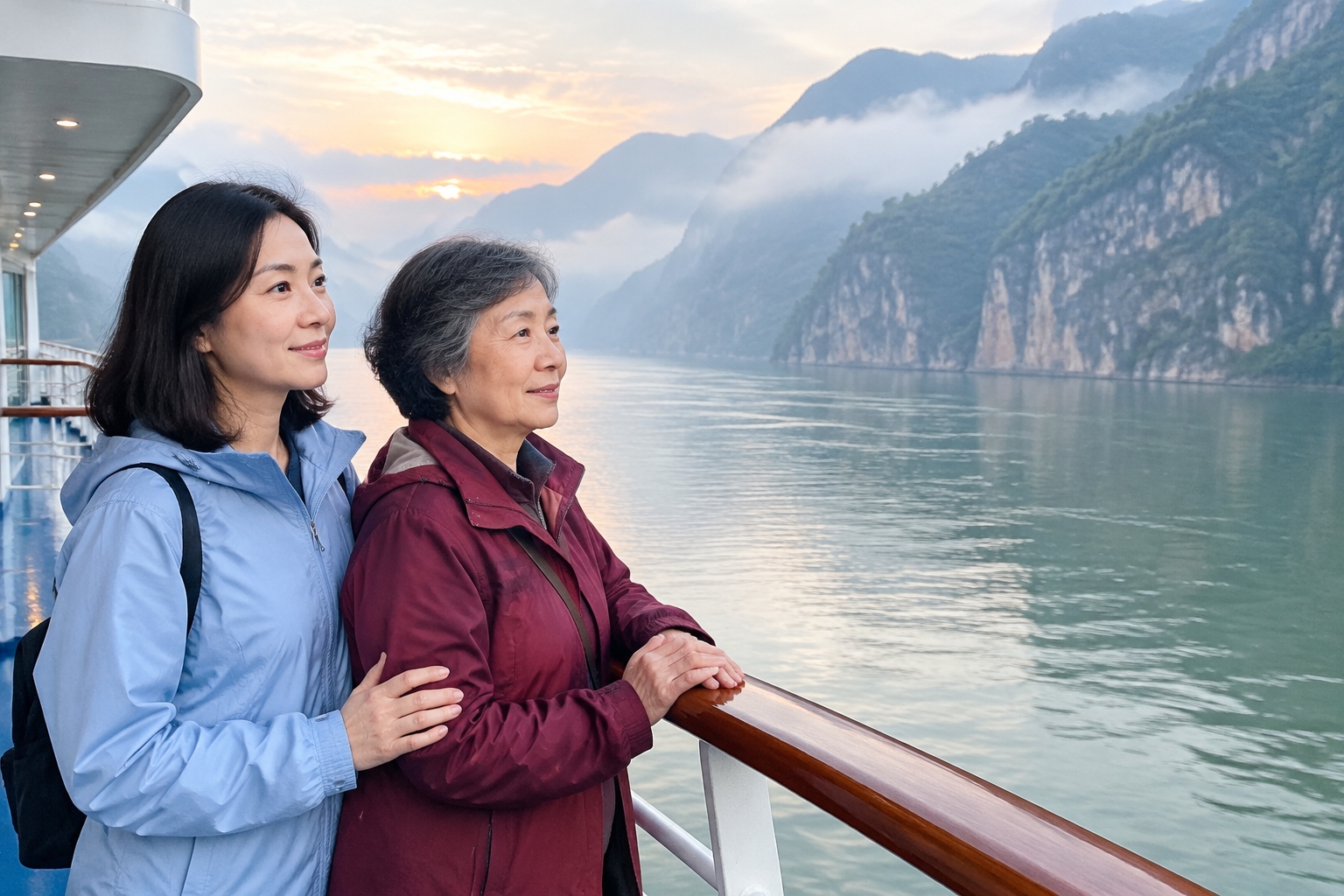
For the next four days, the rhythm becomes this: announcement at 6:30, breakfast at 7, morning on deck or in the room watching both banks, a shore stop around noon, more river in the afternoon, and a talk or performance in the evening. The ship moves at about 20 kilometers an hour—barely faster than cycling. That is the point: the scenery passes inch by inch, not in a scroll.
No packing, no rushing for trains, no searching for restaurants. This is the route’s greatest kindness to older travelers: the room follows you, and the suitcase opens once.
Zero Kilometers an Hour: Three-Hour Shore Stops (Days 4–6)
Day 4: Fengdu Ghost City
Chinese ideas about the afterlife have been made into groups of statues here: the Bridge of Helplessness, the Hall of the Son of Heaven, the eighteen levels of hell. There is a rule at the bridge—step across in one go, and do not look back. The point is not horror. The point is that people should follow the rules. Scaring you is just the method.
Day 5: The Lesser Three Gorges or Shennong Stream
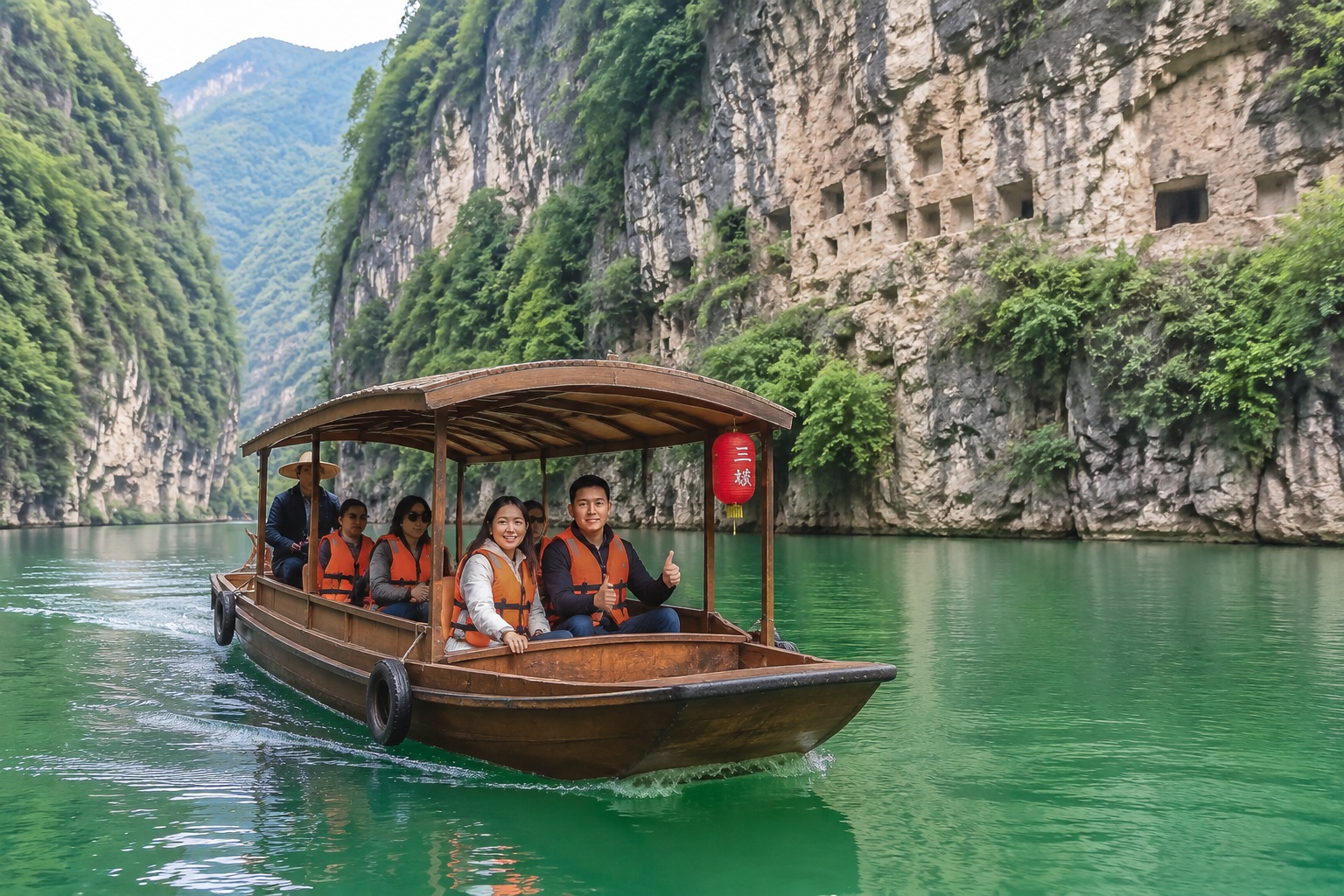
The big ship changes to a small boat and enters a tributary. The water turns from the muddy yellow of the main river to emerald green. The banks are so narrow that you can hear birds on the opposite mountain. Shennong Stream once had trackers pulling boats barefoot; today there are performance trackers—one of the few places on this route where you see human muscle at work.
Day 6: The Three Gorges Dam
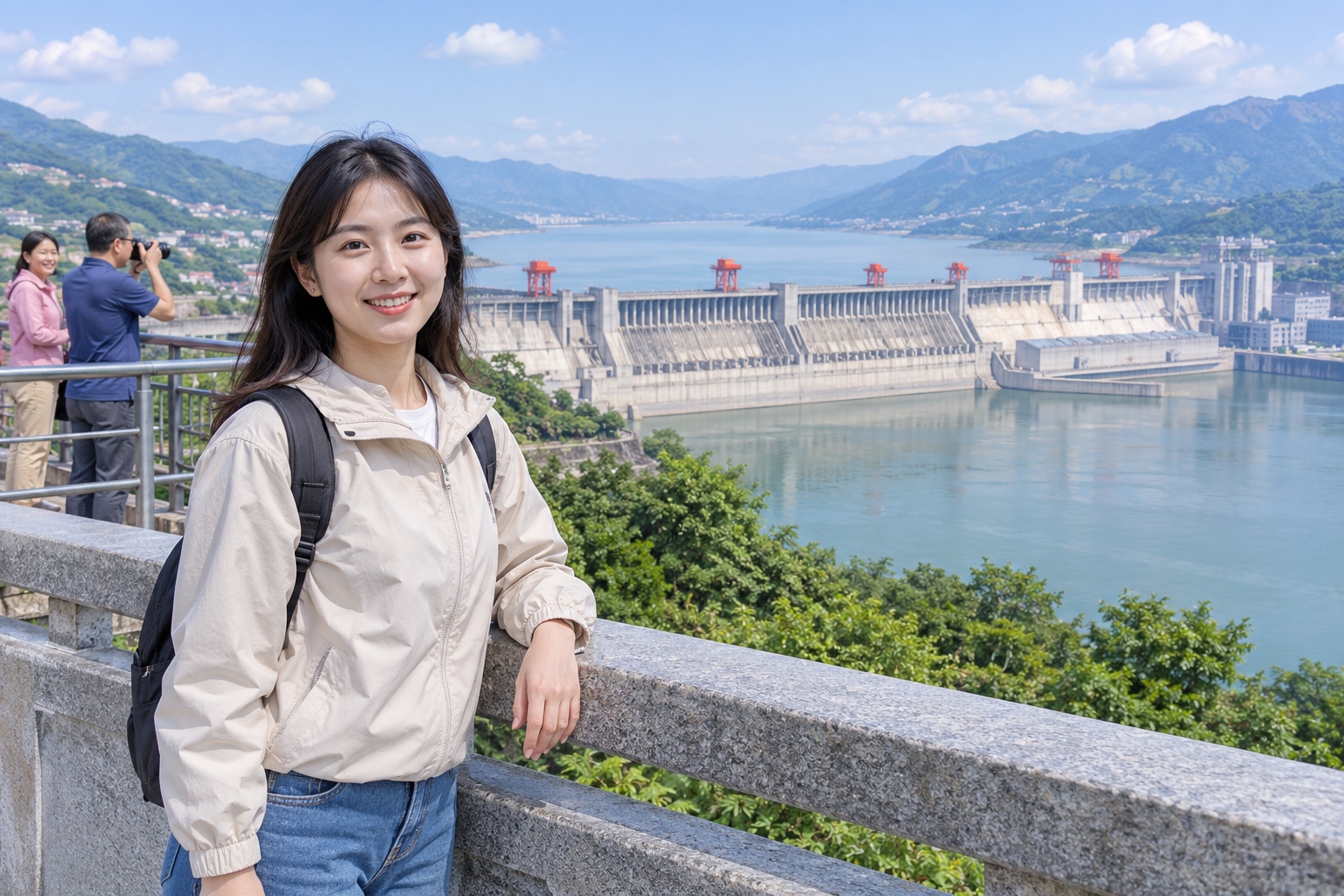
At Tanziling you see the panorama; at the 185 Platform you look at the dam crest; at the river-closure memorial park you see the concrete blocks once dumped into the river. The dam is 185 meters high, and the normal water level is 175 meters. Those two numbers are the key to understanding the whole river.
Passing the dam is another matter. Large ships use the five-stage ship locks, lowering the water level one stage at a time over three or four hours. Smaller ships can take the ship lift and be lifted as a whole in forty minutes—like an elevator for boats. Many ships pass at night, so ask the crew in advance if you want to watch.
The River’s Own Speed: The Three Gorges (Days 5–6)
The names of the three gorges are announced on board again and again.
Qutang Gorge is the shortest, only eight kilometers, and the narrowest. Its entrance is Kuimen, where the cliffs on both banks open like two doors. The image on the back of the 10-yuan note is here. On the north bank sits White Emperor City; Li Bai’s line—“At dawn I leave White Emperor in the colored clouds; a thousand li to Jiangling in one day”—was written about this stretch of water.
Wu Gorge is forty-six kilometers long, with twelve peaks standing in a row. The most famous is Goddess Peak: a stone pillar on the cliff top that looks like a person from afar.
Xiling Gorge is sixty-six kilometers, with many rapids and fast water. The Three Gorges Dam was built in its middle.
One thing needs saying. After the reservoir filled, the “danger” of the Three Gorges changed. The shoals and reefs that once frightened boatmen now lie more than a hundred meters underwater. The river has gone from fast current to lake, and the gorges feel wider and quieter. The old county towns of Zigui and Wushan were moved uphill and rebuilt; more than a million people moved. The river you see now is a river that more than a million people made room for. You are not seeing the Three Gorges Li Bai saw, but you are seeing the same gorge.
Things That Stay Still
There are things on the cliffs that do not move. Rows of square holes from ancient plank roads are cut into the rock—paths that trackers and boatmen used hundreds of years ago. The people are gone; the holes remain. In caves on the cliffs are hanging coffins: the Ba people placed their dead in cliff caves as close to heaven as possible. How they lifted them up is still not settled.
Then there are the poems. The Three Gorges is the most written-about stretch of water in China. Li Bai, Du Fu, Bai Juyi, and Su Shi all passed through. A river has been pressed down by words for more than a thousand years.
After the Boat: Yichang and Wuhan (Days 6–9)
Day 6: Yichang
Disembark in the afternoon at Yichang. It is a small city. Walk by the river and eat something light—after four days on the ship, your stomach needs a rest.
Day 7–8: Wuhan
Take a high-speed train two hours to Wuhan. Day 8: Yellow Crane Tower and Hubu Alley. The present Yellow Crane Tower was rebuilt in 1985; the original tower on this hill had been burned and rebuilt again and again since the Three Kingdoms period. From the top you can see the Yangtze River Bridge and the whole river. Hubu Alley is very touristy, but hot dry noodles are easiest to eat here: alkaline noodles, sesame paste, pickled radish, scallions. Mix fast—if you are slow, they clump.
Day 9: East Lake and Departure
East Lake is several times larger than Hangzhou’s West Lake. The lakeside road is good for cycling, and it is quiet early in the morning.
Five Practical Notes
- Upstream and downstream are different. Chongqing to Yichang is downstream, four days and three nights, faster. The reverse is upstream, five days and four nights, with more stops. For a first trip, go downstream.
- The ticket usually includes meals and shore excursions. It does not include drinks or some optional items. The price difference between cabins is mainly whether you have a balcony. On this route, it is worth paying for the balcony.
- The lock passage may be at night. If you want to see the ship lock or the ship lift, ask the crew on the first day roughly what time you will pass.
- Signal is weak in the gorges. Download offline maps in advance and handle urgent matters on shore.
- There are many steps on shore. Fengdu Ghost City has steps and a cable car; the Lesser Three Gorges requires changing to a small boat. Wear non-slip shoes.
- November is best. Three Gorges red leaves appear from mid-November to early December, the water level is stable, and the river is clear. July and August are flood season, and the water is muddy.
Who This Trip Is For—and Who It Isn’t
It is for: people traveling with parents or children—this is the least physically demanding of twenty possible routes; people who prefer history and stories to adrenaline activities; people who do not want to repack every day.
It is not for: people chasing a high density of “check-ins”—half the time on board is empty, and that emptiness is the product; people who get severely seasick (river ships are very stable, but a few people still feel unwell); people who dislike a fixed rhythm—shore excursions usually leave and return as a group.
What You’ll Bring Back
Not Three Gorges stones or tea. These: the evening the ship leaves port, lights on both banks retreating one by one; being woken by the announcement at 6:30, opening the curtains, and finding a different mountain; really not looking back when you cross the Bridge of Helplessness; hearing birds on the opposite mountain from a small boat; the two minutes when the cliffs of Kuimen press in from both sides; passing the lock at night, the wall of your room slowly rising beside you; the bowl of hot dry noodles in Wuhan, mixed too slowly, clumped.
Nine days, and the ship travels less than a thousand kilometers. The river took a thousand years to reach the view outside your window.