

Hour One: A Hundred-Yuan Note at a Convenience Store Counter
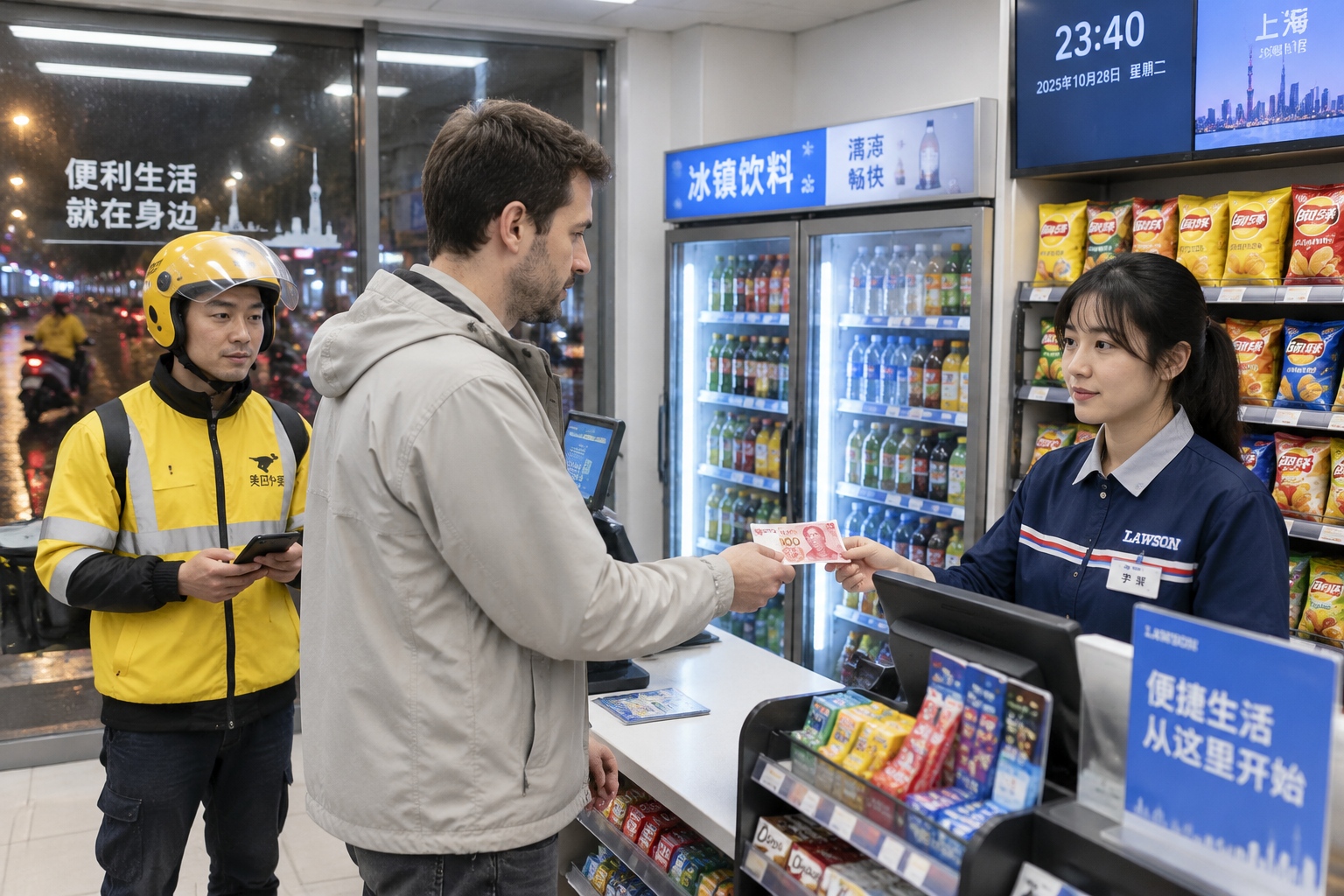
The door chime sounds at 11:40 p.m. in a FamilyMart on Wuding Road, in Shanghai’s Jing’an district. The air inside is cold and smells faintly of oden broth. A microwave beeps twice. Marco Ferretti, thirty-four, an architect from Milan who landed at Pudong International four hours earlier, sets a bottle of water and a salmon rice ball on the counter. The total is 13.5 yuan.
He holds out a 100-yuan note.
The cashier — twenties, name badge reading Xiao Zhou — takes it, opens the drawer, and finds almost no change. She looks at the note, then the drawer, then the customer behind him. “You have fifty?” she asks in Chinese, then mimes it with her hands. The man behind — a delivery rider still in his helmet — passes over a 50 and takes the coins instead.
“In Milan I’d just tap my card,” Marco says the next afternoon. “Here I felt like I’d packed the wrong equipment.”
He had set up Alipay at the airport. His Italian bank card failed on the first attempt and worked on the second, after he switched on data roaming. By the time he reached the store, his phone could already pay. What he hadn’t expected was how public the learning would feel.
Why the First 72 Hours
Transit-without-visa entry now allows citizens of 54 countries to stay up to 240 hours across two dozen provinces, which means a growing number of people arrive in China with three days to a week and a list of landmarks. The photographs come from the Bund and the Forbidden City. What visitors describe afterwards, unprompted, tends to be smaller: a ticket machine, a QR code taped to a table, a park at dusk.
This piece follows three short-stay visitors through their first three days — Marco in Shanghai; Priya Raman, a twenty-nine-year-old teacher from Toronto, in Beijing; and Tom Whitaker, a forty-one-year-old process engineer from Manchester who flew into Shenzhen to audit a supplier. They are not a sample. They are three tired people with phones.
Hour Three: The Airport Train and the Bag That Goes Through a Scanner
Priya lands at Beijing Capital at 2:10 p.m. and takes the Airport Express: 25 yuan, four stops, roughly 25 minutes to Dongzhimen. On the platform, the signs put Chinese characters first and English underneath, a size smaller.
At the ticket machine she finds the English toggle tucked in the corner of the screen, half-hidden behind the Chinese button. She presses it. The machine takes her 50 and returns the change in coins, one at a time, loudly.
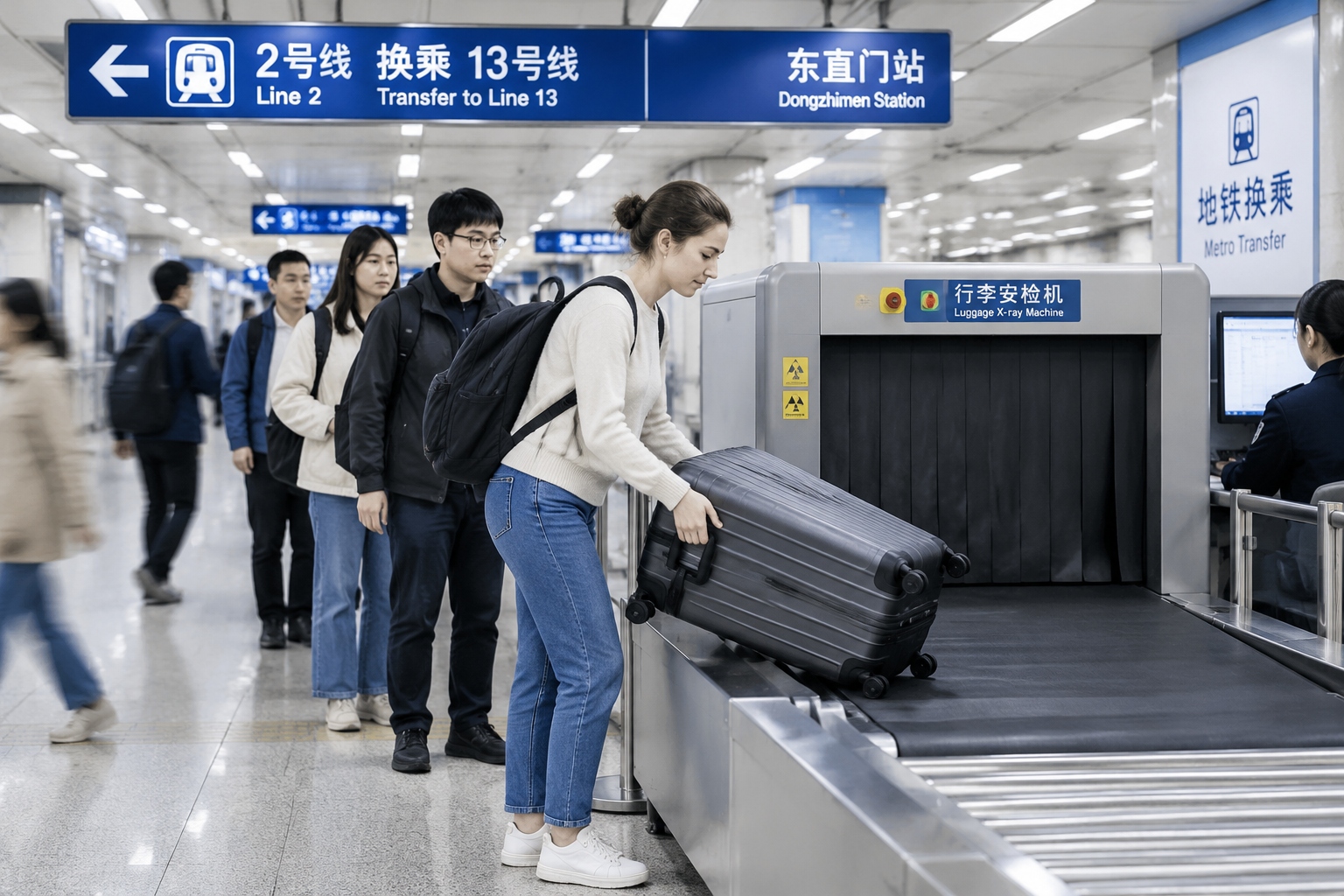
At Dongzhimen she transfers to Line 2. Her suitcase goes through an X-ray; she walks through a metal detector. “I’ve had my bag screened at airports,” she says. “I did not expect it on the way to my hotel.” The fare is 4 yuan. She taps a blue plastic token on the gate, carries it to the other end of the line, and feeds it into the slot to get out.
What surprises her is not any single piece of technology. It’s the assumption of smoothness built into the whole thing — that the train comes every four minutes, that a machine in a Chinese city has an English button at all, that the transfer is signed clearly enough to follow while dragging a 23-kilogram suitcase.
Tom, arriving at Shenzhen Bao’an, takes a taxi instead. Official queue, a dispatcher with a whistle, a meter, about 130 yuan to Nanshan. “The queue was organized by one man,” he says. “I’ve been in airports where nobody organizes anything and everyone shouts.”
Day One: The Phone Becomes a Remote Control
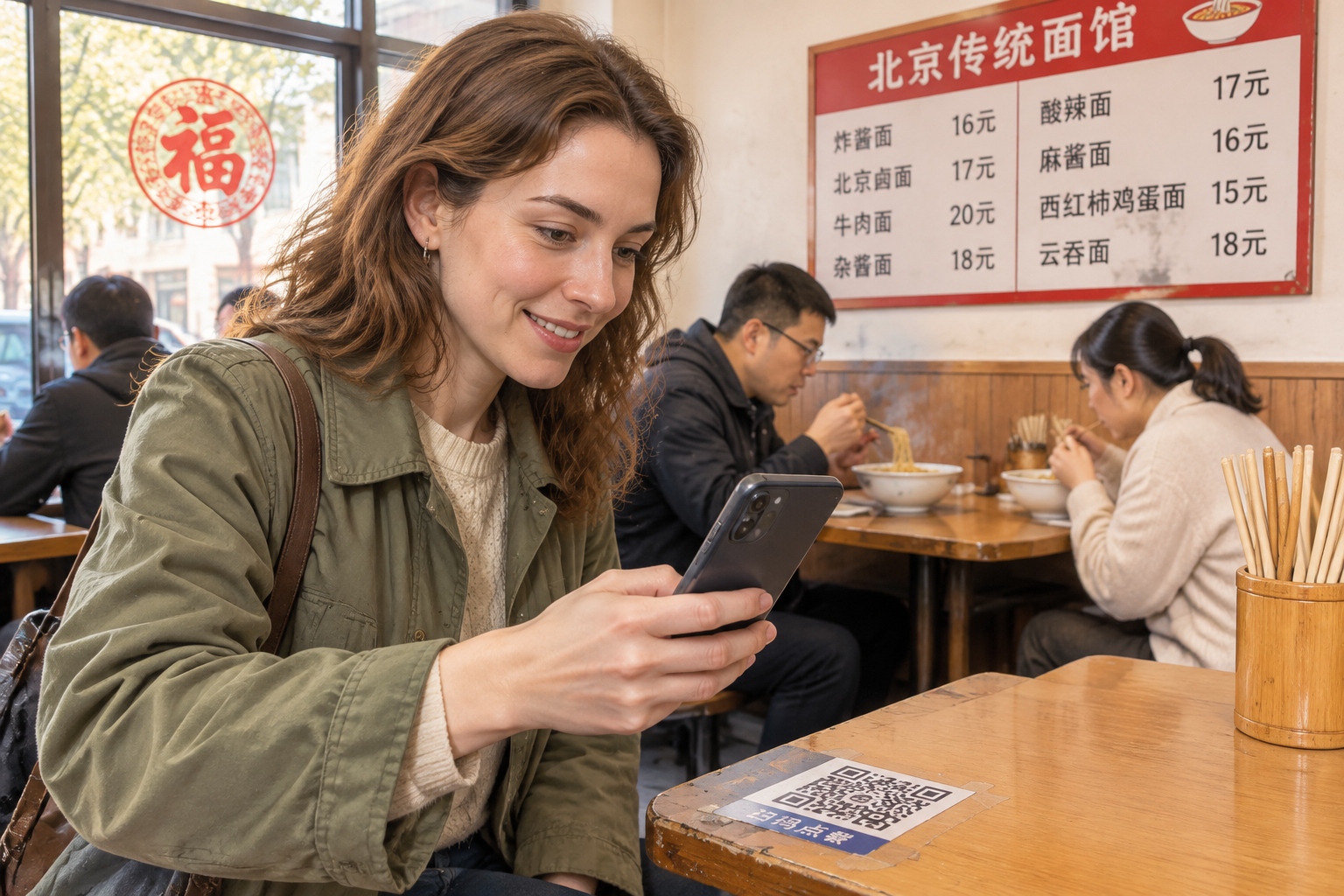
Lunch, day two, a noodle shop near the Drum Tower in Beijing. A QR code is taped to the edge of the table, worn white at the corners. Priya scans it and a mini-program opens: a menu in Chinese, photographs of every bowl, prices. She holds her phone over the menu and reads it through a translation app, then points at the third item and hopes.
“I ordered wrong twice in three days and both times it was fine,” she says. “The second bowl was better than the first.”
By the end of day one her phone has become a remote control for the physical city. Didi, the ride-hailing app, has an English version that mostly works. Amap, the mapping app, gives bus arrival times accurate to the minute — “it told me two minutes, and it was two minutes.” A shared power bank, pulled out of a rack by the door of a café, costs 4 yuan an hour and is returned to a different rack three streets away.
Where it still snags
The friction is real and specific. Setting up a wallet as a foreigner takes five to ten minutes: passport photo, face scan, a card from home that your bank may or may not approve for overseas use. Some mini-programs ask for a mainland phone number for verification, and that is the end of that. Menus in smaller restaurants are not translated. Cash is legal tender and legally must be accepted, but a vegetable stall at 7 a.m. may genuinely have no change for a 100.
Priya carries 300 yuan in cash for the whole trip and spends about 60 of it. “Not because people refuse it,” she says. “Because I can see them doing math in their heads when I hand it over.”
Day One, Evening: A Park That Is Loud on Purpose
7:20 p.m. in a public park in Dongcheng, ten minutes’ walk from where Priya is staying. A speaker sits on a bench, angled outward. Forty women in two loose rows follow an instructor wearing a headset microphone; a man in his seventies watches from a stone step with a birdcage beside him. Two children weave between the rows on scooters and nobody stops them.
The volume is the part visitors notice first. Then the fact that it stops, almost exactly, at 9 p.m.
Later, near a night snack street in Putuo, Tom walks back to his hotel at 1 a.m. “I have never felt unsafe walking at night here,” he says. “I have felt unsafe crossing the road at seven in the evening.” Both things are true at once: bright lights, open convenience stores, cameras on poles, women walking home alone at midnight — and scooters running red lights, e-bikes on the sidewalk, delivery riders going the wrong way down a one-way street. Order and improvisation share the same asphalt.
Day Two: The Station Where Nobody Stands in Line
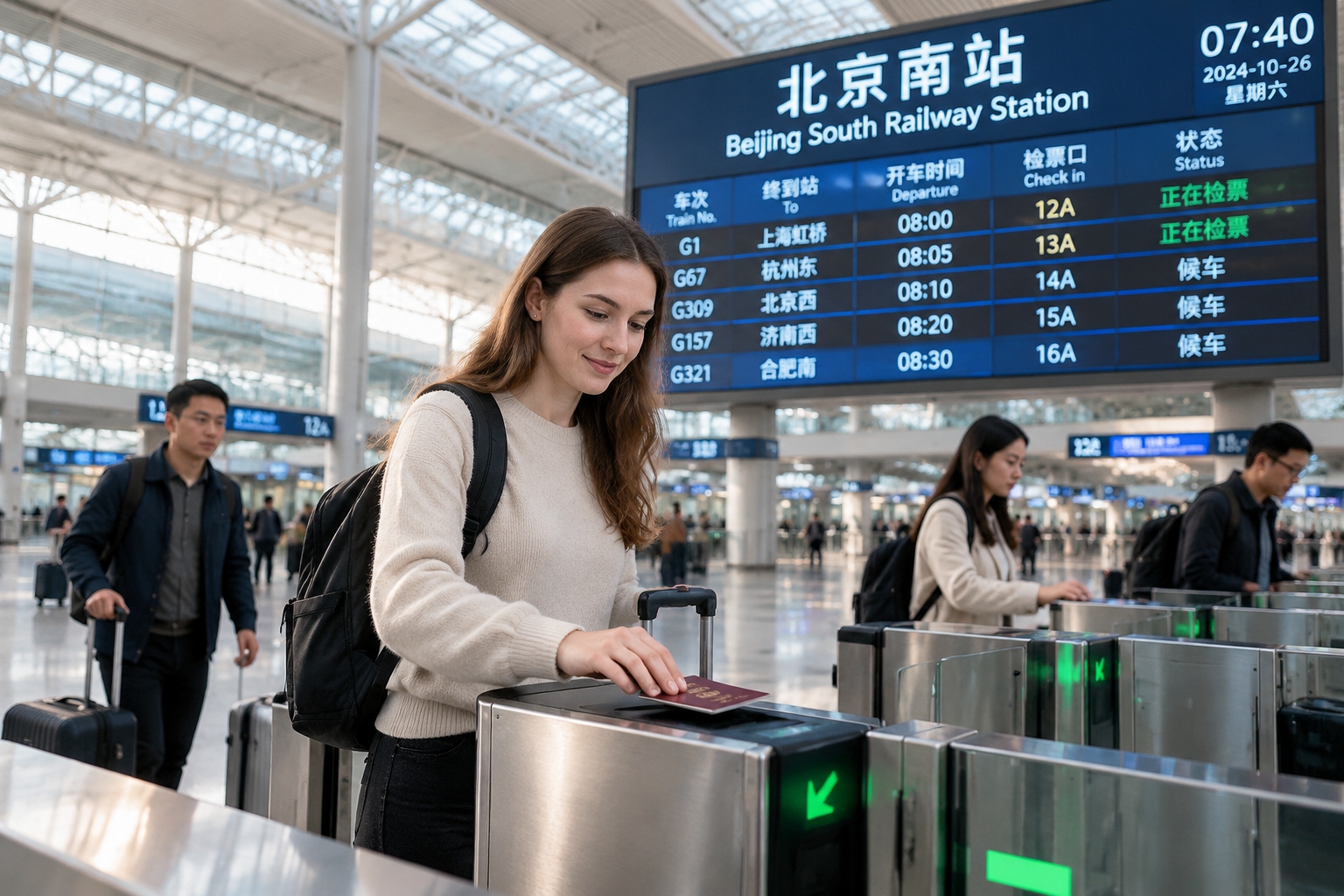
Beijing South Railway Station, 7:40 a.m. The departure hall is the size of a regional airport; the station has 24 platforms. Priya’s train to Shanghai Hongqiao leaves at 8:35 — a G-series, four hours twenty-eight minutes, 553 yuan in second class.
There is no paper ticket. Her passport is the ticket. At the gate she lays it flat on the reader; the doors open; a camera above the gate photographs her face. At the entrance, security ran her bag through an X-ray and passed a handheld scanner over her water bottle. Boarding opens fifteen minutes before departure and closes five minutes before. She is on the platform at 8:22.
The train leaves at 8:35:00.
“That was the one moment in three days when I understood exactly what was happening,” she says. “No translation needed. You get on, you sit down, you arrive.” Marco, meanwhile, takes the 45-minute train from Shanghai Hongqiao to Hangzhou East for 73 yuan, as a day trip, because it was cheaper than he expected and he wanted to see whether the reputation held.
It did, in the sense that nothing happened. No delay, no announcement he needed to understand, no queue.

Day Three: Coffee With Someone Who Has a Deadline
4 p.m. in a café on Yongkang Road, Shanghai. Chen Yuxin, twenty-six, works in marketing for a consumer goods company and has agreed to talk for half an hour before a call. She lives forty minutes away by metro, door to desk. She leaves home at 8:05 and is usually at her desk by 9. On normal days she leaves the office at 8:30 p.m. Twice a month, later.
Her groceries arrive at her door in about thirty minutes. She does not own a car and does not want one. Most weekends she takes a train somewhere for a night — a small town two hours away, a guesthouse, back on Sunday evening.
“Foreign friends ask if I’m tired,” she says. “Yes. But my vegetables come to my door for two yuan, and I’ve never once had to find parking.” Asked about overtime, she thinks for a moment. “Nobody on my team leaves before eight. Nobody says that out loud either.”
This is the part that rarely makes it into either the praise or the criticism. The convenience and the hours come from the same system, and the same person pays for both.
After 72 Hours: What Still Doesn’t Fit
Marco’s list of unresolved things is short and stubborn. He never worked out how to book a train ticket without help, even though the official app now has an English interface. He could not read a single receipt. He kept his home-country VPN expectations and found that some apps loaded slowly or not at all, while everything Chinese-loaded instantly.
Priya’s question is different. On her last morning she watched an elderly woman pay for breakfast with a folded five-yuan note and a plastic bag of coins, and wondered how many people in this city are still outside the system everyone keeps praising. She also noticed that the English signage thins out fast once you leave the airport and the main lines — two stops off the tourist map, she was navigating by photographs.
Tom’s summary is the least romantic. “Everything works,” he says. “I just couldn’t tell you how to do any of it if my phone died.”

On his last night, Marco goes back to the same FamilyMart. Different cashier, different shift. He pays in about a second and a half, phone flat on the scanner, and does not look at the screen. Outside, scooters pass, someone is grilling skewers on the corner, and the temperature has dropped to 14 degrees. He still can’t read the receipt. He keeps it anyway.