
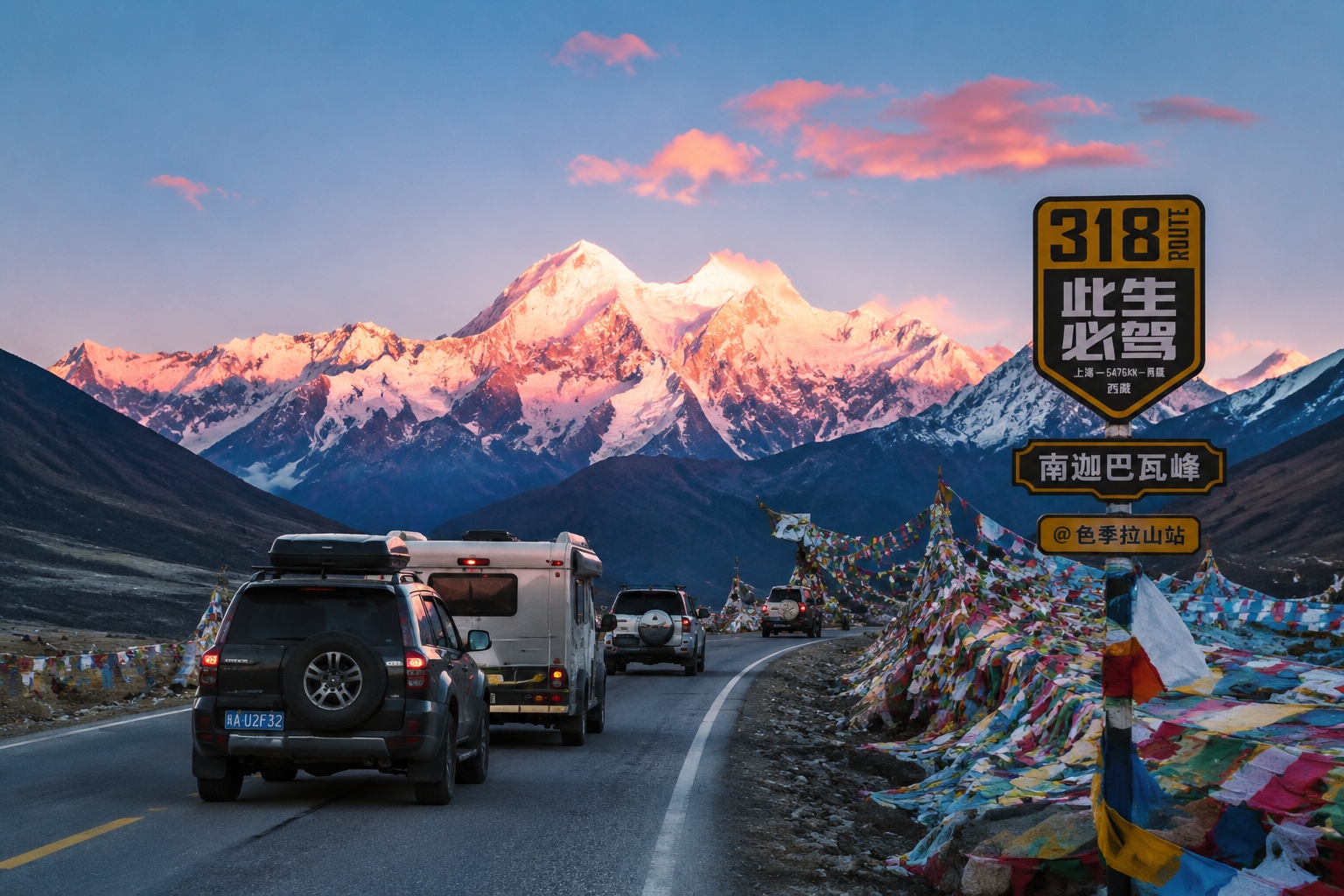

At 7 a.m., at the foot of Mount Sejila, a line of SUVs and camper vans waits for the road to open. On the rear windshield of a Toyota Land Cruiser, a yellow decal reads: “此生必驾318” — “I Must Drive 318 in My Lifetime.” The driver, a young man from Chengdu, rolls down his window and points his phone toward Namcha Barwa, the highest peak in the eastern Himalayas. The sunrise lights up the snowcap in a pink glow. But unlike the classic road-trip image, he is not rushing to the next checkpoint. He has booked three nights at a Tibetan wooden guesthouse in Lulang, a small town over the mountain pass.
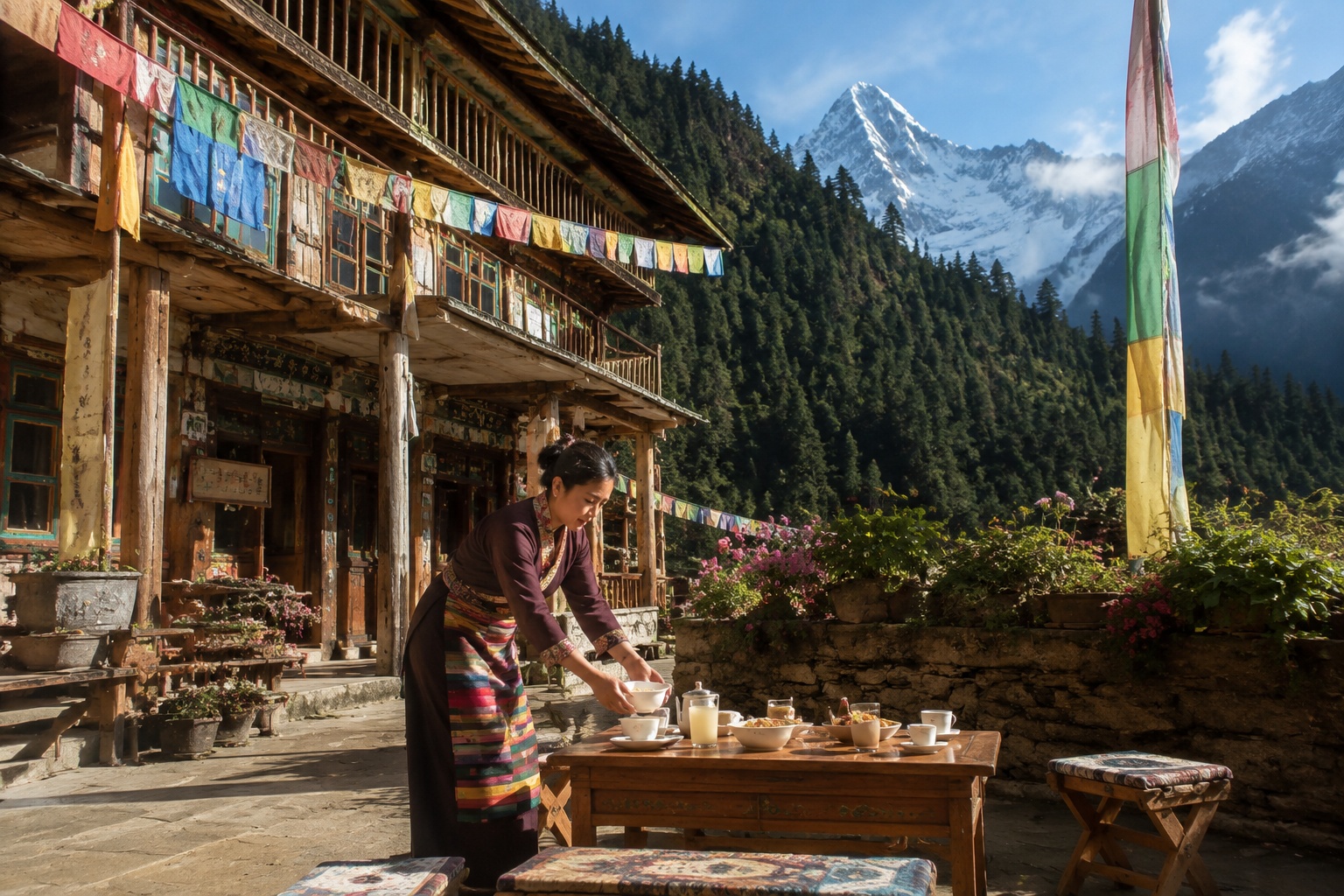
That scene captures a quiet shift in Tibet’s tourism. For years, National Highway 318 was the ultimate bucket-list drive for Chinese travelers, a ribbon of asphalt through some of the world’s most dramatic landscapes. The slogan “此生必驾318” became a viral sticker and a social-media declaration. But today, the road is no longer just a route to cross off. It has become a network of stays, where travelers sleep under hand-woven blankets, eat meals cooked by Tibetan families, and wake to the sound of prayer flags flapping in the wind.
The Highway’s Legend
The 5,476-kilometer highway runs from Shanghai to Zhangmu on the Nepal border, passing through snow-covered mountains, deep gorges, and endless grasslands. The section from Sichuan to Tibet, often called the Chuan-Tibet line, is considered the most scenic and dangerous. It crosses 14 mountains above 4,000 meters, including the 5,000-meter pass of Que’er Mountain.
For Chinese drivers, completing this route is a rite of passage. Stickers with “此生必驾318” (“I Must Drive 318 in My Lifetime”) appear on bumpers across the country. Social media feeds fill with videos of hairpin bends and distant peaks. But for a long time, the journey was mostly about reaching Lhasa. Tourists would drive for days, stop briefly at viewpoints, take photos, and then hurry to the next town. Few spent time in the small villages scattered along the way.
Where the Road Meets a Home
Lulang is 3,300 meters above sea level. In summer, its pastures are dotted with yaks and wildflowers; in autumn, the forests turn gold. Dozens of wooden houses now carry the sign of a guesthouse. One of them belongs to Tsering, a 46-year-old who used to spend his days herding cattle high in the mountains. Five years ago, with a bank loan and support from the village cooperative, he turned his family’s old wooden home into a homestay with 10 rooms.
Tsering’s kitchen smells of butter tea and roasting barley. He serves breakfast to guests at a low table by the window. “Before, tourists would stop for a photo in front of the prayer flags and drive on,” he says in a mix of Mandarin and Tibetan. “Now they stay two, three nights. Some even follow me into the forest to look for matsutake mushrooms.”
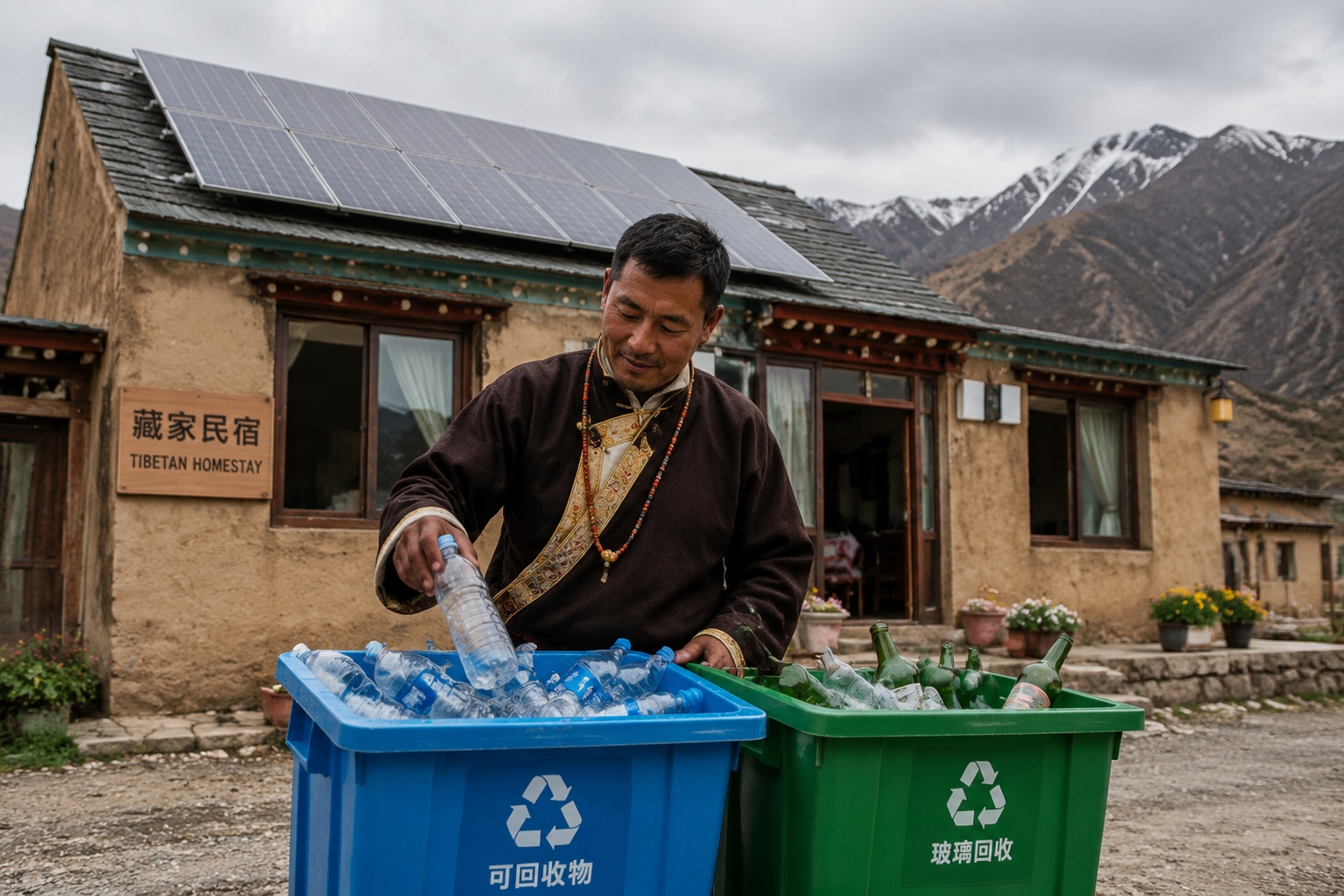
His bathroom includes a modern shower, but the rest of the house keeps its traditional feel: carved beams, colorful rugs, and a wood-burning stove at the center. On the wall, a small sign lists house rules in Chinese and English: “Please maintain quiet after 10 p.m. and recycle your bottles.” Guests are not hard to find. Travel apps like Ctrip and Meituan show dozens of homestays in the area, many with hundreds of reviews from visitors praising the hospitality and the mountain views.
New Guests, New Hosts
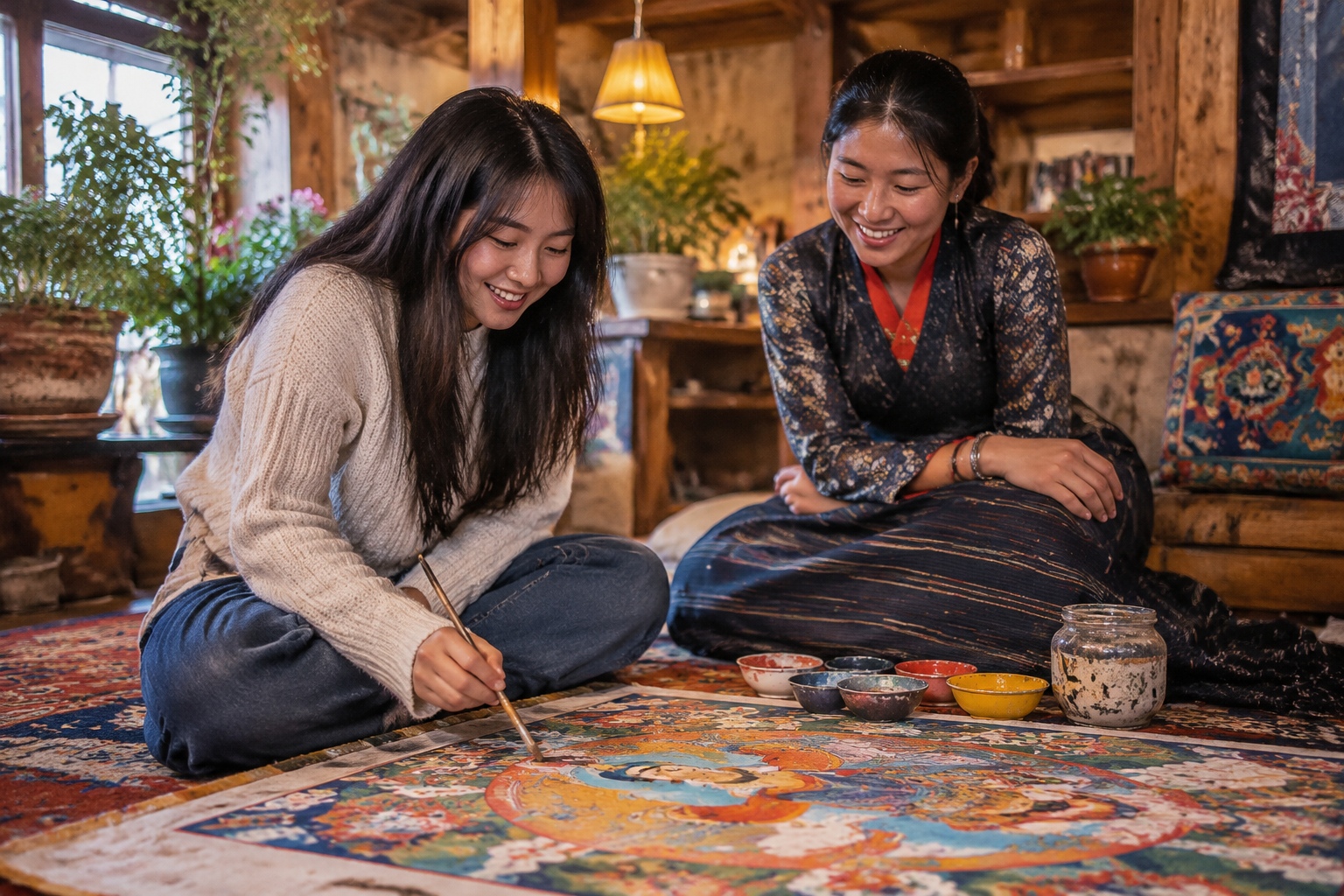
The new visitors are different from the tour-groups of the past. Many are in their 20s and 30s, working remotely or on a long holiday. They come from Beijing, Shanghai, Shenzhen, and increasingly from overseas. They want to hike, paint thangka, or practice something called “slow tourism.” They are willing to spend more on accommodations that feel local. A night at a mid-range homestay in Lulang costs roughly 300 to 600 yuan (about 40 to 85 US dollars), which is often more than a standard hotel room in Lhasa, but guests say it is worth it for the experience.
This demand has created a new type of host. Yangchen, a 34-year-old from Nyingchi, left a job as a hotel receptionist in Chengdu to return to her village. She runs a seven-room guesthouse with her mother. She also teaches guests how to make a traditional Tibetan incense using rhododendron leaves and other herbs. On a sunny morning, I watched a group of four visitors from Shanghai sit around a low table while Yangchen showed them how to mix the ingredients. “I don’t want to turn my house into a mini-hotel,” she says. “I want people to feel like they are visiting a friend.” She keeps the menu home-style: tsampa porridge in the morning, yak meat stew at night. But she has installed strong Wi-Fi and a shared workspace for digital nomads.
The trend is not limited to Lulang. In Bomi, a county famous for its peach blossoms and glaciers, former wooden stilt houses have been renovated into riverside cabins. In Potala Palace’s shadow in Lhasa, townhouses are being transformed into boutique guesthouses with courtyard gardens. In Shannan, the birthplace of Tibetan culture, a handful of families are offering farm stays where guests can help harvest ancient barley.
The Digital Highlands
Tibet may seem remote, but the digital infrastructure has caught up with the mountains. Highways are lined with 4G and, in many areas, 5G towers. Mobile payment apps like Alipay and WeChat Pay are accepted in almost every village shop. Online travel platforms are used to book rooms and order food. In Lulang, Tsering shows me his phone: a shared calendar in a WeChat group for homestay owners, where they update availability and warn each other about road closures.
Electric-vehicle charging stations have also appeared along Highway 318, in places like Nyingchi and Bomi. On a recent morning, two Teslas and one BYD SUV were parked in front of a charging station in Lulang. The drivers, all from different provinces, said they were making the full Sichuan-Tibet circuit. One of them, a woman in her 30s named Huang, said she used to think Tibet was too far for an electric car. “I saw the charging map on my phone,” she said. “It made the trip possible.”
This connectivity has reshaped the business. Travel reviews on apps like Xiaohongshu often decide which guesthouse gets full for the month. A host in Bomi told me that a single viral video on Douyin can bring a flood of guests within a week. At the same time, the internet allows hosts to learn from each other. Some are now using eco-friendly amenities, like bamboo toothbrushes and biodegradable containers.

Beyond the Homestay Boom
With the boom, though, come challenges. In the summer peak season, some villages are overbooked, and traffic jams snake up the mountain roads. In winter, many guesthouses shut down because of snow and the cold. Environmental pressure is real: plastic waste and sewage need to be managed carefully in one of the world’s highest-altitude regions. On a stretch of the highway near Bomi, I saw a group of volunteers collecting plastic bottles left by careless campers.
Local governments are trying to keep the growth sustainable. In several counties, building new guesthouses requires a permit that considers environmental impact. Some villages have set aside shared waste-collection points. Tsering, for example, uses solar panels for part of his electricity and keeps a compost pile for kitchen waste. He says that until two years ago, he used to burn all his trash in the yard. Now he and his neighbors have a recycling schedule coordinated by the village.
The homestay economy is also helping to preserve traditional architecture and crafts. Many hosts have kept the original wooden pillars and hand-painted beams, rather than replacing them with concrete. Women are reviving weaving techniques to produce bedding and wall hangings for guest rooms. A small cooperative in Lulang offers afternoon classes in thangka painting, and the profits go to maintaining a local temple.
The Road Ahead
The road is still busy. But the people who drive it are beginning to stay longer, spend more, and leave their cars behind to walk into the valleys. The sticker “此生必驾318” remains on the bumper, but the journey itself is no longer the only goal. A decade ago, a homestay in a Tibetan village was rare. Now, entire valleys are dotted with them, each with its own character and story.
As I left Lulang, a guest from Shanghai was sitting on the porch, writing in a notebook. She had been there four days and planned to stay another week. “I came for the landscape,” she said. “I’m staying for the people.” That says something about how travel is changing in China’s far west. The highway remains iconic, but the real journey now begins when you park the car and open the wooden door.
Start the discussion at forum.chinacomes.com