

Introduction: An Evening on Taiping Street
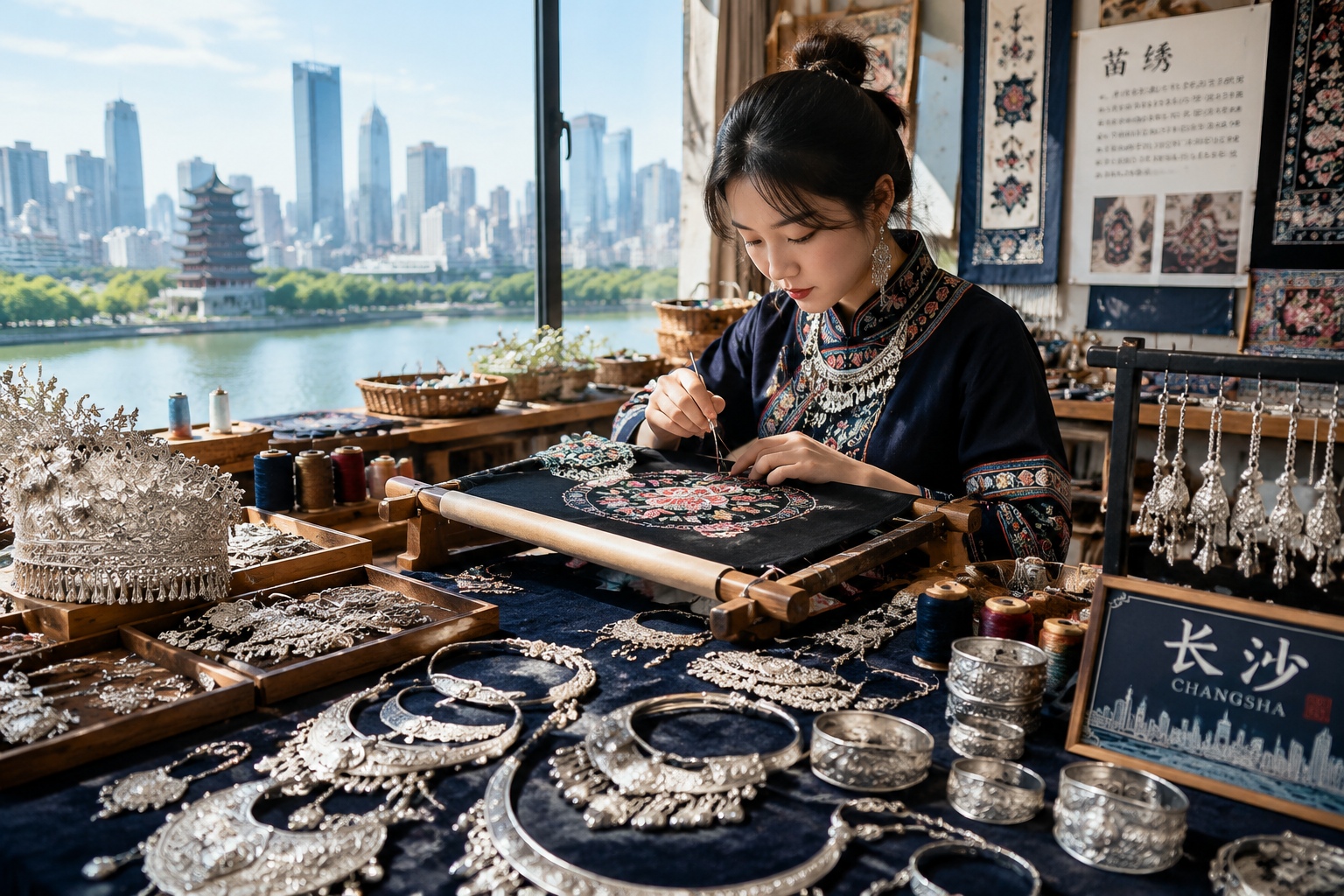
The lamps on Taiping Street glow warm at seven in the evening. In a tiny shop called “Atelier Zhenxiang,” 26-year-old Zhou Yu sits at a wooden embroidery frame. Her needle moves quickly through bright blue silk, stitching a tiger’s head. The technique is called bristling needle, and it makes the fur look almost alive. On a shelf beside her, silver bracelets and earrings with floral patterns catch the light. Two of Hunan’s most famous crafts—Xiang embroidery and Miao silver—share this space, just as they share the history of the region.
This article looks at how these craft traditions are changing today. We’ll meet an embroiderer in Changsha, a silversmith and his son in a Miao village, and see how they are finding a way to keep tradition alive in a digital, mass-produced world.
Xiang Embroidery: From Museum Exhibit to Everyday Design
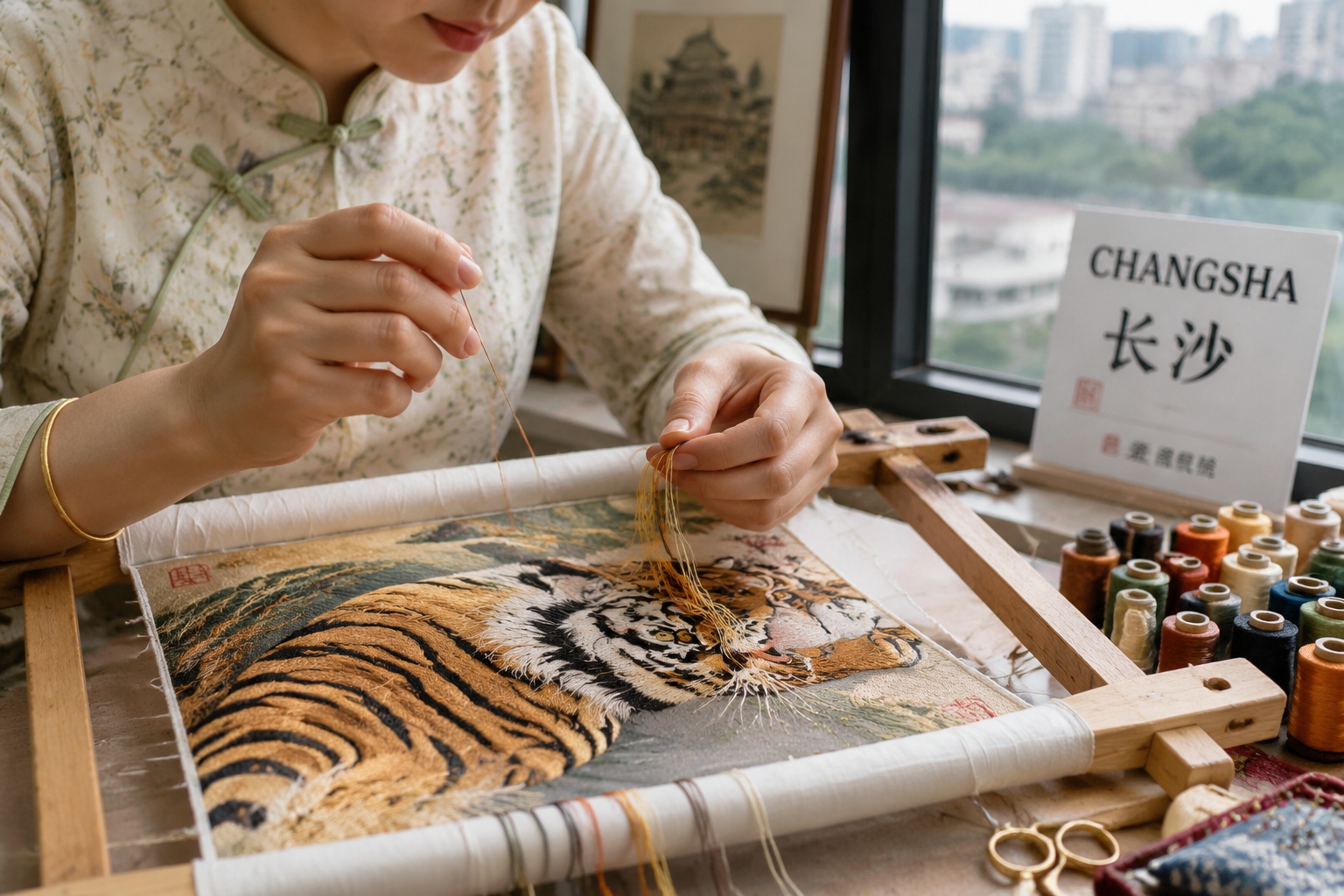
Xiang embroidery is one of China’s “four famous embroideries,” alongside Suzhou, Guangdong, and Sichuan. It dates back more than two thousand years and is known for its vivid colors and a clever technique called bristling needle. The thread is split into fine strands and stitched in crisscross layers, creating a three-dimensional texture that gives animals and birds a lifelike quality. The process is difficult: a single tiger can take more than a month of steady work.
A Craft Rooted in Thread
Zhou Yu learned embroidery from her grandmother. “I used to watch her while she worked,” she says. “It seemed like magic.” After studying at Hunan Arts and Crafts Vocational College, she began to practice the difficult stitches. “In my class of 20, only five continued after graduation,” she recalls. Many young people are put off by the low pay and the patience required. An apprentice might stitch simple patterns for years before being allowed to attempt a bird or a flower.
The Struggle to Attract Young Hands
The craft’s biggest challenge is economic. Apprentices earn little, and it takes years to master the techniques. Zhou Yu had doubts, too. But she realized that embroidery had to become part of modern lives. So she started experimenting with small items that people use every day.
New Life in Fashion and Home
She began making hairpins, earrings, brooches, and phone cases, each with a tiny embroidered detail. She posted photos on social media. “The reaction surprised me,” she says. “Young people were excited, but they said they didn’t know how to wear embroidery with a casual outfit. That’s why I designed a small collection of accessories that are easy to match.”
Her workshop in a shared studio in Changsha is a mix of old and new: a century-old wooden frame next to her laptop and a ring light. She collaborates with local fashion labels, adding embroidered birds or blossoms to modern jackets and dresses. “We don’t need to cover the whole cloth,” she says. “One beautiful detail is enough.” On weekends, she hosts small classes for tourists and office workers. “They just want to feel the craft with their hands. That connection matters.”
Miao Silver: From Mountain Villages to City Streets
Miao silver is the jewelry heritage of the Miao ethnic group, who live in Hunan’s western mountains. In Miao culture, silver carries deep meaning. It is a sign of wealth, a protection against evil, and a family gift to daughters before marriage. A full festival set includes elaborate necklaces, earrings, and headpieces that can take months to craft.
More Than Ornament: The Cultural Weight of Silver
In Miao villages, women wear silver on special occasions. The heavier the set, the greater the family’s pride. Traditionally, silver was a way to store wealth that could be easily carried. Today, many families still pass down silver heirlooms. Each pattern has a symbolic meaning: butterflies represent happiness, fish mean abundance, and floral designs bring good luck.
A Silversmith in the Hills
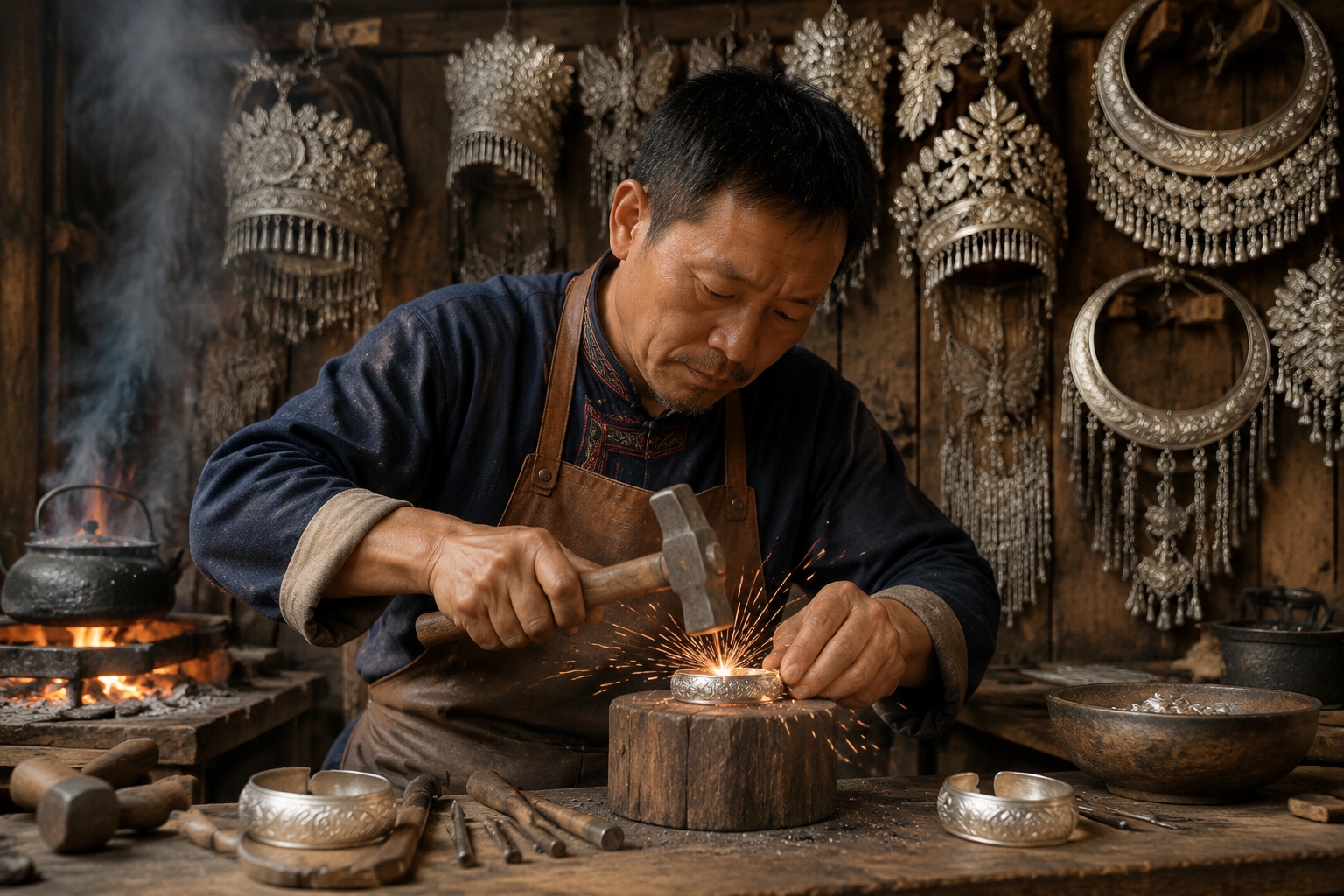
Long Shunsheng, 48, has been making silver in his village near Phoenix Ancient Town for 30 years. He learned from his father at the age of 15. In his small workshop, the air smells of charcoal and hot metal. We watch him as he patiently lays a flat sheet of silver on an iron anvil and begins to shape it with a small hammer. “One bracelet can take three days,” he says. The hammering is rhythmic, almost hypnotic. He still makes the traditional festival headpieces, weighing up to two kilograms, but has also created more modern pieces like slim rings and minimalist earrings. His son, Long Fei, 24, returned from university two years ago and now manages the online business.
E-Commerce and Tourism: A Global Silver Lining
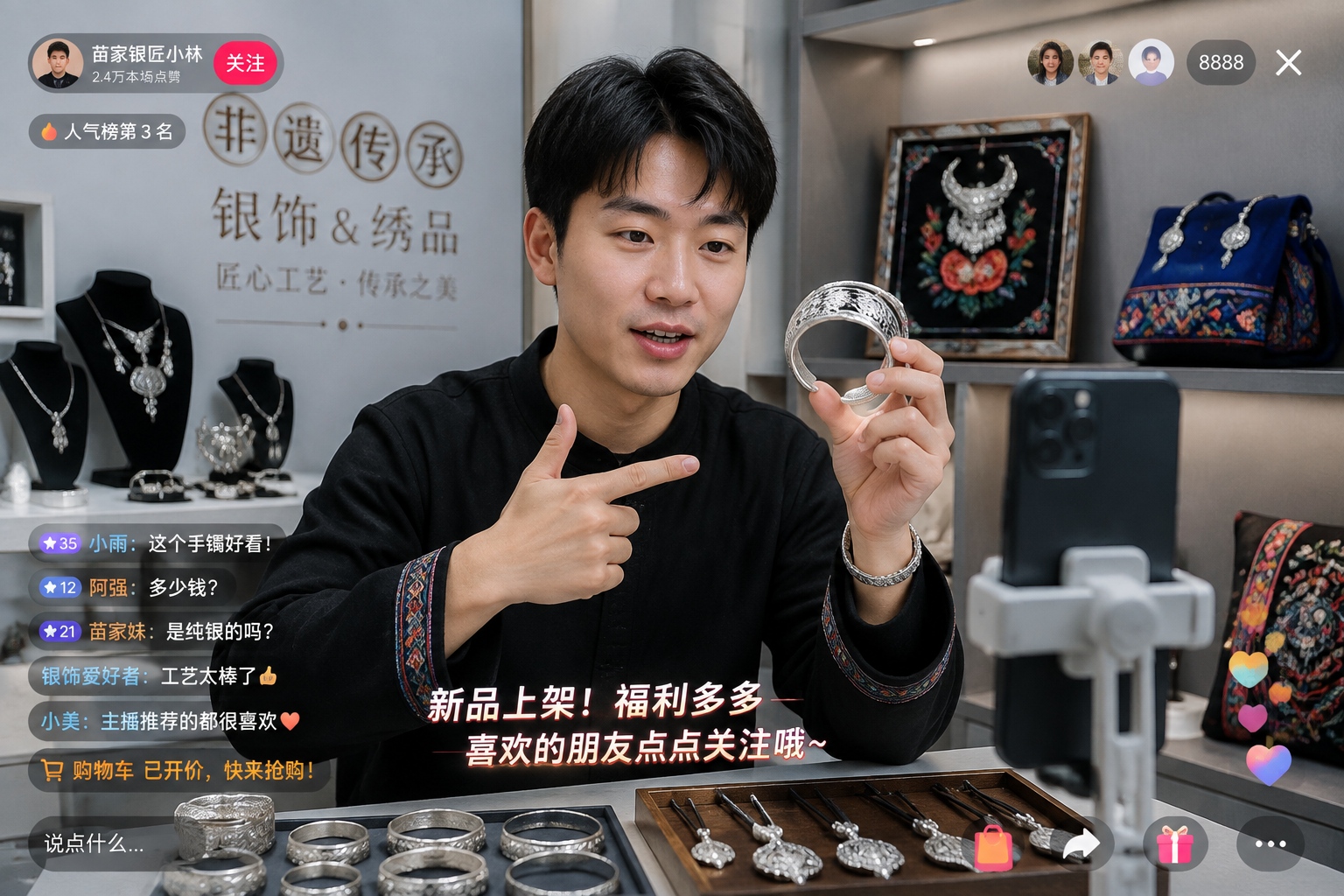
Long Fei posts videos of his father working on Douyin (TikTok) and Kuaishou. The hypnotic sound of hammering has attracted over 200,000 followers. “People find it relaxing,” he says. The videos act as free advertising. Orders come from all over China, and some from abroad. He also opened a showroom in Phoenix Ancient Town, where tourists can see the craftsman at work and buy directly. “We now have customers who found us online and came to visit us personally,” he says.
Tradition and Livelihood: Craftsmanship as a Business
Both Zhou Yu and Long Fei are part of a new generation of rural entrepreneurs. Chinese government programs support “rural revitalization” and help craftspeople with training, loans, and marketing. But both say that market demand is the real driver.
Young Craftspeople Returning Home
“The internet made it possible for me to stay in my hometown,” says Long Fei. His monthly sales can reach 30,000 yuan during holidays. Zhou Yu earns about 6,000 yuan a month from her shop and classes—enough for a modest life in Changsha. They are not getting rich, but they are the best ambassadors for their crafts. They use social media to tell the stories of their hands, and people respond.
When Heritage Policy Meets the Market
Local governments give some craftspeople official “intangible cultural heritage” status, and some receive a small annual stipend. For example, Long Shunsheng receives 3,000 yuan a year. It doesn’t pay the bills, but it brings prestige and access to subsidized trade fairs. “The real help is when they invite us to exhibitions in other cities,” says Long Fei. But the income comes from the pieces they sell.
How to Buy Hunan’s Handcrafts Abroad
If you’d like to own a piece of this heritage, it’s not as hard as you might think. Many artisans sell on Taobao, which has an international site. Some use Etsy, or even Instagram for direct orders. Zhou Yu’s brand “Zhixia” can be found online, and Long Fei ships worldwide through a local agent. If you visit China, craft fairs in Shanghai and Shenzhen feature Hunan artisans, and in Changsha, Taiping Street is a good starting point. Ask for the maker’s name—a genuine craft piece comes with a story, not just a price tag.
Conclusion: Warmth in the Digital Age
A machine can copy a pattern, but it cannot reproduce the touch of a hand that sews a single strand of silk with care, or the hand that hammers a piece of silver for three days. What makes Xiang embroidery and Miao silver special is the human connection we feel when we see the stitches and the hammer marks. They carry the climate of a place, the wisdom of generations, and the spirit of a living tradition.
In Hunan, this connection is being shaped anew by young people who respect the past but are not afraid of the future. They use the old wisdom of their ancestors and the new power of digital networks. They are ensuring that these crafts continue to grow, evolve, and be a part of the world. That is how a craft survives: not by being frozen in a museum, but by being used, worn, lived with. In Changsha and in the villages of western Hunan, the needles are moving, the hammers are beating, and the tradition is very much alive.
Start the discussion at forum.chinacomes.com