
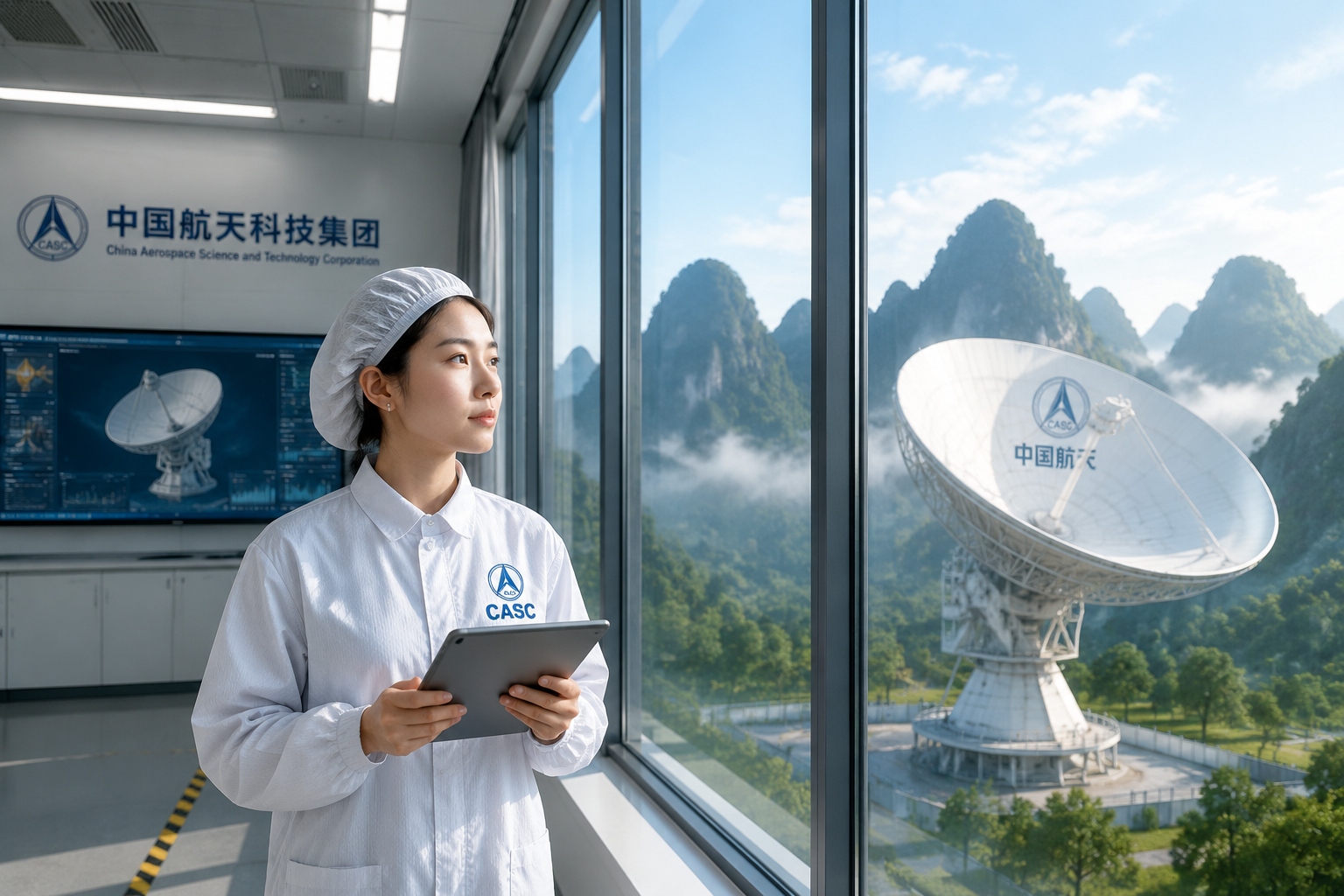

An Unusual Office View
Misty mornings are common in the karst mountains of southwest China. But on a hilltop outside Guiyang, one of them starts not with a cup of tea, but with a pre-flight check of a device that might one day land on Mars.
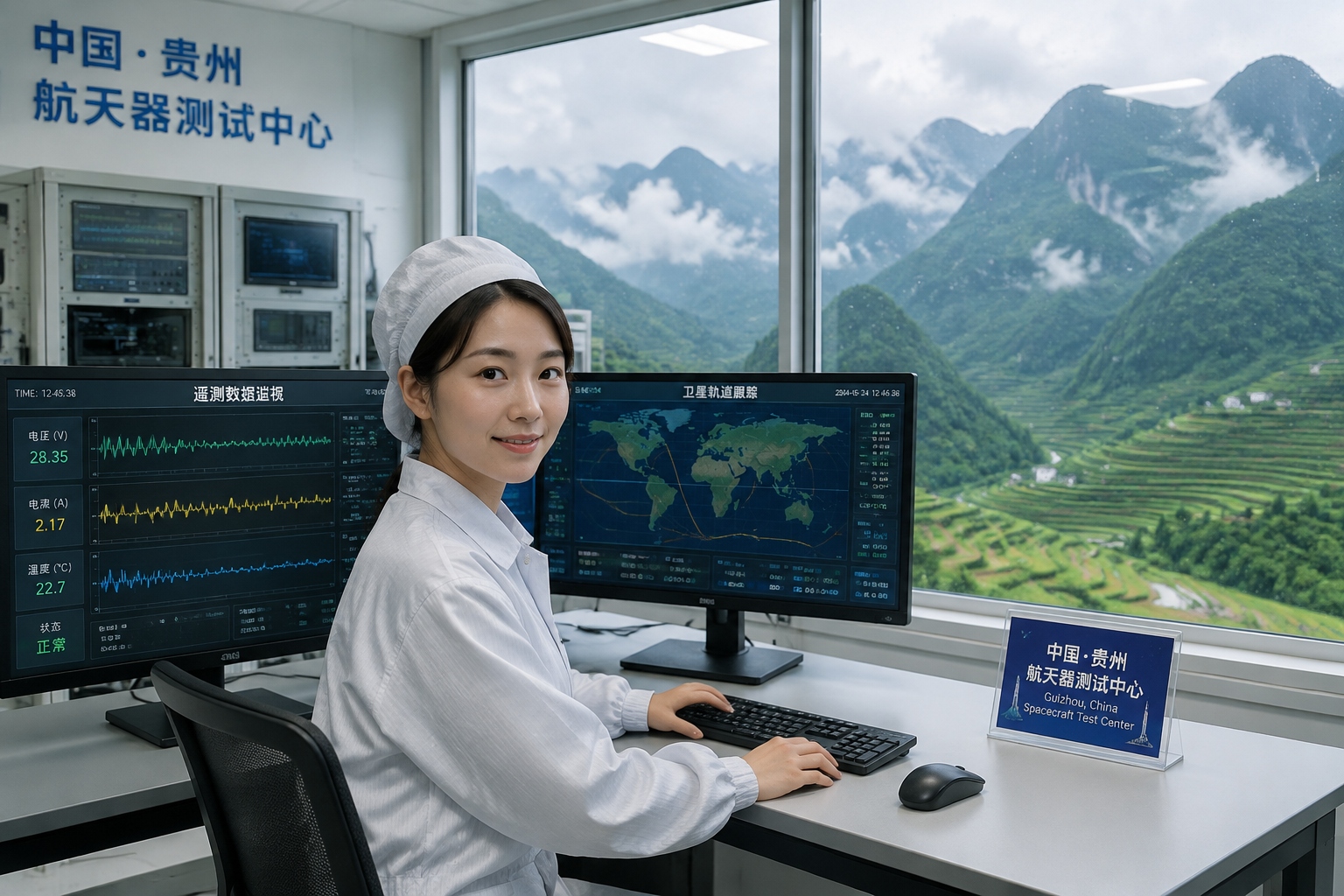
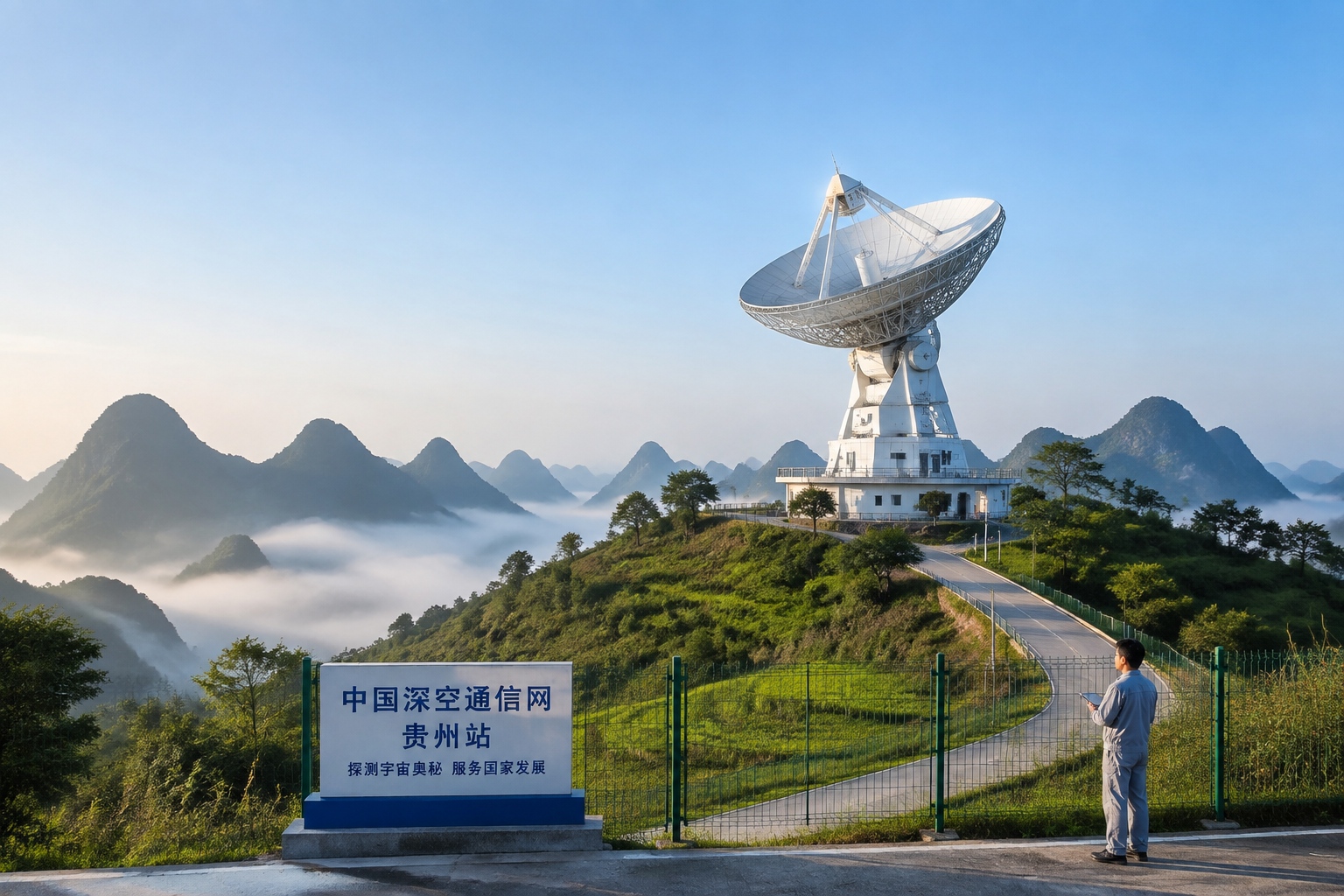
The engineer behind this routine is Chen Yuxi, 29. She is a systems engineer at a deep-space communications test site, a low-slung cluster of buildings tucked between limestone peaks and terraced rice fields. From the outside, it could be mistaken for a research station for agronomy – except for the satellite dishes that turn toward the sky, and the cleanroom hum that never quite goes quiet.
The Daily Climb to the Lab
Most mornings, Chen drives 40 minutes from her apartment in Guiyang, the provincial capital, then takes a shuttle bus along a road that switches back and forth through rolling hills. The commute is a study in contrasts: water buffalo grazing in paddies, village women hanging laundry, and then the sudden glow of a high-tech facility where every wall panel is built to keep vibrations and electromagnetic noise to a minimum.
Inside, she puts on a cleanroom hood and antistatic gloves. Her current project is an X-band transceiver for a future Mars mission. The device will act as the probe’s long-distance radio, sending data across hundreds of millions of kilometers. In the lab, Chen tests how it handles temperature swings, radiation, and the stress of a three-year trip through space.
Why Guizhou, of All Places?
Many visitors are surprised to find a serious aerospace engineering center here. Generations of outsiders have imagined Guizhou as a poor, remote province, famous for waterfalls and sour-spicy food, not spacecraft. But the geography that once made it isolated is exactly what makes it useful.
The province sits on a high plateau, with low radio interference and natural hills that block unwanted signals. The nearby FAST telescope – the world’s largest single-dish radio telescope – is a testament to the same logic. In recent years, Guizhou has also become a hub for data centers, sometimes called China’s Big Data Valley. The quiet valleys turn out to be good for both telescopes and server farms.
For Chen, the setting is part of the appeal. “When I stand outside and look at the mountains, I feel like I’m between earth and sky,” she says. “We test hardware that will travel far beyond this valley, but the valley itself keeps us grounded.”
A Different Kind of Mars Dream
Chen did not grow up dreaming of being an astronaut. She grew up in a small town in Sichuan, where her father repaired televisions and her mother taught high-school mathematics. She studied electrical engineering in Chengdu, and then joined a state aerospace institute after graduation. Three years ago, she moved to this test site in Guizhou.
“I never expected to be in a place with no subway, but with a Mars probe waiting for my test report,” she jokes. Her team is mostly women – a detail she mentions without pride, because she thinks it should be normal. Still, she knows that her job challenges the usual image of a Chinese space engineer: she is young, female, and works far from Beijing.
Her role is not about launching rockets or walking on the surface of another planet. It is about making sure a tiny transmitter can keep working after years of silence, with no service technician nearby. “We are the people who solve problems that happen a million kilometers away,” she says.
The Emotional Side of Testing
Chen’s work is full of small, repetitive tasks: measuring signal loss, rewriting code, heating the device in a vacuum chamber, cooling it again. Even after a dozen tests, she stays alert. “Sometimes we deliberately introduce a defect, just to see if the diagnostic software catches it,” she says. “If we don’t know every weakness, we will not sleep well.”
She admits she still gets nervous when a mission goes live. “During the launch broadcast, I hold my breath even though I have read every telemetry line before. For the next few months, I check the received signal every time I pass a monitor.” She says this with a wry smile, then also talks about how the team celebrates small wins – like when the first test signal comes back clean from a distance of 10,000 kilometers.
Community and Contrasts
After work, Chen does not go back to a war room of engineers. She shares a small apartment with two colleagues. On weekends, they hike through the nearby hills, pick wild berries, or visit the local market where older women sell mushrooms and dried chili in woven baskets. The contrast between her lab bench and the village stalls is not lost on her.
“When I first arrived, I felt like I had stepped into two different films,” she says. “But now I think they are part of the same story. China is building the future, but the future is not a clean white city. It is still rooted in places like this, with dust and wind and people who grow rice.”
The local residents, she says, are also getting used to the facility. Some of them now sell vegetables and tea to the engineers. A few young people from nearby villages have taken jobs as security guards and janitors at the site. “It’s a small thing, but I like the idea that our work makes the area a little more alive,” Chen says.
Tomorrow’s Launches
China’s next Mars mission, expected in the late 2020s, will aim to return samples from the red planet. The test that Chen is helping with now is a piece of that puzzle. International cooperation has also been in the news, with China inviting foreign scientists to contribute to Chang’e lunar research and future deep-space efforts.
The day I visited, Chen was preparing to do another “walk-up” test – a simulation where the spacecraft is placed on a large turntable, and the ground station has to lock onto its signal while it moves across the sky. She watched the data on a screen, shouted a few numbers to a colleague, and then smiled when the signal stayed stable.
“You know, every time I see the numbers line up, I think of a tiny robot rolling on a red plain, millions of kilometers away,” she said. “It’s not a dream. It’s just tomorrow we are practicing for.”
What Her Story Shows About China
For many outsiders, China’s space program seems like a huge, faceless state machine. But Chen puts a human face on it. Her daily routine – the winding mountain commute, the cleanroom gloves, the shared apartment, the hiking boots by the door – shows that deep-space exploration is built not only by heroic astronauts, but by ordinary people who pay attention to extra decimals.
Guizhou may be far from the helipads of Beijing, but it is now on the map for a different reason: it is where some of China’s most advanced technology is grounded, tested, and made ready for the silence of space. And it is where a young woman with a Mars dream records her data, one day at a time.
Start the discussion at forum.chinacomes.com