
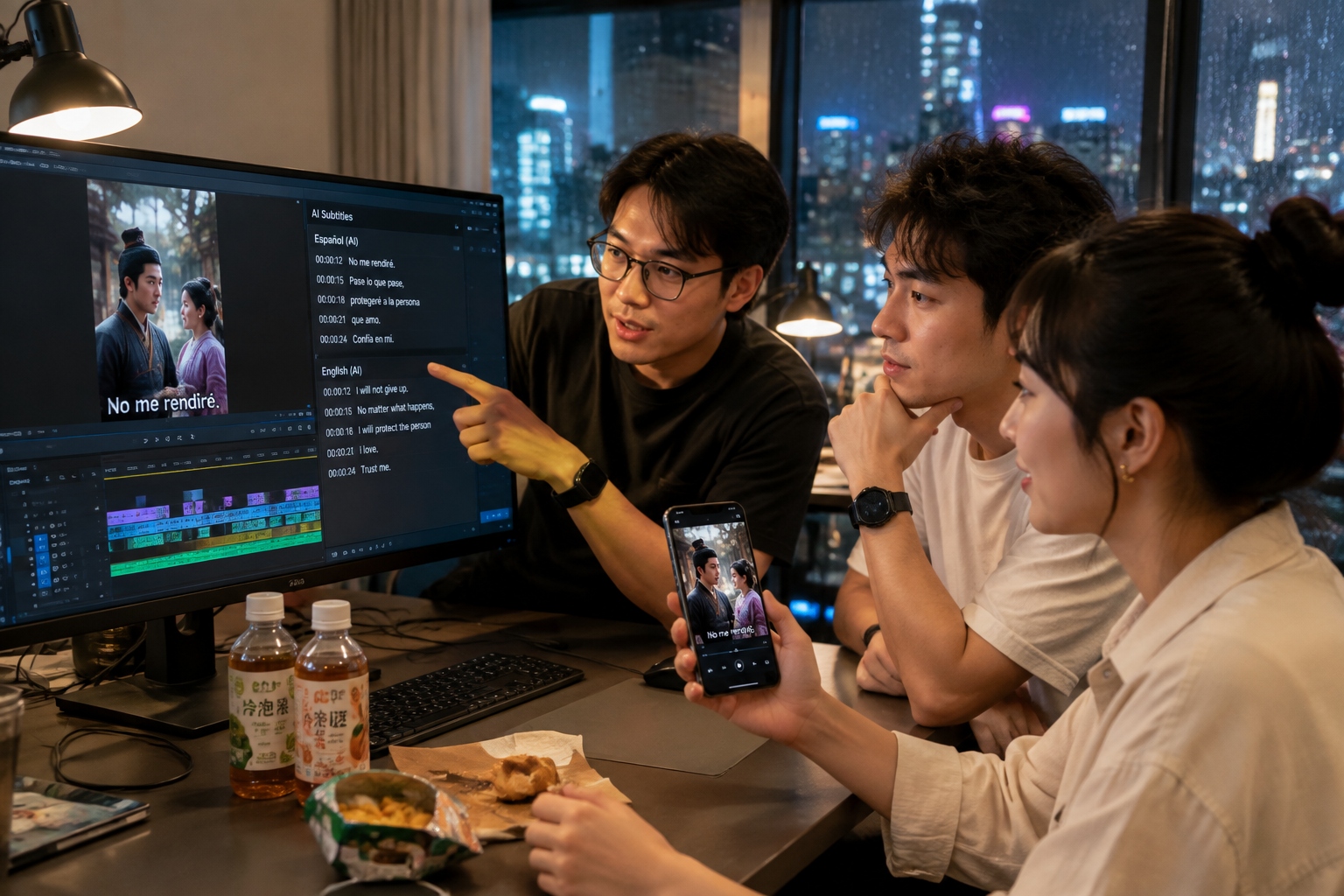

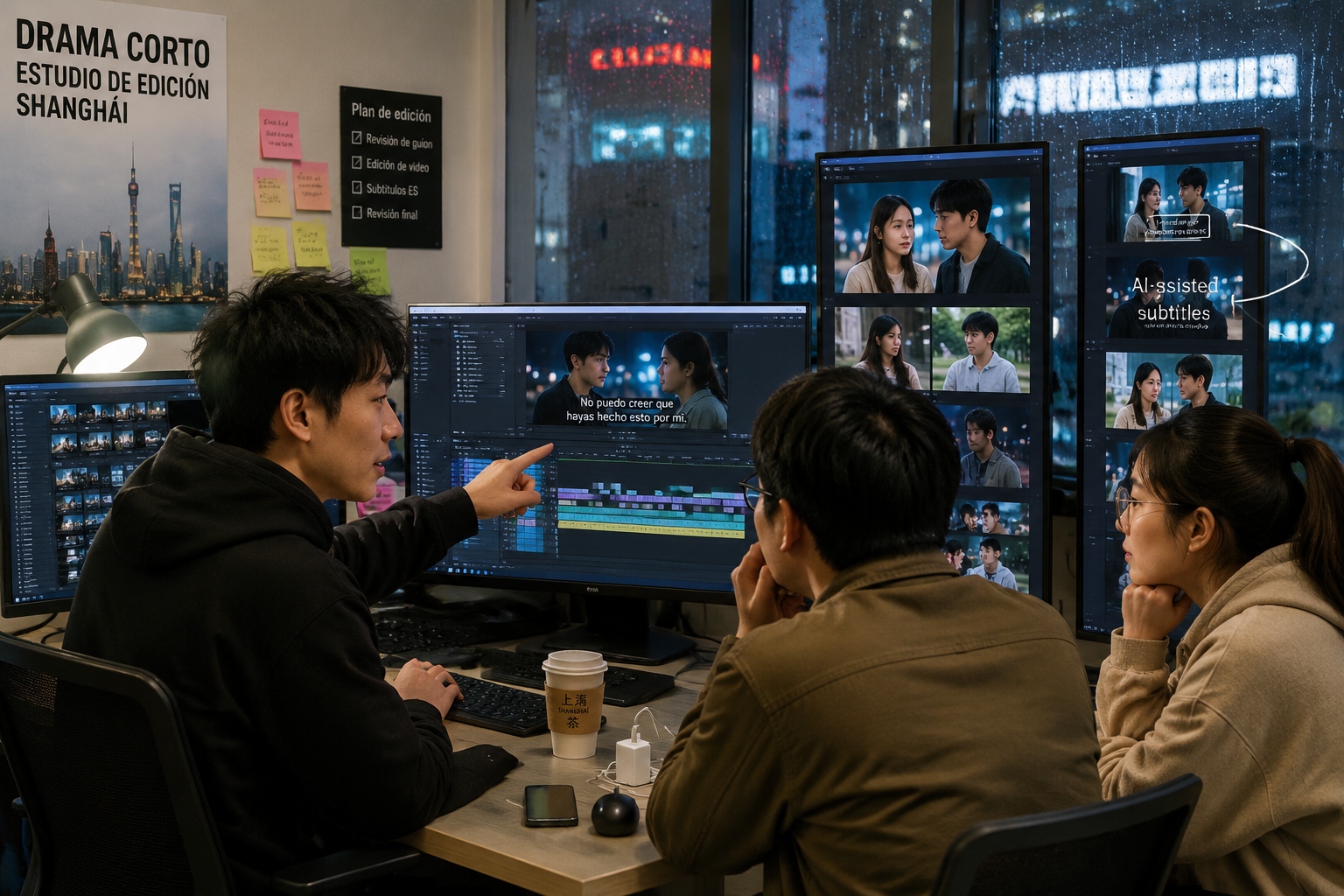
At 11:40 p.m. in a compact editing room in Shanghai’s Putuo District, three people are hunched over a single monitor. A 70-episode vertical drama is about to ship to viewers in Latin America over the next week. But nobody is re-doing the color correction or hand-captioning each frame. A young editor is checking Spanish subtitles produced by a large language model to see if a joke about hotpot still burns in Latin American Spanish.
“In the past, a high-quality subtitle project would take two weeks and a budget of at least 30,000 yuan. Today we finish a draft in two days and use the money for content tests,” says Lin Wei, a 32-year-old production manager. His studio, tucked inside an ordinary commercial building, has quietly joined China’s newest cultural export boom: short dramas.
A billion-dollar wave on a phone screen
Short dramas are scripted, vertical videos with each episode stripped down to one to two minutes. They are built for the thumb, designed for dirty train windows and late-night scrolls. The format went from a niche movement in China’s small cities to a billion-dollar industry that also reaches far beyond China. Over the past two years, Chinese-developed short-drama apps have climbed app-store charts in North America, Southeast Asia and the Gulf states. By some industry estimates, China’s short-drama market surpassed 50 billion yuan (about 7 billion US dollars) in 2024, and overseas revenue is growing so fast that studios now discuss AI tools the way editors once talked about editing software: as both a craft and a survival skill.
More than kung fu: everyday China, one episode at a time
Early Chinese content to travel abroad usually leaned on martial arts, imperial palace intrigue or panda-and-kungfu animation. But the scripts flowing out of China’s short-drama workshops today are often surprisingly ordinary: a 22-year-old girl in a small city opens a boba shop; a delivery rider in Chongqing races through tunnels before rain starts; a retired railway worker in the northeast volunteers as a community marriage counselor.
“When foreign viewers watch a woman in Hangzhou wait for a train, they don’t just see a Chinese moment. They see the same impatience or relief they feel on a platform in Milan or Osaka,” says Tang Ke, a screenwriter based in Beijing. He argues that AI helps preserve those psychological moments, even when the words are changed.
What AI actually brings to the table
The most visible role is translation. But AI is doing more than swapping words. Chinese everyday speech is soaked in internet slang, dialects and social shorthand. A character might say “你懂的”, a phrase that can mean “you know it” in ten different tones. Modern localization tools first digest an entire scene, looking for cultural anchors, then decide whether the sentence should be rendered as “you catch my drift” in an English-language version or “you know what I mean” in a Spanish one. When a dialogue reference relates to a dish or a social custom that does not exist abroad, the AI may choose a recognizable metaphor instead of a literal phrase.
Dubbing is now improving just as quickly. AI voice synthesis can clone the speaker’s timbre and even stress different emotions. The latest generation of dubbing software uses a speaker’s original performance to modulate the dubbed voice’s energy. Some AI lip-sync tools can reshape the mouth region almost invisibly, so a dubbed drama no longer feels like a badly synchronized foreign film.
These AI-supported workflows are not, for now, science projects in expensive labs. Many are running on laptops at small drama studios from Beijing to Xi’an. They give independent teams the ability to test their stories in four or five languages before a single dollar is spent on a marketing campaign.
An algorithm that knows your taste
The same technology helps distributors decide where a show might work best. Recommendation engines can now isolate a plot hook and compare it with viewing patterns in different countries. A short drama about a mother and daughter in a small city may win over audiences in countries with similar family structures, while a drama about high-rise office rivalry might travel better to younger urban viewers.
How one drama travelled further than expected
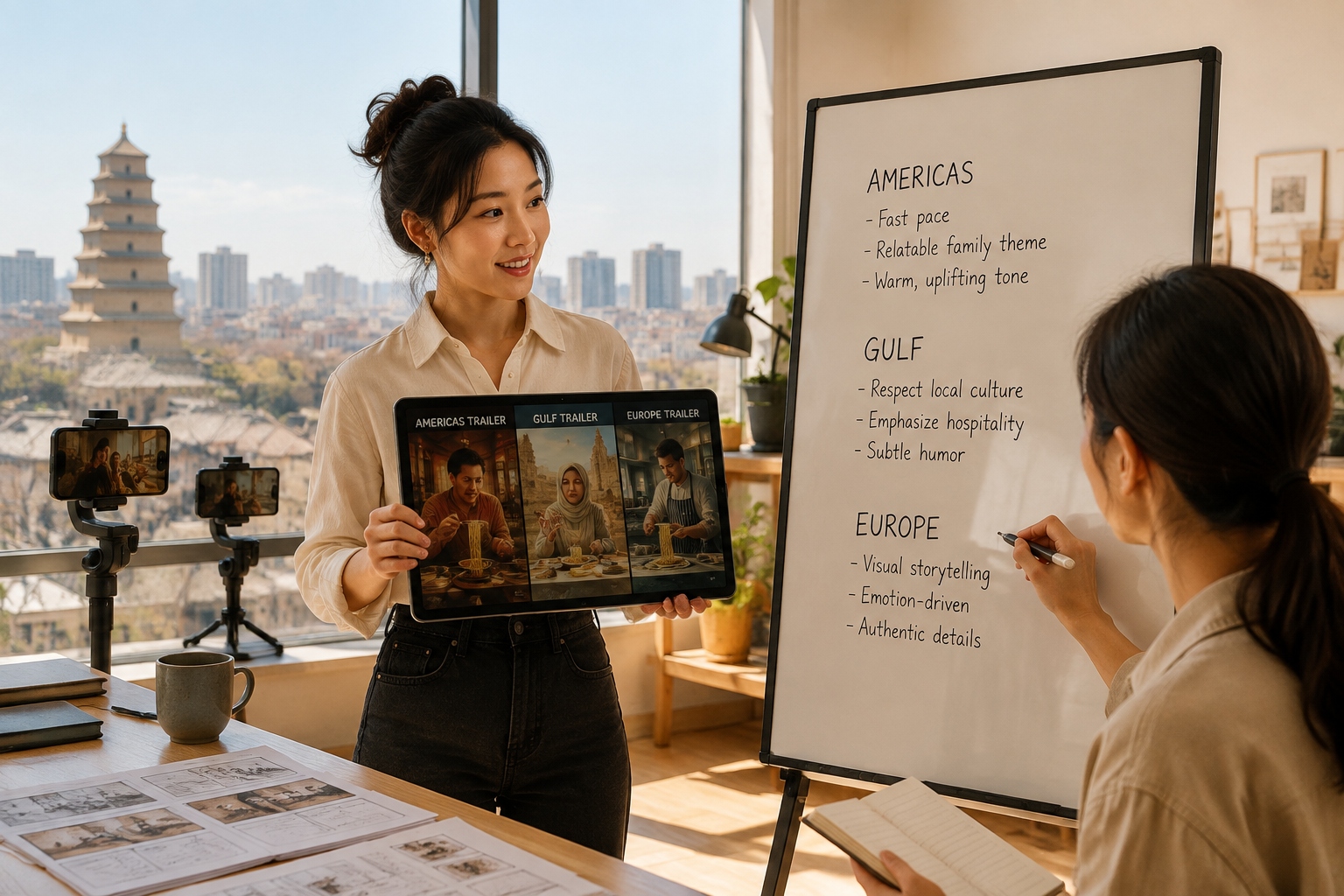
During an industry conference in Shanghai in early 2025, producers shared an internal case that became the talk of the meeting. In that micro-drama, a retired factory worker opens a noodle stall in Xi’an and struggles to pay rent after a delivery platform raises its commission. The drama had no CEO, no revenge, no supernatural twist—the usual top-sellers in aggressive markets. Yet when its studio prepared an AI-powered export package, the software generated three radically different trailers from the same footage: one for South Korea focused on friendship among middle-aged coworkers, one for the Gulf states highlighted a boss’s duty to his employees, and one for France stressed the fight of a small business owner against a digital giant. The same story suddenly spoke to three different emotional histories.
For many small studios, this marks a turning point: AI lets one production actually become many productions, each tailored to a different audience, without hiring separate film crews.
Not everything works
AI still makes mistakes that are hard for foreigners to catch but strange for Chinese viewers. It can flatten north-eastern Chinese slang into standard English, and it tends to clean up accents and natural pauses. Some American viewers have become especially sensitive to scenes that feel over-salted with meme-like expressions, because AI draws from too many internet sources.
There is also the same trap the music industry fell into with streaming: as tools grow powerful, studios start to copy every proven formula. Plot-driven AI can generate hundreds of “wife keeps handbag after divorce” or “boss climbs ranks secretly” stories. But those repetitive blueprints risk driving away audiences looking for new voices. Although AI can open the door, only human experiences can keep the room lively.
When “going global” becomes “living there”
China’s cultural producers have talked about “going global” for decades. For a long time, it meant exporting films adapted for general foreign festivals or setting up overseas offices. Short dramas and AI have changed the logic. Stories from ordinary life can now enter the circulation of casual viewing, where people click because they are exhausted at the end of the day or bored on a weekend—not because they made a deliberate decision to learn about China.
That is a fuller form of cultural exchange. Viewers come for a relatable scene and often stay because they discover that truck drivers, nurses and shopkeepers in a Chinese city carry familiar burdens. AI is only the mechanic that carries the story across the border. The soul remains human.
In the Shanghai editing room, Lin Wei finally speaks. He points to a scene in the new Spanish version where hotpot is called “a friend of spicy food.” He says: “The AI chose that. I accepted it. Maybe the machine understands something about friendship after all.” Then he turns back to the screen, ready to approve the next batch.
Start the discussion at forum.chinacomes.com