
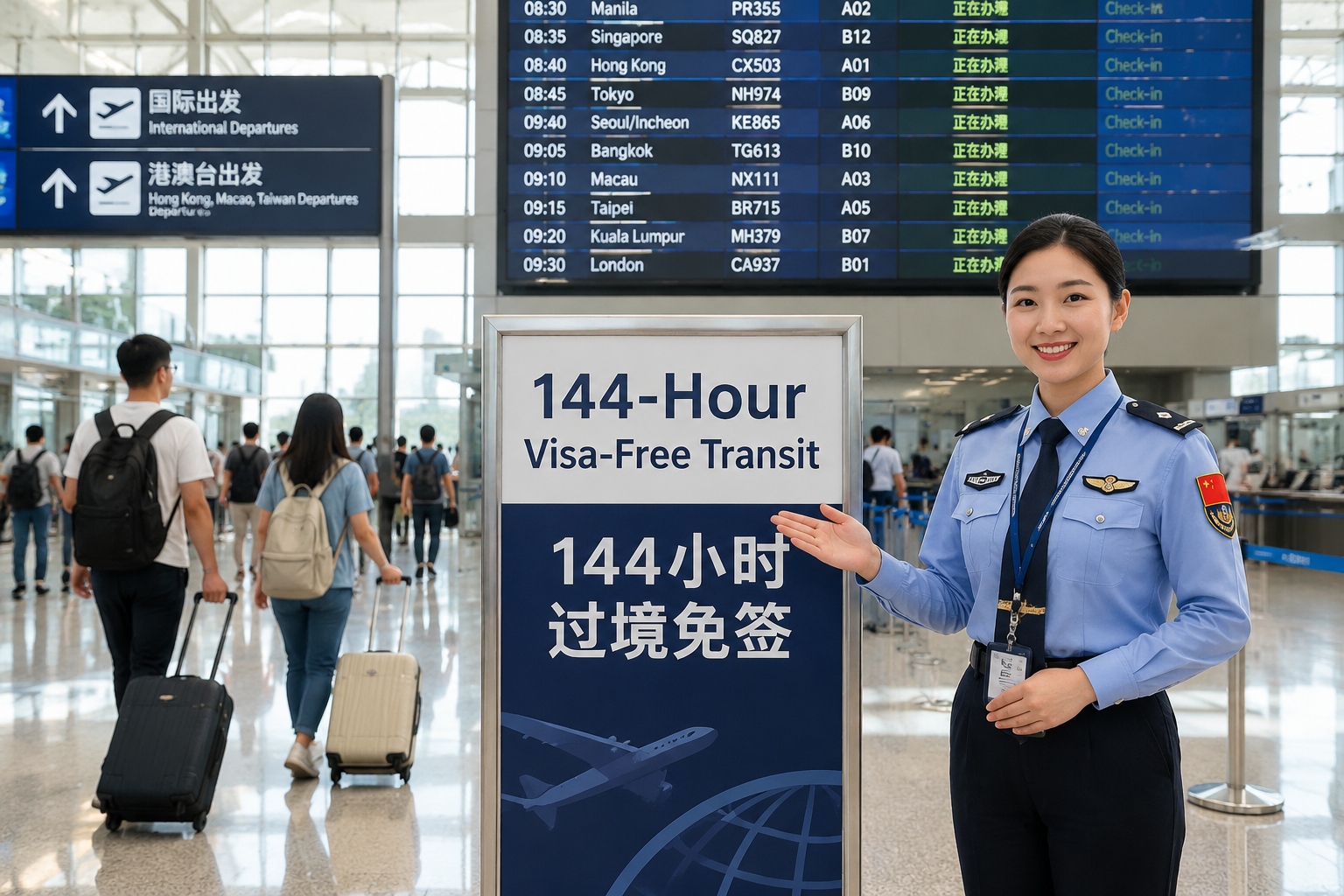

When Lucia, a Brazilian graphic designer, had a 12-hour layover in Beijing on her way to Tokyo, she was surprised to learn she could leave the airport without applying for a visa. Brazil is one of 53 countries whose citizens qualify for China’s 144-hour visa-free transit, a scheme available at more than 20 Chinese cities and ports. But the program is not a blanket all-China pass. Each city that participates draws its own borders and sets its own rules.
If you are planning a stopover in China, this guide explains how the policy works with real-world examples. You’ll learn what no one tells you at the airline counter: the route, not just the entry city, determines whether you can use it.
What Is 144-Hour Visa-Free Transit?
In simplest terms, 144-hour visa-free transit means eligible travelers can stay in mainland China for up to 144 hours (six days) without obtaining a normal L visa in advance. The 144-hour window starts when you pass through immigration. You must leave the country before the clock runs out.
The policy has existed in different forms since 2013, but in recent years China has expanded it to cover a growing number of cities. As of 2024, more than 20 municipalities and provinces are part of the program, including Beijing, Shanghai, Guangzhou, Chengdu, Chongqing, Xi’an, Xiamen, and Shenzhen.
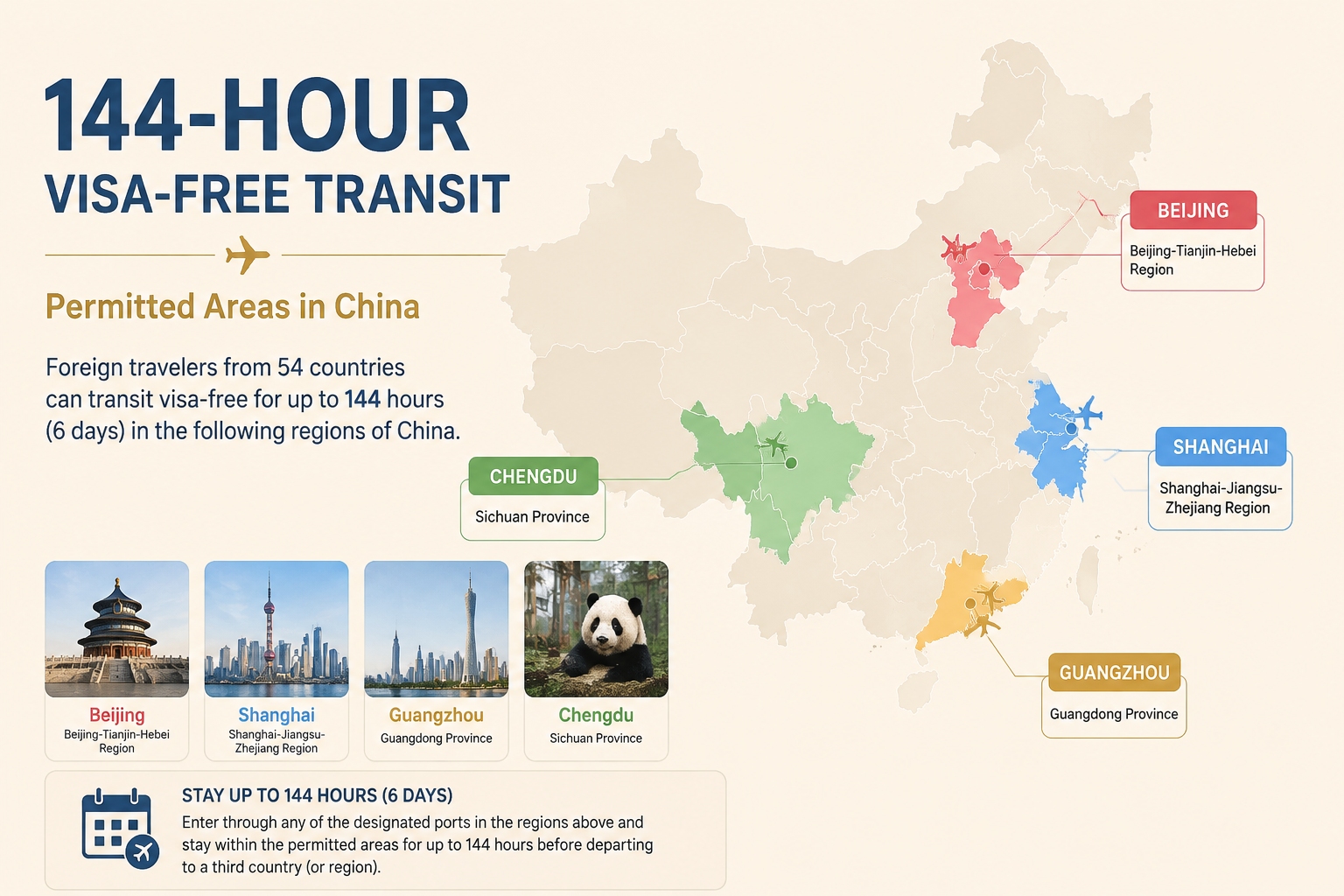
However, the word ‘city’ is misleading. You are not allowed to wander freely across all of China. Instead, you are confined to a specific administrative region that includes the entry city and often its neighboring provinces. For instance, entering from Beijing allows you to spend your six days within Beijing, Tianjin, and the Hebei province. Shanghai gives you access to the broader Yangtze Delta, covering Shanghai, Jiangsu, Zhejiang, and in some cases Anhui. Guangzhou limits you to Guangdong province. Chengdu covers Sichuan province only.
How the Four Major Hubs Compare
Let’s look more closely at the four most commonly used gateways, because choosing the right one determines how many places you can visit during your brief stay.
Beijing: the cultural core
Beijing has two international airports that participate in the scheme—Capital (PEK) and Daxing (PKX). Once you step out, you can explore Beijing’s hutongs, walk along the Great Wall, or take a fast train to nearby Tianjin for a day trip. The ‘Beijing region’ for transit purposes includes Tianjin and Hebei, so you can also fly out from Shijiazhuang Zhengding International Airport if you plan your exit that way.
Shanghai: the financial engine
At Shanghai Pudong (PVG) and Hongqiao (SHA), eligible travelers are free to move within Shanghai, neighboring Jiangsu, Zhejiang, and sometimes Anhui. That is a big advantage if your itinerary includes Hangzhou’s West Lake or Nanjing’s ancient walls. The exit airport can be any within that larger zone—Shanghai, Hangzhou Xiaoshan, Nanjing Lukou, etc.
Guangzhou: southern gateway
Guangzhou Baiyun Airport (CAN) is the southern hub of the scheme. The allowed area is limited to Guangdong province. You can visit Shenzhen’s tech parks or the canton food culture of Shunde, but you cannot cross into neighboring Guangxi or Fujian. Exit should be made from a designated port in Guangdong, like Shenzhen Bao’an or Zhuhai.
Chengdu: panda province
Chengdu’s Shuangliu (CTU) and Tianfu (TFU) airports are the western hubs. The region is simply Sichuan province. That’s enough for pandas and hotpot, but don’t plan a side trip to Yunnan under this policy. You must leave from within Sichuan.
The Four Conditions You Must Meet
Here are the non-negotiables:
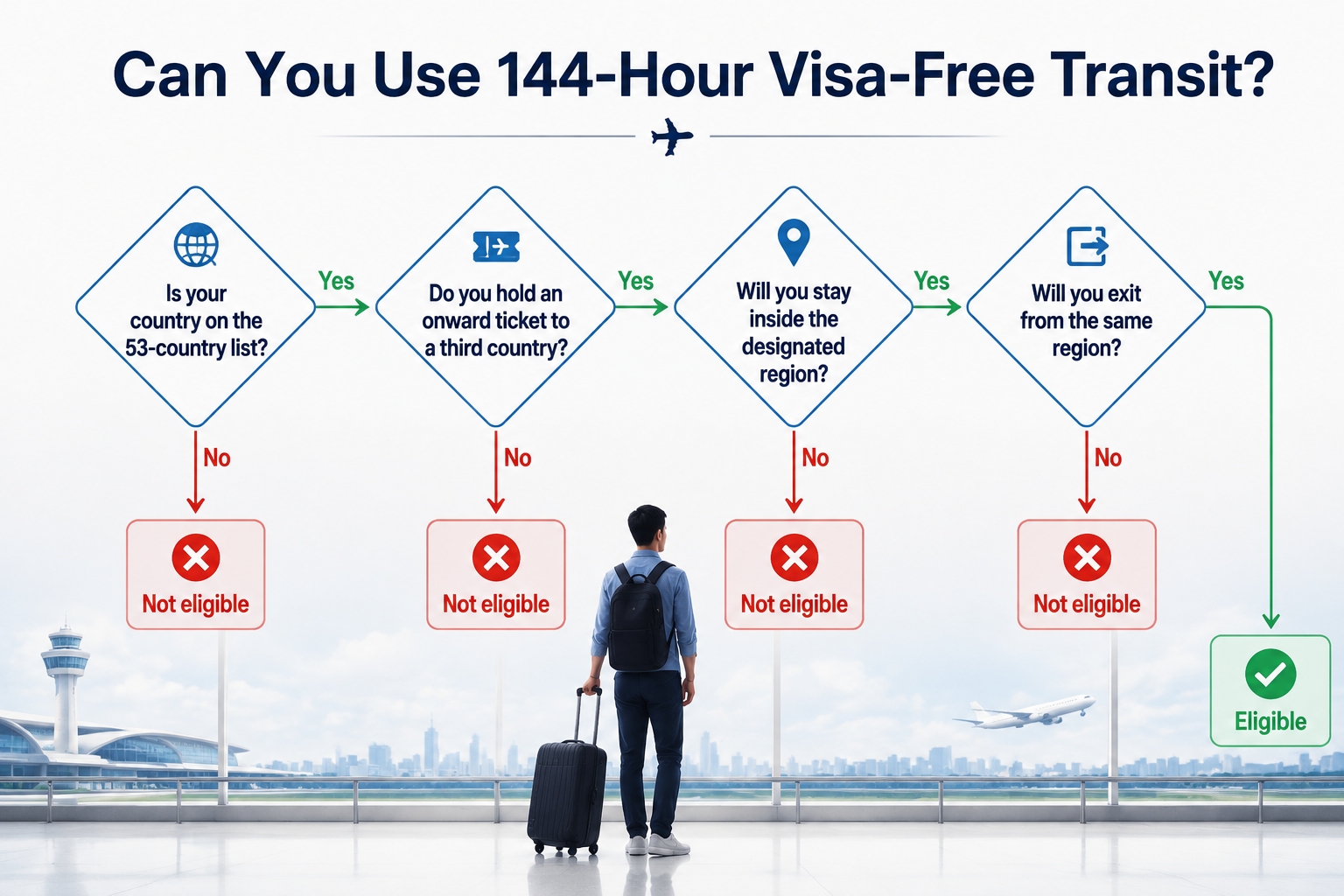
1. Your nationality must appear on the 53-country list. The list includes most European Union countries, the United States, Canada, Australia, Japan, South Korea, Brazil, Argentina, and many more. If you are from a non-listed country, this scheme won’t work.
2. You need a valid passport that remains valid for at least six months, with two blank pages. If your Chinese visa is valid, it often takes precedence and the 144-hour rule won’t be used.
3. You must hold a confirmed outbound ticket to a third country or region within the 144-hour window. The phrase ‘third country’ is key. If you fly from your home country to China, your next flight cannot return to your home country—it must be to a different destination. For example, a US citizen flying from New York to Shanghai and then back to Los Angeles wouldn’t qualify. A ticket from Shanghai to Sydney, on the other hand, is fine.
4. You must enter and exit through designated ports that belong to the same regional scheme. If you enter in Beijing and want to catch your outbound flight in Shanghai, you’ll be blocked. The exit port has to be in the same geographic cluster.
Real Examples: What Works and What Doesn’t
Scenario 1: London → Beijing (stay) → Tokyo
Marcus, a British traveler, arrives in Beijing from London. He holds a reservation to fly to Tokyo five days later. He plans to see the Forbidden City and go to Tianjin by train. Because both Beijing and Tianjin are in the permitted zone, and because his outbound flight leaves from Beijing Daxing, he is eligible. This is a textbook case.
Scenario 2: São Paulo → Beijing (stay) → Shanghai → back to Brazil
Ana, a Brazilian citizen, wants to spend three days in Beijing, then fly to Shanghai and spend another three days there before flying back to São Paulo. Her first problem: the return flight to São Paulo is not a ‘third country’ route because she is going back to her starting country. Even if she had an onward flight from Shanghai to Tokyo, the second problem is that she entered in Beijing but would exit from Shanghai. Since those regions do not match, the transit approval would not be granted. She needs a full tourist visa.
Scenario 3: Seoul → Guangzhou (stay) → Shenzhen → Bangkok
Yuki, from Japan, flies into Guangzhou Baiyun from Seoul. She wants to take a high-speed train to Shenzhen for two days, then fly from Shenzhen Bao’an to Bangkok. This works because Guangdong is one ‘region’ that includes both Guangzhou and Shenzhen. Exit is from a designated port.
One More Rule: Accommodation Registration
Even though you are exempt from a visa, you are not exempt from registration. Every foreign visitor staying in China must have their accommodation registered. Hotels usually do this automatically for you. If you’re staying in a private apartment, inform the local police station within 24 hours in cities, 48 hours in rural areas. Not doing so can lead to a warning or a fine of around 2,000 to 5,000 RMB.
Don’t Overstay—The Penalties Are Real
Chinese immigration doesn’t treat overstaying as a small slip. If you remain past your 144-hour allowance, you will be considered an illegal resident. The public security authorities may fine you at least 500 RMB per day, up to 10,000 RMB, or even place you in custody. Once a violation is recorded, you may be disqualified from using the visa-free transit program in the future. For more serious cases, you could get a ban from entering China for one to five years.
If your exit flight is cancelled due to bad weather, do not panic. Contact airport immigration police or the local exit-entry administration as soon as possible. They can usually give you a short extension or adjust your record, provided you have documentary proof of the disruption.
A Quick Pre-Departure Checklist
– Confirm your nationality is on the 53-country visa-free list.
– Choose an entry city whose permitted region includes all your intended stops.
– Make sure you will not re-enter the country you originally came from.
– Book an exit flight from a designated port inside the same region.
– Print the itinerary or keep an electronic copy of the flight confirmation.
– Have at least two blank passport pages and six months of passport validity.
– Prepare to show proof of any accommodations (hotel bookings, host’s contact).
– Arrive at immigration with a clear explanation: you request 144-hour visa-free transit.
For the most authoritative and updated information, always check the official website of China’s National Immigration Administration (immigration.gov.cn) or consult the Chinese embassy in your home country. Rules can change without warning, and what works today might not apply tomorrow.
Start the discussion at forum.chinacomes.com