

A Monitor in the Wheat Field
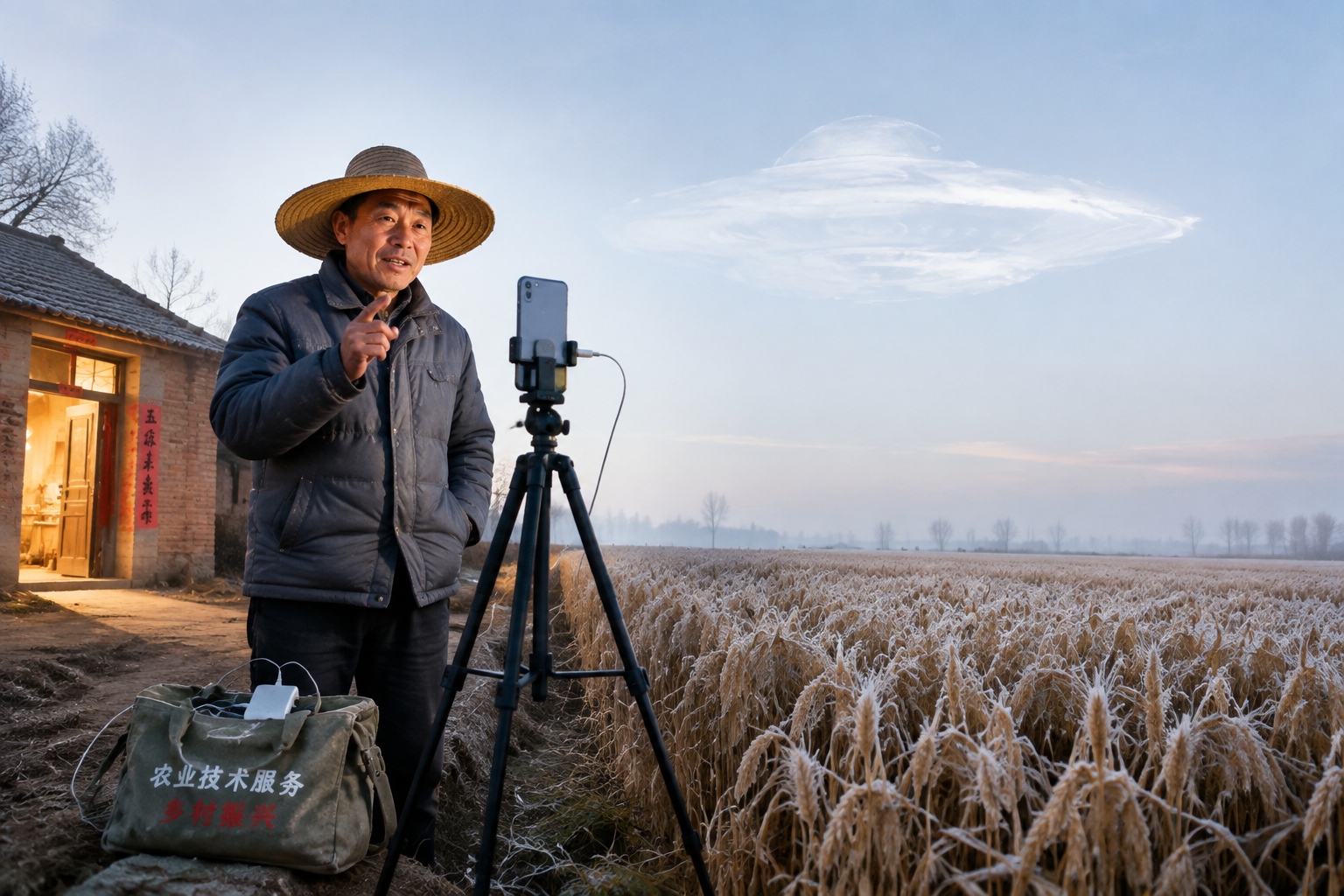
At 6:30 a.m., Gao Jianjun stands at the edge of his wheat field, easing a smartphone onto a cheap tripod. The winter air smells of frost and diesel. He checks the framing: golden wheat, a bent tree, and a vacant sky in which he plans to place a UFO. He pulls a folded sheet of paper from his coat pocket—a rough storyboard with stick figures and arrows. The characters are drawings; the alien mothership is just a circle with a dark shadow beneath.
For most of his life, Gao used this spot for irrigation checks and crop prices. Now he uses it as a film set.
Gao, 45, is one of a small but growing number of villagers across China using artificial intelligence tools to make short films, product demos, and even comedy clips that mix their own footage with computer-generated scenes. His four-minute science-fiction short, titled Wheatfield Encounter, has been watched more than two million times on a local short-video platform. There is no film school in his CV, no professional camera crew. There is just a lot of patience and a subscription to an AI video app.

The Farmer and His “Film Studio”
Inside Gao’s brick courtyard house, the “studio” is a square table covered with a floral plastic cloth. In the middle sits a laptop from 2015, its fan rattling whenever he edits. On the wall hang a dusty calendar and his daughter’s middle-school drawing of a rocket. He laughs when asked where his film office is: “This is it. The wifi is better here than in the bedroom.”
Before 2023, Gao had never heard of text-to-video. He used a secondhand phone to watch sci-fi classics by the Chinese writers Liu Cixin and Wang Jinkang. “I felt these big concepts—black holes, cosmic dust, the end of the earth—but I couldn’t imagine them with my own eyes,” he told me during a visit in November. Last winter, his daughter in Zhengzhou sent him a link to a free generative AI application. She said he could type a sentence and get a moving image. He thought she was joking.
His first attempt was clumsy. He typed: “A silver spaceship flies over a field of corn.” The result showed a pile of silver fruit floating over a yellow carpet. He laughed and tried again for hours. “After about a hundred tries, I realized the machine wasn’t reading Chinese very well,” he says. “Or maybe I wasn’t writing clear enough.” He began to study prompts the way farmers study weather reports—testing, adjusting, waiting for the output to change.
AI tools customized for the Chinese language, such as Kling from the short-video company Kuaishou, Jimeng from ByteDance, and Qingying from the startup Zhipu, have added interfaces specifically for users without technical backgrounds. Many offer free daily credits that allow dozens of short generations. For a farmer who pays less than ten yuan a day on food, this matters as much as the technology itself.
Making a Sci-Fi Short: Prompts, Clips, and Patience
Gao’s working method is half farmer, half visual-effects editor. He films his own “live plates” with the phone: a dirt path, a scarecrow, a cloudy evening sky. Then he moves to the AI app to generate the supernatural elements—a towering black monolith, a spaceship with rippling metal skin, and an astronaut whose helmet reflects the lantern in a farmhouse window.
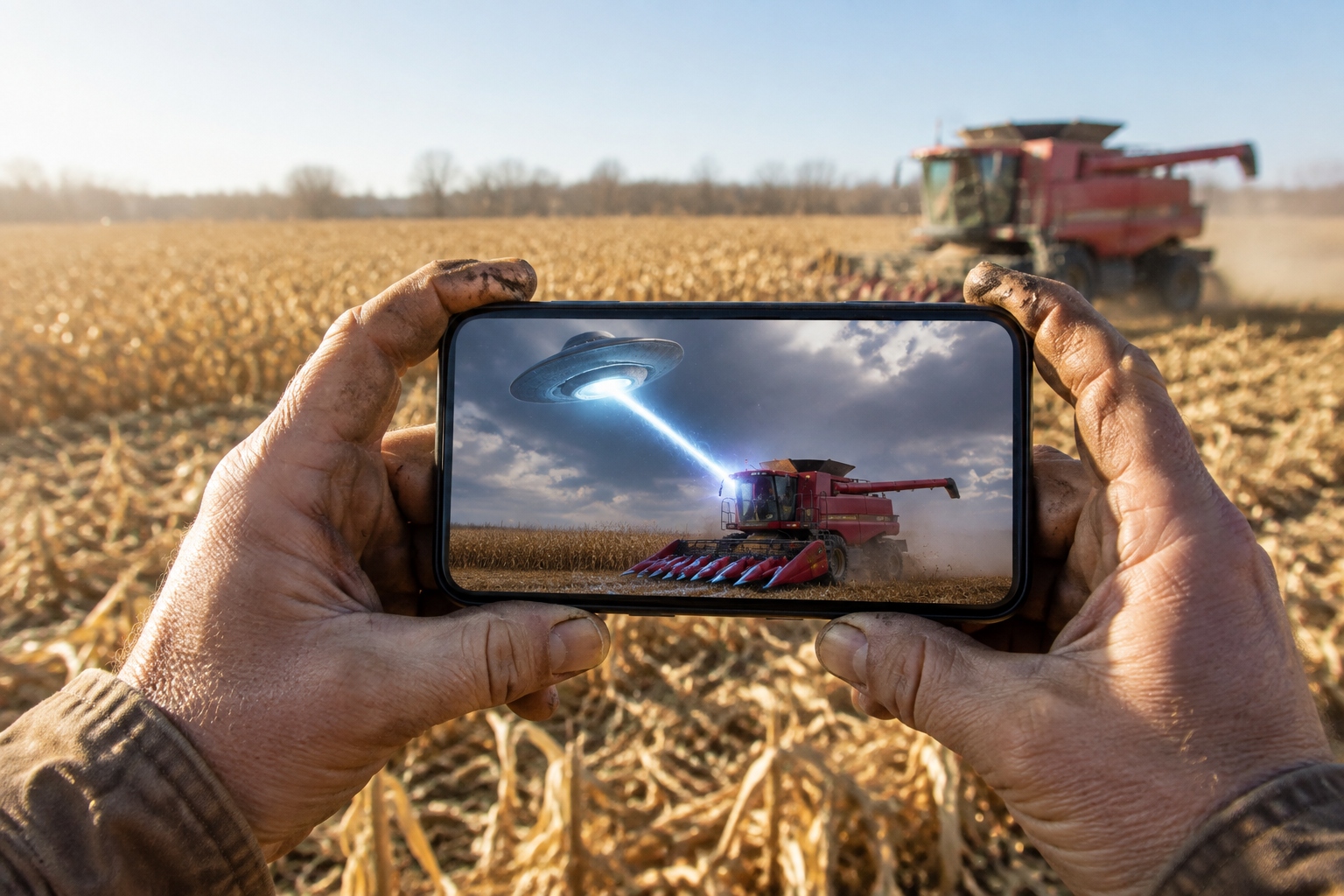
The most difficult shot, he says, was a two-second scene in the film where the alien ship lowers a beam of light over a modern combine harvester. He wanted the machine to look real, not plastic. For three nights he typed different version of the same prompt: “A silver-ray light beam connects a UFO and a red combine harvester in a harvested field. The light has dust particles. Realistic, cinematic.”
Each attempt took about two to three minutes to generate, but failed outputs consumed those free credits. He developed a habit of writing a prompt, generating a still image first, then turning that image into motion. “If the picture looks wrong, no point moving it.” He also started to use an AI voice generator for the film’s narration, because he didn’t want his own local dialect in a “space adventure.” That decision, he says with a grin, made him feel like a director: “You can choose what the audience hears and what it doesn’t.”
After a month and about 800 generations, he had 32 usable clips. He patched them together with free editing software, added a synth soundtrack from an AI music tool, and recorded his own voice at the end with a phone microphone, because “the film should stay mine.”
AI as the New Equalizer
What has changed is not just the existence of a tool, but its price and usability. Five years ago, photorealistic visual effects cost at least hundreds of thousands of yuan per minute. Today, a rural user can begin with small tasks in a few minutes and spend only the cost of a mobile data card. There is no technical certification or camera ownership required. The control interface has been simplified in Chinese, and online tutorials in the same dialect are all over the village’s video feeds.
Behind Gao’s hobby is a broader movement. The Chinese Academy of Information and Communications Technology reported in 2023 that the number of short-video users in rural areas exceeded 300 million. Many rural creators now sell agricultural products through livestreams or produce educational content. But what AI adds is a new layer: it helps people who can’t write code, draw, or animate to express something beyond their daily reality.
This is not always smooth. Text-to-video AI often produces nonsensical backgrounds or morphing faces, and Gao’s early films looked more like fever dreams than cinema. He says that what makes the difference is the same persistence required to harvest wheat in a rainy season: “You don’t control the sun or the storm. You just keep working the plot.”
What the Village Thinks
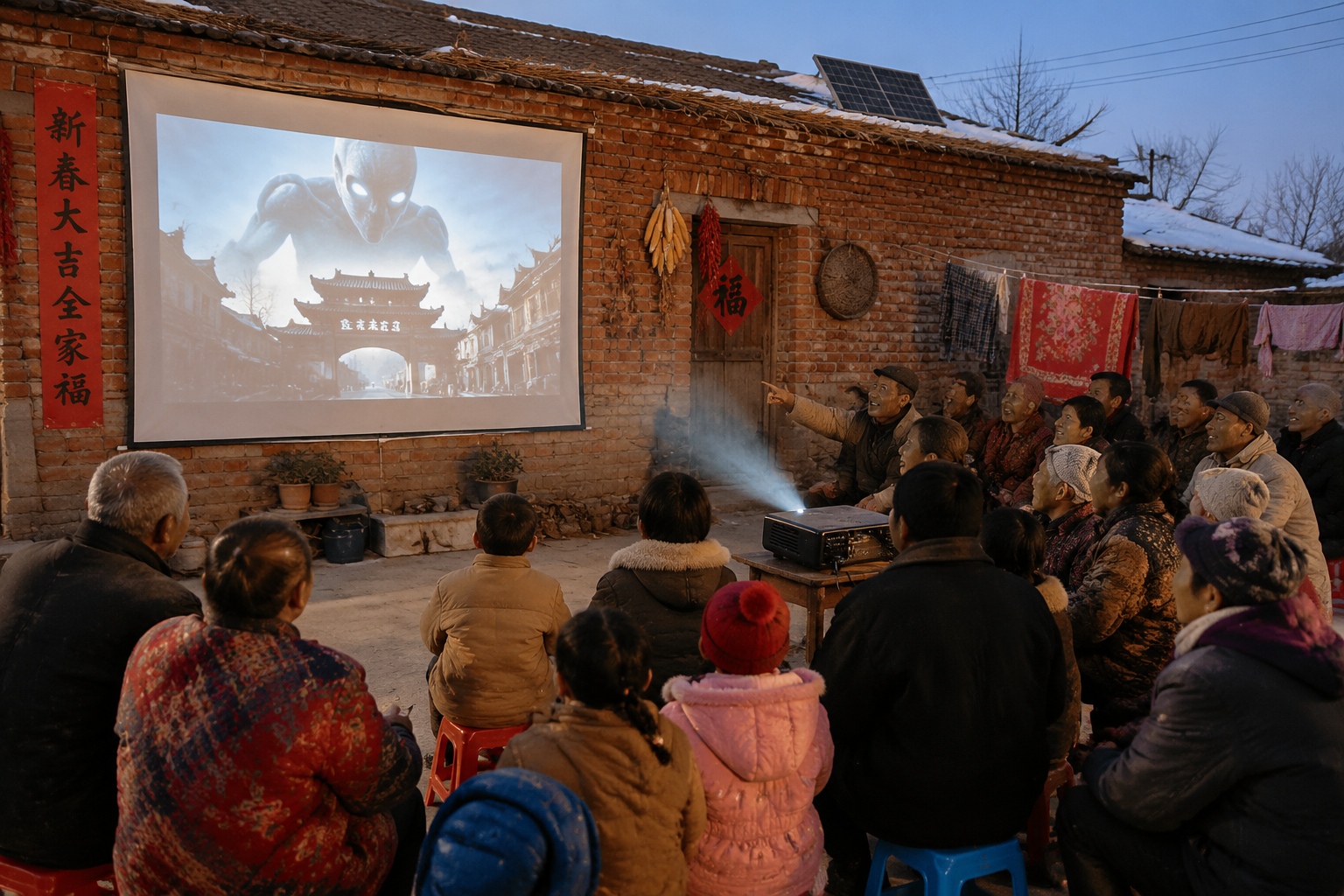
For months Gao worked without telling his neighbors. His wife first saw the flashing screen as another trick for idle time. “He said he was making a movie, and I asked whether he was making ads for fertilizer,” recalled Wang Cuihua, standing in her melon patch. The turning point came when their 24-year-old son, home for the Spring Festival, insisted that the rest of the family watch the final cut on the living room TV. Wang said she felt a mixture of worry and pride when the scene of a giant alien creature towering over the village gate appeared. “I recognize our gate,” she laughed. Then her grandson kept asking whether the monster would come at night.
A few local farmers have since approached Gao with their own needs: one asked for an AI video to promote his strawberry-picking garden, another wanted an “epic” opening for his agricultural machinery repair shop. Gao has started charging a small fee—about 50 yuan for a short product clip—though he admits he spends more time on them than is fair. The village party secretary has shown the film at two public meetings.
Not everyone in the surrounding rural towns is persuaded. Some older farmers see the visual effects as a waste of labor. A 63-year-old neighbor, Li Shutang, argues that “a software cannot feed pigs.” But he stayed until the end of the film and asked a simple question: “Can it make me look young?” Gao is considering that request.
Beyond One Village: Digital Literacy in Rural China
Gao’s story is not isolated. In the eastern province of Shandong, a 52-year-old mushroom farmer named Chen Min uses an AI image generator to illustrate future farm designs for buyers. In southwest Yunnan, a tea grower pastes custom AI artworks onto his packages to sell in city teahouses. These cases are still a minority across China’s countryside—rural internet access is good but coverage of advanced skills is uneven. However, the trend is visible in the attention given to rural short-video trainings in recent years.
Programs such as the national “Digital Village” initiative support e-commerce training and the extension of 5G to townships. In local “new farmer” training centers, AI video tools are often taught alongside livestream sales and simple animation. A creativity boom is not necessary; a practical familiarity is enough. As educator Zeng Chenwen, who teaches digital skills in a county in Anhui, puts it: “Three years ago, rural learners asked me how to use the express delivery app. Last month, a 60-year-old woman tried to make a birthday wish video for her grandson using an AI portrait tool. The distance from learning to creating is shrinking.”
There are limits, too. Electricity outages in remote areas, expensive mobile data, and occasional suspicion toward new technology slow the adoption pace. Many farmers see AI video as a toy, not a tool, and the gap between the most creative rural users and the least connected remains wide. Yet for those who do pick up the tools, the effect can reach beyond entertainment. It brings attention, sometimes a little income, and most importantly, the feeling of being a producer rather than a viewer.
Conclusion: Technology with Dirt on Its Shoes
Late one afternoon, Gao walked me back to the village bus stop. He checked the sky, as farmers often do, and pointed to a cluster of clouds that looked like a spaceship. “Before I started making films, I watched the clouds and thought about rain. Now I watch them and think about shots.”
The new AI cameras are not cameras at all. They are text boxes, algorithms, and training data that turn language into visual poetry. But for two million viewers, it matters less that the pictures are machine-made. What sticks with the audience is a farmer’s imagination—an imagination that always lived in the wheat field, behind the house, in the words of a cheap paperback novel hidden under the bed.
Technology has not turned Gao into a corporate artist overnight. It has simply lowered a gate that used to separate rural life from the silver screen. A middle-aged farmer in Henan is not waiting for a movie studio to come; he carries the studio in his pocket and presses “generate” like any city creator. The future does not arrive in a digital cable or a conference room. Sometimes it arrives in a Chinese winter, wearing a thick coat, typing one Chinese sentence at a time.
Start the discussion at forum.chinacomes.com