


It is just before midnight when Anna, a Swedish architect, lands at Terminal 3 of Beijing Capital Airport. She opens the Uber app she uses at home, but the map shows no cars. This is her first visit to China, and she has just discovered that ride-hailing here does not work the way it does in Stockholm.
What Anna needed is a different app. China runs its own ride-hailing platforms, with separate registration rules, payment methods and driver vetting. The good news for foreign passengers is that you can ride once you understand a small sequence of steps. The bad news for foreigners who hoped to earn money as drivers is much simpler: it is almost impossible for an expat to be approved.
The Names You Will See in China’s Ride-Hailing Market
China’s ride-hailing market is a mix of two models. Didi Chuxing (滴滴出行) is the biggest single operator, offering private-hire cars and taxis. Meituan Taxi (美团打车) operates on the food-delivery Meituan app, and can be useful if you already rely on it for deliveries. AutoNavi, known as Gaode Maps (高德打车), is a navigation platform that works as a broker: you type in a destination, and it lists available fleets from several smaller licensed companies, letting you compare fares.
All three have English-language versions, but they are not interchangeable. Didi has the largest fleet and its English-language rider app is designed specifically for foreigners. Meituan’s taxi section is mostly Chinese, with only the map in English. Gaode has a foreigner-friendly interface, but orders are handled by partner companies whose drivers may have limited English. For most visitors, Didi is the right first download.
How Foreign Passengers Register and Ride
1. Set up a phone number that can receive SMS and calls
When you open Didi for the first time, the app asks for a mobile number. A mainland Chinese number is by far the most reliable. You can buy a prepaid SIM at the airport with your passport, or register your foreign number and rely on international roaming. The latter may work for receiving SMS, but the app also sends driver notifications and sometimes makes voice calls. If your carrier screens overseas SMS or calls, the platform may fail you at the worst moment. If you plan to stay more than a few days, buy a Chinese SIM.
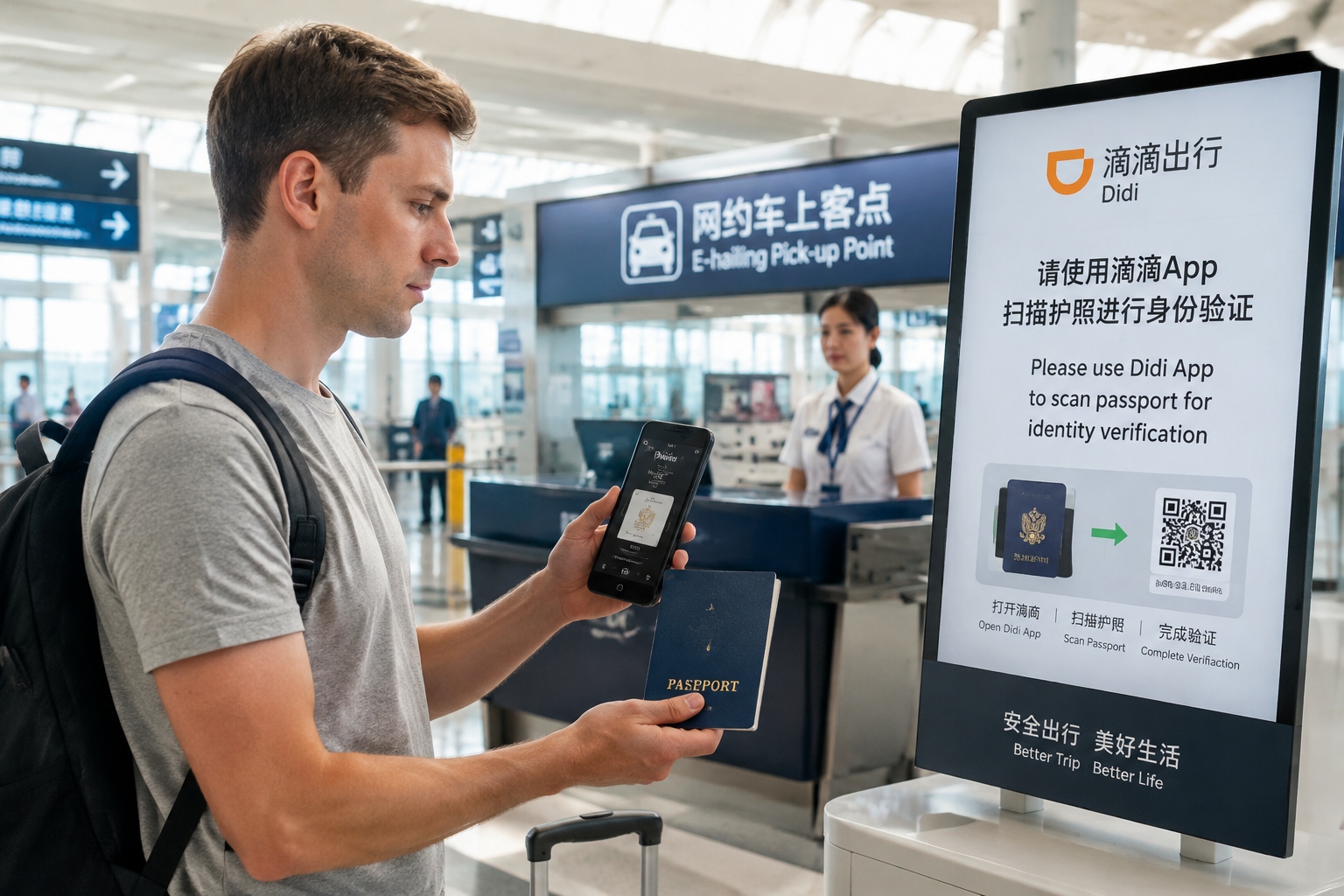
2. Verify your identity with a passport
After the number is verified, the app prompts you to complete “Real-name Authentication”. This is not optional. You choose “Passport” as your ID type, scan the passport’s biodata page and take a selfie. The system compares the selfie with the passport photo. This usually takes a couple of minutes. Minor problems occur if you are wearing glasses, the lighting is poor, or your passport chip is not readable. There is a manual review backup, but it can take several hours. Do a test run in your hotel, not on the airport curb at midnight.
3. Link a payment method before your first ride
Then set up payment. Ride-hailing in China is cashless. The easiest path for foreign visitors is to install Alipay or WeChat Pay before arrival, register with your overseas phone number, and bind an international Visa or Mastercard. Once set, add the payment method inside Didi. Some users report that Didi will let you link an international card directly, but Alipay is the more robust route because the same payment method also works in restaurants and shops. Most trips are automatically deducted after you reach your destination.
Once registration is complete, you can order a car. Type your destination in English or Chinese, and the app will show the route and fare estimate before the driver accepts.
Why a Foreign Passenger Usually Cannot Become a Foreign Driver
Anna might love Beijing and decide to stay. Could she later open the Didi driver app to earn extra cash? No, for practical purposes.
The first obstacle is the driver’s licence. China does not accept a foreign driving licence for road use. A foreign visitor must convert the licence if they hold a visa or residence permit valid for more than 90 days. Tourist visas do not meet that requirement. Even after the conversion and a short written test, the new licence is marked “converted from foreign licence” and the three-year driving history required by the platform starts from the date it is issued. Almost no newly arrived expat has that history.
The second obstacle is residence. China’s national rules for ride-hailing leave a great deal of discretion to city governments. Beijing and Shanghai both require the driver to hold local household registration (hukou). A foreign professional with a residence permit does not hold hukou, and is therefore ineligible in those cities. Chengdu, Chongqing and a number of second-tier cities are less restrictive; they may accept a local residence permit and a record of social security payments. A foreign employee might eventually qualify, but must also pass a city-specific test and obtain the “Network Car-hailing Driver Certificate”. The paperwork is heavy, and the number of foreigners who have successfully done it is negligible.
If you want to drive as a side job, you should also be aware of the consequences of skipping the proper process. Driving a private car for hire without the required certificate is treated as illegal taxi operation. In most cities, the local traffic bureau can impound the vehicle and impose a fine of up to RMB 50,000. For a foreign visitor, getting caught could also create problems with your visa status.
What Makes a Ride-Hailing Ride Legal: Two Documents
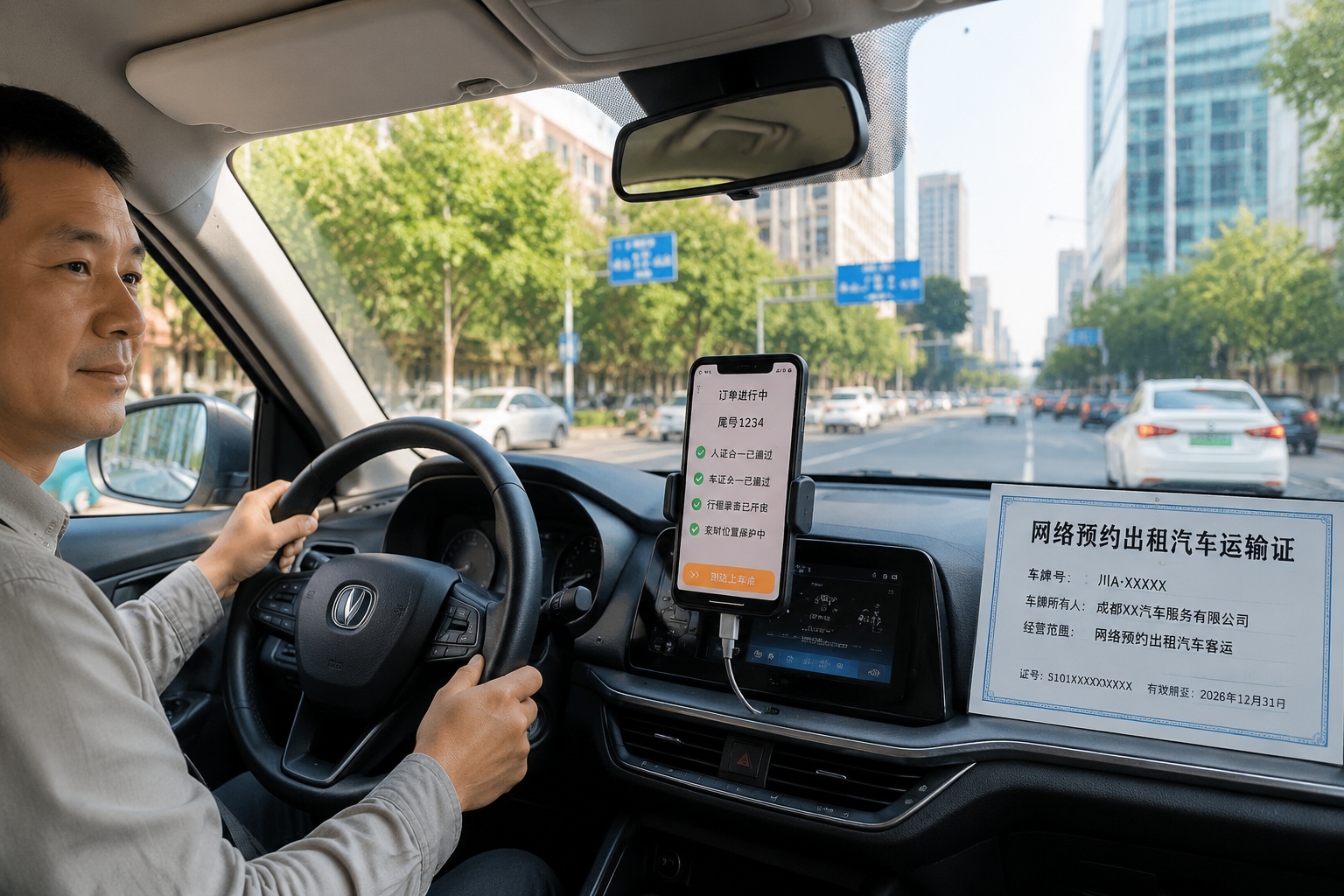
For both Chinese and foreign passengers, one question matters: how do you know a car is legally allowed to pick you up? Under a national rule introduced in 2016, the car itself must carry a “Network Ride-Hailing Transport Certificate” (网络预约出租汽车运输证). The driver must have a separate “Network Ride-Hailing Driver Certificate” (网络预约出租汽车驾驶员证).
In the Didi app, compliant rides carry the mark “Car has permits” beside the licence plate number. The plate number on the app must be the same as the plate on the car that arrives. If a car with a different plate stops, cancel the order. This can happen when a driver uses someone else’s account or temporarily drives a car that is not in the system. Don’t be shy about mentioning the mismatch — a simple “Sorry, plate number doesn’t match” works.
For passengers, riding in an unlicensed car does not lead to a fine, but it is not wise. If an accident happens, insurance companies can deny coverage because the ride is not commercial and the passenger is not a named insured. The app’s trip insurance, if any, is also disabled. For a small cost difference, always take a certified ride.
Practical Fixes for Payment, Maps and Language
Test your card before you really need it
Add your international card to Alipay or WeChat Pay and make a small purchase, like a bottle of water at a convenience store, before your first ride. If the card is declined, contact your bank before you find yourself on a rainy roadside.
Share a Chinese address, not an English one
Many destinations have English names that ride-hailing apps cannot map to a precise address. Change the app to Chinese and type the destination, or open Gaode Maps or Baidu Maps, find the destination and tap “Share to ride-hailing” (发送到叫车). The app will receive the exact coordinates.
Handle the driver call without stress
Most Didi drivers do not speak English, but the app has a text chat with built-in translation. You can also select preset phrases from the chat window such as “I am at Gate B2”, “Please wait”, or “Thank you”. If the driver calls, pick up, say “Hello”, and immediately send the address as text in the chat. Do not wait; the driver can see the chat while on the road.
If You Really Can’t Make the App Work, Use a Taxi
Sometimes the verification fails, or you run out of battery. Traditional taxis are still everywhere. In almost every Chinese city, you can flag one on the street. At airports and train stations, follow the signs to the official taxi queue. Have your destination written in Chinese characters. You can pay the driver in cash, though it is still smart to keep small bills. You can also ask your hotel front desk to call a taxi; most hotels have a direct line to a dispatch centre, and the car will wait at the entrance.

Another fallback for people without app-based verification is to book a car through a local travel agency or a hotel concierge. This costs more, but the driver is registered and used to dealing with foreigners.
Bottom Line
Anna can take a Didi from Beijing Capital Airport tonight. She needs a phone number that can receive SMS, a passport for real-name verification, and a payment method linked before the ride starts. The entire setup can take less than fifteen minutes. For the person in the passenger seat, China’s ride-hailing system is accessible. For the person who dreams of sitting in the driver’s seat with that same app, the system is deliberately closed. Knowing the difference is the simplest way to stay on the right side of Chinese mobility rules.
Start the discussion at forum.chinacomes.com