

“Can I Legally Own 100% of My Factory in China?”
Anna, a packaging entrepreneur from the Netherlands, is planning to build a sustainable packaging plant in Shanghai. She doesn’t want to enter a joint venture unless she must. So her first question to her lawyer is simple: “Can I set up a wholly-foreign-owned company?”
The answer lies in a fast-dwindling but still vitally important document: China’s Negative List for Foreign Investment Access. The 2026 edition, published by China’s National Development and Reform Commission and Ministry of Commerce, quietly took effect on January 1, 2026.

The Negative List in Plain Language
Think of the Negative List as a rule book that tells foreign investors where they are forbidden to invest, or where special restrictions, such as Chinese partnership requirements, apply. If your industry is not on the list, you are free to invest just like a Chinese investor. That means you can often hold 100% equity.
For Anna, whose packaging business sits on the open side of that line, the message is: no joint venture needed, no outbound ownership cap, no additional approval. But for investors in media, nuclear power or certain mining operations, the picture changes dramatically.
A Decade of Shrinking Restrictions
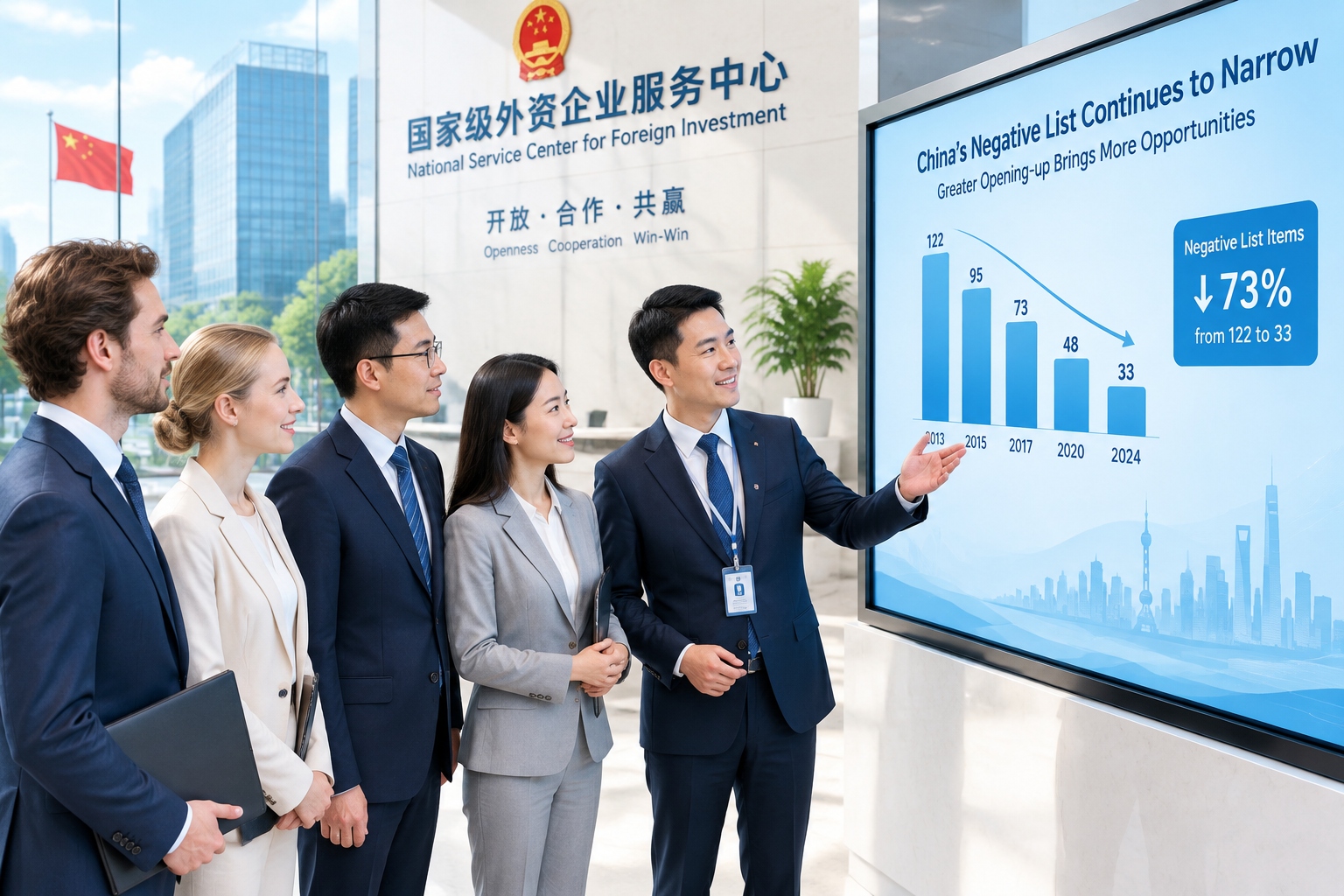
China’s nationwide Negative List first appeared in 2017. At the time it was 63 entries long. Over the next years it gradually narrowed: to 48 in 2018, 40 in 2019, 33 in 2020, 31 in 2021, then to 27 in 2024. The 2026 edition brings the national list down to just 24.
The most dramatic change came in manufacturing. In 2024, China removed the final manufacturing restrictions. A visible example is Tesla’s Shanghai Gigafactory, which became the first wholly-foreign-owned car plant in China after auto manufacturing restrictions were lifted in 2019. Today, foreign investors can open everything from a widget factory to a computer-chip packaging plant entirely on their own.
What Is Still Prohibited or Restricted in 2026
Despite the progress, certain sectors still have closed doors or need Chinese control. Here are the main areas listed in the 2026 Negative List:

| Sector | Status | Rule in practice |
|---|---|---|
| News, publishing, radio, television and internet news | Prohibited | No foreign investment at all, whether direct or indirect. |
| Compulsory education (primary and junior high schools) | Prohibited | Must be fully run by Chinese entities; foreign schools are banned. |
| Traditional Chinese medicine secret formulas | Prohibited | Prescriptions considered state secrecy are off-limits to foreign companies. |
| Rare earth and radioactive minerals | Prohibited | Mining and processing are closed to foreign capital. |
| Tobacco production | Prohibited | Reserved for the state tobacco monopoly. |
| Oil and gas exploration & extraction | Restricted | A Chinese partner must hold a controlling equity stake. |
| Nuclear power plant construction and operation | Restricted | Chinese party must be controlling shareholder; approval is highly selective. |
| Crop seed breeding for major grains | Restricted | Joint-venture only with Chinese majority ownership for wheat, corn, and soy seeds. |
| Telecommunications services | Restricted | Basic telecoms require Chinese control; value-added telecoms are traditionally capped at 50% ownership, but pilot free-trade zones now allow more. |
| Hospitals | Restricted | Wholly foreign-owned hospitals are permitted only in designated free-trade zones, not nationwide yet. |
Even with a shorter Negative List, don’t assume that every “restricted” sector is impossible. The key is to look at the separate Free Trade Zone version, which tends to be more open than the national list. For example, restrictions on certain value-added telecom services have already been lifted in the Shanghai and Hainan free-trade ports, effectively letting foreign investors own 100% of a cloud or data application business in those zones.
Where Foreign Investors Are Welcome: The Encouraged Catalogue
Outside the Negative List, China actively pushes outward investment with a separate document called the Catalogue of Encouraged Industries for Foreign Investment. If your sector appears there, you qualify for concrete benefits: reduced corporate income tax, tariff relief, and quicker administrative processes.
For example, an environmentally friendly packaging producer like Anna could find her project categorized under “green packaging and waste recycling” or “biodegradable materials.” That places her in the encouraged list.
What does an encouraged-status project actually get?
- Tax reduction: Enterprises located in western China’s encouraged sectors enjoy a corporate income tax rate of 15% rather than the standard 25%.
- Tariff exemption: Self-use equipment imported within the total investment volume is exempt from customs duty.
- Support: Local governments often accelerate planning approvals, land supply, and license permits.

What the 2026 Changes Mean in Practice
Three effects stand out for investors.
1. Manufacturing is now a straightforward bet. There’s no longer any special restriction for foreign-owned factories. If you’re planning a production base in electronics, electric vehicles, biomedical devices, or even furniture, you can go wholly foreign-owned without negotiating a joint venture.
2. Services are the new frontier. The 2026 list strengthens pilot openings in value-added telecom and healthcare. Wealthy foreign medical groups can now operate standalone hospitals in Shanghai, Beijing, Suzhou, and many free-trade zones. But outside these zones, the old corporate partner requirement still stands.
3. Free-trade zones remain the “shortcut” address. Because the free-trade-zone Negative List is shorter than the national one, an investor in a sensitive sector can sometimes restructure to operate from a designated FTZ. For example, investing in a data centre or online education platform is still constrained nationally, but in a free-trade port, a 100% foreign-owned company may be allowed for specific service lines.
An Action Plan for First-Time Investors
If you are planning to enter China, use these steps:
- Identify your sector code. China uses a national industrial classification code. Confirm exactly where your activity fits.
- Compare the National Negative List and FTZ version. Choose the version that applies to your actual registration address.
- Check the Encouraged Catalogue. Even outside restricted sectors, you may be leaving money on the table if you don’t file for encouraged-sector status.
- Do not forget industry specific licences. The Negative List isn’t the only permit you need. Hospitals, schools, energy-related projects and telecommunication activities have additional supervision from sector regulators even when ownership is open.
- Talk to local investment promotion officials. Each province and city has investment agencies with English-speaking teams. They can confirm vague clauses and often walk you through the paperwork.
The Bottom Line
The 2026 Negative List proves that China’s door has opened wider, but it hasn’t vanished. Sectors such as media, education, nuclear energy and rare earth are still protected, while manufacturing and many service industries now welcome totally foreign-owned firms.
Back to Anna: her packaging project is unconditionally outside the Negative List. She can own 100% of her Shanghai factory and may claim encouraged-industry tax cuts if she expands to central China. For her, China is a clear and predictable market. For an investor trying to enter television or rare earth mining, the message remains: choose a partner — or choose another industry. That is the real story of China’s 2026 list.
Start the discussion at forum.chinacomes.com