

One Door, 18 Square Meters of Life
I climbed the stairs of an old walk-up in Hangzhou one rainy Saturday afternoon, mainly to see if Lin Xiaoman could really live well in 18 square meters. The building was from the early 1990s, with peeling signage on the ground floor and motorbikes parked in the corridor. By the time I reached the fifth floor, I was out of breath.
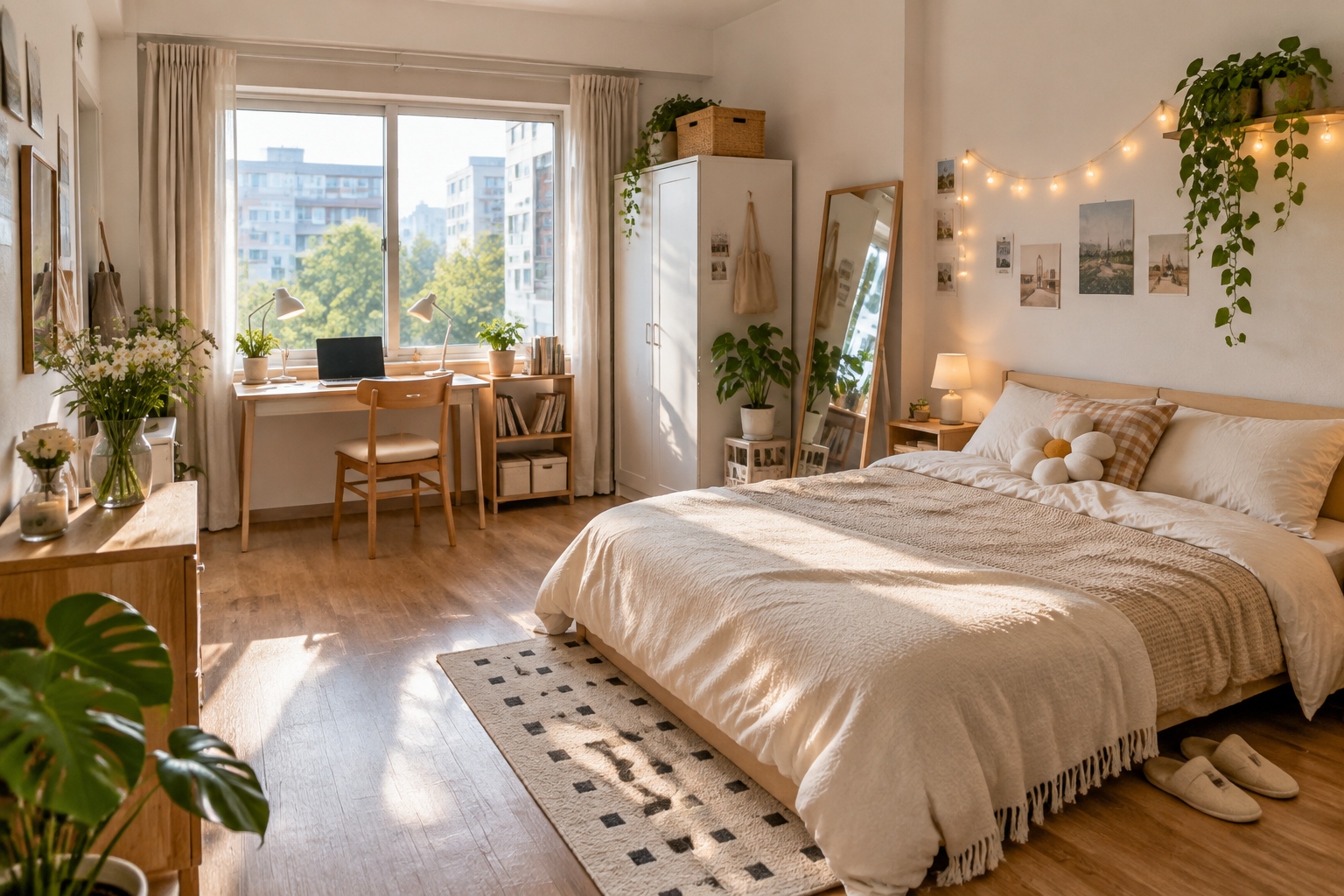
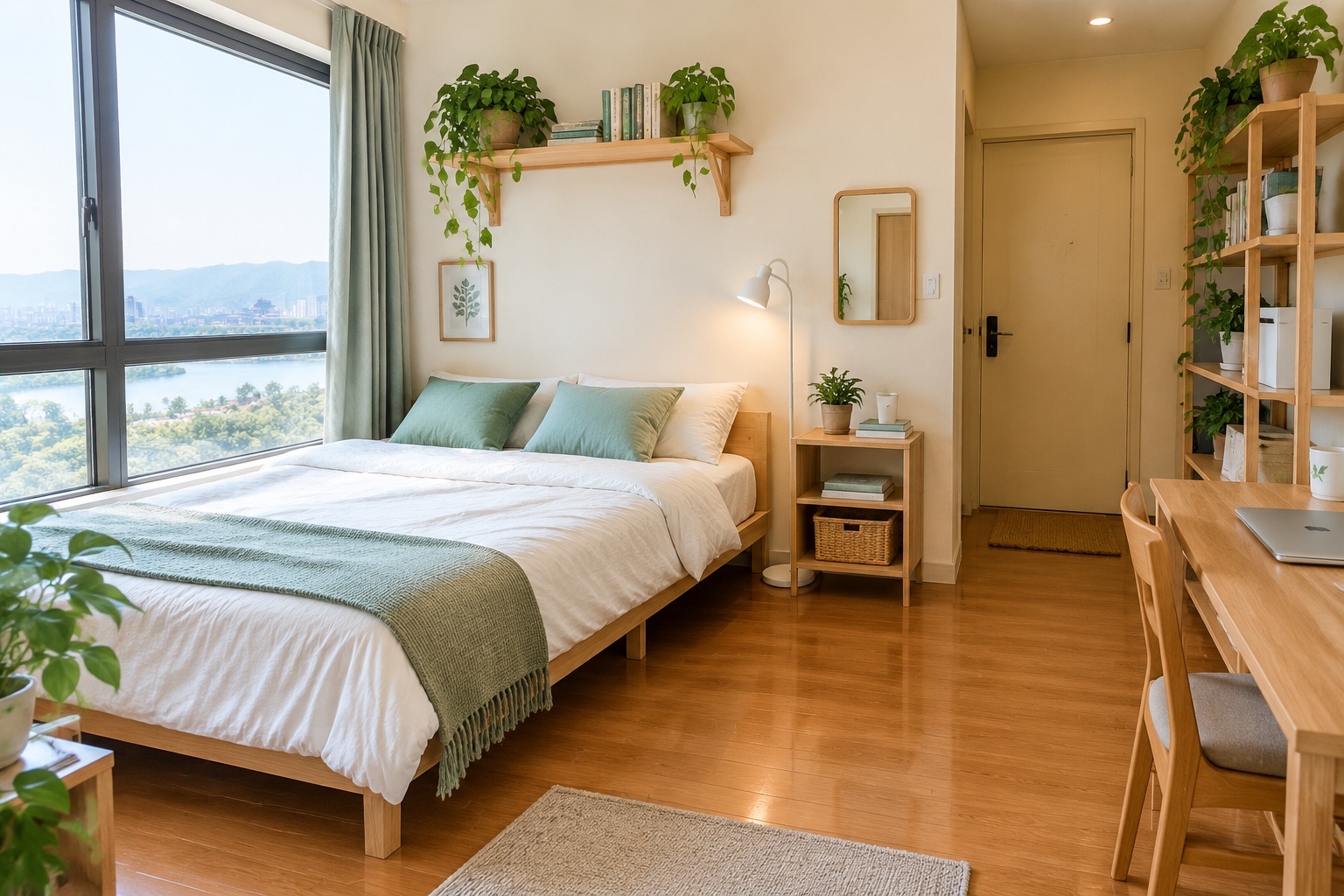
When Xiaoman opened the door, she laughed at my face. “The walk is the first home repair,” she said. Then she moved aside, and the room immediately offered a quiet counterpoint to the building: clean cream walls, a low bed under a large window, a narrow wood shelf with pothos and mint plants, a small desk, and a mirror that made the whole space feel twice as large. The total floor area, including the tiny bathroom cubicle by the entrance, was about 18 square meters —- about 194 square feet.
“Four months ago, this place looked like a storage room that had been left behind by someone who didn’t care,” she said. Grey paint was flaking from the wall, the floor had a mysterious sticky stain, and the single fluorescent tube buzzed when turned on. At night she would come home from work and feel the walls closing in. “I used to joke that my room had an atmosphere of waiting,” she said, “waiting to move, waiting to earn more, waiting for a real life to begin.” One Friday night, she decided the waiting should end.
Do It Without Leaving a Mark
Xiaoman is a product designer, not a professional renovator. Her rented home was one of hundreds of thousands of small apartments taken by young professionals in Chinese cities each year. But her approach reflects a broader trend: “rental makeover” (出租屋改造) has become a popular form of self-expression, with thousands of tutorials and before-and-after photos shared every day on Xiaohongshu, Douyin, and Bilibili.
There is no fixed belief that renters should make expensive permanent changes. On the contrary, the modern Chinese renter often looks for materials that will not destroy the room or annoy a landlord. Xiaoman’s landlord only allowed one non-structural intervention: she could repaint the walls in a neutral off-white, since it would not affect the next tenant. The rest of her plan used peel-and-stick or modular products that can be removed at the end of a lease.
1. Surfaces That Can Be Peeled Off Later
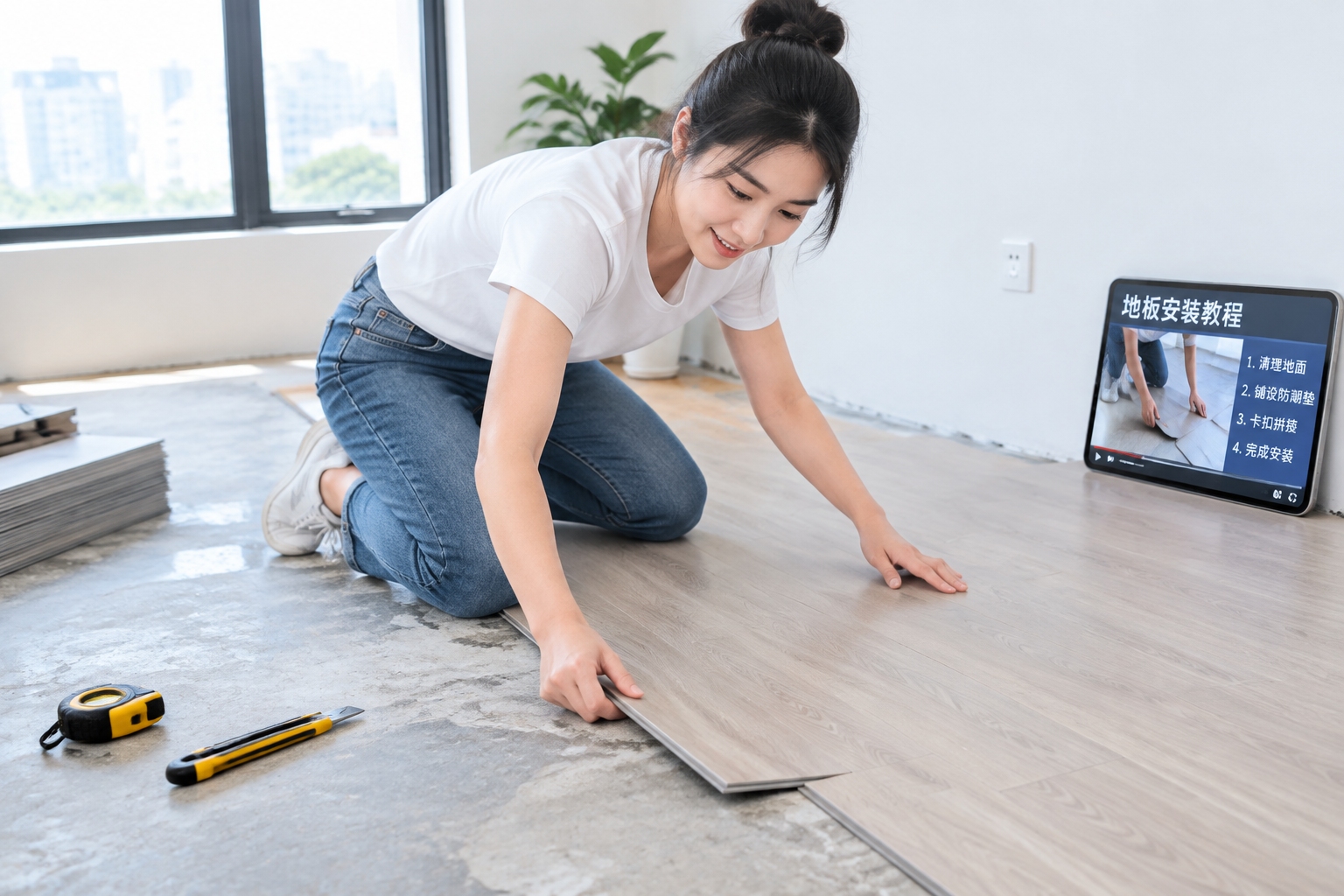
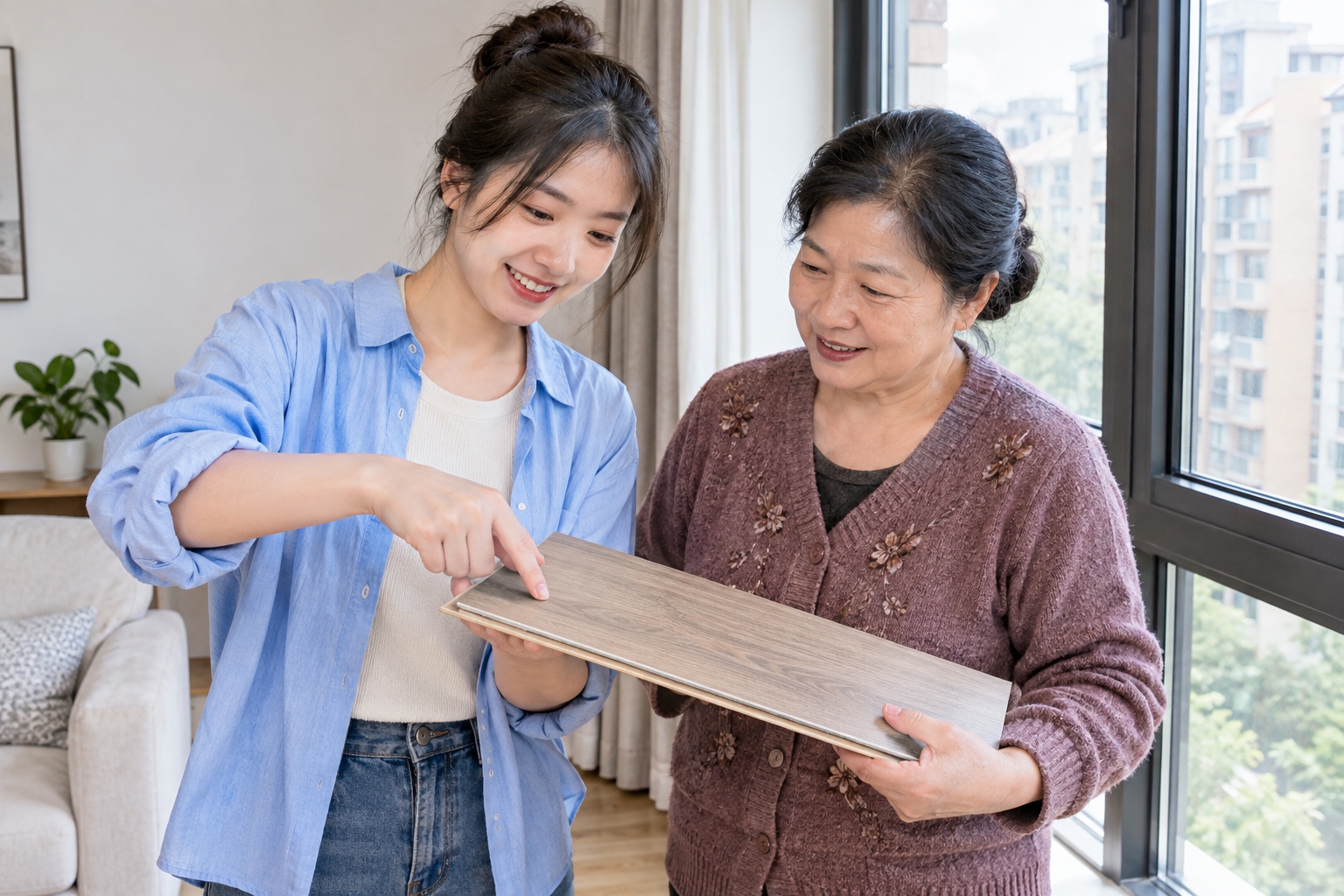
The biggest visual upgrade was the floor. Instead of expensive wood or risky adhesives, she chose “floating” stone-plastic composite planks, thin sheets that click together and lie loosely on top of the old uneven concrete. She ordered about 15 square meters from an online retailer, cut the edges with a utility knife, and spent three weekends on her knees fitting them together. The total cost of the flooring was about 320 yuan, roughly 45 US dollars. “My back ached, but every evening when I put my feet on the floor, the memory of the discomfort disappears,” she said.
2. The Vertical Rule: Fill the Wall, Save the Floor
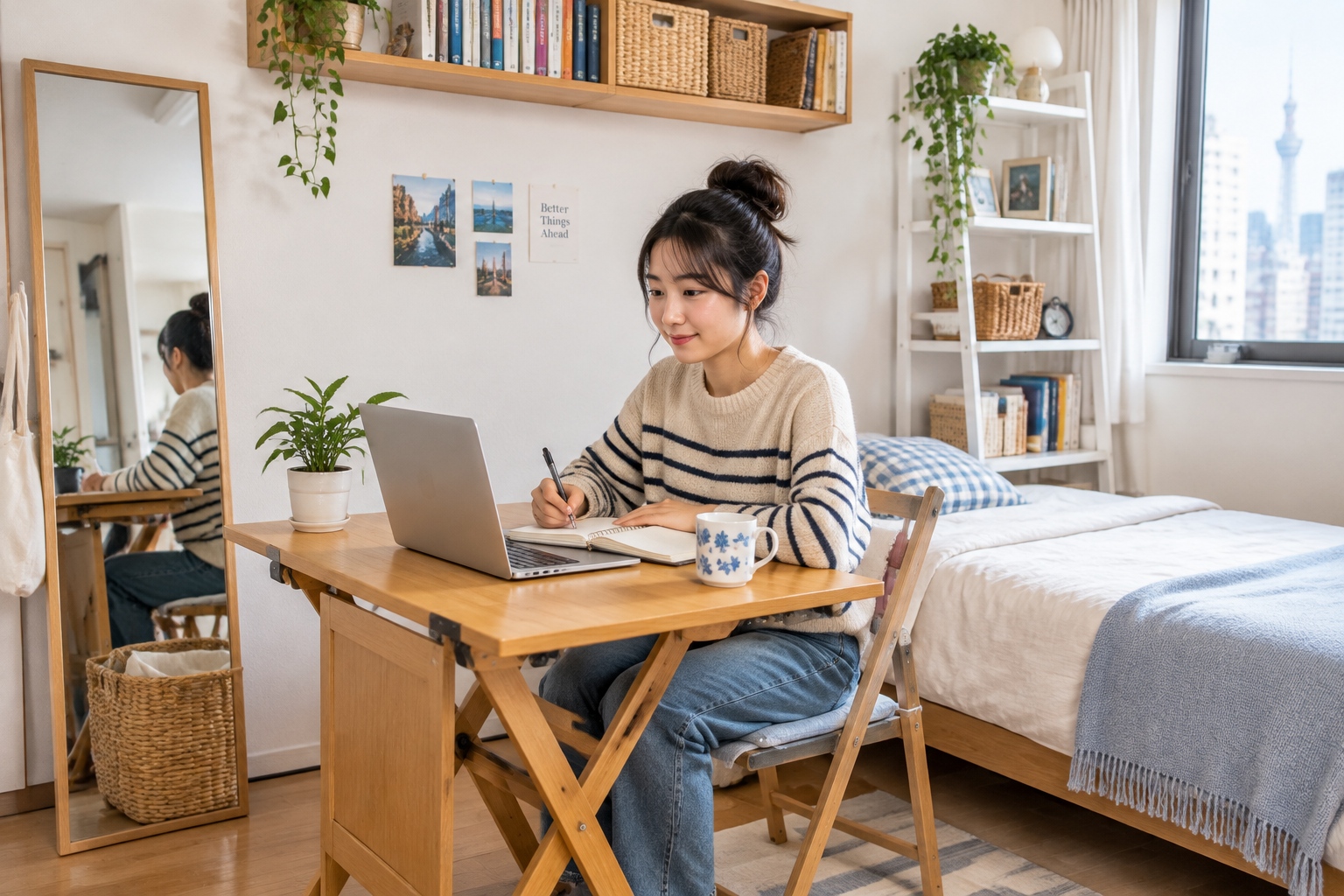
In a 18-square-meter room, every square meter of floor is precious. Xiaoman learned to use the vertical dimension. Above the desk, a slim wooden shelf holds books, small jars of tea, and a speaker. Beside the bed, a tall utility ladder, painted white, does the job of a nightstand and a wardrobe rack. A full-length mirror stands behind the door, doubling the sense of space and adding light. “If you put things under the bed and above your eye level, you have less visual clutter,” she said. “You feel calmer because the room is not eating your energy.”
3. Hybrid Furniture Turns One Corner into Three Rooms
A one-room apartment must be a bedroom, living room, and home office at once. Xiaoman avoids pieces with a single function. She uses a low platform by the window as a lounge bench during the day and a luggage rack at night. A folding table, bought second-hand from Xianyu (China’s largest second-hand marketplace), swings out only when she eats or works on physical drawings. Extra floor cushions are stored in a basket and become extra seats when friends visit. “The table was 60 yuan,” she said proudly. “It took me an afternoon to sand and repaint it, and now it is exactly the color I wanted.”
The Final Bill: Less Than a Mid-Range Smartphone
Curious about the real cost, I asked Xiaoman to walk me through her purchase history. She went through six pages of a spreadsheet she maintains:
- Floating floor planks: 320 yuan
- Wall paint, sandpaper, brushes: 128 yuan
- Second-hand table, old wooden ladder, and ladder paint: 140 yuan
- Curtains and rods: 190 yuan
- Lights, LED strips, and bulbs: 160 yuan
- Plants, pots, and jars: 75 yuan
- Rug, floor cushions, and small storage boxes: 280 yuan
- Mirror, hooks, and small tools: 171 yuan
Total: about 1,464 yuan, or just over 200 US dollars. That is roughly the same as her monthly rent in this part of Hangzhou. “Some of my friends spend this much on a night out in Shanghai,” she said, laughing. She didn’t buy anything that required a drill or a hammer; the landlord never complained. The biggest investment, she said, was patience.
Why Bother When You Do Not Own the Room?
This kind of behavior raises an obvious question for many people outside China: if the apartment is temporary, why spend time and money on it? Why not save as much as possible for a down payment on a home you actually own?
There are practical and emotional answers. In cities such as Hangzhou, home prices have risen far above the income of most young office workers. A modern apartment in a desirable district can cost more than ten years of an ordinary salary. For Lin Xiaoman, buying a home in the near future is neither a likely nor an obsession. “I have full control over this room,” she said. “I cannot control the property market. If I wait until I can buy a place to feel comfortable, I might live in a gray box until I am 45.”
Her view mirrors a broader generational shift. Young Chinese today marry later, change jobs more often, and tell researchers that they value personal experience over permanent settlement. A rental makeover turns an act of necessity into a daily creative experiment. It also offers a sense of agency: although she does not own the walls, she owns the atmosphere she wakes up to each morning.
This idea is reinforced by a strong community. Online, shareable before-and-after images turn individual projects into collaborative inspiration. A novice in a remote suburb can learn from a designer in Shanghai how to use inexpensive mesh racks or repaint old furniture. The result is a practical culture of “poetic problem solving”: fewer influencers copying identical living rooms, more people improvising with rented space.
The Day the Landlord Came to See the Changes
One unexpected side effect of Xiaoman’s project was its connection with neighbors. One Saturday morning, the old man upstairs knocked on her door. He had seen her carrying floor planks and asked if she could help him choose a plastic carpet for his wife’s bedroom. It turned out his own son, who worked in Wenzhou, was coming back to Hangzhou and hated the old floor. Xiaoman spent half an hour showing him how the vinyl planks clicked together, and later gave him a link to the online store.
A few weeks later, the landlord came to fix the showerhead and stayed a little longer, amazed at what she had done. Instead of raising the rent, he joked that she had increased the apartment’s value. “If you move away,” he said, “please tell me before you take the floor apart. I might want to leave it for the next person.” This moment, she recalled, changed her again: “He sees the room as a home, not only as an asset. That small line made me realize that the flexibility is not only in the floor—it is also in the relationship.”
A Tiny Home Is Still a Home
As I left her apartment the rain had stopped. Xiaoman turned off the overhead light and flicked on a warm string of LED bulbs near the window. The room, with its soft shadows and plants, formed a small golden center in the old building. She gave the desk a gentle pat. “A lot of people talk about their future dream home,” she said. “I prefer to practice a tiny version of that every day. It costs far less than I expected, and it reminds me that I can improve my surroundings even when I cannot buy them.”
Rental makeovers will not solve China’s housing prices. But the culture growing around them says something simple and powerful: home is not a size or a title. It is the sense that you have stopped waiting for your real life to begin, and have started making it usable, beautiful, and warm — even if it is only 18 square meters.
Start the discussion at forum.chinacomes.com