

Morning Smoke and the Scent of Onions
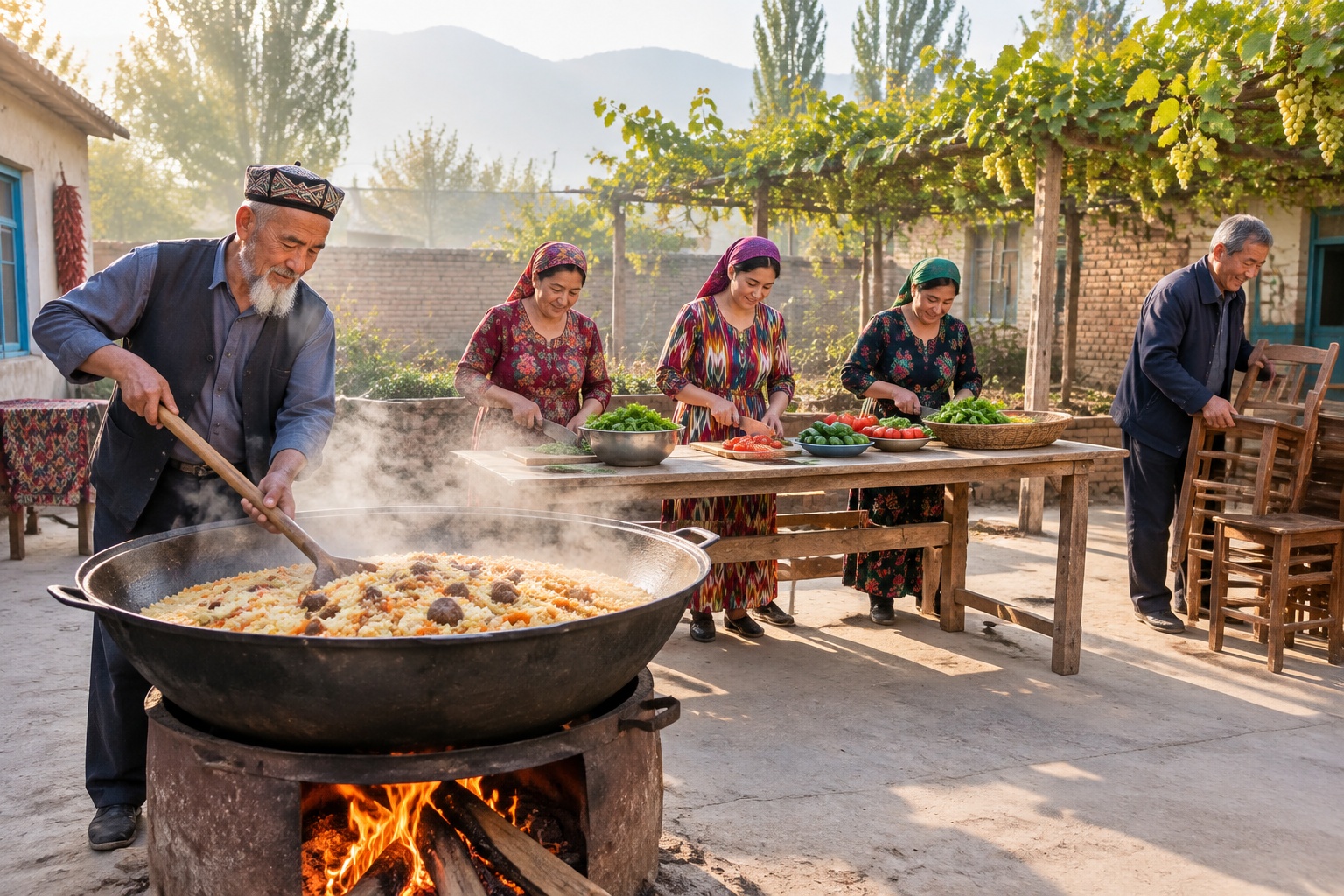
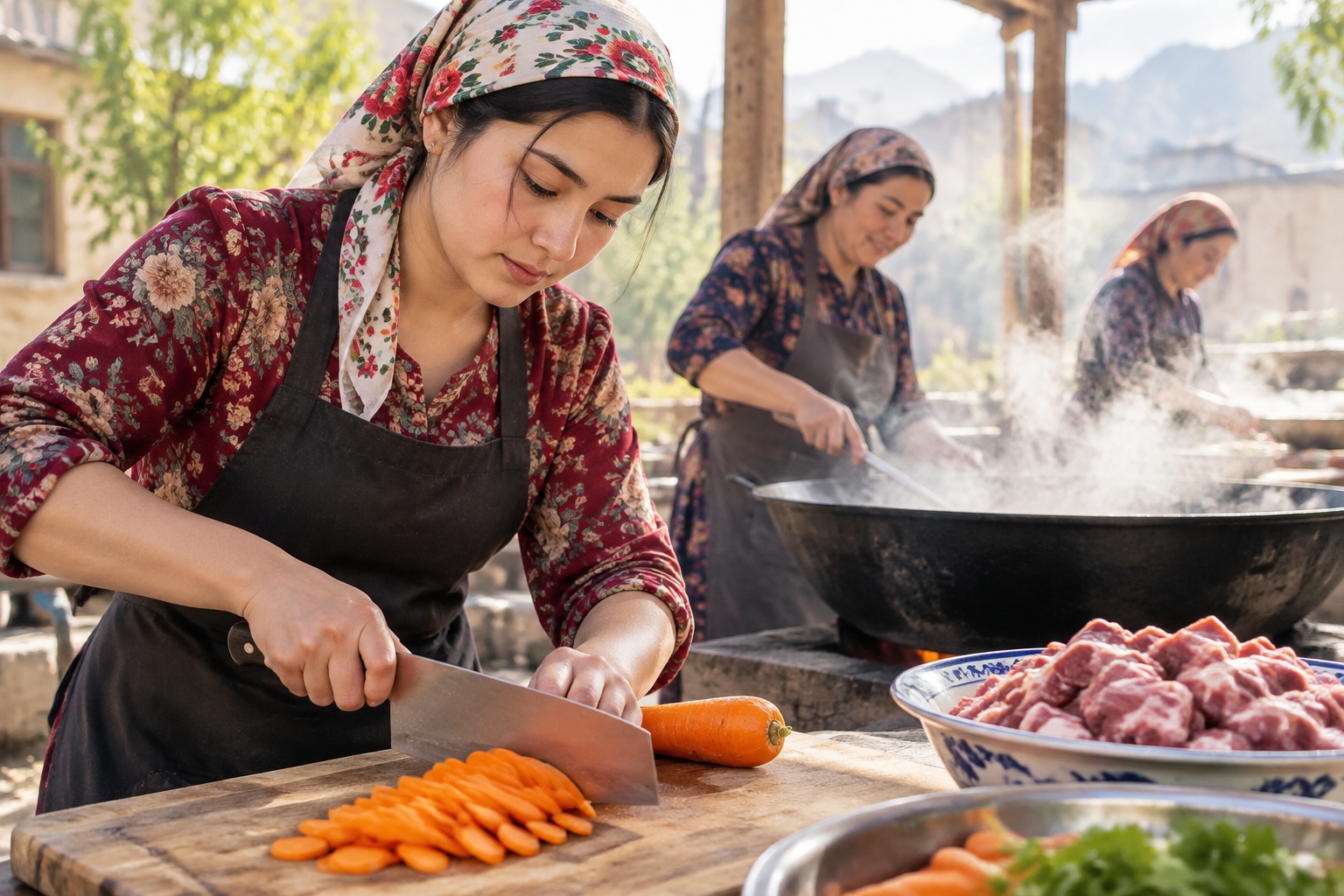
At 6:30 a.m., the air in the Ili River valley still carries the chill of night. In a courtyard behind a low brick wall, a thin column of white smoke rises from a chimney. Inside, 62-year-old Ablajan is stoking a wood fire under a massive iron wok. His daughter-in-law, Gulnar, is at a long table slicing carrots into even strips, her knife moving in a steady rhythm against the wooden board.
“The rice goes in last,” she says, wiping a strand of hair from her forehead. “First we brown the lamb, then the onions, then the carrots. By noon, the whole alley will know we’re having a wedding.”
This is the second day of the wedding celebrations for her son, Adil, who will bring his bride home tonight. In a few hours, the courtyard will fill with relatives, neighbors, and friends from across the ethnic spectrum of this region.
Ili is home to Uyghurs, Kazakhs, Han Chinese, Hui, and Mongolians, among others. For many here, interethnic friendships are simply part of the neighborhood. And a wedding is the perfect place to see how that works in practice.
Pilaf That Feeds a Whole Village
By 9 a.m., the courtyard is alive with voices. Three generations of women are chopping, stirring, and tasting. A huge pot of rice is steaming over the fire, and the smell of lamb fat and caramelized onions drifts out to the street. The pilaf, or polo as it’s called locally, is being prepared for nearly 200 guests.
“We started with 15 kilograms of rice,” says Ablajan, pausing to fan the flames. “In the old days, people would bring their own bowls and take the food home. Now we set up tables and chairs. But the principle is the same: you cook enough so that no guest leaves hungry.”
Wang Guohua, a Han man in his 50s, lives two doors down. He walks in carrying a stack of plastic chairs, his face already sweating. “I’ve lived here for twenty years,” he says, setting them down. “Adil calls me Uncle Wang. On wedding days, everyone helps. We don’t need an invitation.”
Wang’s wife, a Hui woman, is inside helping with the pastries. The scene is ordinary here: a Uyghur household, Han and Hui neighbors in the kitchen, a Kazakh family arriving with a side of yoghurt and a tape recorder.
The Kazakh Aytes Arrives
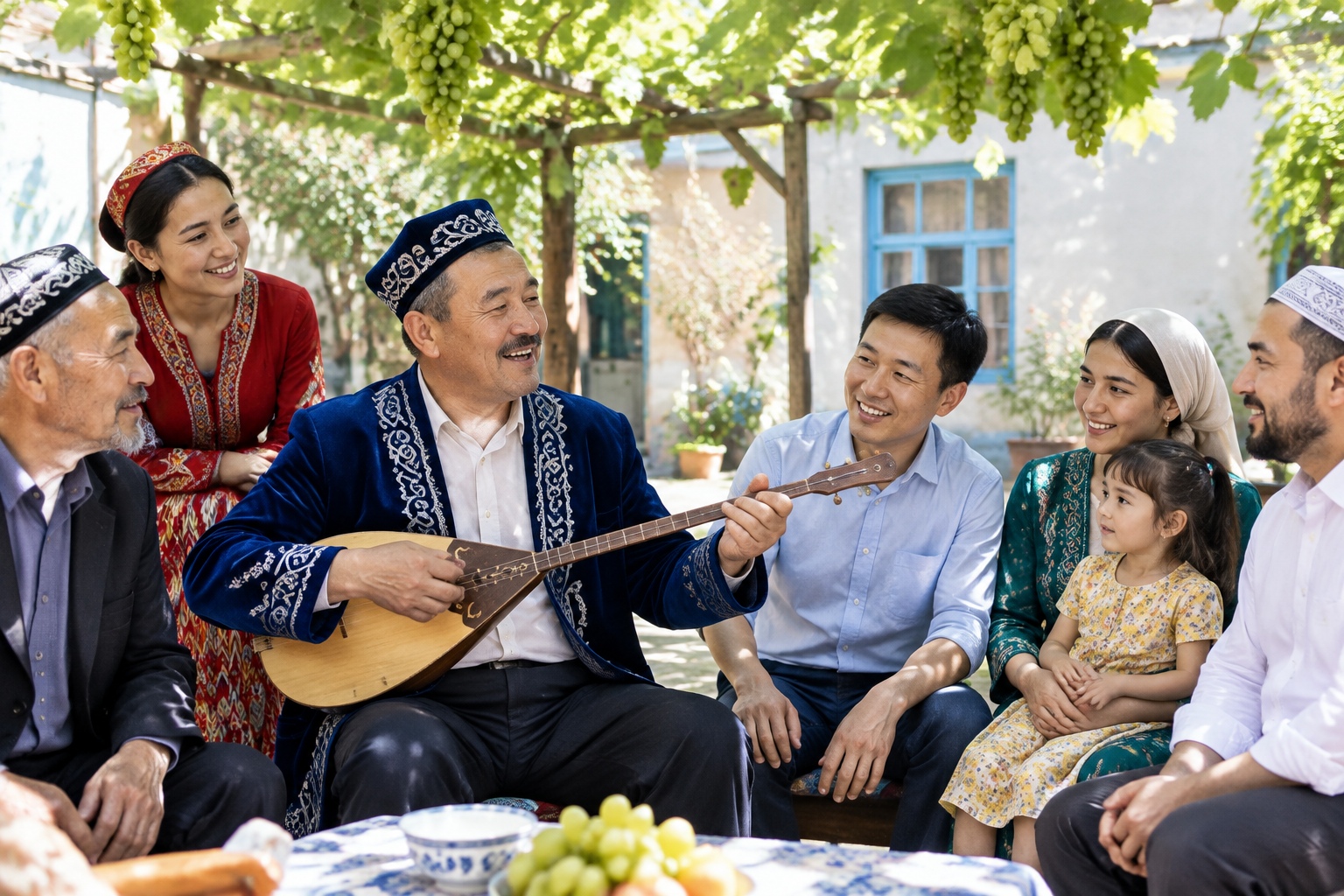
Around noon, a short procession walks through the gate. A Kazakh man in a dark coat carefully places a dombra, the two-stringed lute, on a worn carpet under the grape trellis. His name is Nursultan, a well-known aqyn in the area – a folk poet-singer who performs aytes, the Kazakh tradition of improvised musical dialogue.
“Today I’m singing for the young couple,” Nursultan says, tuning the strings. “I didn’t prepare. An aytes should come from the heart, or it’s not an aytes.”
He begins a slow melody. The courtyard gradually quiets. His voice is gravelly but warm. He sings about two rivers meeting, about the bride’s journey, about the way neighbors are sometimes closer than relatives. The lyrics are in Kazakh, but several Uyghur guests nod along. Some have heard this before. The music works like a bridge.
“My father used to take me to aytes competitions in the summer pastures,” says a young Kazakh woman, Aigerim, who now lives in the city. “When I hear it at a Uyghur wedding, I feel like our cultures are woven together in this region.”
An Open-Door Feast
By late afternoon, the bride has arrived. She is brought to the courtyard in a decorated car, her hands covered with intricate henna patterns. Women from both families sing traditional songs, and older relatives throw candies over her head for good luck.
Then it’s time for the pilaf. The big pot is carried out, and the rice is fluffy and golden, studded with pieces of tender lamb, carrots, and chickpeas. Guests line up with plates. Some sit at long tables, others on carpets under the trees. Wang Guohua is pouring tea, helping his Uyghur neighbor serve the queue.
“Eat, eat,” urges Ablajan, waving a spoon. “There’s more in the kitchen.”
At the table, a group of Kazakh friends are telling a story about a hunting trip. A young Uyghur man teases them about the size of a fish he claims to have caught. A Han child is being taught by a Uyghur girl how to say “delicious” in her language. Everyone laughs when the boy says it wrong.
Dancing Until the Streetlights Go Out
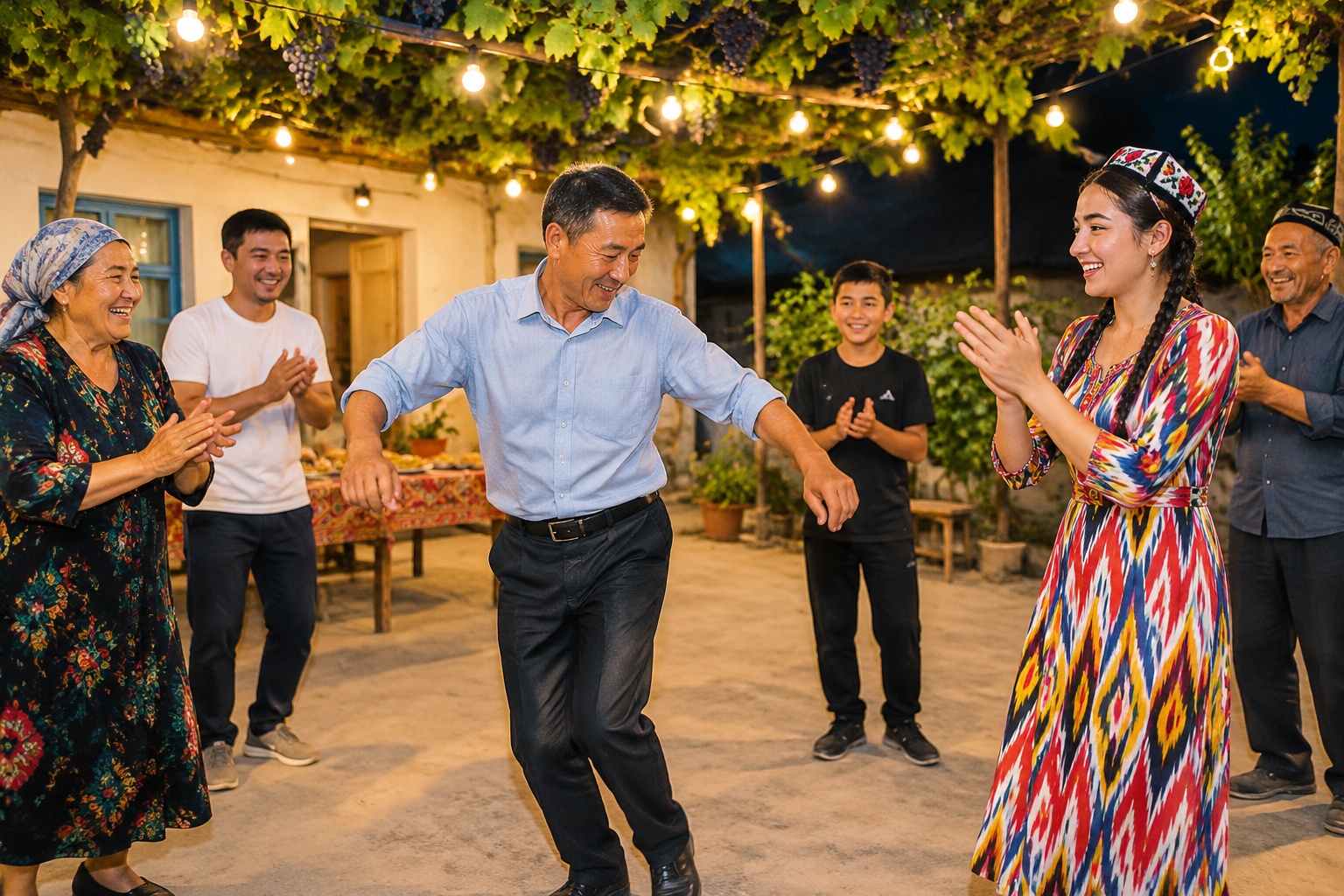
After dinner, the courtyard transforms. A space is cleared in the middle, and a sound system is set up. The first song is a traditional Meshrep tune, and the older guests form a circle. They clap and sway, then one man steps in for a solo dance, arms rising and falling with the rhythm. He is soon joined by a young woman.
“It doesn’t matter if you know the steps,” says a middle-aged Uyghur woman, pulling a hesitant Han guest into the circle. “Just follow the music.”
The dancing continues for hours. At one point, a Kazakh woman starts a modern pop song on her phone, and the younger crowd makes a new circle, mixing pop moves with traditional hand gestures. Even Wang Guohua, sweat on his brow, gives it a try.
By midnight, the fire under the pilaf pot has died down. The last few guests linger, talking quietly under the grape trellis. The bride has changed into a new dress and is saying goodbye to her girlfriends. Ablajan sits on a low stool, finally still, watching the scattered leftovers.
“Every wedding is the same,” he says, a tired smile crossing his face. “You work hard, you worry, you eat, you dance. And in the morning, you are not alone.”
Living Together, Not Side by Side
It’s easy to talk about ethnic harmony in abstract terms. But in places like Ili, it doesn’t exist as a concept. It exists as a pot of pilaf shared by neighbors, as a Kazakh song performed at a Uyghur wedding, as a Han man stacking chairs without being asked.
This wedding was not staged for visitors. It was simply the way life happens here – with a little help from everyone, and enough rice to feed them all.
Start the discussion at forum.chinacomes.com