

The Problem With Using Booking.com in China
It’s not that Booking.com doesn’t work, it’s that it shows you an incomplete version of China’s huge accommodation market. International platforms list many international hotel chains, a handful of high-end local properties, and a few boutique hotels in tourist centres. What you don’t see are the thousands of mid-range and budget hotels that ordinary Chinese travellers use, not to mention the growing number of homestays and guesthouses known as minsu.
There’s also a pricing gap. Domestic travel sites receive special promotional budgets from property owners, allowing them to sell rooms at better rates. Those same owners often set a higher baseline price on international portals because they expect overseas guests who don’t know better.
The Biggest Domestic Players: Ctrip, Meituan, and Their International Siblings
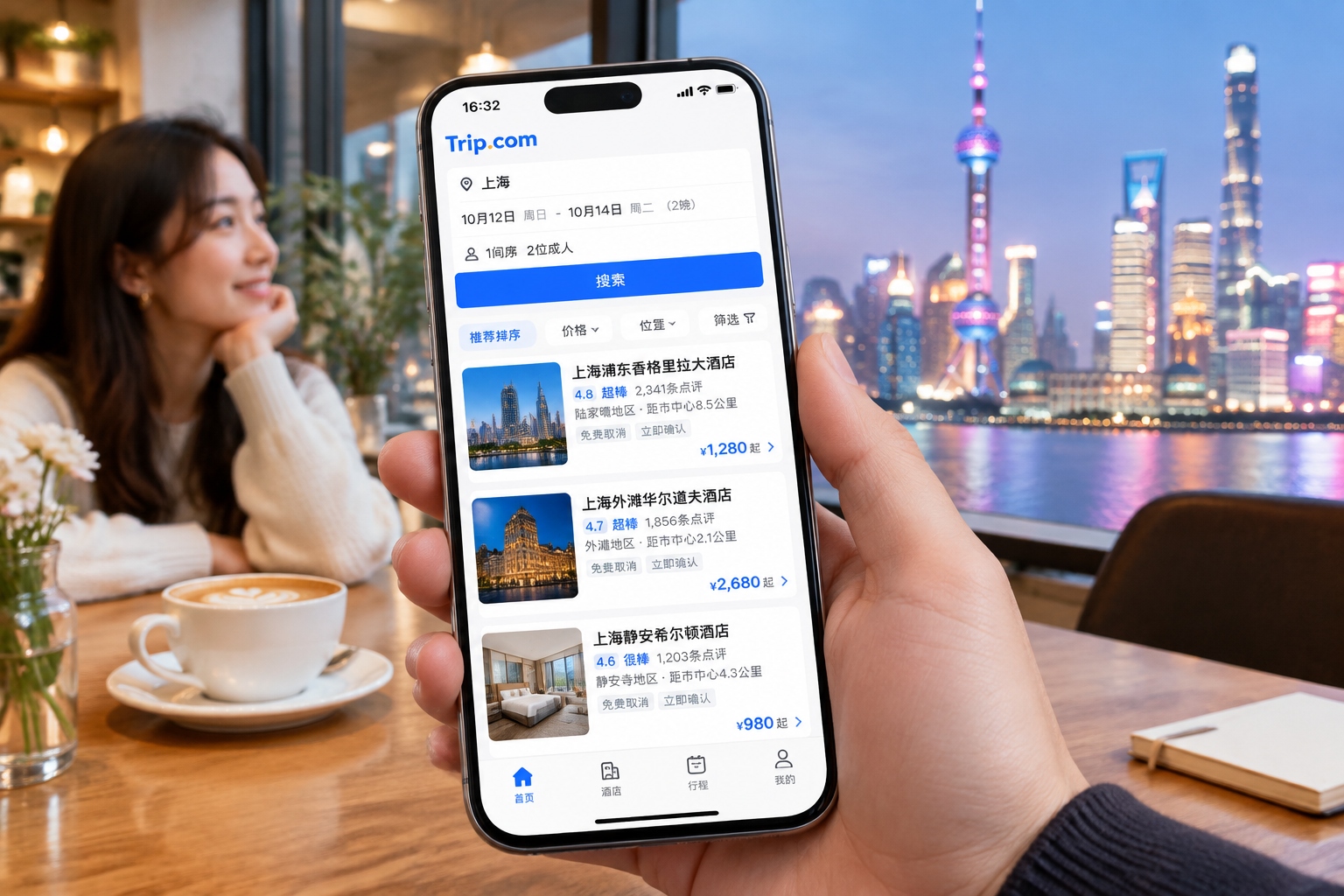
Ctrip, known as 携程 outside China, is the country’s largest online travel agency. Its English-facing arm is Trip.com, which gives you access to much of the same inventory but with a slightly simplified set of features. Trip.com is often the safest choice for first-time visitors because it supports English, accepts international credit cards, and lets you register with an overseas phone number.
However, if you want to call yourself a smart traveller, you should also know about Meituan, the same super-app that delivers your bowls of noodles. Meituan is the leader when it comes to booking budget hotels for immediate stays. It also offers “day-use rooms” that let you rent a hotel room for a few hours to take a nap or shower during a long layover—a concept that is still relatively rare on Western hotel apps.
Another niche product is Qunar (去哪儿), a metasearch engine similar to Kayak, which compares prices across multiple booking channels. It is only in Chinese, but useful if you are used to a search-then-book workflow.
How Local Platforms Beat International Ones
Choose Ctrip or Meituan and you’ll likely see these benefits:
- Lower prices: Because the platforms have scale, they negotiate aggressively. Special “member” rates are often 10–20% cheaper than Booking.
- More choices: Listings cover everything from luxury skyscraper hotels to family-run guesthouses in small towns.
- Access to local deals: Bundle your hotel with attraction tickets or a high-speed rail pass, and the total cost might surprise you.
- Honest reviews: Chinese travellers are not shy. If a room is noisy or smells of cigarettes, the reviews will tell you in no uncertain terms.
The Catch: Payment and Registration
Local platforms are built around Chinese mobile phones and mobile-payment systems. If you try to create an account, you’ll receive a verification code by SMS to a Chinese number, and when you check out, you’ll be expected to pay with Alipay or WeChat Pay linked to an account with a Chinese bank card. If you don’t have those, you might be stuck before you even start.
There are workarounds. Some Chinese accounts allow “pay at hotel” as an option at the last step of the booking. You can select that, book, and then pay later with cash or an international credit card directly at the front desk. Some platforms accept UnionPay cards from abroad too, but don’t count on it. In those cases, Trip.com or Ctrip’s international site is your easy path.
If you travel frequently to China or plan a longer stay, the simplest trick is to ask a Chinese friend to make the booking for you and pay them back. It might sound like a hassle, but it opens doors to discounted rates that you won’t find anywhere else.
Hotels, Hostels, and Minsu: What Kind of Place Should You Choose?
In China, the options can be broken into a few categories. Standard hotels range from five-star international chains to “fast hotels” like Hanting and Home Inn – no-frills places that are clean and reliable for a night’s sleep. Business hotels add a desk and better lighting, often attracting travellers who need to work.
Then there is the minsu (民宿), China’s version of the guesthouse or B&B. These are often set in residential buildings or traditional courtyard homes. A minsu in a historic district like Beijing’s hutongs or near the water of Wuzhen can be far more charming than a generic hotel room. Hostels are also widespread, especially in cities popular with backpackers, and many offer dormitory beds under ¥80.

For Business Travel: Prioritise Location Over Decor
Business travellers can usually get by in an international hotel brand like Hilton or Marriott, but those are expensive and not necessarily in the best spots for meetings with Chinese companies. A better bet might be a local five-star chain, such as Jin Jiang or China World, which often costs less and offers 24-hour business centres. The distinguishing factor is geographical convenience: staying within walking distance of a metro station can save you half an hour each day. Check that the hotel has an elevator, because some small, inexpensive hotels in converted buildings do not. If you need stable Wi-Fi for video calls, read recent comments about it; Chinese internet is fast, but building layouts and VPN habits can cause unpredictable login issues.
For Leisure Travel: Choose an Experience, Not Just a Bed
If you’re on vacation, booking a minsu can make your trip substantially more memorable. Look for a property with a courtyard, teahouse, or local design touches. You’ll often have the chance to talk with the owner, who might be a retired teacher, a young artistic couple, or a family that likes to cook for guests. But be aware that minsu properties usually run on a smaller scale: breakfast may not be included, desks may be missing, and there might be no person at the front desk after 9 p.m. Check-in times vary, so communicate your arrival time in advance.
The Booking Process: From Search to Confirmation
Let’s walk through the typical flow when you use a Chinese platform with a local account.
Step 1: Search and Filter
Open the app and type the city, whether it’s Shanghai, Xi’an, or a smaller destination. Then choose your check-in and check-out dates. The filter can feel overwhelming: stars, brand, price, street, metro station, free breakfast, free cancellation, etc. If you use the Chinese interface, you can install a browser translator that works with the webpage of these platforms. On the app, you can take a screenshot and use a translation app on a second phone.
Step 2: Register and Verify
As mentioned, a phone number is necessary. For Trip.com, you can use your overseas number. For domestic Ctrip or Meituan, register with your friend’s number or use an online SMS receiving service for the one-time code. Just be careful; some services are unreliable for this purpose. Alternatively, use Alipay’s “TourPass” or another payment option if you have an account.
Step 3: Choose Payment and Review Cancellation Policy
Many rooms have a “pay at hotel” choice. If you choose to pay online, you must use Alipay or WeChat Pay. Those usually require a linked Chinese bank card, but you can link some foreign cards, such as those from Visa or Mastercard, depending on your bank. The process is not straightforward, but it works with some effort.
Always read the cancellation rules before you confirm. Unlike many Western platforms that offer free cancellation until a day before arrival, discounted Chinese hotel bookings are often non-refundable. If you need flexibility, book a more expensive “flexible rate” or look for the label saying “free cancellation”.
Checking In: Passports, Deposits and Other Things to Expect
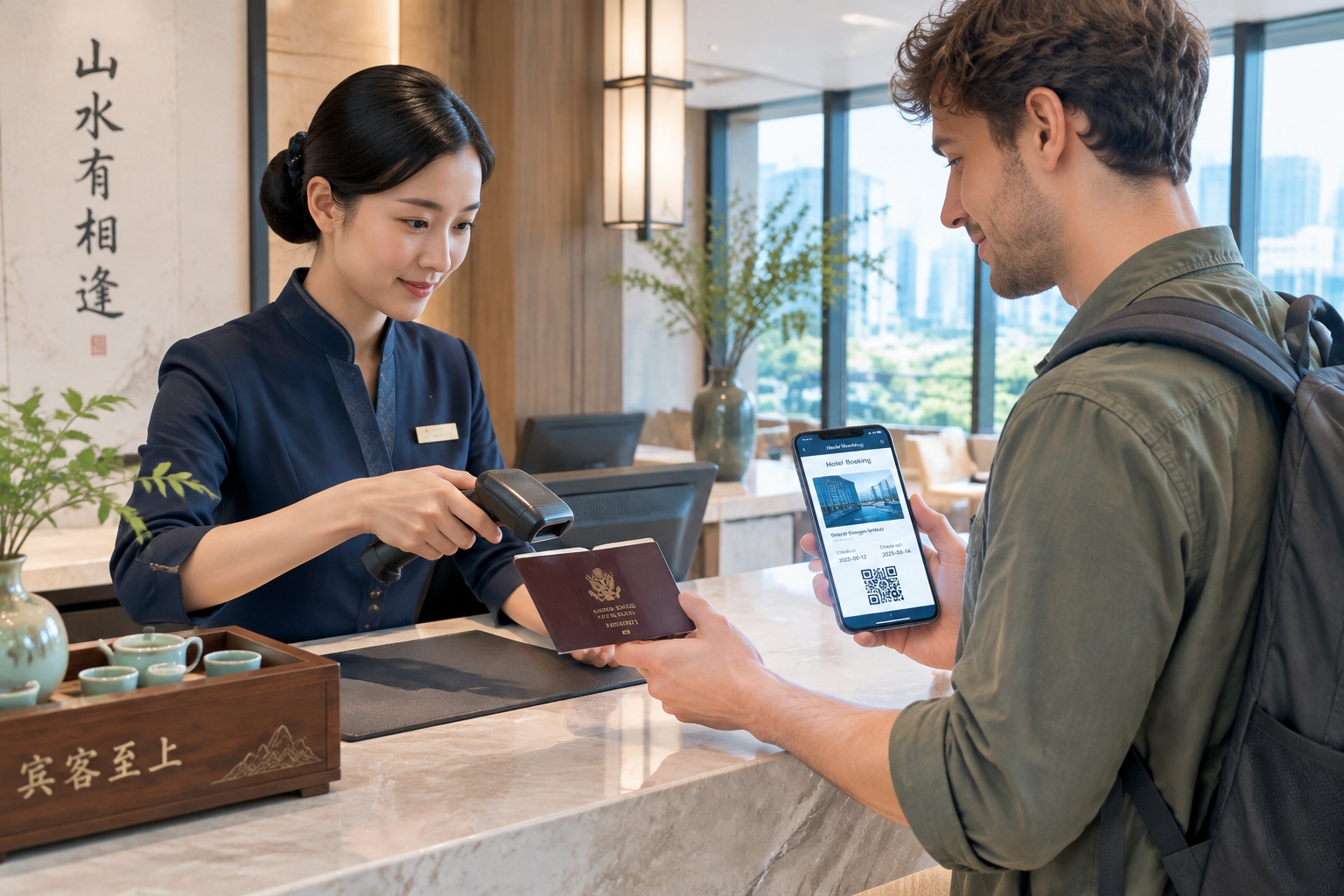
You reach the hotel, sweating after a day of exploring. The receptionist asks for your passport—never just your driver’s license. China requires hotels to register foreign guests with the local police, so expect them to scan your passport and maybe ask for your visa page. It takes a few minutes.
You may be asked for a deposit of ¥200 to ¥500 to cover possible incidentals, like a snack taken from the minibar or damaged towels. The hotel may place a pre-authorisation on your credit card if it accepts international cards, but some small properties only take cash for the deposit. Ask in advance if you don’t have cash. At check-out, the deposit is returned once the room is inspected.
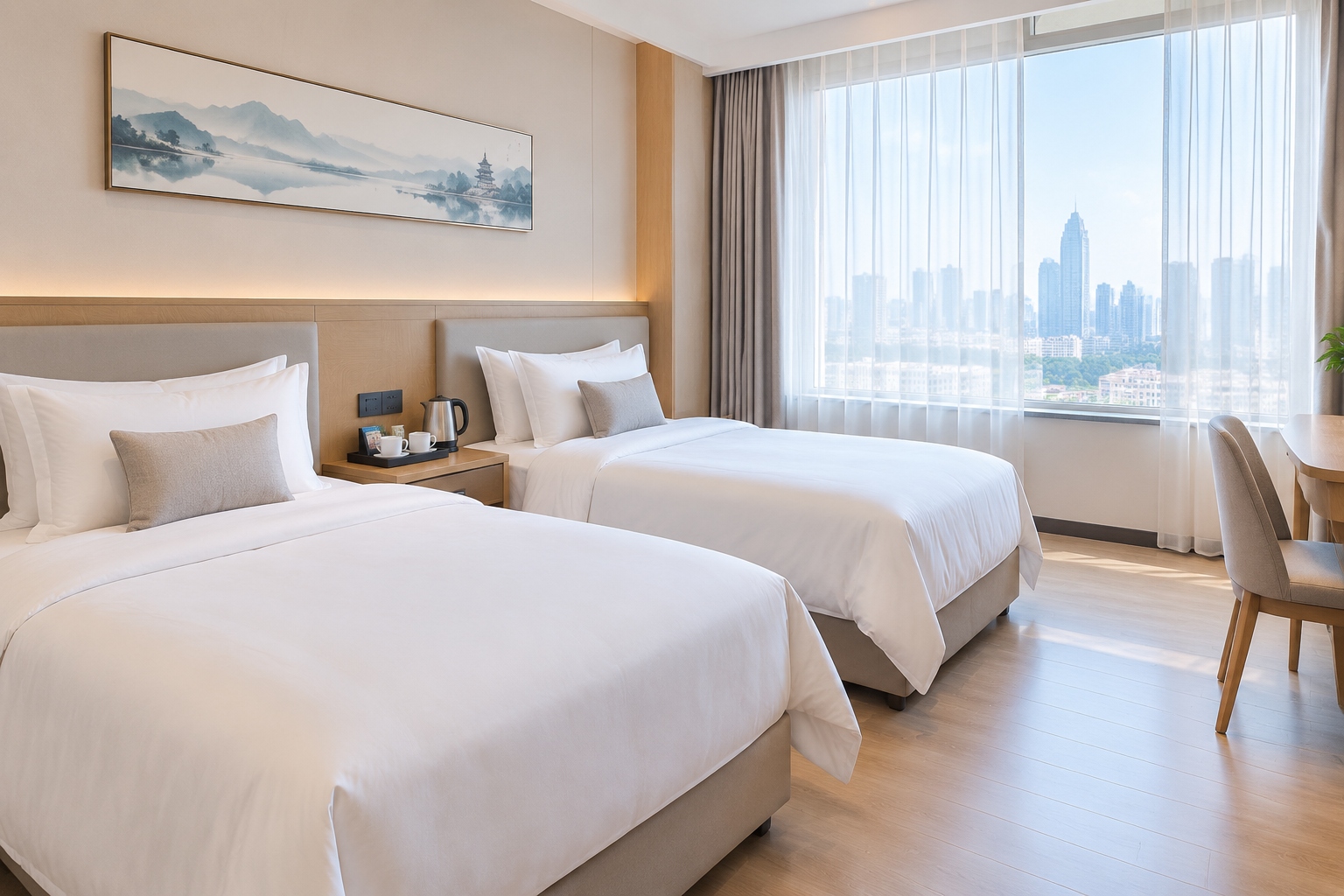
It might be surprising to meet a few “peculiarities” of Chinese hotel rooms. First, every room has slippers and an electric kettle, so you can brew tea. Second, Wi-Fi might require you to accept terms in Chinese and sometimes access is via a QR code. Third, bring a universal adapter because non-international chain hotels may have Chinese-standard sockets only, although many have USB ports now.
Can’t Read the Chinese Interface? A Quick Survival Guide
Not every traveller has a Chinese friend to help with domestic apps. Here are five ways to work around the language barrier.
- Use the international sites: Trip.com and Agoda cover much of China’s hotel stock, and Booking is improving too. They’re not perfect, but they’re enough for a first trip.
- Enable machine translation: Chinese platforms often have desktop web versions. In Chrome, right-click and choose “Translate to English”. It may not be perfect, but it gets you through the booking forms.
- Download the app and use Google Translate: If you want to stick to mobile, screenshot each page and translate it. Visual translation in Google Translate or Apple’s Translate can overlay text on the image.
- Ask a local staff member: Once you see a hotel that interests you, you can call the property directly. Many hotel receptionists speak a little English and can confirm if they have rooms and whether you can pay at checkout.
- Use a bilingual hotel aggregator: Some newer apps like Agoda have local partnerships to offer Chinese inventory, but may not show all guesthouse listings.
While it’s useful to learn a few Chinese characters like 酒店 (hotel) and 民宿 (guesthouse), the simplest path is to rely on Trip.com for your first booking, then expand your reach when you feel more confident.
Final Thoughts
Booking accommodation in China is not about preventing yourself from getting ripped off; it’s about making sure you can see all the possibilities. For a business trip with a corporate credit card, Booking.com might be just fine. But for a cultural trip in a city like Xi’an or a beach holiday in Sanya, mastering local platforms opens up rooms you’d never otherwise find, at price points that feel reasonable even on a backpacker budget.
Take the time to set up your accounts, maybe with a little help from a friend, and you’ll discover a different travel world entirely. When you’re standing on the balcony of an ancient courtyard guesthouse at sunrise, sipping tea that your host left outside your door, you’ll be glad you learned the difference.
Start the discussion at forum.chinacomes.com