

Introduction
A few years ago, a Spanish entrepreneur I know landed in Hangzhou with a suitcase full of olive oil samples. He had already secured a contract with a cross-border e-commerce platform, but no one had told him about the data localization requirements, the value-added tax nuances, or the fact that his home country’s trademark registration would mean little in Chinese courts. He learned the hard way that China’s digital economy has many layers – and the layer you see from outside is rarely the full picture.
For foreign investors and partners, the first thing to understand is that “China’s digital economy” is not one industry. It is a patchwork of distinct sectors, each with its own dominant players, consumer habits, and regulatory guardrails. This guide breaks down the five most active areas – e-commerce, social content, local services, fintech, and enterprise cloud – and adds a compliance checklist to help you avoid the hidden pitfalls.

E-commerce: The Gateway That’s Not as Open as It Looks
The Landscape
China’s e-commerce market is the world’s largest, with annual online retail sales exceeding 15 trillion RMB. The battlefield is largely split between Alibaba’s Taobao/Tmall, JD.com, and Pinduoduo, with newer players like Douyin (TikTok’s domestic version) aggressively selling via live streams. Cross-border e-commerce zones, such as the pilot areas in Shanghai, Hangzhou, and Ningbo, allow foreign brands to sell directly to Chinese consumers with simplified customs procedures and deferred tax payments.
What Foreign Brands Need to Know
Foreign brands can enter through two main routes: cross-border e-commerce (B2B2C via platforms) or domestic e-commerce (setting up a Chinese company). The cross-border route is cheaper to test, but you must comply with the Catalogue of Goods Prohibited and Restricted for Cross-Border E-Commerce. Your product labels, ingredient lists, and even packaging language must meet Chinese standards – a rule that catches many small exporters off guard.
One well-known success story is Aesop, the Australian skincare brand, which launched on Tmall Global with pre-market marketing and influencer partnerships. But for every Aesop, there are dozens of brands that failed because they treated Chinese e-commerce as just another sales channel – not as a relationship-building exercise with local consumers.
Cross-Border E-Commerce Innovations
The system itself is evolving. New “bonded warehouse” models allow goods to be shipped to and stored in Chinese free-trade zones, then sent to consumers only after a sale is made – cutting delivery times to days. This is a practical option for perishable goods, cosmetics, and small electronics. Yet, even here, brands must work with licensed third-party operators and carefully track consumer protection rules.
Social and Content Platforms: Where Attention Becomes Revenue
How the Ecosystem Works
WeChat (Weixin) is not just a messaging app; it is the operating system for Chinese life, with over 1.3 billion users. Its ecosystem now integrates short video (Channels), e-commerce mini-programs, and official accounts. On the other hand, Douyin and Kuaishou have built entirely new shopping models around live streaming and short video. In 2023, Douyin’s e-commerce GMV reportedly exceeded 2.4 trillion RMB.
For a foreign partner, the quickest way to understand: in the West, you build a website or a page and then push traffic to it. In China, you create content that lives inside an existing super-app, and then you turn that attention into sales. An influencer or “Key Opinion Leader” (KOL) with 500,000 followers can generate sales volumes that would require a prime-time TV ad slot back home.
Monetization Paths
There are three common paths for foreigners:
1. Influencer Marketing: Paying local KOLs to feature your product in videos or streams. This is essential for consumer goods – almost no brand skips it.
2. Store in Mini-Programs: Tesla, Nike, and many other global brands run official stores inside WeChat, using native features for payments, customer service, and membership.
3. Content-as-Commerce: Creating your own short-video account on Douyin, posting everyday content that builds a following, then using that to drive purchases through the platform’s built-in mall.
Regulatory Guardrails
All Chinese platforms require ICP filing for any hosted service, and commercial content that advertises products must be clearly flagged under China’s E-Commerce Law. The Cyberspace Administration of China (CAC) also regulates “fake reviews” and paid engagement that is not disclosed. For foreign entities, using third-party agencies to manage local social accounts is common, but be aware that your company can still be held liable for the agency’s actions.
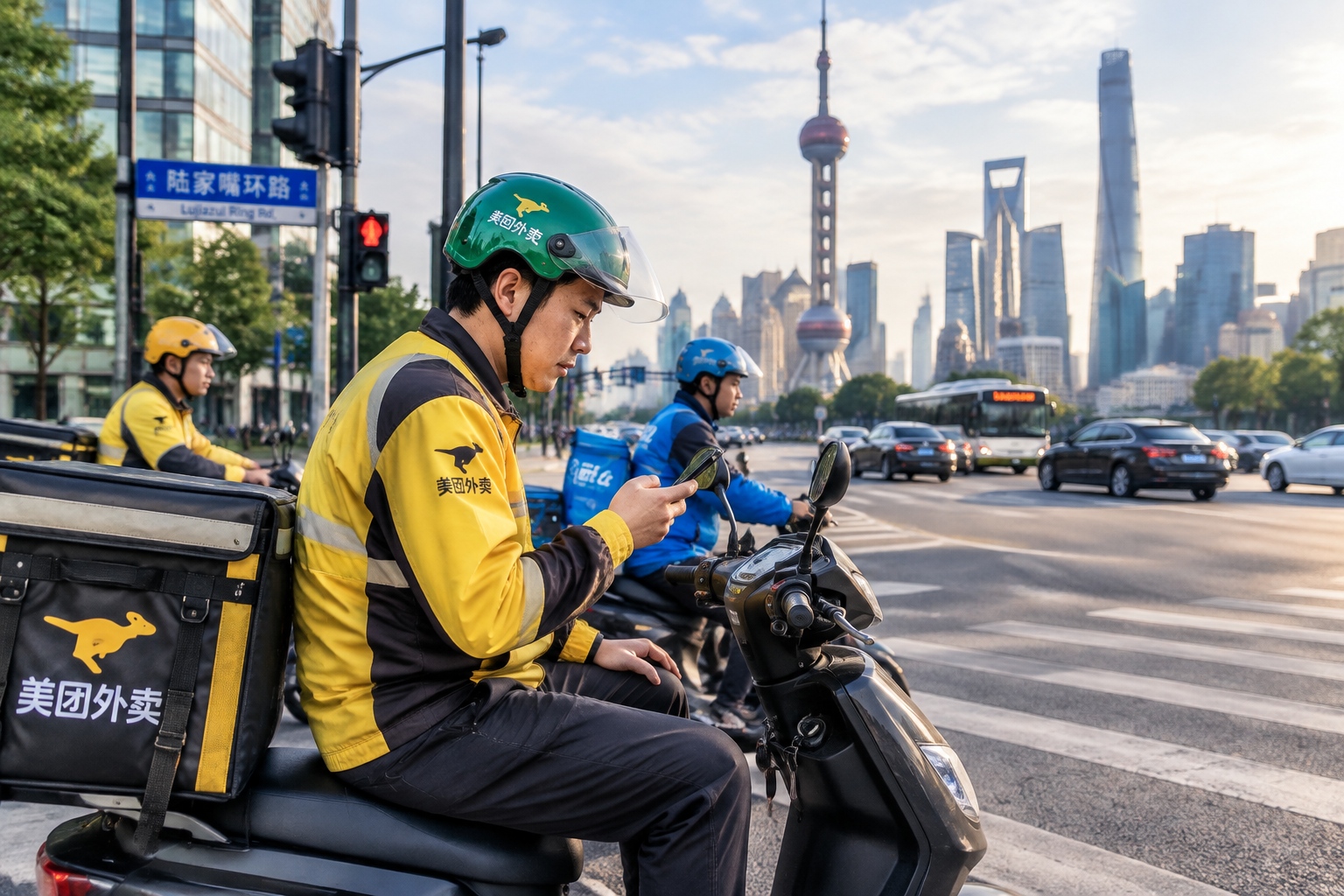
Local-service platforms are deeply integrated into urban life across China.
Mobility and Local Services: Daily Life, Dense Competition
The Giants
When it comes to moving people, food, and groceries, two names dominate: Meituan in local services (food delivery, hotel bookings, cinema tickets) and DiDi in ride-hailing. Their business models are essentially platform-based networks – they connect millions of merchants and independent drivers with consumers. There is heavy competition underneath. ByteDance’s maps and food delivery attempts, plus Alibaba’s Ele.me, still fight for scraps in certain cities.
What Investors Should Watch
1. Local Merchants: Small restaurants now live and die by their ability to appear in Meituan’s rankings. If you are a food or beverage brand, your digital strategy must include platform optimization – it is not optional.
2. Fleet and Drivers: DiDi has rolled out a fleet of electric vehicles and autonomous driving pilots in cities like Beijing and Guangzhou. Foreign auto parts suppliers and software developers may find B2B opportunities in these partnerships.
3. Regulatory Shift: In 2021, China started a major anti-monopoly campaign, hitting Alibaba with a record fine of 18.2 billion RMB. Since then, the market has slowly moved from “grow at all costs” to “regulated growth.” New entrants now face more stringent platform neutrality rules – great news for smaller players, but a reset to older monopolistic mentalities.
Fintech: Huge Market, Tight Leash
Payments
Walk into any convenience store in a Chinese city and you will see QR-code payment via Alipay or WeChat Pay. This nearly cashless system processed an unthinkable 3.5 trillion RMB in third-party payment transactions in 2023. But the sector is tightly controlled by the People’s Bank of China (PBOC). Non-bank payment institutions must obtain a license, meet real-name verification requirements, and keep reserves with the central bank. For foreign investors, direct ownership of a Chinese payment license is currently restricted, but overseas players can still partner by offering technology for cross-border payments, settlement, or fraud prevention.
Wealth Management and Credit
According to the US-China Business Council, the removal of restrictions on foreign ownership in financial services has opened new doors. Since 2020, foreign firms have been allowed to hold 100% ownership in local securities, fund management, and futures companies. Yet, digital-only finance faces a stricter ceiling: Internet deposit products have been banned, and mobile micro-loans require special clearance from banking regulators.
A real-life example: the former Ant Group (Alibaba’s fintech arm) had the world’s largest IPO halted in 2020, right before the government imposed new rules on micro-lending and consumer finance. Today, Ant has reinvented itself as a technology service provider that partners with regulated banks, rather than operating as a standalone lender.

QR-code payment is ubiquitous, even in traditional street markets.
Enterprise Services and Cloud: The Next Battleground
Cloud Infrastructure
China’s cloud market is growing at double-digit rates, with Alibaba Cloud, Huawei Cloud, and Tencent Cloud fighting for share. Foreign and multinational companies operating in China use these local clouds to avoid slow cross-border latency and to comply with strict data localization rules that require certain personal data to stay inside Chinese borders. However, the market is not simply a Chinese remake of AWS. Government procurement gives preference to domestic clouds, and foreign cloud providers like AWS or Azure can only sell “co-branded” services through Chinese partners.
SaaS Opportunities
The SaaS market is much younger. Many Chinese SMBs still rely on WeChat and manual spreadsheets for inventory and CRM. That creates a sweet spot for foreign software companies that can bring expertise in vertical niches – like international payroll, supply chain analytics, or cross-border logistics management – without needing to compete head-on with local giants like Kingdee or Yonyou. To succeed, your product must integrate with WeChat and Alipay’s enterprise messaging for notifications, approvals, and payments; a pure web interface is not enough.
One practical example: a German manufacturing company launched an IoT-based predictive maintenance SaaS for Chinese factories. They used Alibaba Cloud’s leased infrastructure and co-developed with local partners to meet data security regulations. Within two years, they had over 50 industrial customers in the Yangtze River Delta.
Key Compliance Essentials for Foreign Players
Negative List
China maintains a “Negative List” for foreign investment, which specifies sectors where foreign ownership is restricted or forbidden. Digital business is not entirely open – for instance, content platforms that stream news or publish online media are restricted, and internet data centers require a Chinese partner with a majority stake. Start with the latest Negative List (2024) to see if your intended subsector is greenfield-friendly.
Data and Security
The Cybersecurity Law, Data Security Law, and Personal Information Protection Law form a strict framework. To transfer personal data collected in China out of the country, you need to pass a security assessment conducted by the CAC, unless you meet the criteria for cross-border data flows under special exemptions. This is especially relevant for any company using Chinese consumer data for AI training or global analytics. Talk to a Chinese data protection lawyer early.

ICP and Other Licenses
If you plan to run a website or mobile app on a server inside China, you must obtain an ICP license (for commercial services) or ICP filing (for non-commercial). For some sectors – like e-commerce, FinTech, or online gaming – you will need additional industrial licenses, often requiring a Chinese entity to apply. Many foreign companies choose the “WFOE” (Wholly Foreign-Owned Enterprise) structure for non-restricted activities, but always verify whether your industry is categorized as “value-added telecommunications” or “information services.”
Conclusion
The Chinese digital economy is not a gold rush anymore—it is a deeply regulated, highly competitive, but enormously rewarding market for those who study its contours. The brands that succeed do not parachute in; they learn the rules of each sector, build local partnerships, and treat compliance as a strategic asset, not an afterthought. If you bring a product or service that respects Chinese consumers’ preferences and follows the law, there is still a seat at the table.
Start the discussion at forum.chinacomes.com