
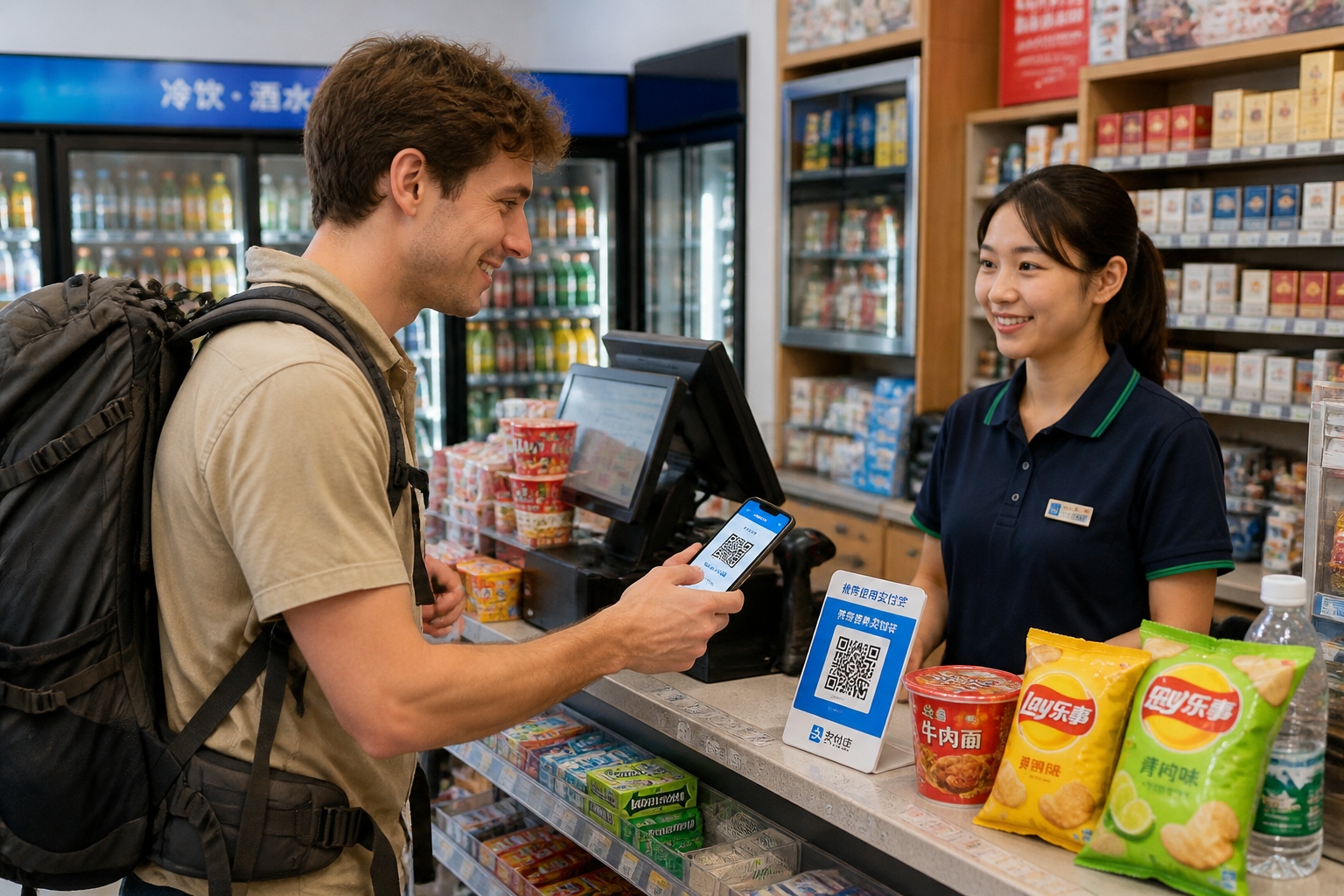

“Can you scan this?” is the sentence I hear most often in China. Walk into a fruit shop, a noodle stall, a taxi, or a local pharmacy; there is almost always a printed QR code on the counter or the dashboard. Before my first trip to Xi’an, I thought WeChat Pay and Alipay were just trendy extras. Ten minutes after landing, I understood they are part of how daily China actually runs.
Why QR-code payments are an essential part of arrival
China has not entirely stopped using cash. Banknotes are still legal tender, and you can exchange small amounts at the airport. But in everyday city life, most transactions happen with a smartphone. I once watched a local friend buy a cucumber from a roadside cart, scan a QR code, and keep walking without slowing down. That ease is exactly what makes mobile payments in China feel less like a feature and more like a default.
International credit cards are not widely accepted by small merchants. Many restaurants, cafés, and convenience stores either have no card terminal or prefer not to use one. If you travel around China without a Chinese bank account, the simplest solution is to link your foreign Visa or Mastercard to Alipay or WeChat Pay.

WeChat Pay or Alipay: what difference actually matters?
Both apps are accepted by nearly every merchant that displays QR codes, which means almost every merchant in urban China. You rarely need both, but many travellers set up both anyway as a backup.
- Alipay feels more like a travel tool. It has a clear English interface, a built-in translation feature, and mini programs for Didi, metro tickets, hotels, and food delivery. Many visitors find it easier to navigate before they get used to China.
- WeChat Pay lives inside WeChat. If you already use WeChat to stay in touch with Chinese friends or new contacts, WeChat Pay is convenient because you do not need to switch apps. It is also the main way people send money to each other, though sending red packets is usually limited for foreign users.
- Bank card support is similar. Both apps allow international Visa, Mastercard, and a few other cards to be linked. Visa and Mastercard are your safest choices.
My personal rule: if you want the smoothest international user experience, start with Alipay. If you plan to communicate with local hosts or business contacts through WeChat, you will probably need WeChat Pay anyway.
Prepare these three things before you fly
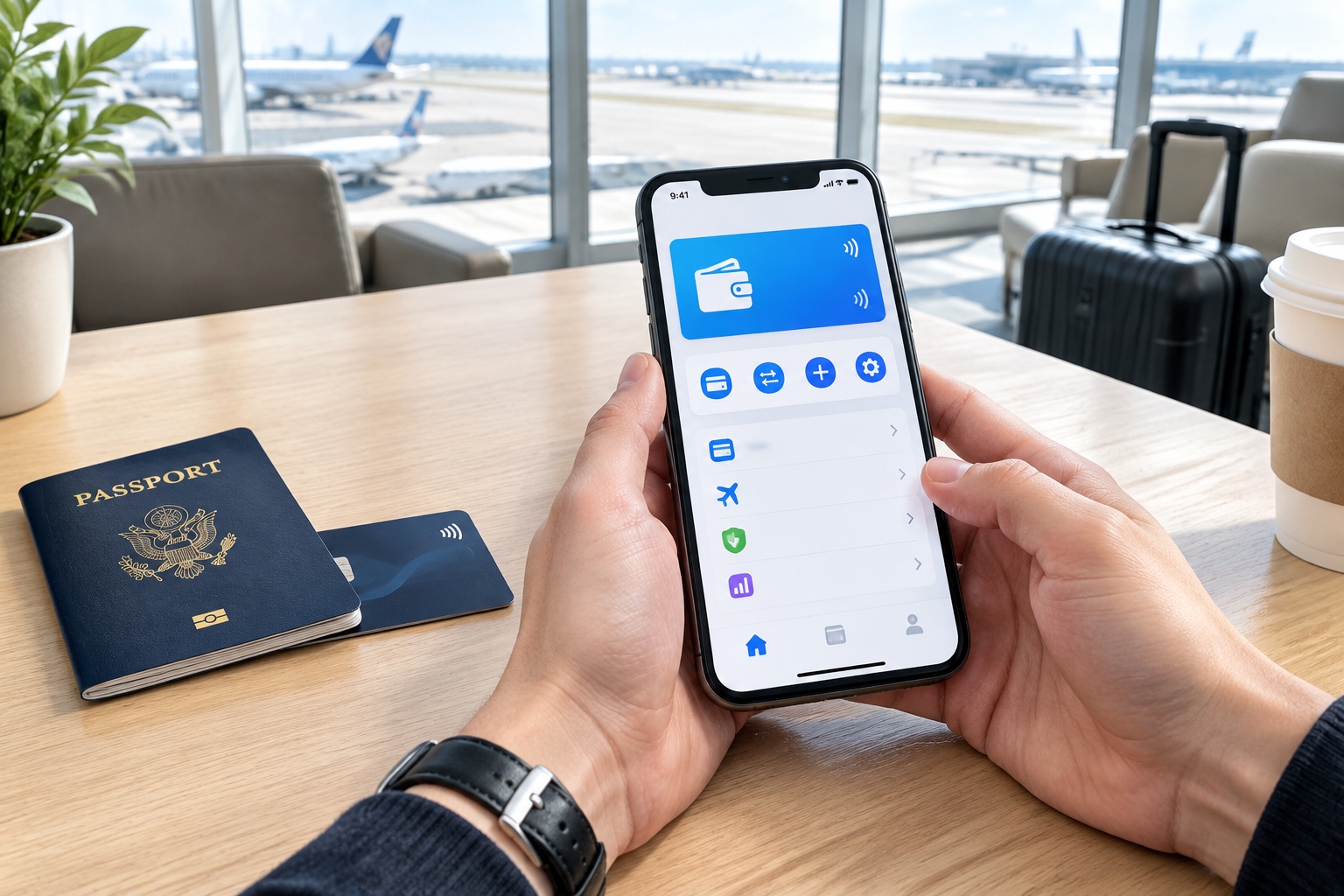
- Your passport: both apps follow Chinese identity rules. You may be asked to take a photo of your passport or enter its details during or after registration.
- A working phone number: an international number is enough. I have used a European number without problems. You don’t need a Chinese SIM card, but you do need to receive SMS verification codes.
- An international Visa or Mastercard: call your bank before the trip and activate international online transactions and 3-D Secure verification. Without this step, your card may be rejected.
Download the apps on your home network. Apple’s App Store and many Android stores in your home country will show the international version. If you wait until you land in China, some app stores require a Chinese Apple ID or other workarounds.
How to set up Alipay from outside China
Alipay has made its sign-up flow relatively straightforward for international visitors.
- Download the Alipay app from your usual app store before departure.
- Open the app and tap “Sign Up”. Choose your country code and enter your international mobile phone number.
- Enter the SMS verification code, then set a six-digit payment password.
- Tap “Me” at the bottom, then “Bank Cards”, then tap the plus sign to add a card.
- Enter your Visa or Mastercard details and complete the card verification. Your bank may ask you to approve the request via its own app or SMS.
- If the app asks for identity verification, often called “real-name authentication”, follow the instructions and upload your passport or enter passport data. This step is part of China’s anti-money-laundering rules and is routine for overseas users.
Once the card is linked, you can pay by showing the QR code to the cashier or by scanning the merchant’s QR code. The app will show the exchange rate and any handling fee before you confirm.
How to set up WeChat Pay with a foreign credit card
WeChat Pay uses the same principle: foreign phone number + international bank card.
- Download WeChat and register with your international phone number. Choose the country code of your SIM card.
- After registration, tap “Me” > “Services” (or “Pay” depending on your app version).
- Open “WeChat Pay”, then tap “Bank Cards” and choose “Add a Bank Card”.
- Enter your Visa or Mastercard details. The app may ask you to verify the card with your bank.
- When prompted, provide your passport information. If the verification menu is not obvious at first, complete any transaction and follow the payment prompts; the system will guide you through the missing steps.
- Set your payment password and, if the phone supports it, enable fingerprint or face recognition.
WeChat Pay works in the same QR-code style. You can use “Pay” to show your barcode to a cashier, or use “Scan” to pay the seller.
Foreign card and no Chinese bank account: how the money flows
For most visitors, there is no need to pre-load money. Alipay and WeChat Pay take payment directly from your linked international card. You see the final price in yuan, the app converts it using the card network rate, and your bank charges the resulting amount in your local currency.
Because the payment is direct, you avoid the old “TourPass” prepaid-card system that confused early travellers. You do not need a Chinese bank account for daily purchases such as coffee, groceries, taxi rides, or cinema tickets.
If you want to send money to a Chinese friend or receive payments from local people, the situation is different. Those features may require a Chinese bank account or identity verification that goes beyond what a tourist can provide. For shopping and services, the linked-card route is enough.
Everyday situations: metro, taxi, restaurant, and small shops
Metro and bus
Alipay has a “Transport” icon that works in most major cities. Open it, choose the city, and you get a QR code for the turnstile. WeChat Pay has a similar mini program called “Transit QR Code”. Scan the phone at the gate, walk through, and the metro fare is charged to your linked card. No ticket machine or cash needed.
Taxis and ride-hailing
You can hail a taxi and ask the driver to scan your payment code. For ride-hailing, open Didi inside Alipay or use the WeChat mini program version. The fare is deducted automatically if your card is linked. One small tip: if your phone number is not Chinese, messages from the driver may still reach you, but sometimes it is easier to send a short message with your exact location.
Restaurants and QR-code ordering
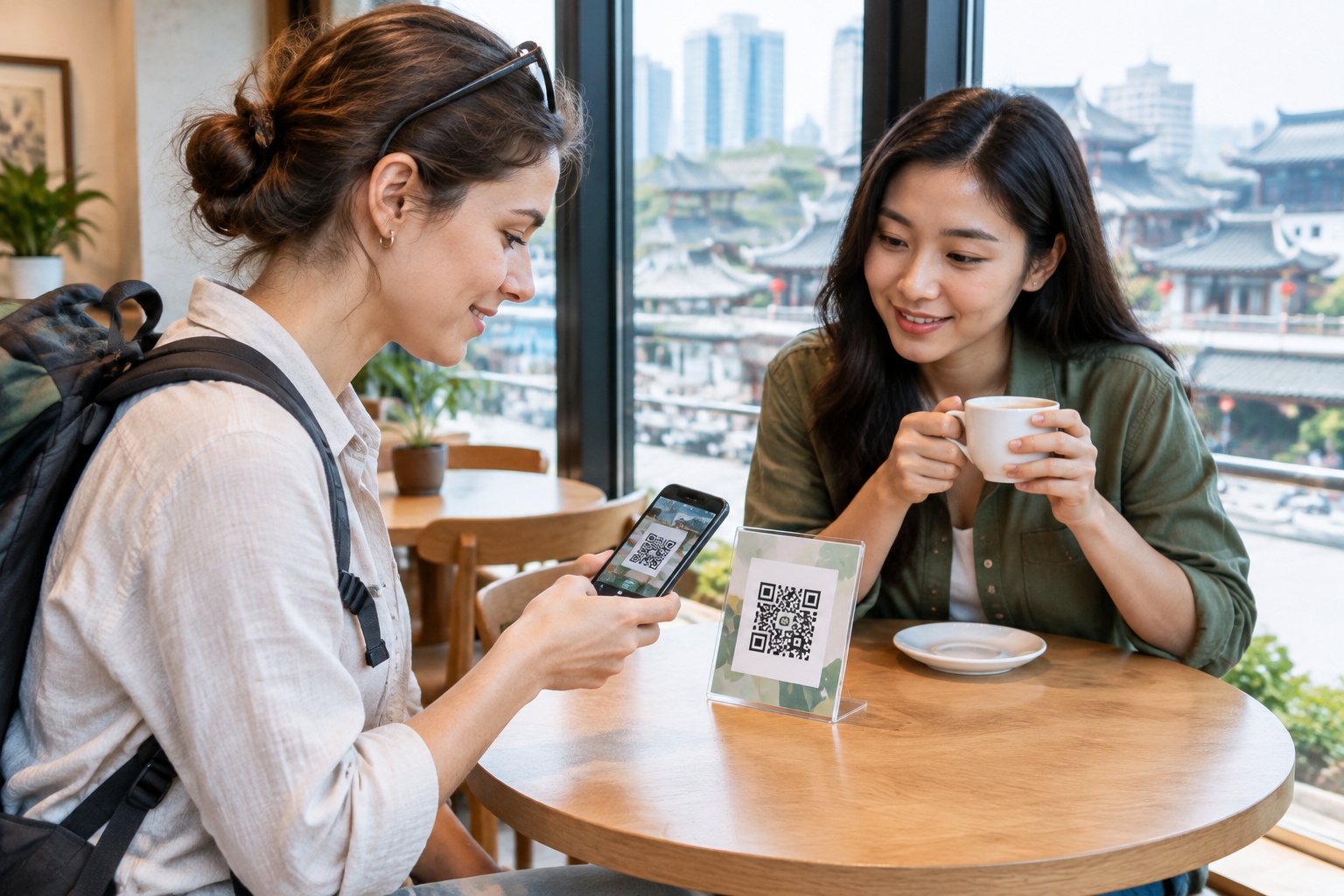
Many restaurants let you scan a QR code on the table to see the menu and order. You finish the meal and pay from the same mini program. Some mini programs are in Chinese only, but camera translation apps can help. For small street shops, the merchant will enter the exact amount, you scan and confirm.
Convenience stores and supermarkets
At 7-Eleven, FamilyMart, or large supermarkets, you can either show your barcode at the counter or use the self-checkout machine’s QR-scanning option. Both Alipay and WeChat Pay work.
Common setup problems and practical solutions
My card was rejected when I tried to add it
First, contact your bank and make sure international online payments are enabled. Second, verify that your card supports 3-D Secure. Third, try another Visa or Mastercard. American Express is often accepted at big hotels and malls, but it can fail at small local merchants.
The app asks for a Chinese phone number
This usually appears for features outside daily payments, such as registering a local delivery address or using a ride-hailing mini program that requires a mainland SIM. You can still use your foreign number for the main wallet. For occasional services, enter your foreign number and keep confirming SMS codes.
Transaction limit error
International card payments may have lower daily limits than local payments. If you hit a limit while buying something expensive, ask the store to split the transaction, pay cash, or use the other app you set up as backup.
Customer service options
Alipay has an in-app 24/7 customer support centre with English chat. WeChat Pay customer support is mostly accessible through WeChat’s Help Centre, and the language can be switched to English. Many larger problems, however, are resolved on the spot by the card-issuing bank rather than the app.
Keep one small backup that is not digital
Mobile payment covers almost everything in Chinese cities, but a small amount of cash is still wise. If your phone battery dies, if your bank blocks a transaction after a long trip, or if you want to buy fruit from a village stand far from any bank counter, cash saves the moment. You can withdraw yuan with your foreign debit card at domestic ATMs, and banks often charge a manageable fee.
Setting up mobile payment in China used to feel like paperwork and patience. Today, it feels closer to normal travel preparation. Download the apps, link your card at home, and when someone in Beijing says “can you scan this?”, you will know exactly what to do.
Start the discussion at forum.chinacomes.com