
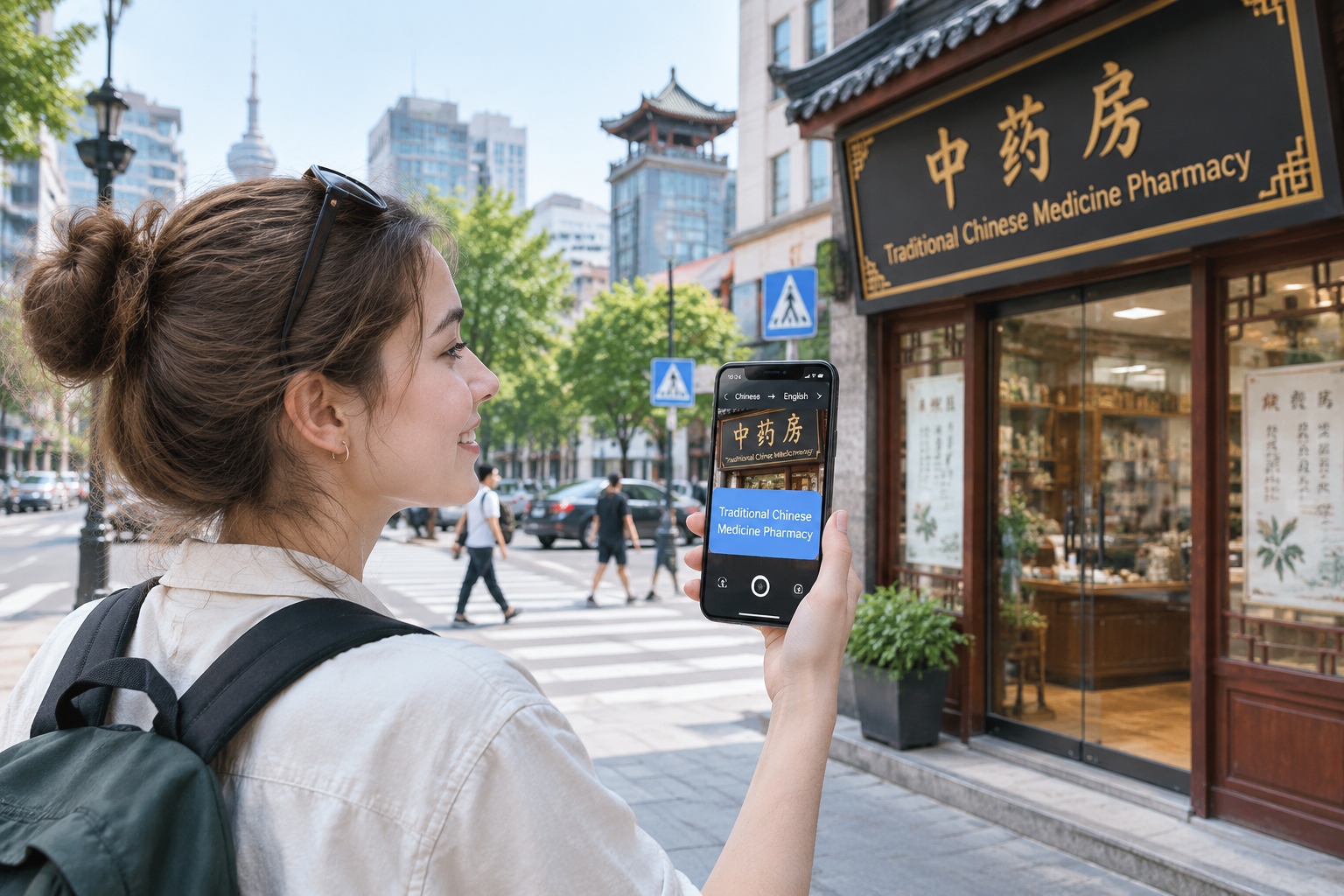

Before my first trip to China, I worried about the language barrier. My Chinese repertoire was limited to ‘nǐ hǎo’ and ‘xièxie’, and I had read stories of travelers getting stuck in remote towns with no way to ask for help. Then I spent a year living in Shanghai, using only everyday Chinese and a handful of digital tools. Here is what actually helped me break through, and what will help you, too.
Translation Apps: Your Digital Interpreter
The fastest way to overcome language barriers is a good translation app. My go-to is Baidu Translate. It has a camera mode that instantly overlays English text onto Chinese signs, menus, or bus route screens. There is also a conversation mode that listens to both speakers and translates out loud. Download the offline English-Chinese pack before you travel, since you may lose signal in some areas.
Youdao Translator is another excellent option, especially for its accurate phrasebook and voice recognition. Microsoft Translator also works in mainland China and is useful if you need support for less common languages. For purely menu reading, Waygo was popular for years, but full-featured Chinese apps have become better at handling complete sentences.
One important warning: Google Translate is often blocked in China, along with other Google services. Make sure to install your translation apps and any necessary offline packs while you still have home internet.
Essential Chinese Phrases Worth Learning
Technology can handle most logistics, but a few spoken phrases create human warmth. Here are the expressions you will use the most, grouped by situation.
Polite Basics
- 你好 (nǐ hǎo) – Hello
- 谢谢 (xièxie) – Thank you
- 对不起 (duìbuqǐ) – Sorry / Excuse me
- 再见 (zàijiàn) – Goodbye
Getting Around
- 请带我去这个地址 (qǐng dài wǒ qù zhège dìzhǐ) – Please take me to this address.
- 多少钱? (duōshǎo qián?) – How much is it?
- 左转 / 右转 (zuǒ zhuǎn / yòu zhuǎn) – Turn left / right
- 在这儿停 (zài zhèr tíng) – Stop here
At a Restaurant
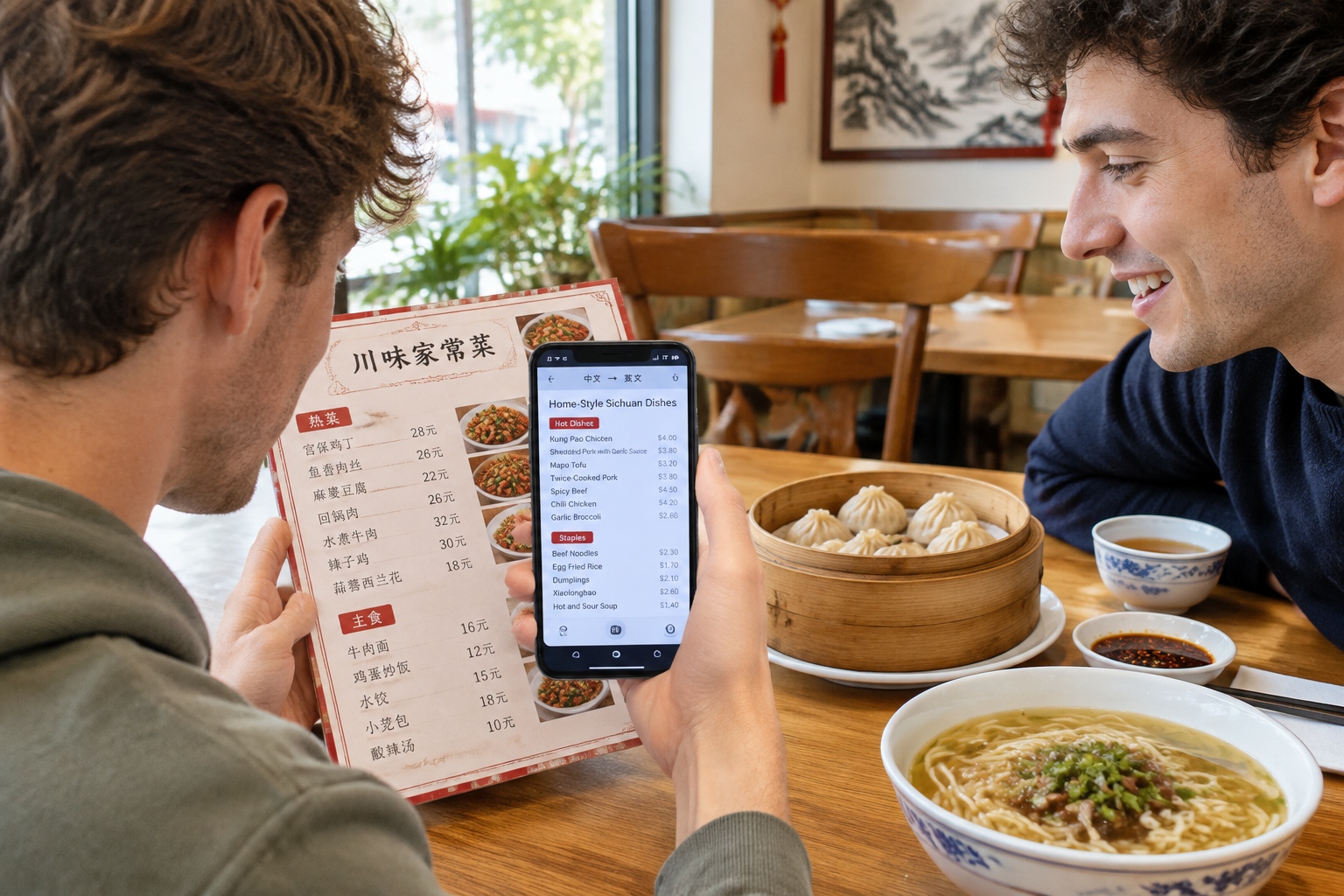
- 我要这个 (wǒ yào zhège) – I want this one (point at the menu)
- 不要辣的 (bú yào là de) – Not spicy, please
- 买单 (mǎidān) – Check, please
- 请给我一杯水 (qǐng gěi wǒ yì bēi shuǐ) – Please give me a glass of water
At a Hotel
- 我预订了房间 (wǒ yùdìng le fángjiān) – I have a reservation
- 我的房间没有热水 (wǒ de fángjiān méiyǒu rèshuǐ) – There is no hot water in my room
- 请帮我叫出租车 (qǐng bāng wǒ jiào chūzūchē) – Please call a taxi for me
In an Emergency
- 救命 (jiùmìng) – Help!
- 请带我去医院 (qǐng dài wǒ qù yīyuàn) – Please take me to a hospital
- 我的护照丢了 (wǒ de hùzhào diū le) – I lost my passport
- 请帮我报警 (qǐng bāng wǒ bào jǐng) – Please call the police
Don’t worry about perfect tones. Locals are used to hearing broken Chinese from tourists and will appreciate your effort.
Gestures That Speak Louder Than Words
When pronunciation gets tricky, your hands can save the day. Pointing at objects is acceptable in China, but pointing at a person should be avoided. To call a waiter or shop assistant, raise your hand with your palm down and wave your fingers toward the ground. The gesture may remind you of shooing a cat, but here it is the polite way to get attention.
Hand gestures for numbers are helpful in markets. One to five are intuitive. Did you know the hand sign for ‘eight’ is the same as the gun gesture in much of the West? Extend your thumb and index finger while folding the rest; this makes a shape like the Chinese character 八 (bā). People use it when showing prices or quantities.
For anything complicated, like needing a bathroom or a phone charger, try miming the action. Most Chinese will happily play charades with you. Smile, nod, and it never feels awkward.
The Taxi Card Trick Every Traveler Needs
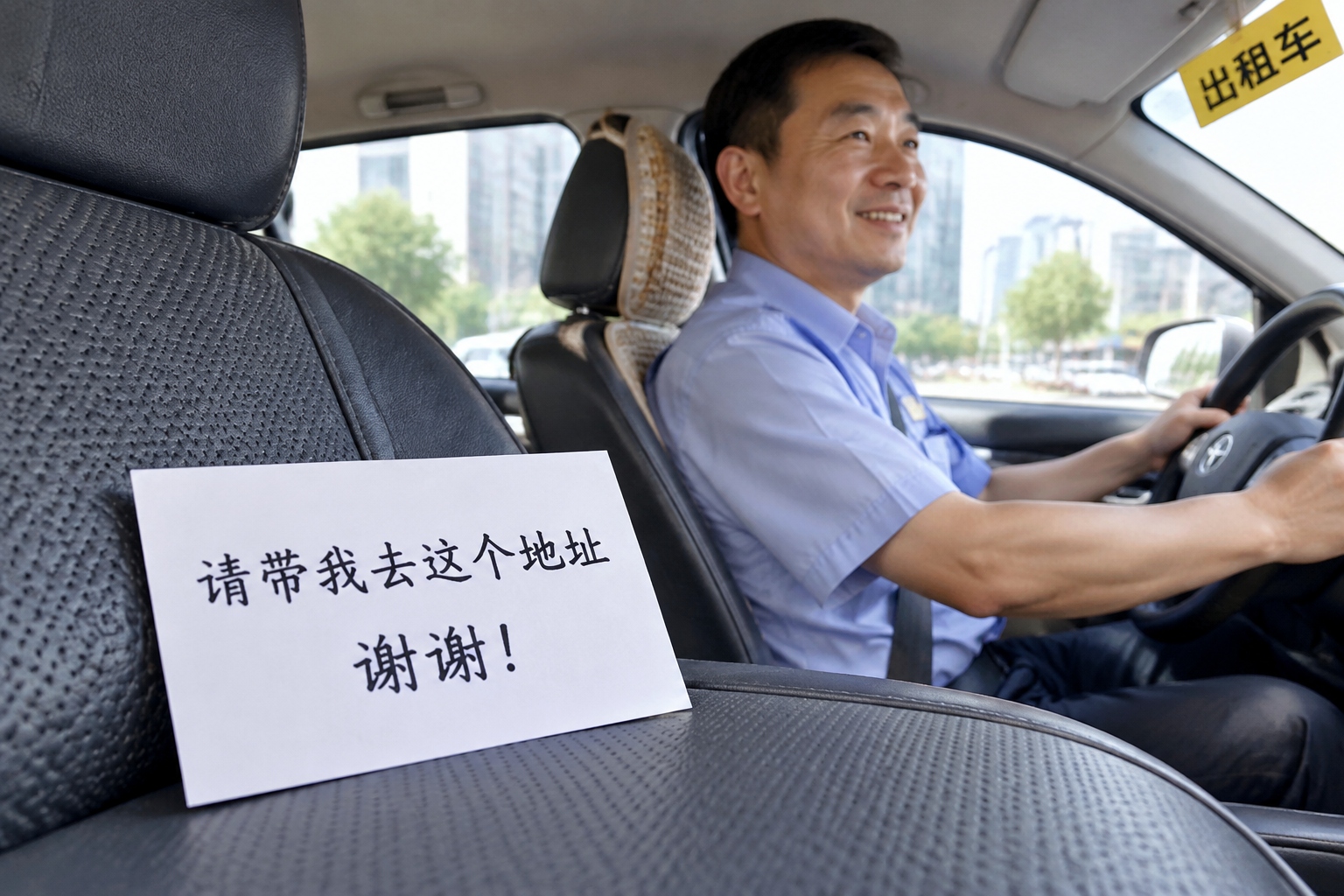
The best way to avoid getting lost in a taxi is to show the driver your destination in Chinese characters, not try to pronounce it. A physical or digital address card solves the problem.
A printed card for taxi drivers can be as simple as this:
请带我去这个地址。
谢谢!
That translates to ‘Please take me to this address. Thank you!’ Fill in the actual address below the first line, or copy it from your map app. If you are staying at a hotel, grab the hotel’s business card at the front desk—it already has the address and phone number, and taxi drivers recognize those instantly.
WeChat Tricks That Work Wonders
WeChat is more than a chatting app in China: it is your key to getting around, paying, and understanding the streets. Two translation features are especially handy.
First, in any WeChat chat, long-press a message and tap ‘Translate’ to see it in your language. Second, open WeChat’s scan tool and choose ‘Translate’ mode. Point the camera at a sign, a printed page, or a handwritten note, and the app will overlay the translated meaning. It is not as thorough as Baidu or Youdao, but it is in an app you may already have.
Another practical habit: always keep a digital map open when you need directions. Show the screen to a passerby or driver and let them point out the way. Many locals prefer this over trying to pronounce English street names.
Beyond Language: Small Customs, Smoother Communication
A warm, patient attitude can outperform any pocket translator. Do not raise your voice in English; it will not make Chinese easier to understand. Speak slowly, or type the question into your translation app and let the other person read it. If you use the speaker mode, allow the person to hear their own language at a natural volume.
Remember that ‘face’ matters a lot in Chinese culture. People may say that they understand you even when they don’t, to avoid embarrassment. To be sure, invite them to tap on a map or write down what they want you to know. And when a mistake happens, use the phrase 没事 (méi shì), meaning ‘no problem.’ Say it lightly and move on.
Language barriers are normal, but they don’t have to be walls. With the right app, a few prepared phrases, and a sense of humor, you will find that people across China are willing to meet you halfway.
Start the discussion at forum.chinacomes.com