
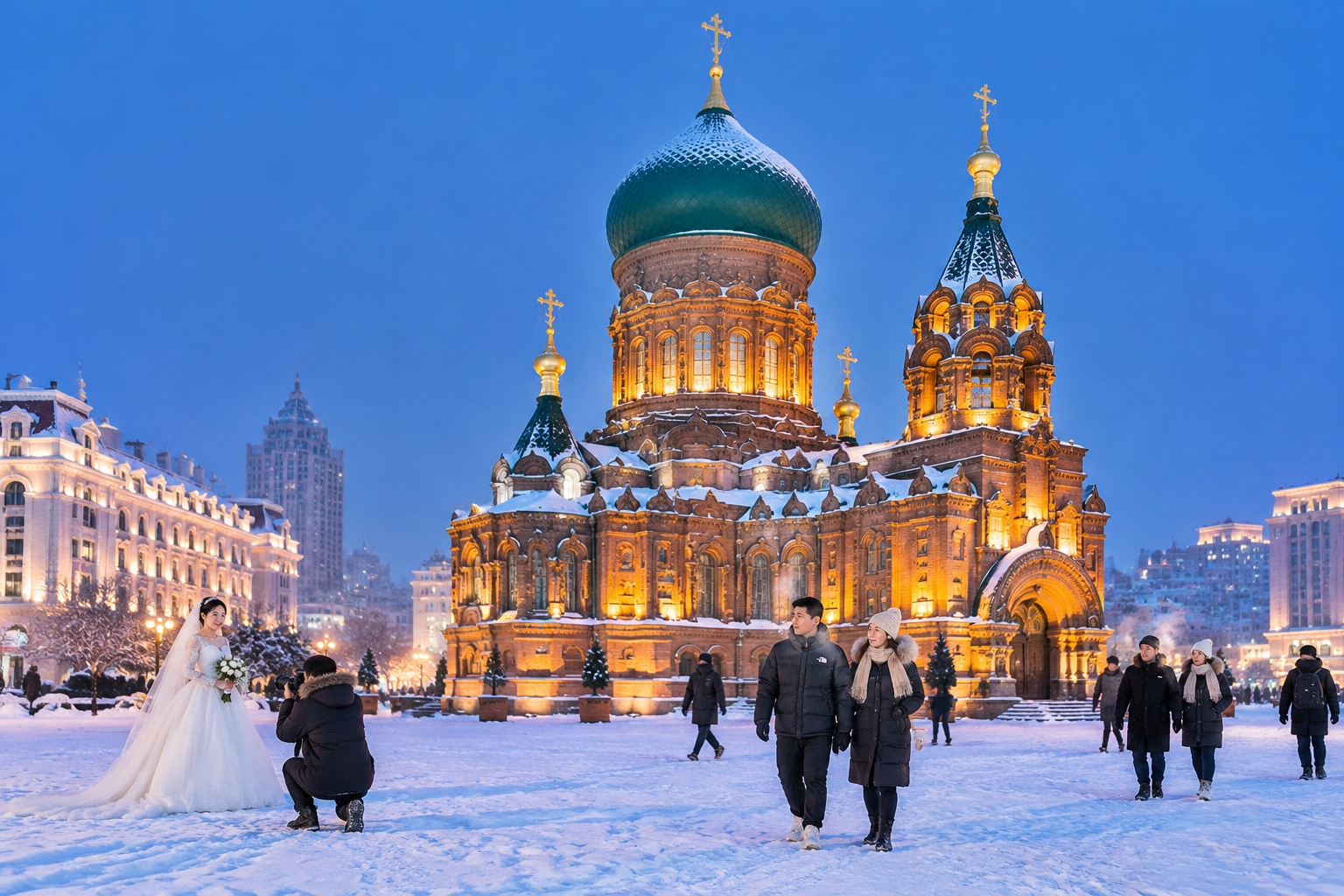

A bride in the snow, and a green dome above her
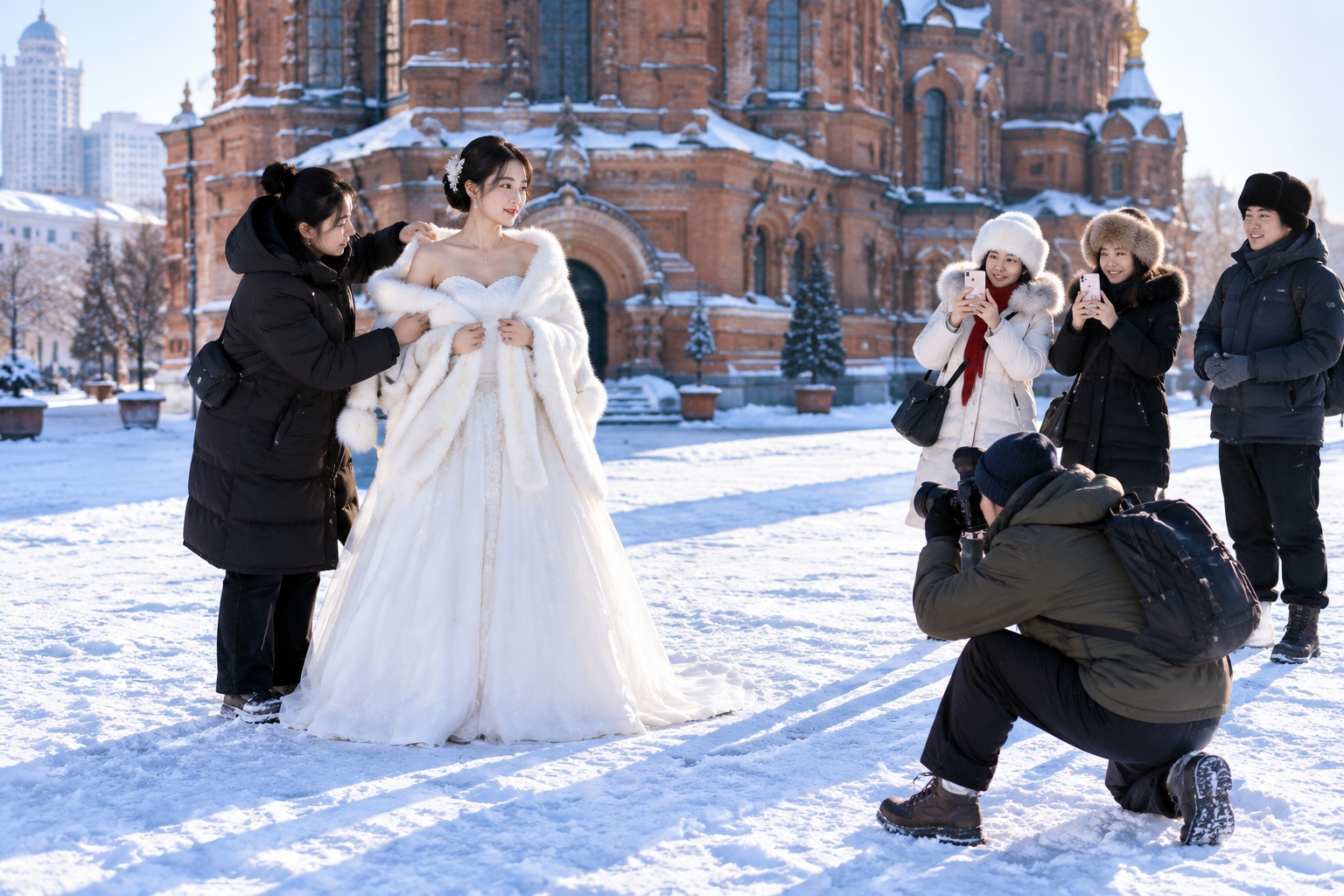
The bride is standing in a strapless white dress, in the snow, at about minus 18 degrees Celsius. Her shoulders have gone the colour of the sky. A photographer in a padded black coat shouts instructions through a cloud of his own breath, and an assistant stands beside him holding a fur cape, ready to throw it over her the second the shutter clicks.
Behind them, filling the top of every frame, is Saint Sophia Cathedral: red brick walls, a wide green onion dome, a gold cross, four smaller turret roofs around it. It looks like a piece of Moscow that fell out of an airplane and landed in northeast China.
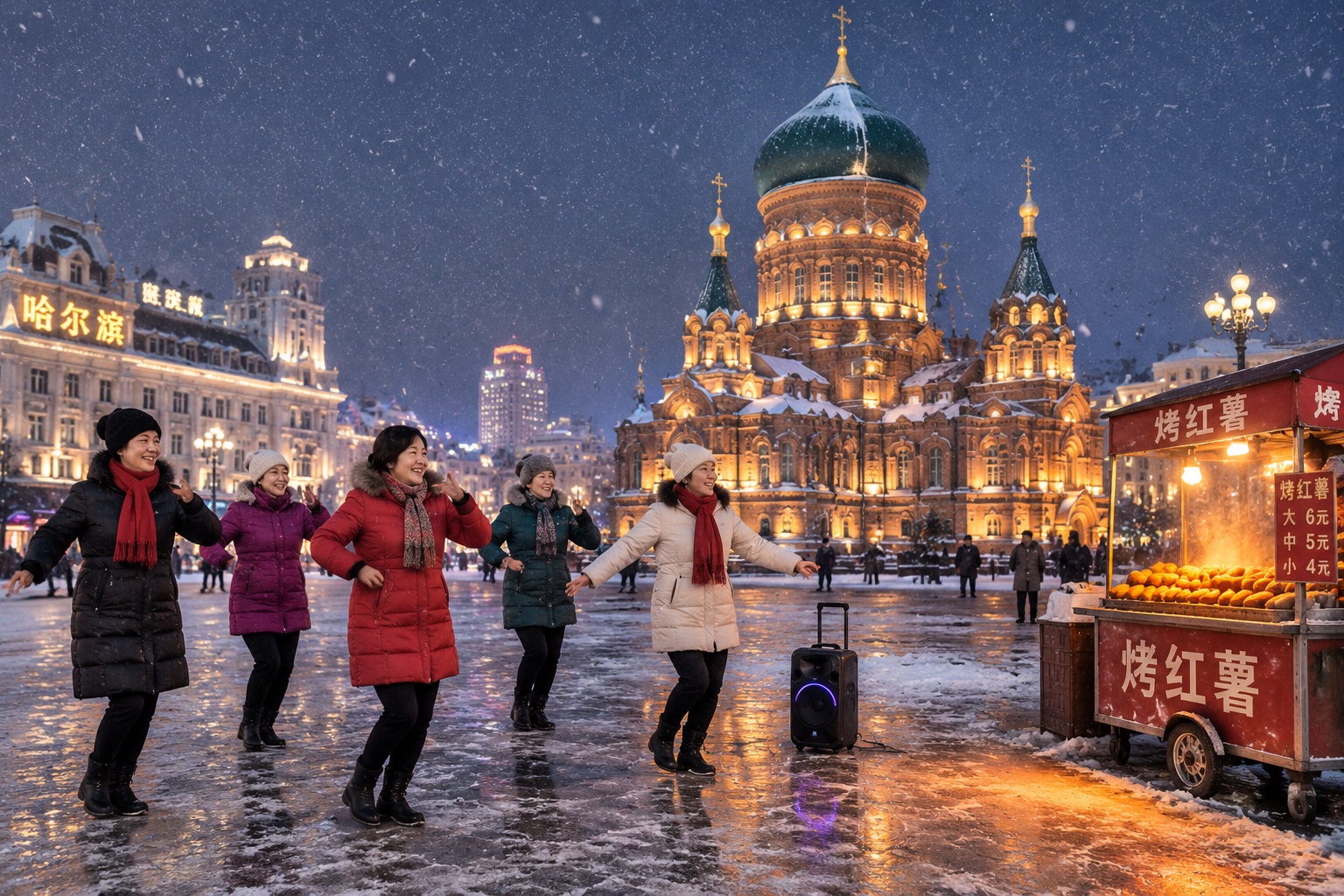
Nobody here finds it strange. It is a Tuesday morning in Harbin. A line of women in puffer jackets walks slow laps around the square for exercise. A man sells roasted sweet potatoes from a barrel cart, and the smell — burnt sugar and charcoal — cuts through the cold. Two teenagers film a dance routine, their phone propped against a backpack. The cathedral just stands there, the way it has for about a hundred years, under a sky like wet tin.
What is an Orthodox cathedral doing in northeast China?
Harbin is the capital of Heilongjiang, China’s northernmost province. It sits closer to Vladivostok than to Beijing, and it exists in its present shape largely because of a railway.
In 1898 the Russian Empire began pushing the Chinese Eastern Railway across Manchuria — a shortcut to its Pacific ports that would cut hundreds of kilometres off the Siberian route. Harbin was the construction hub, then the administrative centre. Russians, Jews, Poles, Germans, Japanese, Koreans and Chinese migrants arrived together, and a polyglot railway town appeared on Chinese soil.
The railway is not a neutral subject in China. It was built under unequal treaties, guarded by Russian troops, and it turned a large part of the northeast into an imperial sphere of influence; Chinese historians generally describe the period as one of foreign encroachment. That context matters for the building you are looking at. The first Saint Sophia, a wooden church, went up in 1907 for soldiers of the Russian army stationed here.
The brick cathedral standing today was built between 1923 and 1932, largely with money from Russian émigrés who had fled the 1917 revolution. In the 1920s and 30s, Harbin’s Russian community numbered in the tens of thousands — one of the largest émigré populations in Asia. Saint Sophia, about 53 metres high, was the biggest Orthodox church in the Far East.
The decades when the domes came down
The 20th century was rough on this building. Services stopped in the late 1950s. During the Cultural Revolution (1966–1976) the crosses and onion domes were taken down and the bell tower was demolished; for years afterwards the empty shell served as a warehouse. A generation of Harbin residents remembers it as a dark, soot-stained box behind a fence.
In 1997 the city cleared away the buildings crowding it, restored the cathedral and reopened it as the Harbin Architectural Art Museum. That decision is worth pausing on. The church was not handed back to a congregation, and it was not torn down. It became an exhibit about the city that grew up around it.
Inside: models, photographs and a city that no longer exists
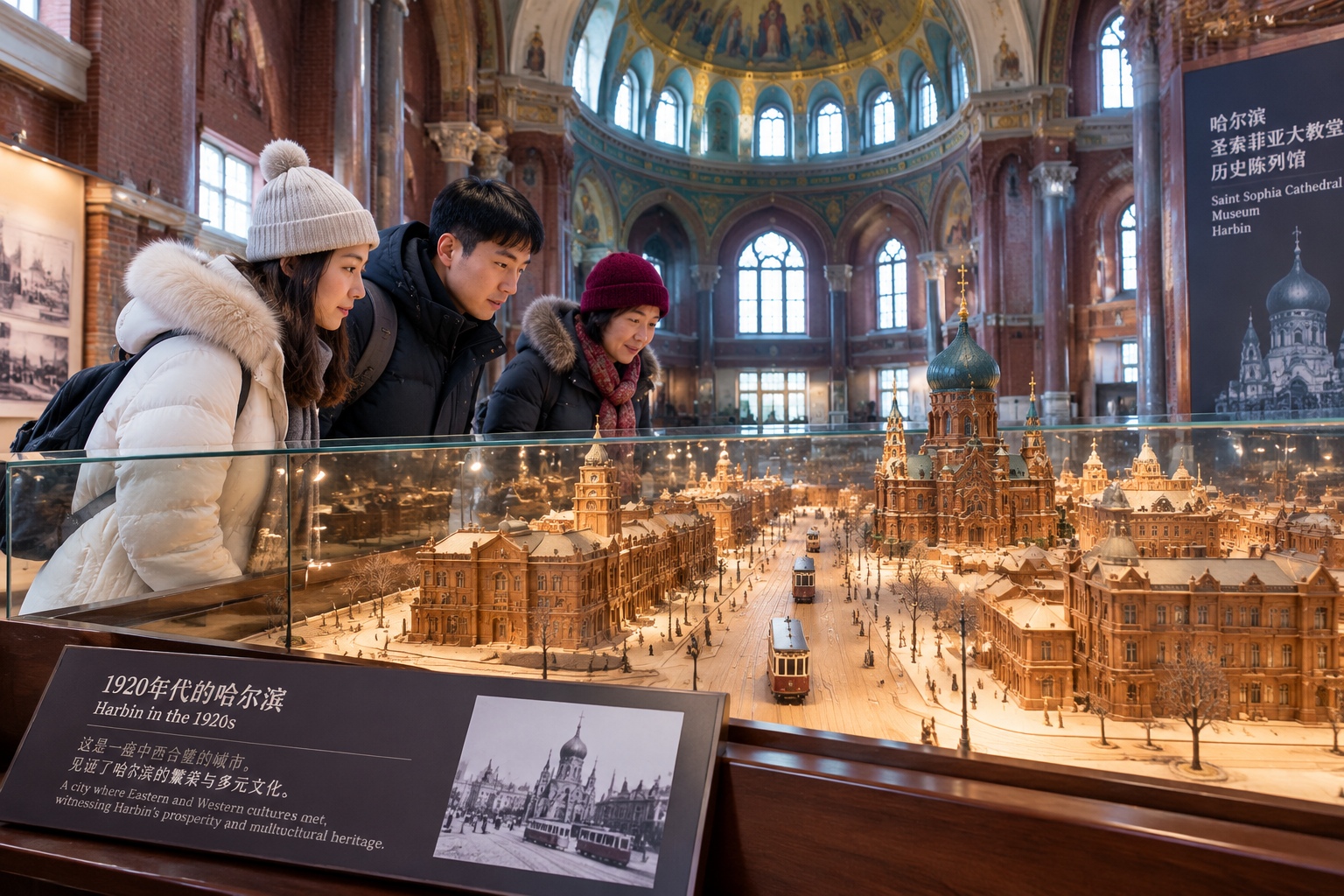
Tickets cost around ¥20 (about US$3). You pass a security gate and a small gift shop before you reach the nave. Inside, under the painted dome, the air is cold and the acoustics are enormous — people whisper without being told to.
The exhibits are modest: photographs, drawings, and wooden models of buildings that are gone. The centrepiece is a large scale model of early 20th-century Harbin. You lean over the glass and look down at a miniature town of spires, tramlines and river wharves, most of which no longer exists. Labels are in Chinese and English, sometimes Russian too. What you take away is less about religion than about a city built by other people’s ambitions, which then had to become itself.
A scar, a landmark, or both?
Ask people in Harbin what the cathedral means and you get a range of answers. Older residents may mention the warehouse years. Younger ones usually talk about photographs — school trips, graduation shots, wedding shoots. Official city material calls Saint Sophia a landmark and a symbol of Harbin’s multicultural history, while museum text describes the railway era plainly as a period of foreign expansion. Both things are allowed to be true at once.
The most common attitude I’ve run into is neither pride nor grievance, but something more practical: it’s ours now. In the winter of 2023–24, when Harbin’s ice-and-snow season drew record crowds and the city’s over-the-top hospitality became a national joke — southern tourists were affectionately nicknamed “little potatoes”, park benches got heated cushions, frozen pears were carved into flowers — Saint Sophia was on every itinerary. It is the postcard. It has also been the backdrop for Russian visitors tracing a family history, and for Chinese travellers who simply like how it looks in snow.
One thing worth knowing before you go: Saint Sophia is a museum, not a working church. Harbin still has a small Orthodox community, and services are held at the Church of the Intercession a short walk away. Visitors arrive at Sophia expecting icons and incense and find ticket gates instead.
The square in winter, and Central Street ten minutes away
The cathedral sits in the middle of a pedestrian square. Around dusk the floodlights come on, the snow on the brick turns from grey to amber, and the dome goes a deep, almost black green. This is the hour to be here.
Winter is what this building was made for, photographically. Snow banks up against the walls. Vendors sell hot soy milk and gloves. Small photo studios nearby rent out “Russian princess” costumes — velvet, faux fur, tiaras — and hire photographers by the hour; on a January weekend the queue for the mirror reaches the door. It is a business, it is not subtle, and it is genuinely fun to watch.
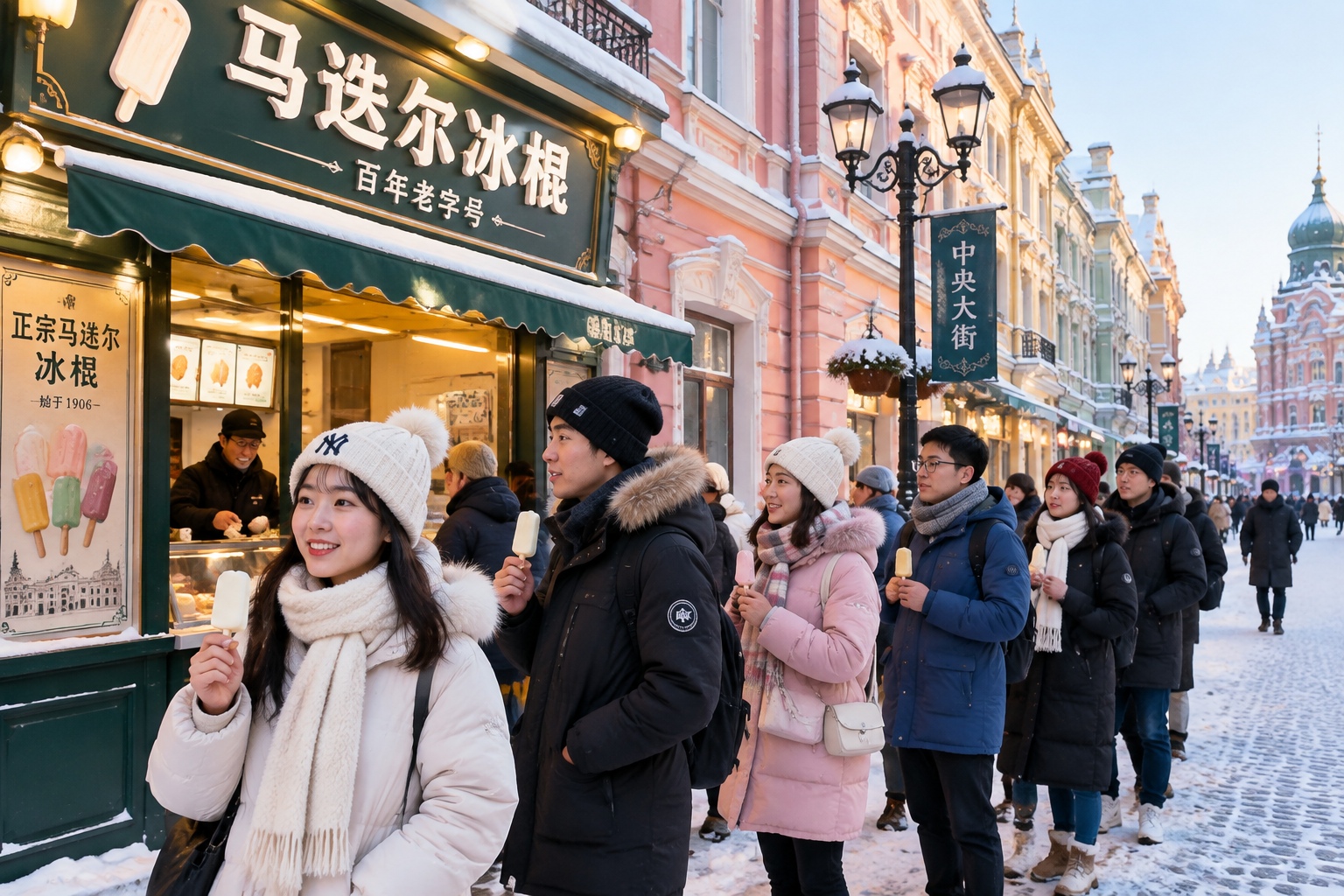
Ten minutes’ walk northwest is Central Street (Zhongyang Dajie), the cobbled pedestrian spine of old Harbin, lined with pastel facades, bakeries selling brick-sized loaves of Russian bread, smoked sausage shops and century-old restaurants serving both borscht and braised pork. The queue outside the Modern ice pop shop is longest when the temperature is lowest. Harbin residents will tell you, completely straight-faced, that ice cream tastes better at minus 20.
If you go: practical notes
Getting there. Saint Sophia is in the city centre, a 10–15 minute walk from the nearest metro stop (Line 2) and about the same from Central Street. A taxi from Harbin Station takes around 10 minutes. Ride-hailing inside the app of your choice works fine; show the Chinese name, 圣索菲亚教堂, to the driver.
Tickets and hours. The square is free and always open; the interior costs roughly ¥20, and hours shorten in winter. Prices and opening times shift with the season, so check the sign at the gate or the official WeChat account. Bring your passport — tickets are often booked by real name.
Best time. December to February for snow and the Ice and Snow World across the river; the square is busiest between 4pm and 6pm when the lights come on. Late June and September are pleasant, green and far quieter.
Crowds and cold. Expect queues during Chinese New Year and the winter school holidays. January temperatures sit between -15°C and -25°C, and the wind on the square is real. Boots, hat, gloves, and a phone battery that will die faster than you expect.
Money and food. WeChat Pay and Alipay are the default, though foreign cards can now be linked. Nearby, Central Street covers Russian-influenced bakeries and ice cream; a short taxi ride to Daowai district gets you Harbin’s own cooking — sweet-and-sour fried pork, smoked meats, and dumplings in rooms that have not changed in decades.
Start the discussion at forum.chinacomes.com