
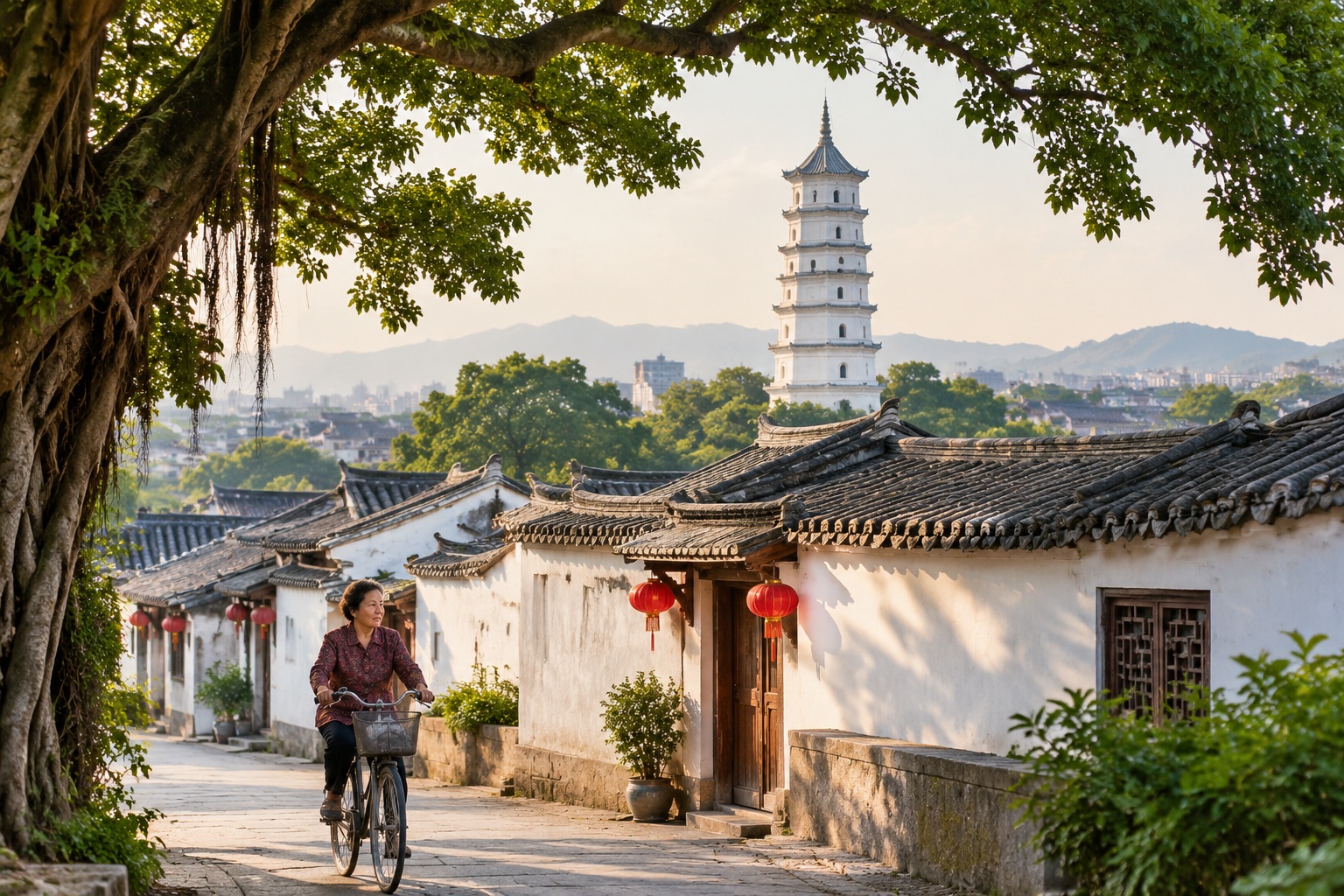

Two Pagodas, One Skyline
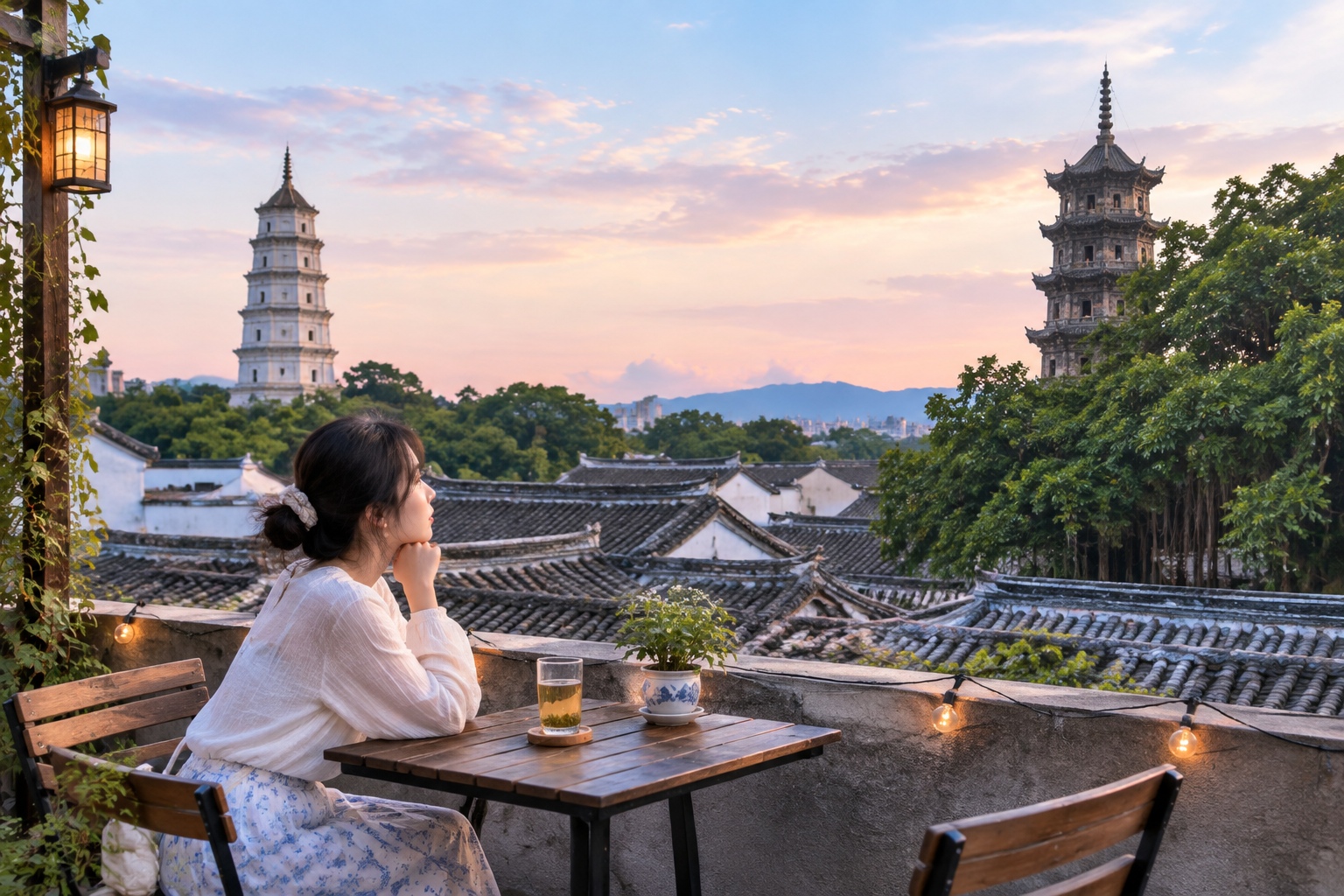
Stand on a rooftop café on Nanhou Street just before sunset and you can see both of them at once: the White Pagoda lifting its whitewashed brick above grey tiled roofs to the east, and the darker stone Black Pagoda further west, half-swallowed by banyan trees.
They are about 1.5 kilometres apart — roughly twenty minutes on foot, longer if you stop for fish balls, which you will.
Fuzhou people call them the Twin Pagodas of Rongcheng. “Rong” is the banyan tree: in the 11th century an official named Zhang Boyu ordered banyans planted across the city, and the nickname stuck. The pagodas are older than that. Wang Shenzhi, the warlord who founded the Min Kingdom and turned Fuzhou from a provincial town into a capital, raised the White Pagoda in 904, in the last years of the Tang dynasty, as a monument to his parents. His successors built the Black Pagoda in stone in 941. Both have burned and been rebuilt — the white one standing today is largely a 16th-century reconstruction — but they have been marking the same two points on the skyline for more than a thousand years.
Most visitors photograph them and move on. A better way to use them is as bookends. Start at the White Pagoda on Yu Mountain, walk west for twenty minutes, and you cross the streets where a good deal of modern Chinese history was argued out.
What “Three Lanes, Seven Alleys” Really Means
The name sounds like poetry. It is actually an address.
Sanfang Qixiang — Three Lanes and Seven Alleys — is a 40-hectare grid in the middle of Fuzhou, cut through by Nanhou Street, which runs north to south. Three lanes run west off it: Yijin, Wenru, Guanglu. Seven alleys run east: Yangqiao, Langguan, Ta, Huang, Anmin, Gong, Jibi. The names deserve a beat of translation. “Yijin” means returning home in brocade — the old phrase for a scholar who comes back to his village successful. “Wenru” means scholar of letters. “Gong” refers to a government office. These were not random streets. They were a résumé.
The layout itself is the oldest thing here. It dates to the Tang and Song dynasties, when Chinese cities were organised into walled wards — fang and xiang — with gates that shut at night. Almost every other Chinese city pulled those wards down centuries ago as trade outgrew them. Fuzhou’s survived, largely because the families inside kept being powerful. For roughly a thousand years this was the gentry’s quarter: officials, scholars, salt merchants, people who could afford a courtyard house with a skywell and a carved wooden screen at the door. Around 200 Ming- and Qing-era buildings are still standing. In 2015, UNESCO’s Asia-Pacific heritage programme gave the district a conservation award.
The district has been restored since 2006, and it is worth talking about what that cost and what it bought.
One Courtyard, Two Famous Residents
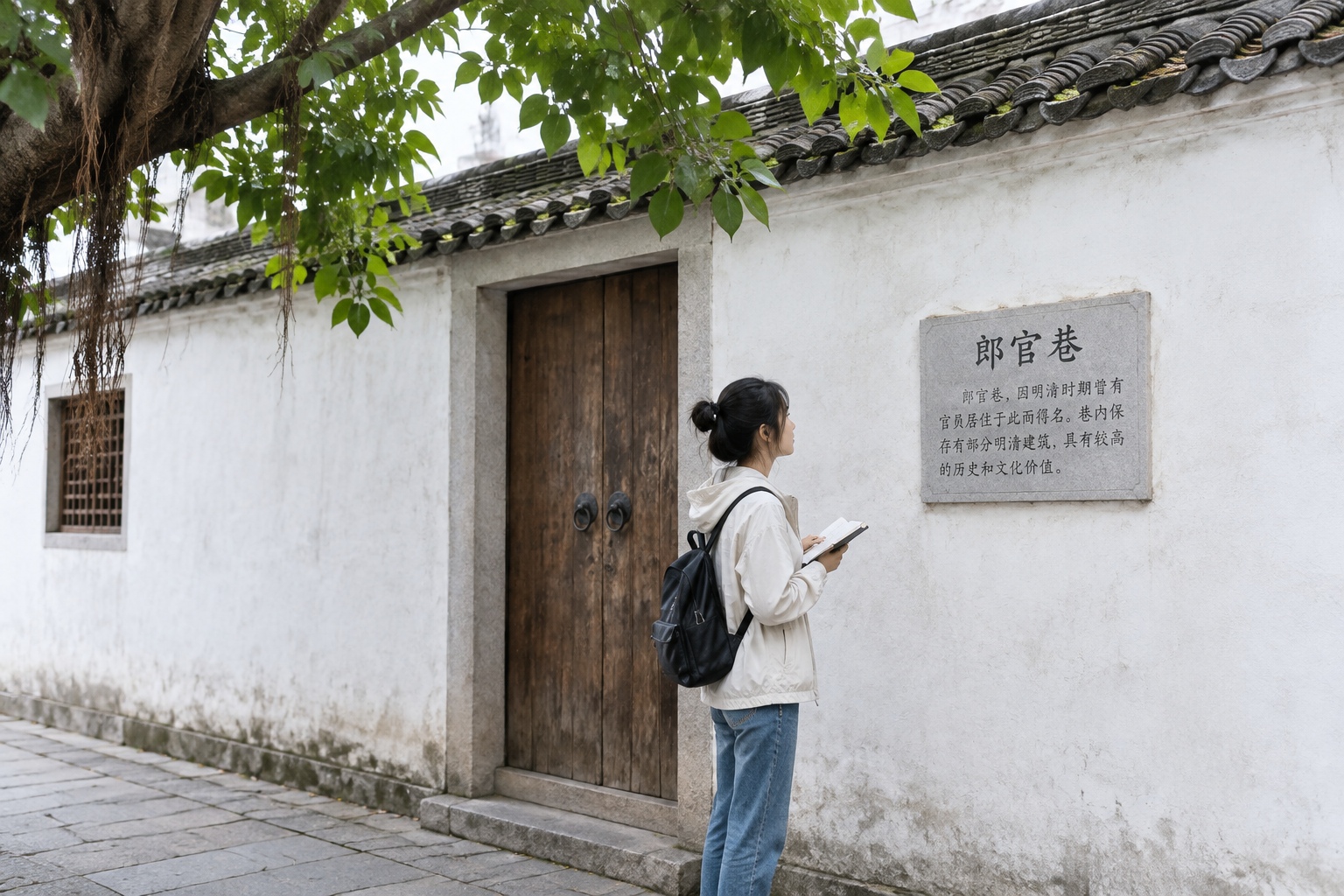
On Yangqiao Road, at the northern edge of the block, there is a house with a small plaque naming two people, and the pairing is almost too neat.
Lin Juemin grew up here. In April 1911, aged 24, he took part in an uprising in Guangzhou aimed at overthrowing the Qing dynasty. The night before the attack he wrote a letter to his pregnant wife, Chen Yiying — the “Letter to My Wife” — trying to explain how a man could love his family and still choose to die for a country that did not yet exist. He was one of 72 men killed and buried at Huanghuagang. The letter is still taught in Chinese schools; it may be the most widely read piece of writing in modern China.
After his death the family left, and the house was sold. The buyer was the grandfather of Bing Xin, then a small girl, who grew up to become one of the most widely read Chinese writers of the 20th century. She died in 1999 at the age of 98, and wrote about this courtyard for the rest of her life. Lin Juemin’s niece was Lin Huiyin, the architect and poet who would later help survey China’s ancient timber buildings. One house, one family network, a revolution and a literature.
Yan Fu, Langguan Alley, and the Book That Rewrote Chinese Politics
Walk two minutes south and turn into Langguan Alley. At number 20 there is a plain whitewashed house where Yan Fu spent the last year of his life; he died there in October 1921.
Yan Fu matters more than most people outside China realise. Born in Fuzhou in 1854, he was sent at fourteen to the Fuzhou Naval College, the Qing empire’s first modern naval school, established in 1866 and run by Shen Baozhen — whose family home still stands in Gong Alley, a few minutes away. The school taught navigation, English and calculus, and sent its best students to Britain and France. Yan Fu went to the Royal Naval College in Greenwich. He came home knowing Darwin, Mill and Montesquieu.
In 1898 he published his translation of Thomas Huxley’s Evolution and Ethics as Tianyan Lun. It handed Chinese readers a vocabulary for change — natural selection, the survival of the fittest — but Yan Fu framed it as a warning rather than a gospel. He was not saying the strong deserve to win. He was asking whether a country could reform itself quickly enough to avoid being carved up. After China’s defeat by Japan in 1895, that question was not academic. A generation of reformers and revolutionaries, from Kang Youwei’s circle to Sun Yat-sen’s, argued with the words Yan Fu had put into Chinese.
Lin Zexu, the official who destroyed British opium at Humen in 1839 and thereby helped trigger the First Opium War, was also a Fuzhou man. His memorial temple stands at the southern edge of the district on Aomen Road, a fifteen-minute walk from Yan Fu’s door. So in one afternoon you can stand in the rooms of the man who tried to shut China’s door and the man who spent his life translating arguments for opening it. Neither of them won cleanly. That is the interesting part.
The Lanes on an Ordinary Tuesday
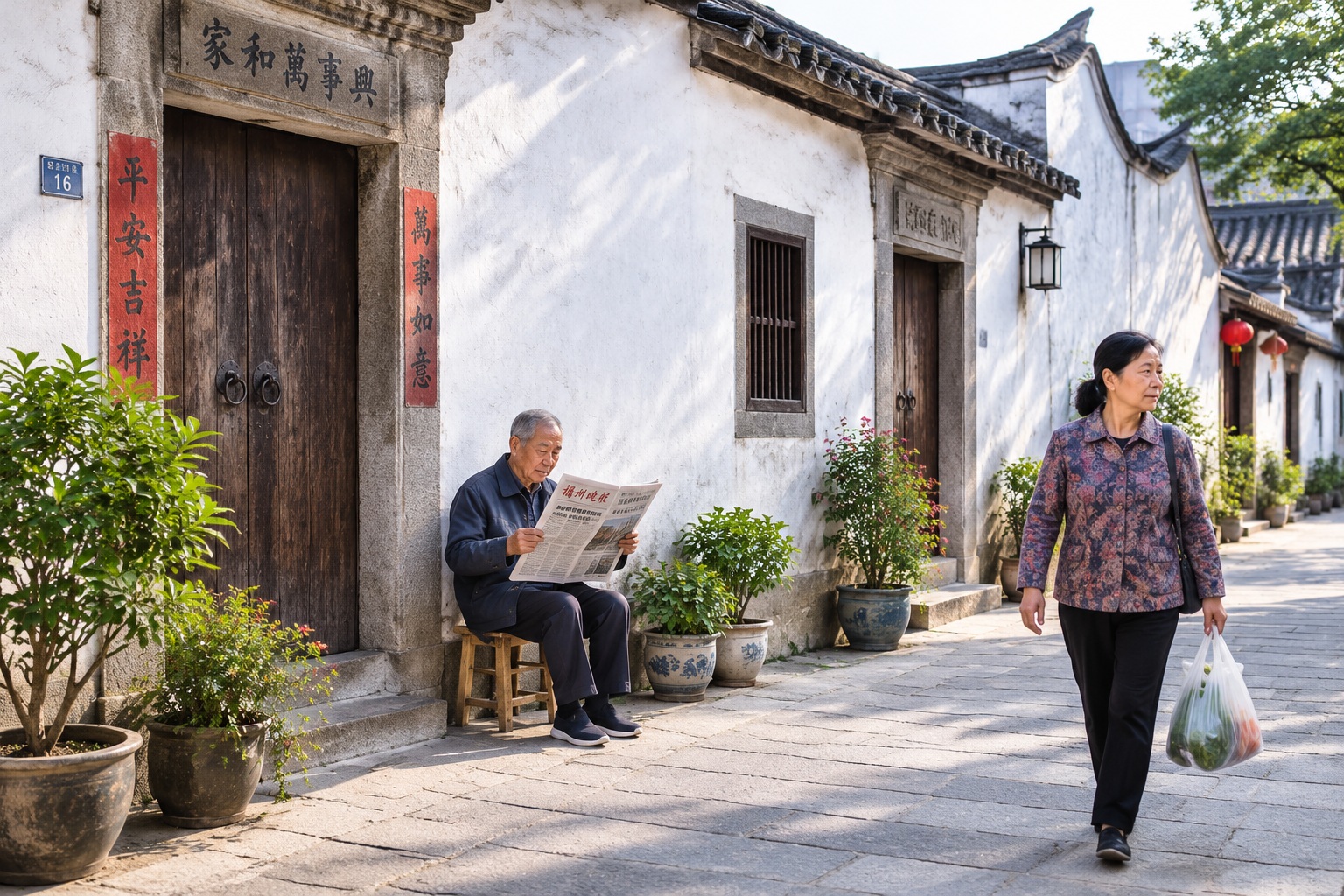
Come at seven in the morning and the district belongs to Fuzhou people, not tourists.
Nanhou Street is quiet. Someone is practising taiji in front of a temple gate. The rouyan shop that has been open since 1876 is already steaming. Rouyan are “meat swallows”, wonton-like dumplings whose wrappers are made by pounding pork into a thin sheet instead of rolling flour — which sounds odd and tastes like the best thing you will eat all week. A few doors down, a woman is weighing jasmine tea. Fuzhou is the city that taught China to scent green tea with jasmine; the local tea carries a protected geographical label and is still sold here by the liang, in paper packets.
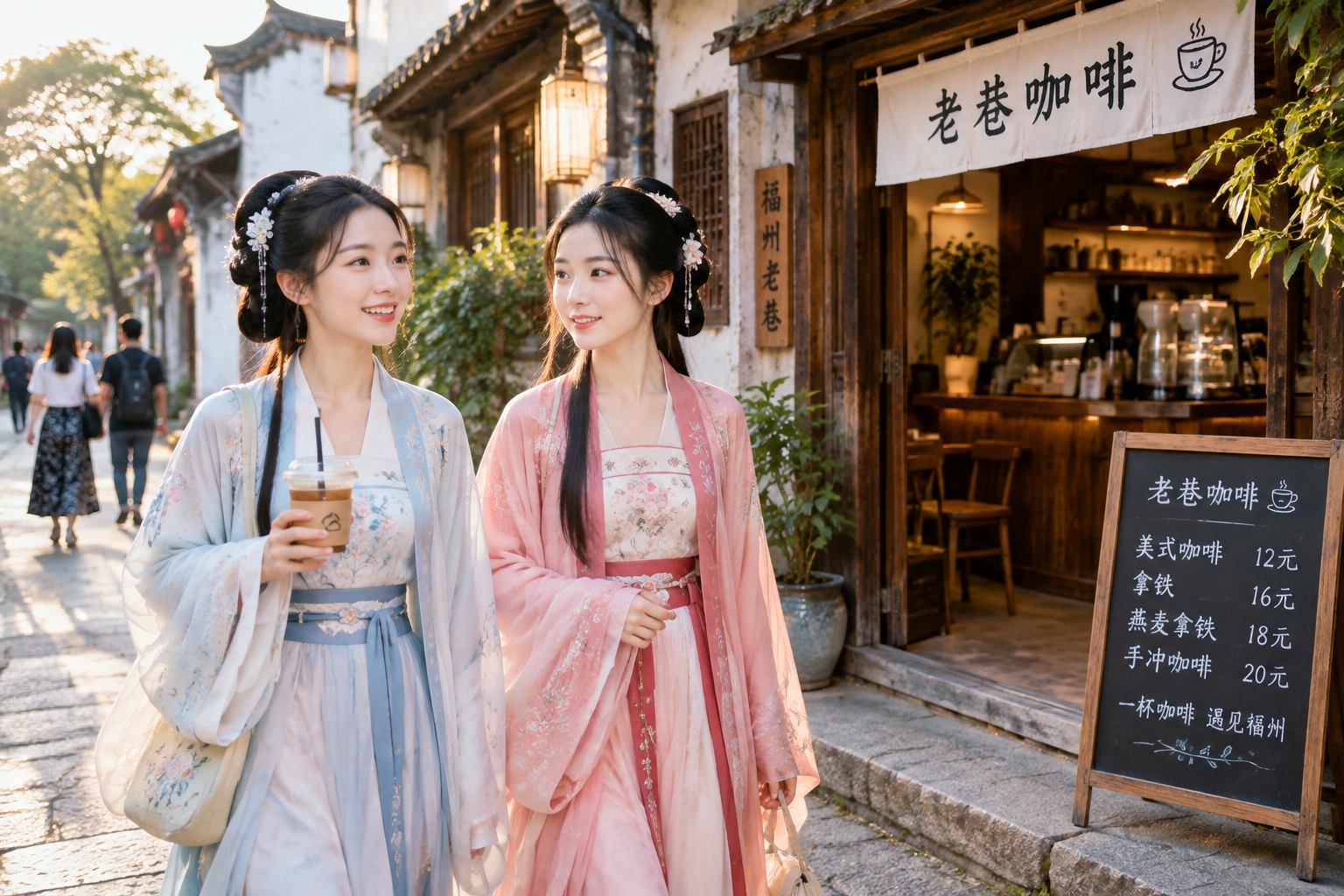
By ten, the tour flags appear. By two in the afternoon the alleys fill with a very different crowd: students and young couples renting hanfu — the layered traditional dress — from shops that have opened inside restored wooden buildings, walking slowly past the white walls to be photographed. Coffee shops and small bookshops have moved into courtyard houses. One store sells oil-paper umbrellas, another sells bodiless lacquerware, another sells cork pictures, a Fuzhou craft in which thin slices of cork are assembled into landscapes.
Not everyone loves it. During the restoration that ran from 2006 to 2010, thousands of residents were relocated, and plenty of Fuzhou people will tell you the lanes now feel like a stage set — beautiful, but with the same souvenir shops you find anywhere. Others point out that before the restoration the buildings were genuinely collapsing, and that a few thousand people still live inside the block. Both things are true. The museums, at least, are free, and they are serious: Lin Juemin’s letter, Bing Xin’s furniture, the family genealogies of officials who lived here three centuries ago.
What strikes me most is how young the crowd is. For a place that markets itself on ancient history, the lanes are mostly full of people born after 1995, dressed up, drinking coffee, photographing each other against a wall that has stood since the Ming dynasty. That is not a contradiction. It is how a city keeps a neighbourhood alive.
If You Go: Practical Notes for Sanfang Qixiang
Fuzhou’s Metro Line 1 stops at Dongjiekou, right at the northern entrance to the district; from Fuzhou Railway Station it takes about twenty minutes. Walking the lanes is free. Most of the former residences and small museums are free too — bring your passport — and several close on Mondays. In a normal year the district records more than 10 million visits, so timing matters: early morning or after eight at night are the two hours when you can still hear yourself think.
The White Pagoda sits in the Yu Mountain park east of the district, the Black Pagoda in the Wushan area to the west. Both are short walks, neither takes more than an hour, and together they frame the whole old city. If you eat only one thing, make it rouyan; follow it with a cup of jasmine tea.
The pagodas were built to hold a city together, and they still do the job. Stand between them at dusk, as the tea shops close and the lanterns come on over Nanhou Street, and Fuzhou stops being a stopover on the way to somewhere else. It becomes a place where you can see, quite literally, what a thousand years of argument about China’s future looks like from street level.
Start the discussion at forum.chinacomes.com