


Two bottles of water and a cashier who wasn’t sure about a $20 bill
Greg is 52, runs a heating and air-conditioning company in Denver, and had never been to Asia. On his first afternoon in Shanghai, he walked into a convenience store near Hongqiao Railway Station, put two bottles of water on the counter, and handed over a 20-dollar bill.
The cashier turned it over twice, held it up to the light, and looked at the woman behind him in line. She had already paid — phone out, QR code scanned, the terminal chiming — before Greg had found his wallet.
Later he asked me, half joking, what he was supposed to do with the 400 yuan he’d exchanged at the airport. Over the next ten days — Beijing, Shanghai, Shenzhen, Wuhan — the same small dislocation kept recurring, and it was never really about money. It was about assumptions. Greg kept running into things he had filed away as impossible, or at least as not-how-things-work.
I’ve lived in China for years and have hosted a fair number of visiting Americans. What follows is not an argument that China is winning, and Greg wouldn’t make it either. It’s an account of what an ordinary, skeptical American notices in ten days, and why the gap between the two countries is usually narrower in principle and wider in practice than either side assumes.
Cashless isn’t a gimmick. It’s a different cost structure.
Americans hear “mobile payment” and think of Apple Pay, which is a thin layer on top of the same card networks, carrying the same 2–3% interchange fees that make small vendors grumble. In China, Alipay and WeChat Pay are the rail itself. Around a billion people use them, and the fee for a small merchant is often a fraction of a percent, sometimes waived entirely.
That difference shows up on the street, not in a press release. The woman selling roasted sweet potatoes from a converted cart on a Wuhan corner has a laminated QR code taped to her cart. So does the man who repairs shoes. For a one-person business, no card terminal means no monthly rental, no minimum volume, no waiting three days for settlement.
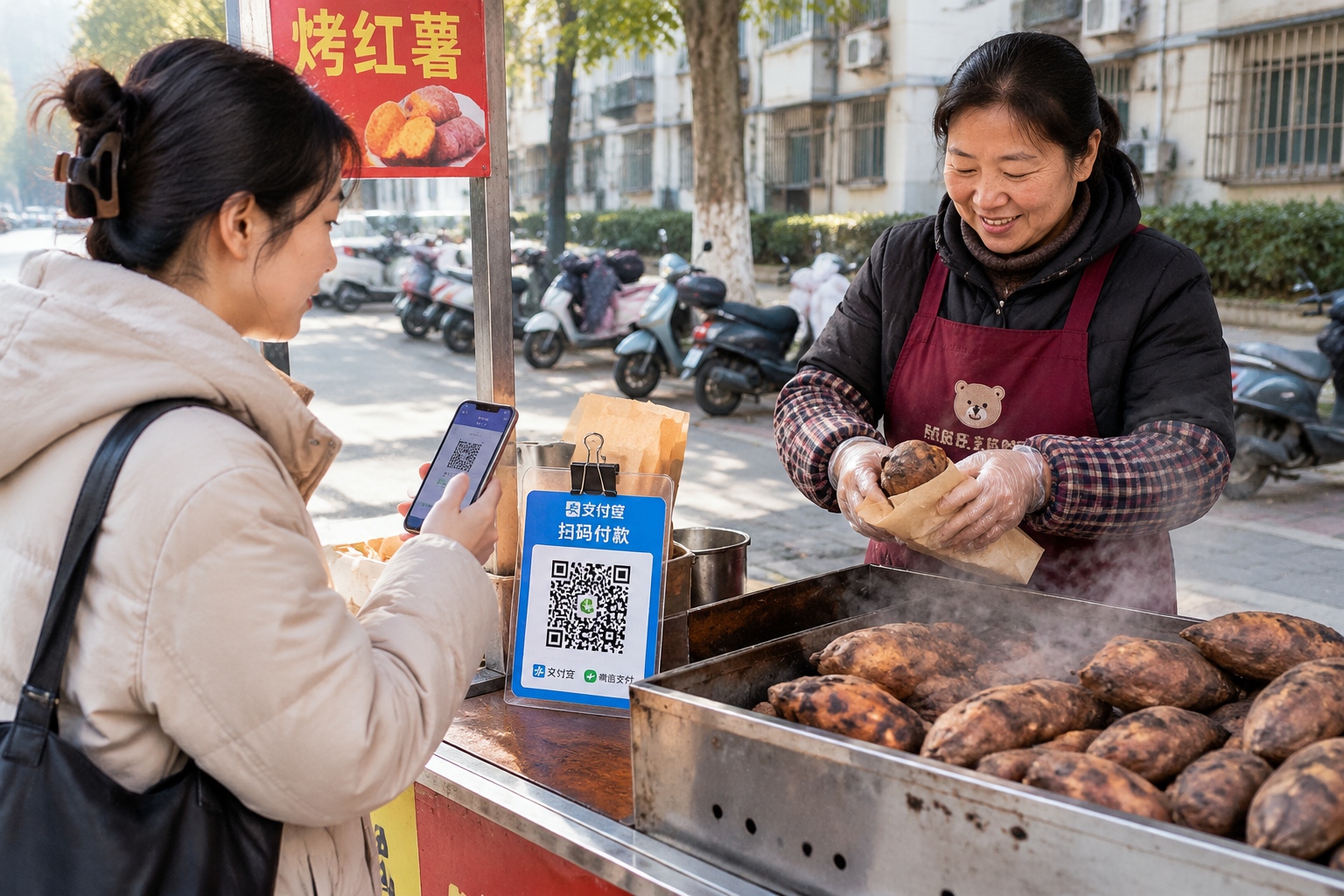
It’s worth saying that this is not frictionless for outsiders. Maya, Greg’s 22-year-old daughter, spent two days fighting with her US-issued card before it finally linked. Foreign visitors were largely locked out of these apps until regulators pushed through changes in 2023 and 2024. The system is built for people inside it.
The train that reset their sense of distance
Beijing South to Shanghai Hongqiao is 1,318 kilometers. The train takes four hours and eighteen minutes, departs every few minutes at peak times, and arrives with a punctuality that makes you stop checking the clock.
Greg’s reference point was Amtrak. Denver to Chicago is roughly 1,600 kilometers and eats most of a day. He kept doing the math out loud: “So you could live in one city and work in another.”
China’s high-speed rail network now runs to about 48,000 kilometers, more than the rest of the world combined. It got there by building dedicated passenger lines instead of sharing track with freight, standardizing rolling stock at 350 km/h, and financing construction through a state railway company that borrows against future ridership and the land value that collects around new stations.
That last part matters. China State Railway Group carries an enormous debt load, and plenty of individual lines will never earn back what they cost. The honest way to describe it is that China made a decision about what counts as a return — mobility, land development, regional equality — and then spent accordingly. The United States made a different decision, and it isn’t obvious that either country is being irrational given what it was optimizing for.
Electric cars that cost less than a used pickup
In 2024, “new energy vehicles” — battery electric and plug-in hybrid — made up more than 40% of new car sales in China, and crossed 50% in some months. The cheapest BYD Seagull starts around 70,000 yuan, roughly $9,700.
What struck Greg wasn’t the sticker price. It was the plumbing underneath it. In a Shenzhen residential garage, we counted forty chargers on a single basement level, cars cycling through them like washing machines. On the highway outside Wuhan, we passed a battery-swap station where a driver pulled in, exchanged a depleted pack for a full one, and left in under four minutes.
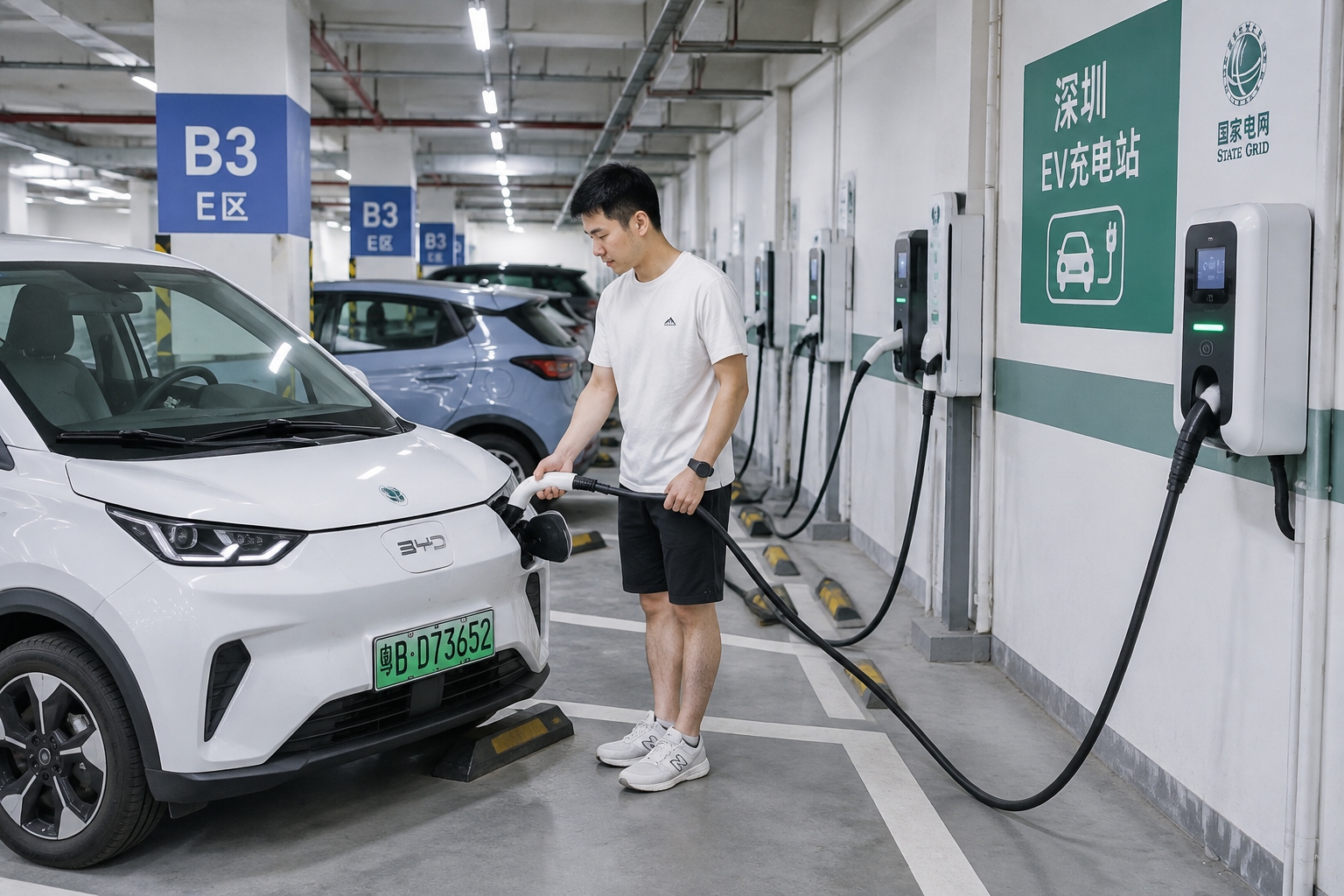
The speed came from a policy stack that started in 2009 and compounded: purchase subsidies, license-plate lotteries in big cities that heavily favor electric cars, mandates pushing cities to build charging, and a domestic supply chain — CATL, BYD and dozens of others — that makes cells, motors and software under one roof.
The costs are real too. Two years of price war have crushed margins across the industry, and several Chinese EV brands will not exist in five years. Cheap cars are cheap partly because somebody is losing money on them.
Where the green transition looks like a warehouse roof
China installed about 277 gigawatts of solar in 2024. For scale, that single year of installations is larger than the entire cumulative solar capacity of the United States. Wind additions came to roughly 80 gigawatts.
Numbers like that get quoted in policy debates and then forgotten. What Greg noticed was smaller. On Shenzhen’s industrial fringe, warehouse roofs were covered in panels. Electric buses were the default rather than the exception; Shenzhen’s city fleet went fully electric years ago. Beijing’s air, once a punchline, has improved dramatically — measured PM2.5 concentrations have fallen by more than half since 2013.
Maya had packed N95 masks. She never used one.
None of this means the problem is solved. Coal still generates the majority of China’s electricity, some provinces curtail solar because the grid can’t absorb it, and the buildout has in places outrun the planning around it. The green transition here is not a moral posture. It’s an industrial program, and industrial programs have side effects.
Drones, robotaxis, and a habit of deploying first
In Shenzhen, Meituan runs drone delivery routes that drop meals at lockers in office parks. In Wuhan, hundreds of Apollo Go robotaxis carry paying passengers through ordinary traffic, at ordinary speeds, to ordinary destinations.
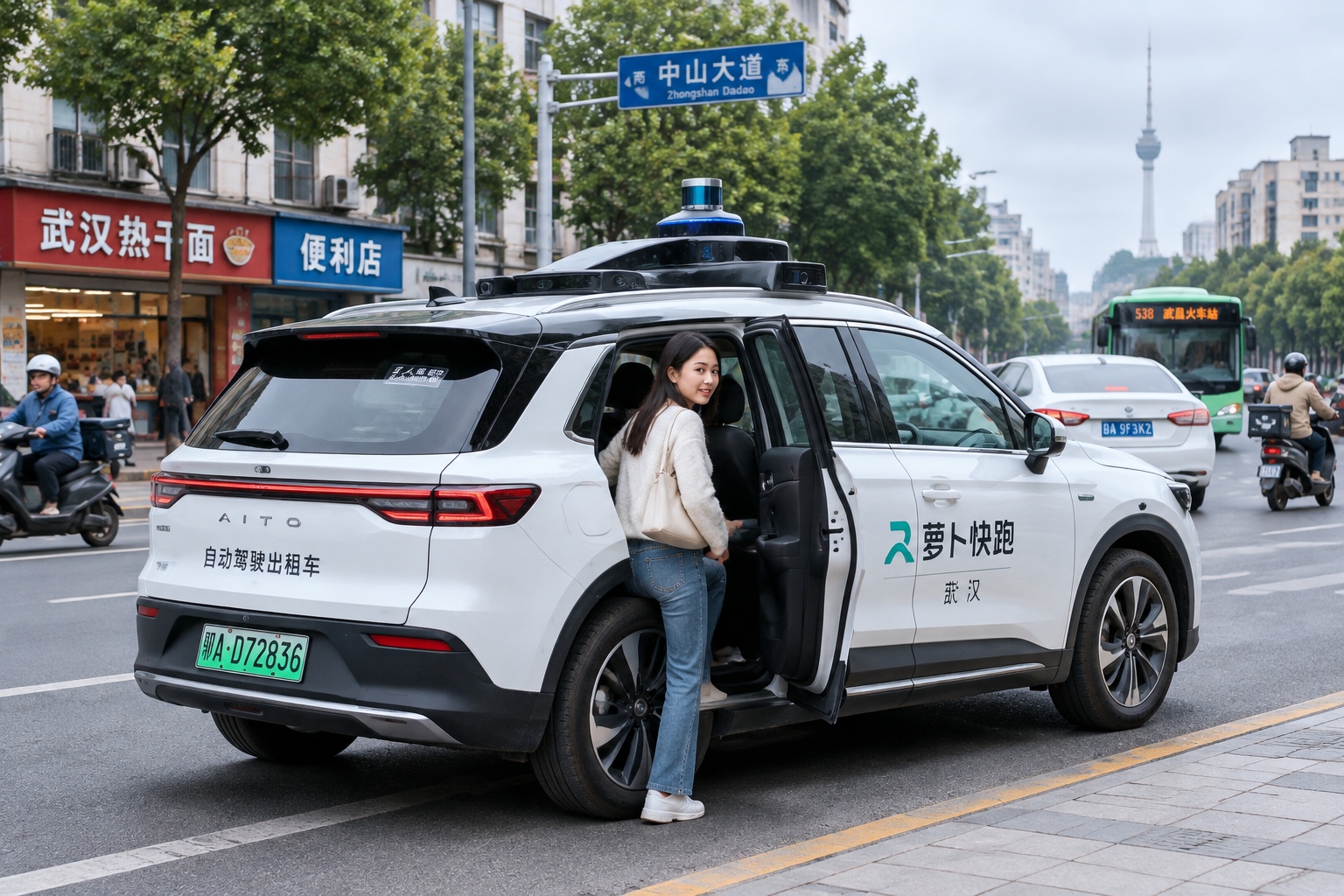
Greg rode in one and came back with a mixed review: safe, cautious to the point of irritating, and unnerving when it hesitated at a four-way stop. Wuhan’s taxi drivers have complaints of their own, and they aren’t wrong to have them.
The interesting part is the method. China tends to pilot a new technology in a district, let it run in public, and write the rules afterward — sometimes years afterward. The United States tends to litigate and permit first, with federal agencies, city councils and environmental review each holding a veto before anything moves.
You can argue either approach is correct. The Chinese version gets things onto streets faster and corrects course in public. It also means people absorb risk before anyone has agreed on what the risk is.
The part that has nothing to do with technology
The most quietly surprising stop of the trip wasn’t a factory. It was lunch.
In a residential block in Wuhan, a neighborhood canteen serves subsidized meals — rice, a vegetable, a meat dish, soup — for somewhere between 10 and 18 yuan, about $1.50 to $2.50. The core customers are people in their seventies and eighties who live alone, plus delivery riders and office workers who wander in.
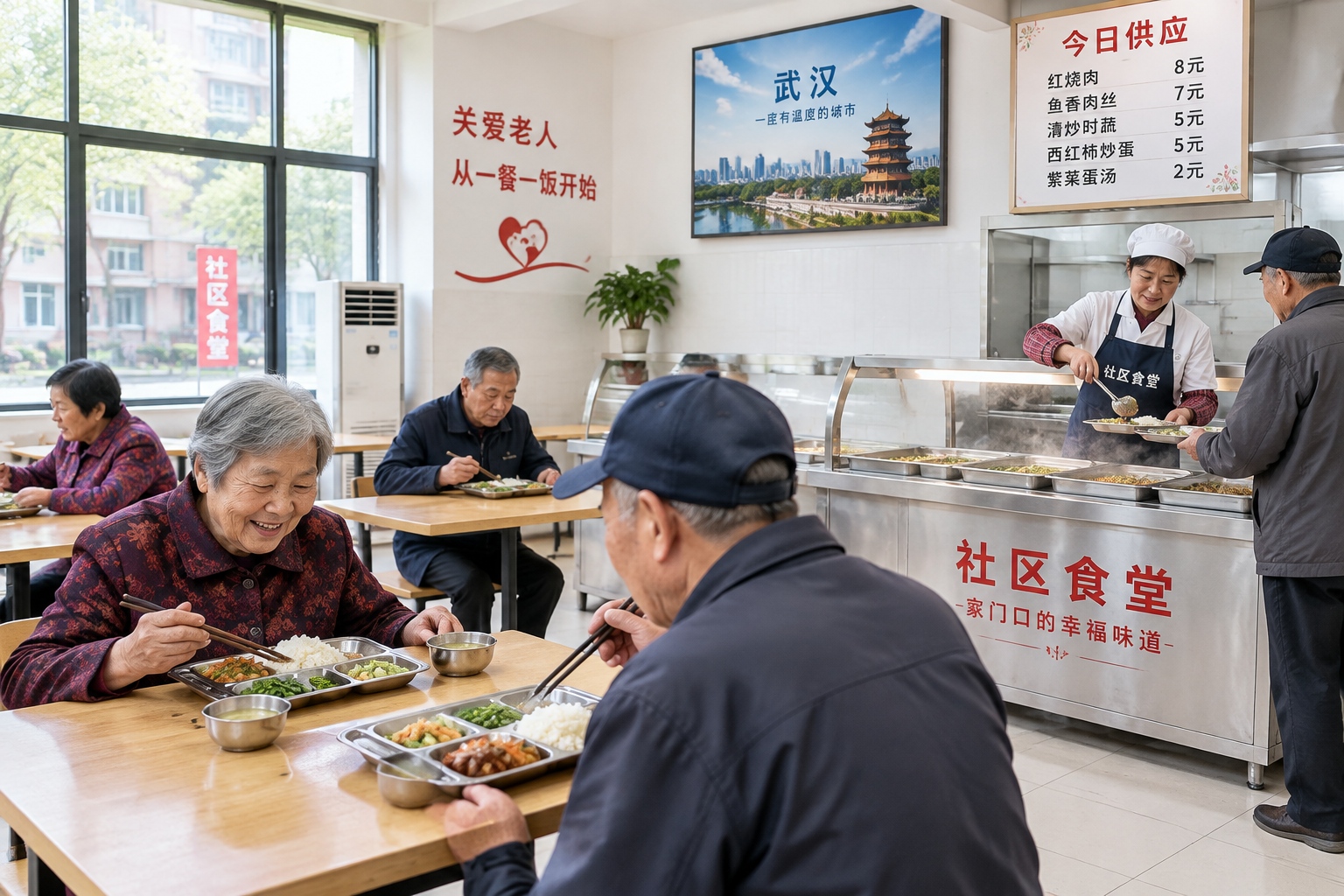
Behind it sits the shequ, the neighborhood, an administrative unit Westerners find hardest to classify. It’s not quite a city office, not quite a homeowners’ association, not quite a social services agency. It has staff, a small clinic, an activity room, sometimes a canteen. It is the layer that delivered groceries to shut-ins during lockdowns, and also the layer that enforced those lockdowns.
Greg, who has spent thirty years watching American towns struggle to fund senior centers, understood both halves immediately. “That’s the part I want,” he said. “And I don’t want the other part.” That tension is real, and pretending otherwise helps nobody.
What didn’t impress them
A trip that produces only wonder is a bad trip. Some of what Greg and Maya saw, they actively disliked.
They couldn’t read the news they wanted to read. Instagram and Google Maps required workarounds. They met a 23-year-old recent graduate hunting for work in a market where youth unemployment had climbed above 20% before the statistical methodology changed in 2023 — and where a good degree no longer guarantees a good job. They heard about a relative’s apartment that stopped construction halfway. They watched a twelve-year-old neighbor’s week: school, tutoring, homework, repeat, six days out of seven, in a country where one exam at eighteen still shapes a life.
And they noticed who was missing from the nice restaurants — the migrant workers who poured the concrete, many of whom still can’t enroll their children in local public schools because their household registration, the hukou, belongs to a village hundreds of kilometers away.
On the last night Greg put it bluntly: “This isn’t a place I’d want to live.” Then he paused. “But I want to know why they could build that train and we can’t.”
The actual lesson of ten days
That question is the whole point. Most Americans arrive in China expecting to compare scoreboards. What they end up comparing is menus.
Americans grow up treating certain things as laws of nature: that public transit can never pay for itself, that cashless payments must route through card networks, that electric cars are a luxury product, that feeding elderly neighbors is charity rather than infrastructure, that anything large takes twenty years and three lawsuits. Ten days in China doesn’t prove those beliefs false. It proves they’re choices — made under different constraints, with different tradeoffs, by people who are not fundamentally different from anyone else.
Some of those choices carry costs Greg wouldn’t accept for his own family, and he said so. The point of the trip was never to switch sides. It was to notice that the range of things a society can do is wider than the range it currently believes in.
On the flight home, Greg texted me a photo of the train at Denver airport, which comes every fifteen minutes when it comes. The caption was four words: “We could do better.”
Start the discussion at forum.chinacomes.com