

A Lunch Tray, and a Question Nobody Asks
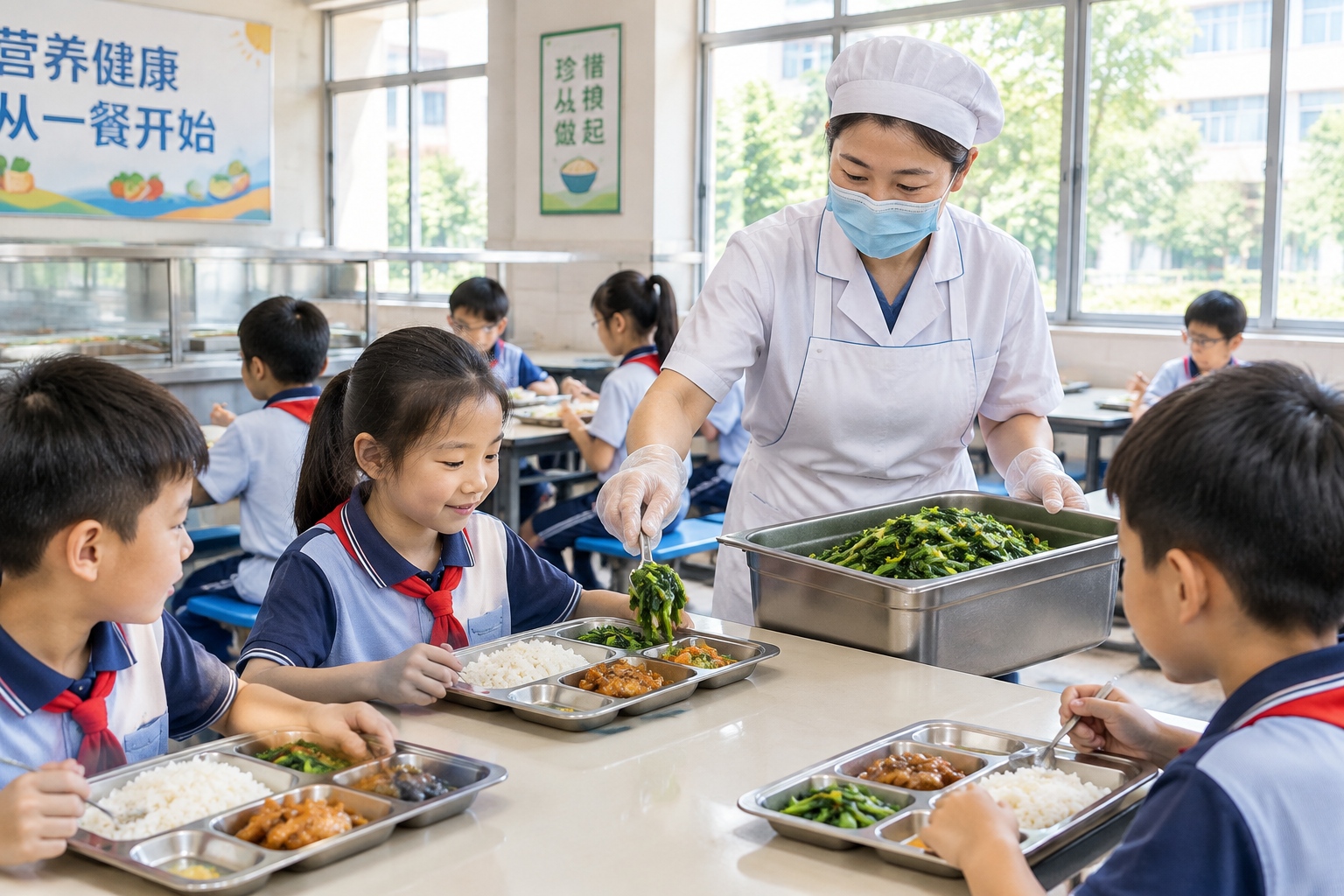
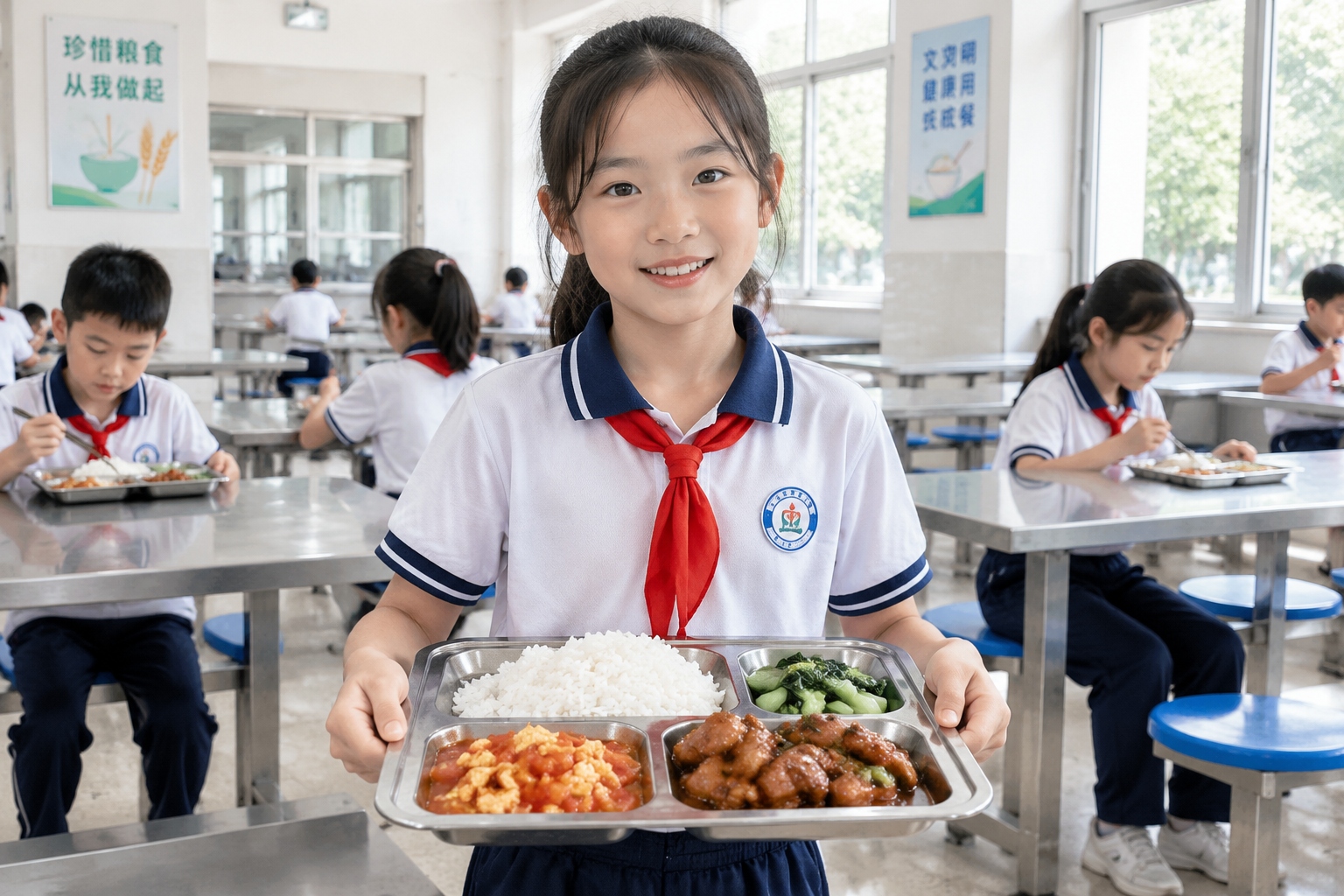
At 11:40 a.m., the lunch bell rings at a primary school in Shanghai’s Minhang District. Ten-year-old Li Wei picks up his tray: rice, tomato-and-egg stir-fry, braised chicken, and a small scoop of stir-fried bok choy. He eats the greens in two seconds. He does not wonder where they came from.
That spoonful of greens is ordinary—maybe 50 grams, costing about 0.3 yuan (4 U.S. cents). But its journey is anything but local. The bok choy on Li Wei’s tray likely traveled more than 2,000 kilometers from a farm in Yunnan Province, through a cold chain that never breaks, to arrive at his school before 6 a.m.
The Plate in Reverse: What’s Actually on a Chinese School Lunch
Chinese school lunches follow a rough formula: one meat dish, one vegetable dish, one soup, and rice. In wealthier cities, there may be two meats and two vegetables. The national nutrition guideline for school meals recommends 300–500 grams of vegetables per student per day, with at least half being dark leafy greens.
Most urban public schools do not buy vegetables directly from farmers. They sign contracts with licensed food distributors. Those distributors win annual bids from local education bureaus or school districts. The bid specifies food safety standards, delivery schedules, and often a maximum price per meal. A school lunch in Shanghai costs about 12–15 yuan ($1.70–$2.10), with the government subsidizing part of it for low-income students.
The distributor then sources from wholesale markets or directly from large farms. Local vegetables are preferred when available, but Shanghai’s own farmland has shrunk. In 2023, Shanghai produced about 2.5 million tons of vegetables, while consuming over 6 million tons. The gap comes from other provinces.
At the Farm: 3 A.M. in Yunnan
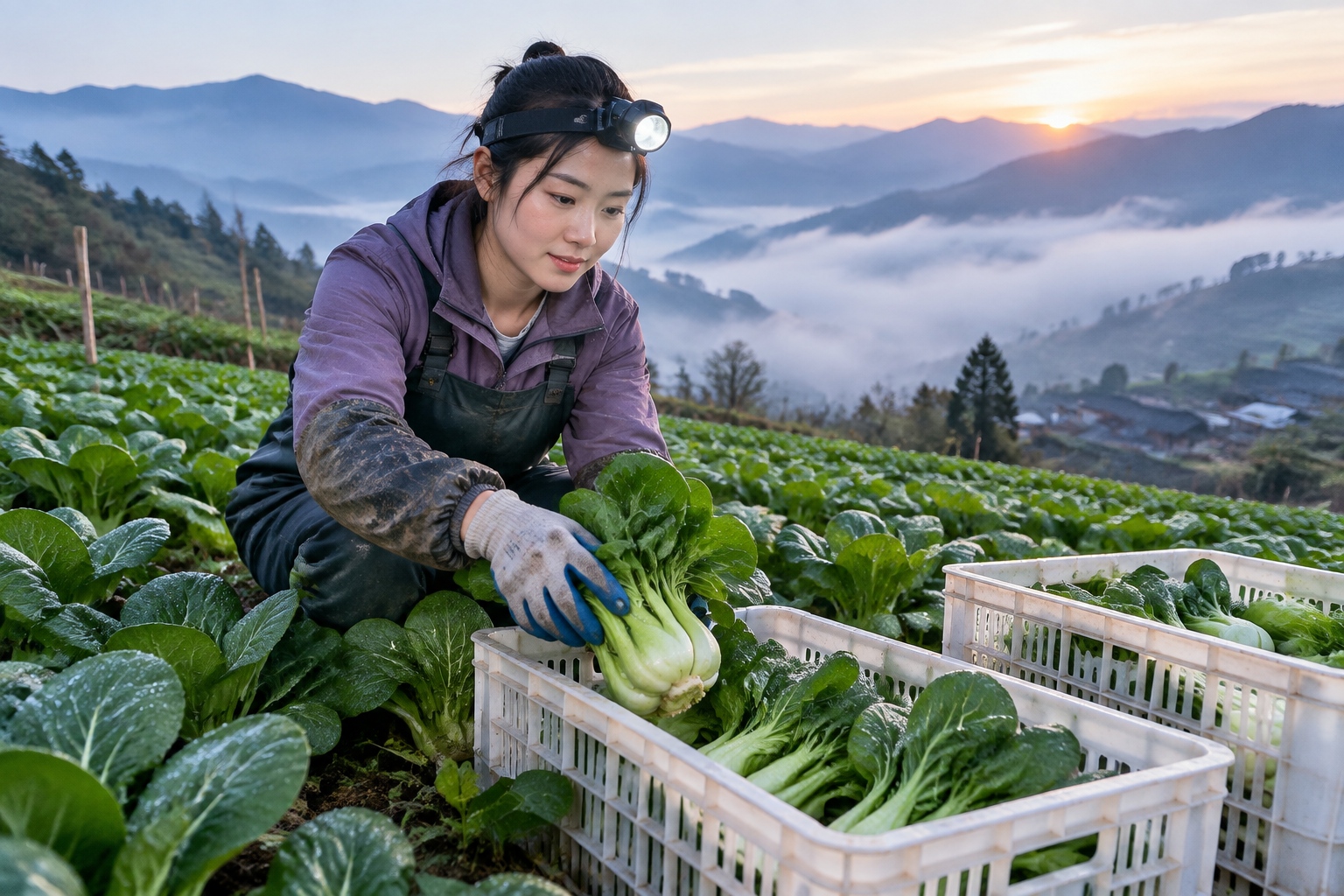
Sixteen hundred kilometers southwest of Shanghai, in Songming County, Yunnan, farmer Zhang Guilan turns on her headlamp at 3 a.m. She and three workers harvest bok choy by hand, cutting each head at the base and dropping it into a plastic crate. The field is 1,900 meters above sea level. Yunnan’s mild winter and high altitude make it ideal for growing leafy greens when eastern China is cold.
By 5 a.m., the crates are loaded onto a small truck and driven 20 minutes to a packing house. There, the greens are pre-cooled to 4°C in a forced-air cooler. A technician takes a sample from each batch and tests for pesticide residue using a rapid test kit. The results are logged into a computer system. If the batch fails, it never leaves the facility.
China grows vegetables on about 34 million hectares (84 million acres)—roughly the size of Germany. Total vegetable output in 2023 was 830 million tons. Yunnan alone exports over 20 million tons of vegetables to other provinces each year.
Sorting, Packing, and the First Cold Chain Handoff
Inside the packing house, workers grade the bok choy by size and color. They trim the roots, weigh each crate, and stick on a label with the farm’s code, harvest date, and batch number. The crates are stacked on pallets and moved into a cold storage room at 2°C.
By 8 a.m., a refrigerated truck pulls up. The driver checks the trailer temperature: it must be between 0°C and 4°C. A temperature recorder is placed inside. The pallets are loaded. The truck carries 18 tons of vegetables, including bok choy, lettuce, and broccoli. Paperwork includes a certificate of origin, a pesticide residue test report, and a delivery note. The truck leaves for Shanghai.
A Thousand Kilometers on the Road
The driver, Wang Jian, has been on this route for six years. The trip from Songming to Shanghai’s Jiangqiao wholesale market is about 2,200 kilometers. He drives for 30 hours, with two rest stops. A GPS tracker and a temperature sensor send data to the distributor’s control room every 10 minutes.
Why not grow vegetables closer to Shanghai? In winter, eastern China’s temperatures drop below freezing. Greenhouses can grow greens, but they cost more. Yunnan’s open-field winter vegetables are cheaper, even after paying for diesel, tolls, and the driver. A liter of diesel costs about 7.5 yuan ($1.05). The truck burns 30 liters per 100 kilometers. Tolls for the route are roughly 1,200 yuan ($170). The total transport cost adds about 0.8 yuan per kilogram to the vegetables—still less than the cost of heating a greenhouse.
The City Distribution Center: 2 A.M. Arrival
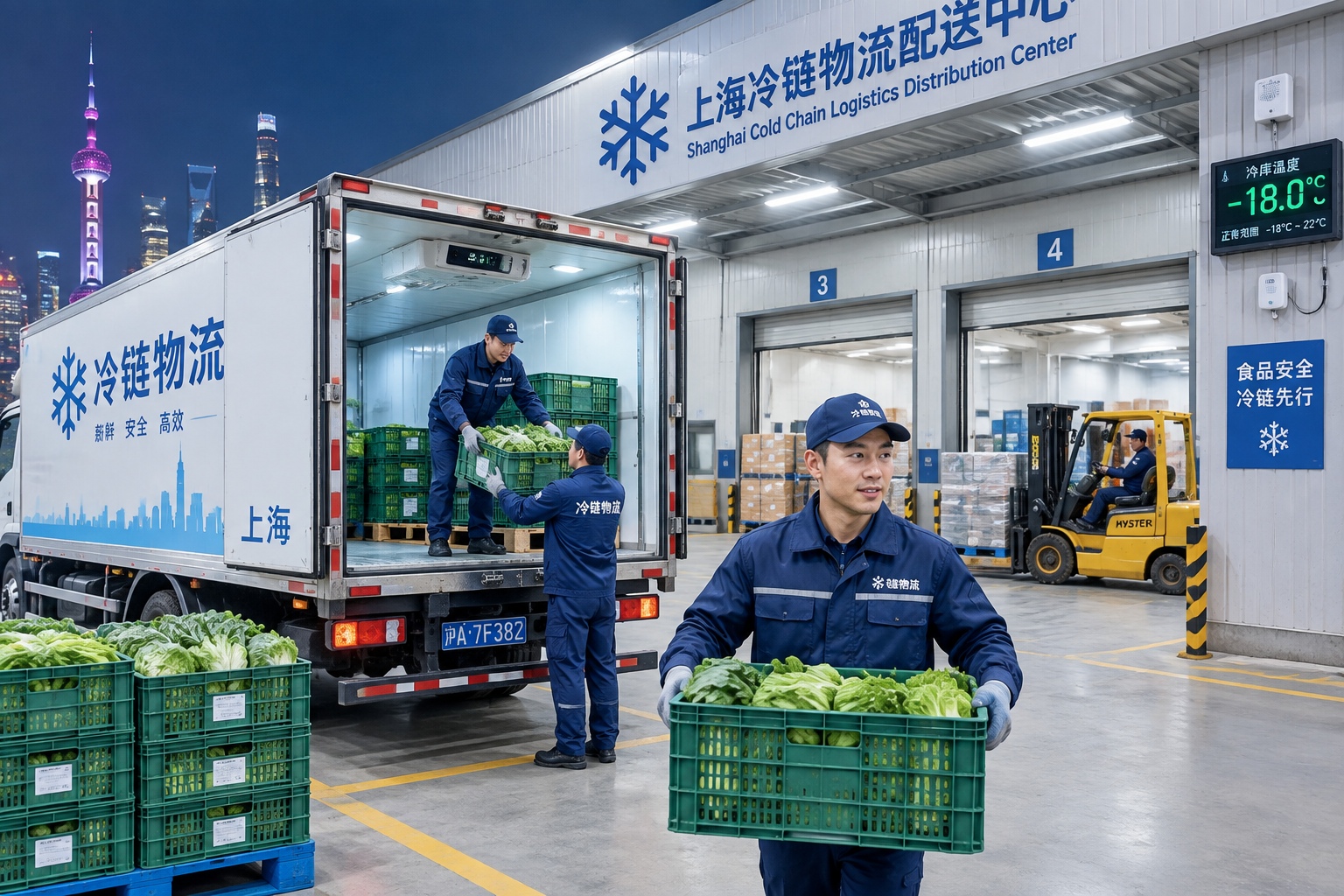
At 2 a.m., Wang Jian’s truck arrives at Jiangqiao, one of Shanghai’s largest wholesale markets. The temperature recorder is checked. The vegetables are unloaded and moved to a distribution area. By 4 a.m., smaller trucks load orders for individual school districts. A single school might receive 20 kilograms of bok choy, 15 kilograms of tomatoes, and 10 kilograms of pork.
At 5:30 a.m., a delivery van arrives at Li Wei’s school. The cafeteria manager, Ms. Chen, checks the temperature of the vegetables with an infrared thermometer. She inspects the leaves for yellowing or wilting. She checks the delivery note against the order. Then she signs. The vegetables are taken to the kitchen, washed, and cooked. A sample of each dish is kept in a refrigerator for 48 hours—a standard food safety rule known as liu yang.
Why It Works This Way
Three forces shape this supply chain. First, urbanization. China’s urban population has grown from 36% in 2000 to 66% in 2023. As cities expand, nearby farmland disappears. Shanghai’s vegetable self-sufficiency is about 40%. Second, seasonality. A school lunch must include leafy greens year-round, but northern winters are harsh. Third, food safety. After several school food scandals in the 2010s, the government tightened rules. Centralized procurement, cold chain, and batch testing are now standard.
Scale also matters. China’s school lunch program serves over 200 million students. The rural nutrition improvement program alone covers about 37 million students in poor areas, with a central government subsidy of 5 yuan per student per day. That scale allows distributors to buy in bulk and negotiate lower prices.
The People in the Chain
Zhang Guilan, the Yunnan farmer, harvests 200 kilograms of bok choy on a good day. She earns about 4,000 yuan ($560) per month. In the packing house, Ms. Liu grades vegetables for eight hours a day, sorting about 10 tons. Wang Jian, the driver, sleeps in his cab to save money. In Shanghai, purchasing manager Mr. Zhao starts work at 3 a.m., checking prices and quality at the wholesale market. At the school, chef Zhang arrives at 6 a.m. to start cooking. Principal Wang eats lunch with students once a week—a companion meal policy that requires school officials to eat the same food as students.
Parents also monitor. Li Wei’s mother, Ms. Zhou, volunteers on a parent food committee. Once a month, she visits the school kitchen unannounced, checking storage temperatures and expiration dates.
Technology and Rules, Running in the Background
Much of this system runs on software. Distributors use order management systems that predict demand based on school calendars. Cold chain companies use IoT sensors to track temperature. Testing labs upload results to government platforms. Schools post weekly menus online. None of this is glamorous, but it is how a simple spoonful of greens arrives safely.
Cost, Waste, and Regional Gaps
The system is not perfect. Vegetable losses in China’s cold chain are still around 15–20%, compared to under 5% in developed countries. In remote areas like Tibet or northern Xinjiang, winter vegetables must be trucked even farther, sometimes over 3,000 kilometers. Costs rise, and variety shrinks. Some rural schools still lack proper kitchens and rely on processed food or simple meals.
Price volatility is another challenge. A bad harvest in Yunnan can double the price of bok choy in Shanghai within a week. School lunch budgets are fixed, so distributors absorb some losses—or cut portion sizes. The system works, but it is a daily balancing act.
What This Means for Readers Outside China
If you live in London, New York, or Sydney, your supermarket salad and your child’s school lunch likely follow a similar path. But China’s scale and speed are different. The country moves 8.3 billion tons of vegetables a year, mostly by road and rail. Cold chain logistics have grown rapidly: from 2015 to 2023, China’s cold storage capacity doubled to over 200 million cubic meters. This infrastructure makes it possible to deliver a 50-gram portion of greens for a few cents.
For ordinary families, the result is that a child in Shanghai can eat Yunnan bok choy in January, just as a child in New York can eat Chilean grapes in February. The difference is that China’s system is designed to keep school meals cheap and standardized, not just to serve affluent consumers.
Back to the Spoon
Li Wei finishes his greens and moves on to the chicken. He does not know about the 3 a.m. harvest, the 2,200-kilometer drive, or the temperature log. He just knows the greens taste a little salty. That is the point. A spoonful of vegetables is not a miracle. It is the ordinary output of urbanization, logistics networks, and public governance. The invisible supply chain works so well that we forget it exists—until someone asks where the greens came from.
Start the discussion at forum.chinacomes.com