


The Night a Stranger Fixed My Bike
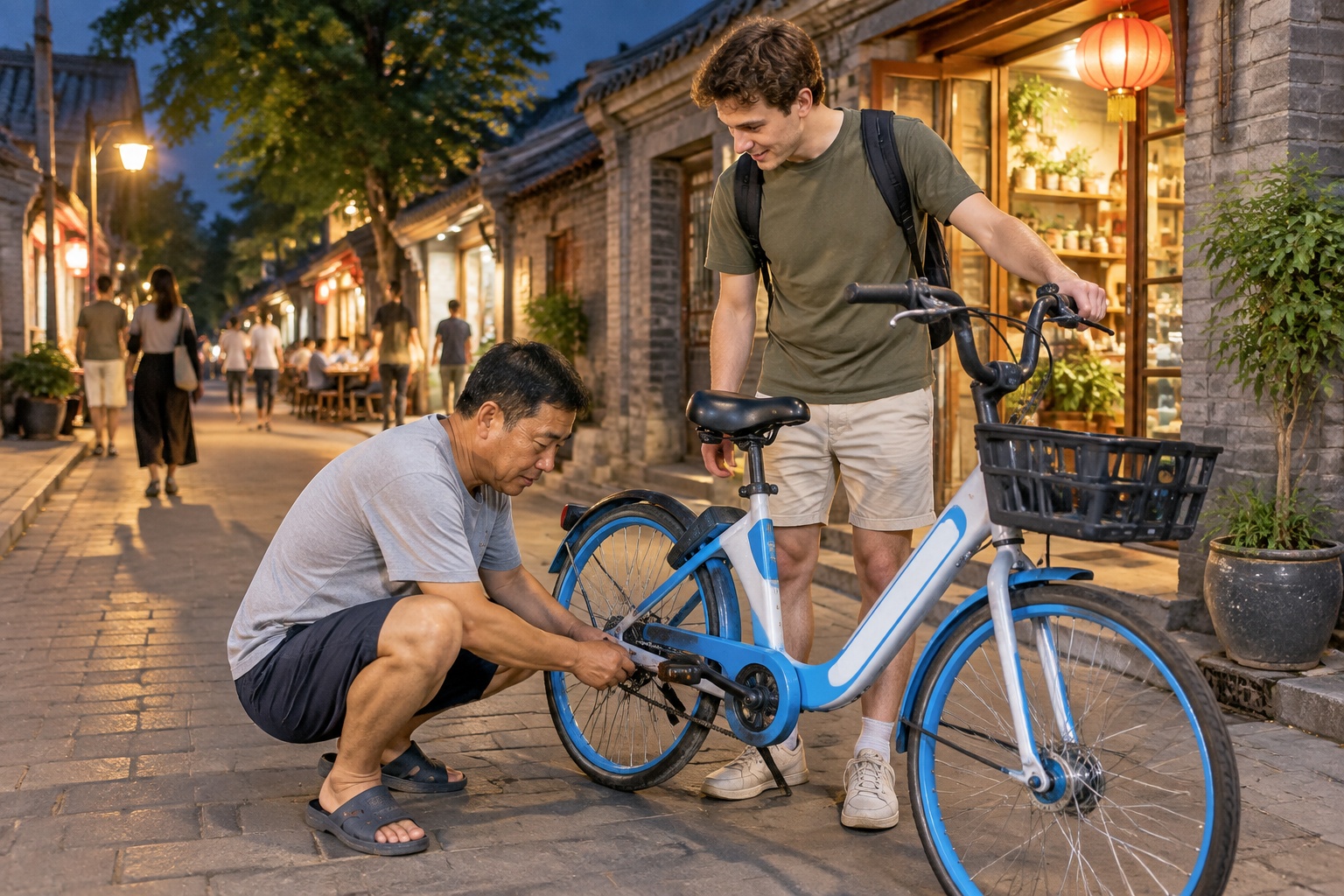
It was a Tuesday night in Beijing, close to ten, and I was standing on a hutong corner with a shared bike whose chain had slipped off the gear. No tools, no useful signal, and a bad attitude.
A man in his sixties walked past in slippers, a cigarette in his mouth. He looked at the bike. He looked at me. He didn’t say anything — just crouched down and got to work. Thirty seconds later the chain was back on. He wiped his hands on his shorts and was already walking away before I finished saying thank you. He never smiled. He never asked where I was from.
That is the kind of friendliness most visitors to China actually meet and almost nobody writes about. It isn’t warm in the way we’re taught to expect. It’s practical, unscheduled, and offered by people who would be genuinely puzzled if you called it generosity.
The “Friendliness Training” Tourists See Is Real — It’s Just Not the Point
Let me deal with the obvious objection first. Yes, China trains people to be nice to visitors. Scenic spots drill their staff on English phrases. Hotels near major attractions run service workshops. Cities organize “civilized tourism” campaigns that put volunteers in red vests at subway exits during holiday weeks, handing out maps and pointing lost foreigners toward the right bus.
All of that exists. And if your only contact with China is a two-day stop at a famous mountain, that’s probably the friendliness you’ll notice.
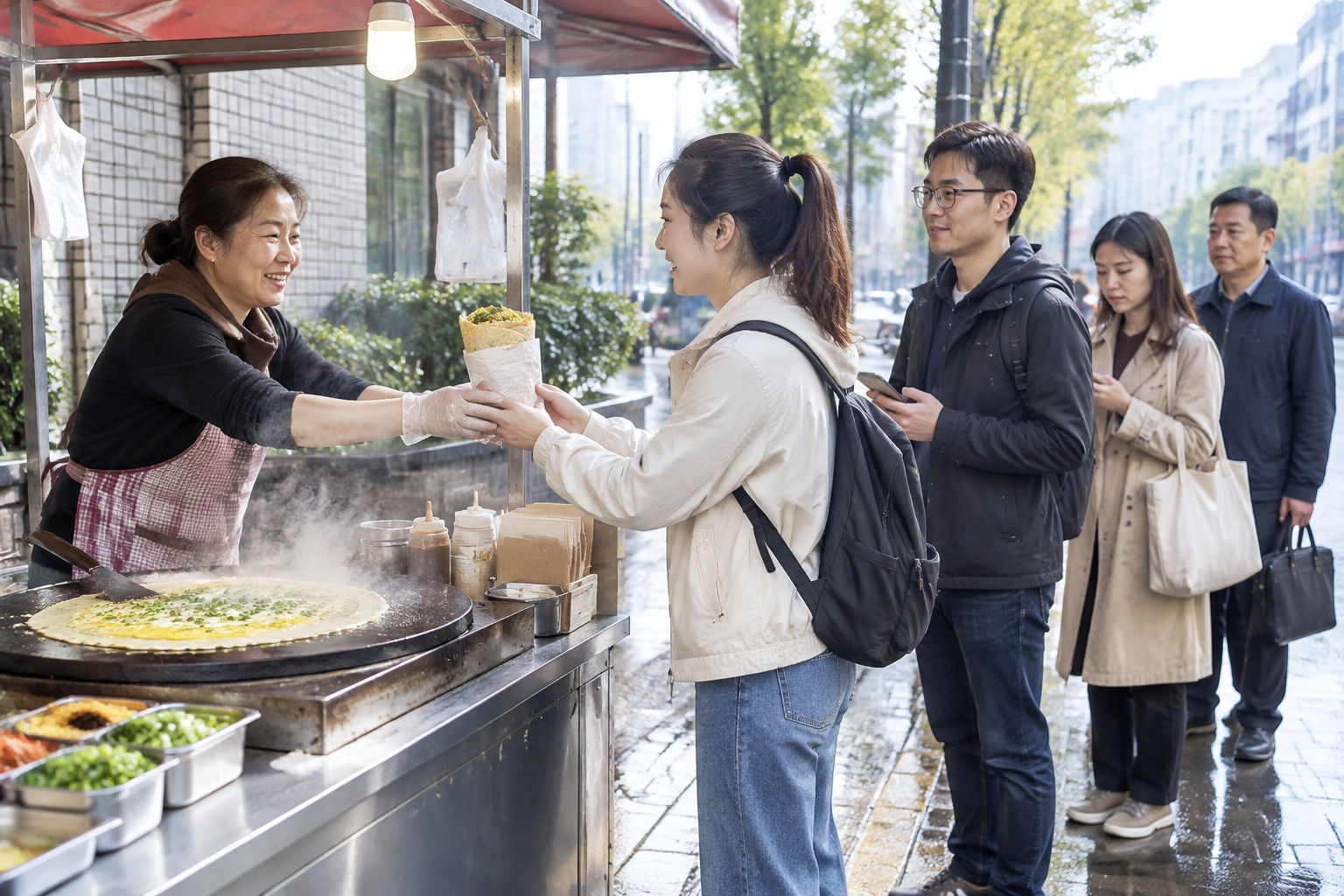
But it can’t explain what happens on an ordinary Wednesday: the woman at the breakfast stall who remembers you don’t eat cilantro, the delivery rider who waits an extra four minutes because he can hear you’re on a call, the teenager who wordlessly turns your phone around when you’re holding the QR code at the wrong angle.
None of those people were trained. Something else is going on.
Three Ordinary Reasons Strangers Help You Here
1. Density — You Are Almost Never Actually Alone
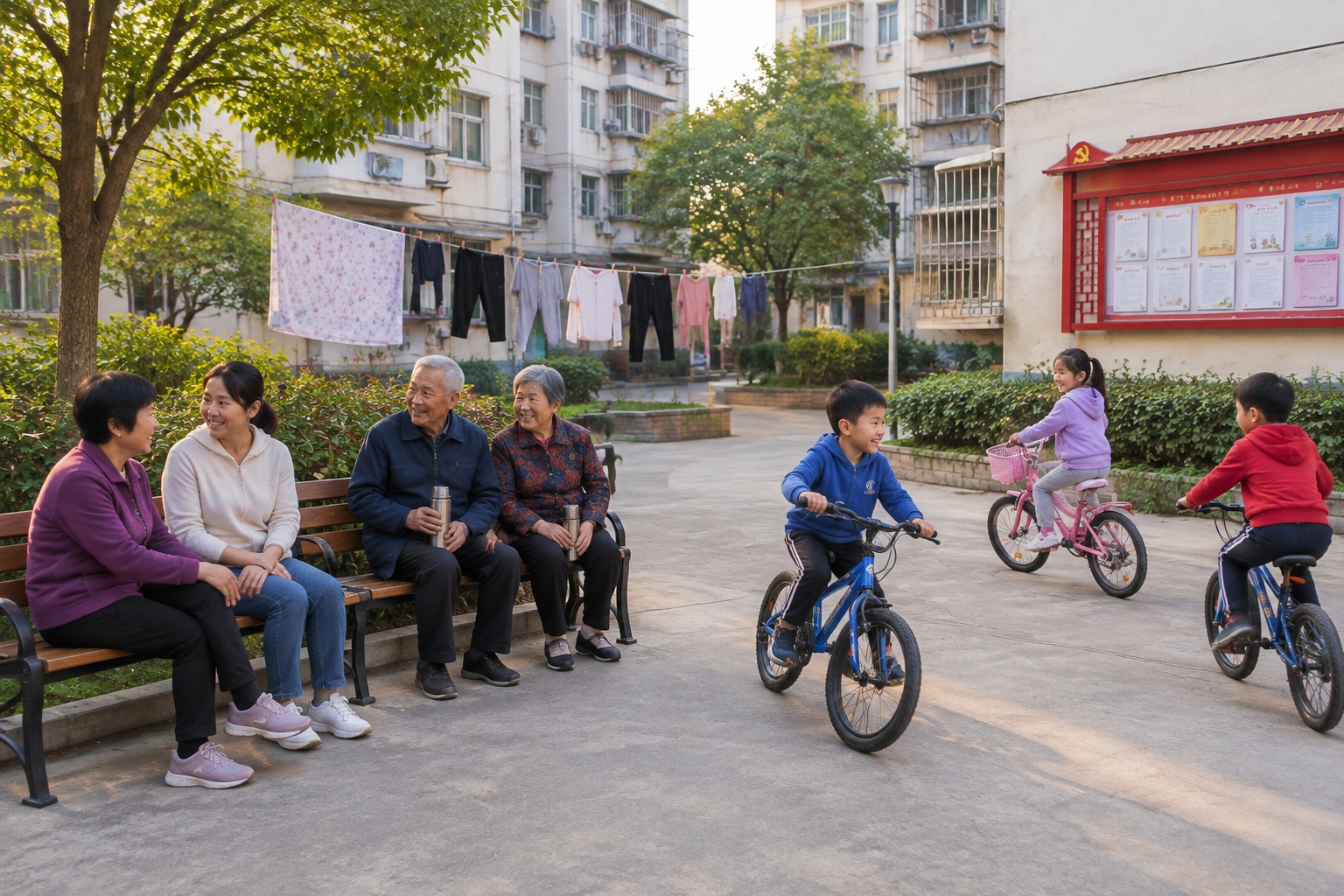
Around two-thirds of Chinese people now live in cities, and Chinese cities are dense in a way most Western cities are not. A residential compound of 5,000 people is unremarkable. The ground floor of nearly every building is a shop, a noodle place, a courier station or a vegetable stand. Older people sit outside because the apartment is small and the street works as a living room.
In that environment, strangers aren’t abstract. You pass the same fifty faces every day. You recognize the woman who walks her dog at 6:40 every morning. Urban planners here talk about the “15-minute life circle” — the goal that work, school, clinic, market and park should all sit within a quarter-hour walk. It’s a policy target, but it also describes how a lot of neighborhoods already function.
High density makes indifference expensive. When you are never more than twenty meters from another human being, helping is often faster than not helping.
2. Safety Changes the Math of Talking to Strangers
This one is hard to explain to people who haven’t been here. China’s intentional homicide rate sits around 0.5 per 100,000 people — in the same range as Japan, and roughly a tenth of the US figure. Guns are effectively unavailable. Street crime in major cities is rare enough that it doesn’t organize daily life.
You can feel the consequences in small things. Ten-year-olds ride the subway alone. Parents let teenagers take overnight trains across provinces. Women walk home at midnight through unlit hutong lanes without a second thought. When I tell Chinese friends that some American parents won’t let a twelve-year-old walk to a park alone, they look at me like I’ve described another planet.
Here’s the link to friendliness: when the person beside you is very unlikely to hurt you, helping them costs almost nothing. A lot of what gets read as Chinese warmth is simply the absence of fear.
3. Reciprocity Is the Default Setting
China is often described as a “relationship society,” but that undersells how far the logic stretches. The assumption running under daily life is that today’s favor is tomorrow’s insurance. You help the stranger now because someone else — a colleague, a neighbor, another stranger — will help your mother when she’s the one standing on a corner with a broken chain.
You can see it during disasters. In August 2022, when wildfires tore through the hills around Chongqing, thousands of ordinary people showed up on motorbikes to ferry water, food and firefighters up roads too narrow for trucks. Nobody was mobilizing them. Shop owners gave away supplies. When Zhengzhou flooded in 2021, office workers waded out with inflatable boats to pull strangers from submerged cars.
The same instinct runs at a much smaller scale. During the 2022 lockdowns in Shanghai, residents who had never spoken to each other built WeChat groups to swap rice, eggs and medicine across apartment blocks. That was improvisation as much as solidarity, but it worked because the underlying expectation was that you help.
According to the Ministry of Civil Affairs, more than 200 million people in China are registered as volunteers on the national system. That number deserves some salt: registration is often organized through schools and employers, and signing up isn’t the same as showing up. Still, the infrastructure reflects something real.
The Digital Version of the Same Impulse
Online, this friendliness has a very specific flavor. On Xiaohongshu, Douyin or Weibo, thousands of posts a day are basically people asking the internet for small, mundane help: which hospital has the shortest queue for a child’s fever; is this shop’s milk tea actually good; how do I get from Terminal 3 to the high-speed rail station at 11 p.m.
And people answer. In detail. With photos, timetables and personal anecdotes. There’s no obvious reward — no reputation score you can cash in — beyond the mild satisfaction of being useful.
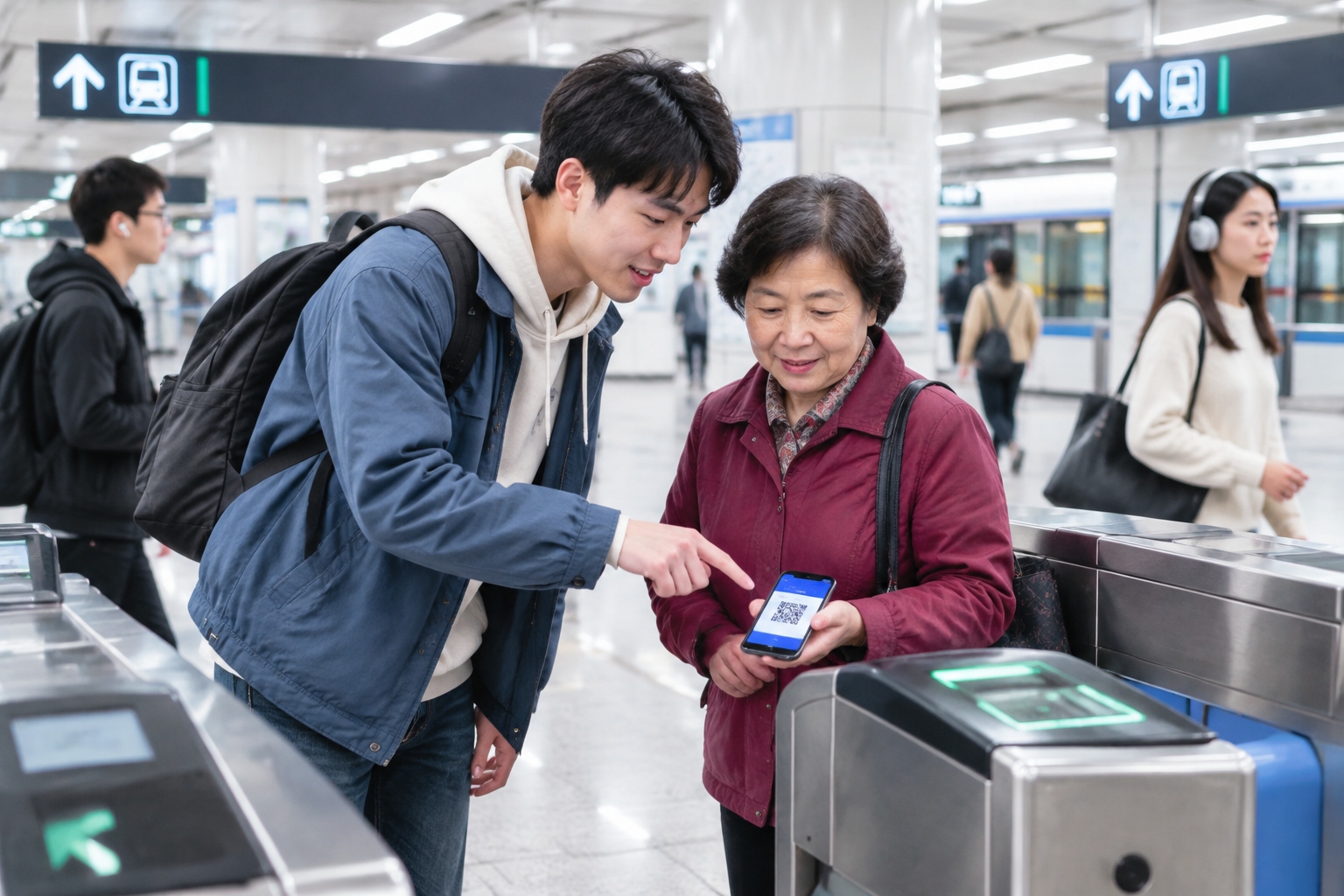
There’s a second digital ritual you’ll see constantly here: an older person approaches a much younger stranger and hands over a phone, saying nothing more than “help me look at this.” The younger person takes it without hesitation, taps through three screens, fixes the setting and hands it back. Both sides treat it as completely normal.
Worth saying: the same internet can be brutally impatient, comment sections can turn savage in seconds, and there is a real generational gap in how people behave online. The kindness isn’t uniform. It’s just common enough to be a pattern.
What Confidence Has to Do With It
Most explanations of Chinese hospitality reach for history — Confucianism, host-and-guest ritual, the idea that a guest is owed care. That’s part of it, but it feels incomplete for what I actually see on the street today.
What I see looks more like confidence. A generation that grew up with things working — trains that arrive, packages that come, streets that are safe, a phone that handles everything from rent to a hospital appointment — tends to be less anxious about strangers. There’s a casual assumption that the world outside your door is basically orderly and the people in it are basically reasonable.
That assumption isn’t patriotism, and it isn’t performance. It shows up as a relaxed kind of helpfulness: not “let me serve you,” but “this is obviously what you do.”
The generational shift is visible. Chinese people in their twenties and thirties travel abroad in numbers their parents never did, and many come back with a sharper sense of what they did and didn’t like about how they were treated elsewhere. That has made them more confident about their own way of doing things — including the way strangers treat each other.
Where It Gets Complicated
I don’t want to paint a country of saints. Tourists get scammed around Wangfujing in Beijing and Nanjing Road in Shanghai, the same way they do anywhere. Rush-hour commuters are not gentle. If you’re a foreigner who only speaks English, plenty of these small kindnesses pass you by entirely — sometimes because of a language wall, sometimes because a tired cashier simply doesn’t want the extra effort.
Places differ, too. The warmth of a Chengdu teahouse, where people argue cheerfully and refill your cup without asking, feels different from the brisk politeness of Shenzhen, a city of young transplants where almost everyone is from somewhere else. Small towns are usually friendlier than megacities. Coast differs from interior. Weather, income and commute length all show up in how people behave.
And some of what looks like friendliness is density plus rules: cameras on poles, community grid workers, neighborhood committees. Systems shape behavior. That doesn’t make the behavior fake — it just means kindness here has infrastructure behind it.
How to Actually Meet It, If You Visit
Skip the guided tour for one afternoon. Stand on a corner frowning at your phone for more than ninety seconds and someone will stop. Learn two phrases and use them badly — the effort lands harder than the accent. Order something you can’t identify from a stall with no English menu. Ask a shopkeeper where locals eat.
If someone helps you and refuses payment, don’t push money at them. Offer to buy them a drink, or a bag of fruit. That’s a language everyone here understands.
And don’t expect a smile. The smile is optional; the help is not.
The Man With the Cigarette, Revisited
I’ve thought about that hutong guy a lot. He didn’t know my nationality and wouldn’t have cared. He wasn’t performing for a camera or representing his country. He fixed a bike because a bike needed fixing and he happened to be the person standing next to it.
That’s the version of China that never fits into a headline, a warning or a brochure. You find it at ten at night, on a side street, from someone who is already halfway home.
Start the discussion at forum.chinacomes.com