

A Tuesday Night in Chengdu, and Nothing Happens
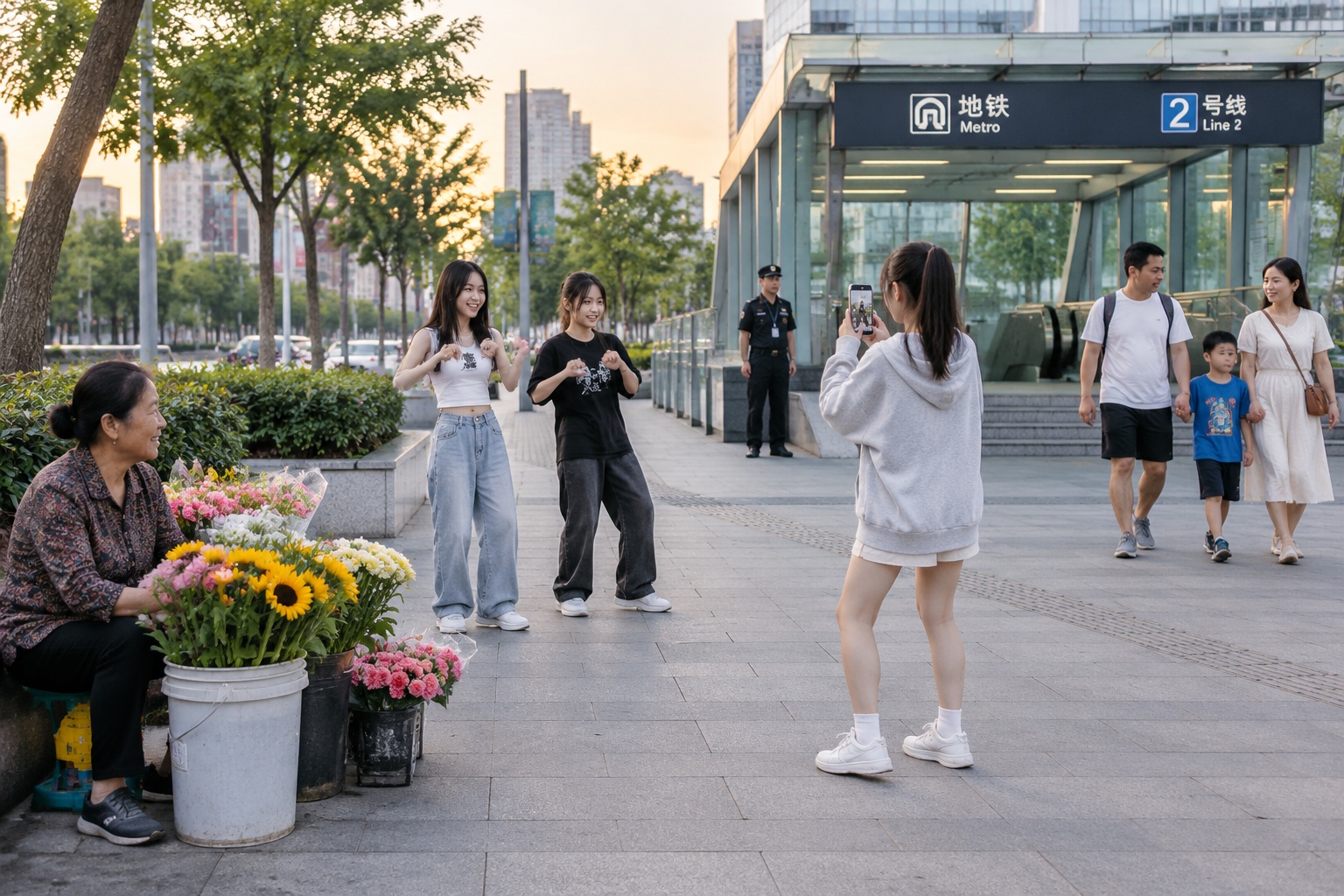
Dan Kozlowski is 41, installs heating and cooling systems in Toledo, Ohio, and had never left North America before last October. His wife won a work trip, he tagged along, and on his second night in Chengdu he walked back to the hotel alone at about 11:30 p.m., past a hotpot restaurant with a line out the door, a group of teenagers filming a dance video, and an older woman selling flowers out of a plastic bucket.
Somewhere on that walk, he realized he had been looking for something and hadn’t found it. He had expected armed officers, checkpoints, a mood of being watched. What he counted instead: one uniform, a security guard dozing at a subway entrance, and a man asleep on a bench with his phone resting on his chest.
By the end of two weeks, he had a sentence he kept texting to his brother: “This is not a police state.”
The phrase “police state” gets used a lot about China in Western media and political speeches. It is serious enough to test against what a person actually sees — and against the parts of life in China that a two-week tourist never touches.
What the Label Is Supposed to Mean
In political science, a police state is a country where the police, not courts or legislatures, run things: pervasive surveillance, arbitrary detention, punishment for speech, and a population that behaves differently because it is afraid. It is a serious charge about how power works.
A fair way to check it is to split it into two questions that often get mashed together. Is everyday life militarized and intimidating? And are there real limits on political activity, journalism and dissent? The honest answers to those two questions are not the same, and pretending they are is why so many American visitors come home confused.
The Street-Level Version
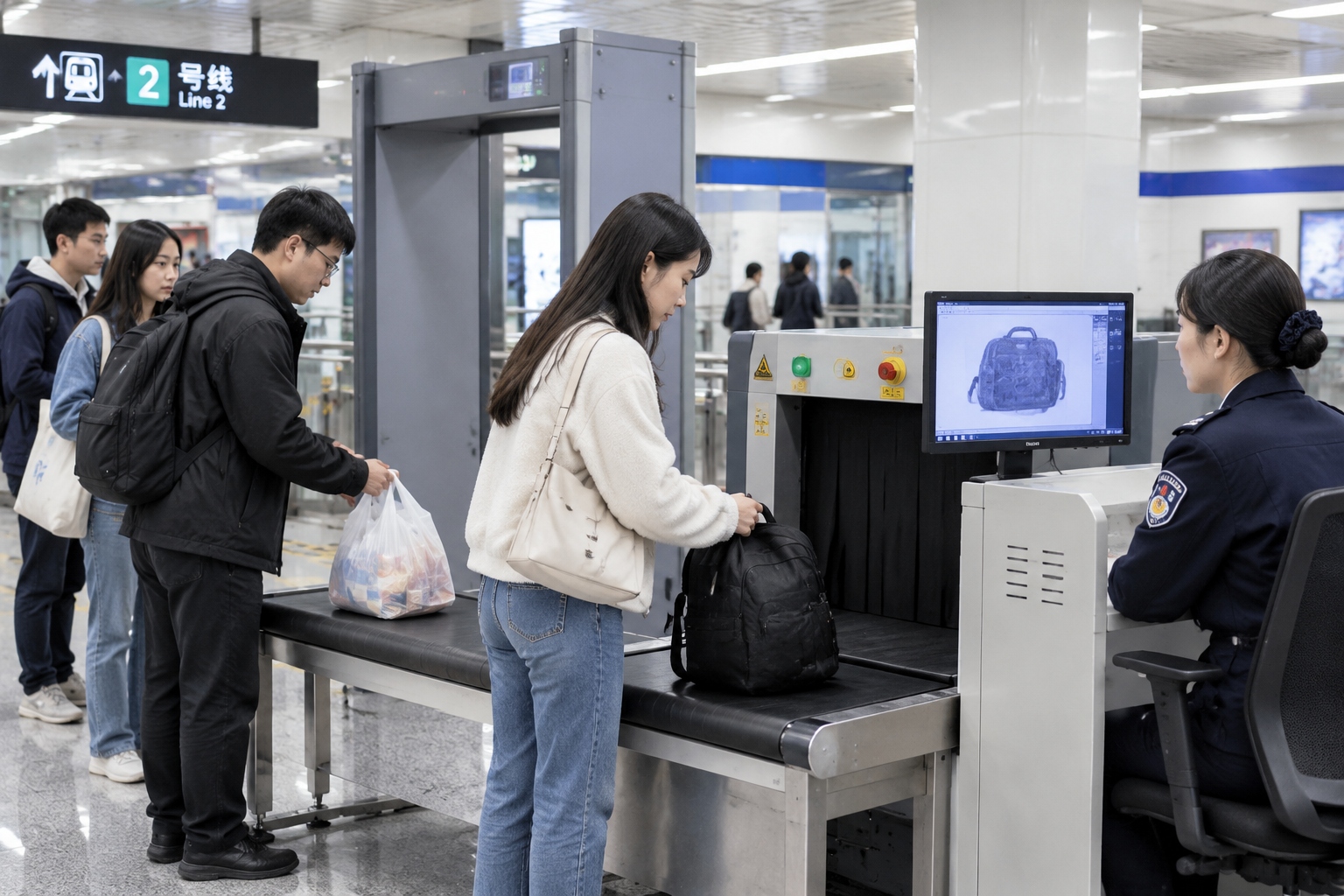
Start with the subway, because it is the closest thing to a “checkpoint” a visitor meets every day. In Beijing, Shanghai, Guangzhou and most large cities, you put your bag on an X-ray belt and sometimes take a sip from your water bottle. The staff are usually employees of a security contractor earning perhaps 4,000 to 6,000 yuan a month, not sworn police. It costs you twenty seconds. It is tedious. It is not intimidating, and almost nobody treats it as such.
Police themselves are mostly visible directing traffic, at train stations and airports, and in the small blue-signed paichusuo — community police stations — that sit in residential neighborhoods the way a pharmacy sits in an American strip mall. Their daily work looks closer to social work, dispute mediation and paperwork than to anything a visitor would call occupation.
Trains are where the ID checks are. Chinese citizens scan a national ID card or their face at the gate; foreigners show a passport, sometimes to a person, usually to a machine. It takes longer than in Europe, and it is the moment most visitors first feel the state’s presence as an ordinary administrative fact rather than a dramatic one.
The Numbers That Surprise Americans
U.S. federal statistics put police strength at roughly 2.3 sworn officers per 1,000 residents. Published Chinese figures come in around 1.4 to 1.5 per 1,000 — even before counting the hundreds of thousands of auxiliary fujing who are not on those rolls. Definitions differ and both sets of numbers are imperfect, but the direction is consistent: the United States does not have fewer police per person than China. It has more.
Then there is crime. The United Nations Office on Drugs and Crime has put China’s intentional homicide rate at roughly 0.5 per 100,000 people, while the U.S. figure has hovered near 6. Gun homicides track firearm ownership: the Small Arms Survey estimates about 120 civilian firearms per 100 Americans, against roughly 4 per 100 Chinese.
None of this means one system is automatically better. It means the emotional picture many Westerners carry — a country held down by force — doesn’t match the numbers they rely on for their own country.
Where the Surveillance Critics Have a Point
Here is the part a cheerful travel video will skip.
China runs the largest camera network anywhere. There is no official count; independent estimates range from tens of millions to several hundred million, and the true figure is probably unknowable from outside. Facial recognition gates appear at some residential compounds, train stations and office towers. Mobile phone numbers require real-name registration tied to an ID. That infrastructure exists, it is expanding, and police use it to solve ordinary crimes — bike theft, phone snatching — as well as to monitor people the state considers a risk.
For a tourist, the practical effect is close to zero. For a journalist, a labor organizer, a rights lawyer, a Uyghur in Xinjiang, or a Tibetan in parts of Sichuan and Qinghai, the effect is not close to zero at all. Two people can live in the same country and describe two different places. Anyone who tells you only one of those accounts is real is selling you something.
The Rules Foreigners Actually Bump Into
Three pieces of paperwork are worth knowing before you fly, because they are the closest most visitors get to a police matter.
1. Register your address within 24 hours
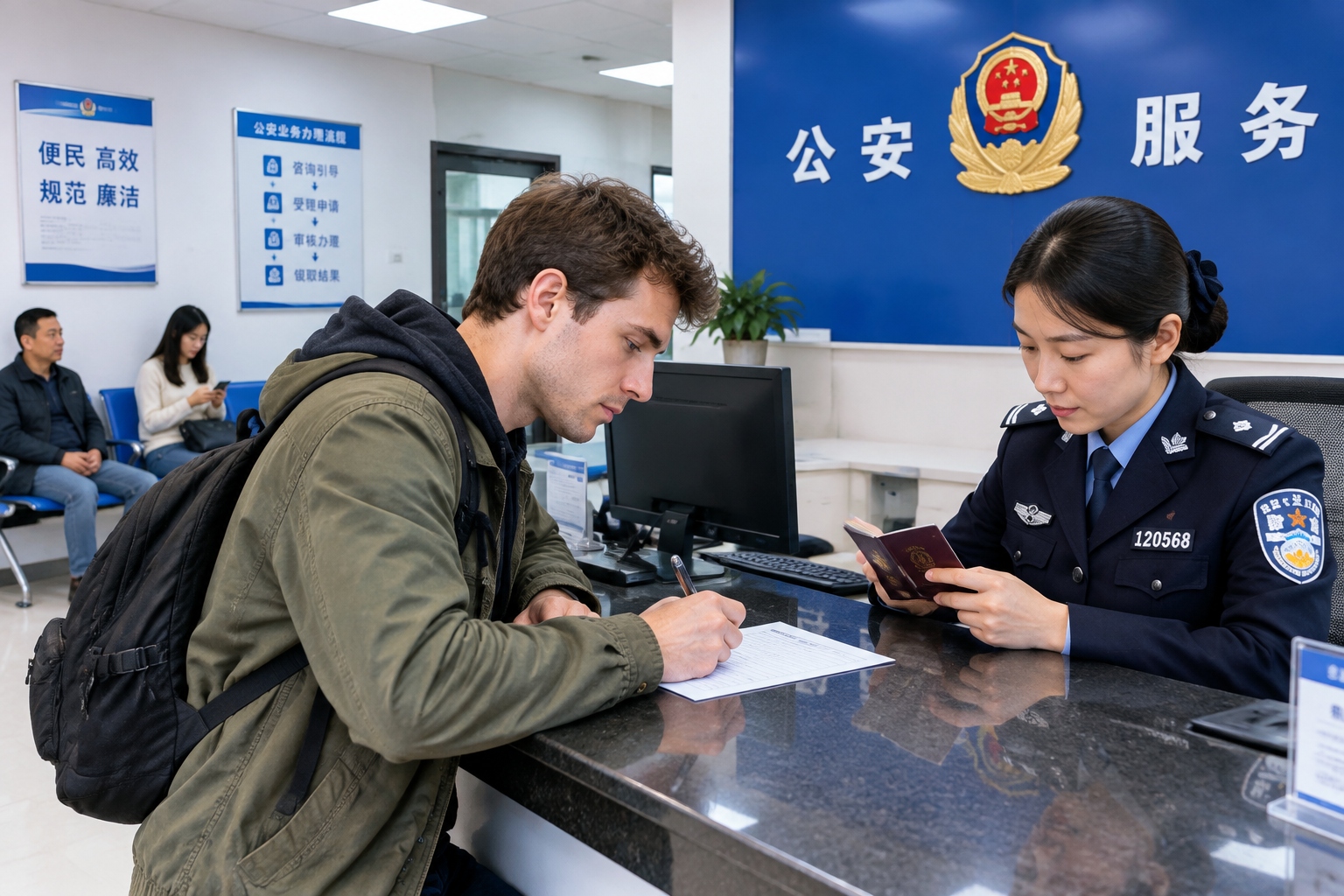
Stay in a hotel and the hotel does this for you. Stay in an apartment, a friend’s home or a short-term rental, and you are required to register at the local police station within 24 hours of arriving. The rule applies in most cities, though enforcement varies and some places are looser in practice. Bring your passport plus the host’s ID or property document, fill in a short form, and you are usually out in fifteen minutes. Skip it and you can be fined up to 2,000 yuan, and in rare cases asked to leave.
2. Carry your passport
Officially you should have it with you. In practice, checks of foreign pedestrians are uncommon outside border regions and a few sensitive areas, but “uncommon” is not “never,” and a scanned photo on your phone is not a substitute for the document.
3. Hotel eligibility has loosened
For years, plenty of smaller Chinese hotels simply refused foreign guests because their license didn’t cover it. Since 2023 and 2024, several provinces and cities have pushed hotels to accept foreign passports, and refusals have dropped noticeably. They haven’t disappeared everywhere, especially in smaller towns. Booking through a major international platform usually sidesteps the problem.
One thing no longer exists: the health code. The QR system that tracked movement during COVID-19 was switched off in December 2022, and the last border restrictions lifted on January 8, 2023. For a lot of Western commentary, that app was evidence of a control state. It is gone, and the country didn’t fall apart.
What Two Weeks in China Actually Feels Like

The details visitors repeat to friends back home are small and domestic. Women jogging at 5:30 a.m. in city parks. Seven-year-olds riding the bus to school alone. Packages stacked in an apartment lobby for hours without anyone taking them. A phone left charging on a table while its owner queues for noodles. Loudspeakers announcing air quality and lost-property notices. Two neighbors arguing, talked down by a neighborhood committee member in a cardigan.
Several American and European YouTubers who document long stays, from Shenzhen to Chongqing, land on the same word, and it isn’t “surveillance.” It’s “safe.” That word is doing real work: it describes something Americans notice missing from their own lives, and it explains why a visitor’s conclusion can sound jarring to people who have only read about China.
It is also an incomplete word. Safety from street crime and safety from political consequence are two different products. China supplies a great deal of the first, and very little of the second to certain categories of people.
Practical Notes If You’re Going
Emergency numbers: 110 for police, 120 for an ambulance, 119 for fire. English-speaking operators exist in big cities but are not guaranteed; asking a hotel front desk to call for you is faster.
Payments: Alipay and WeChat Pay both accept foreign cards now, and setting either up takes about ten minutes. Cash remains legal tender and shops must accept it, but plenty of small vendors will look at a 100-yuan note the way an American barista looks at a check.
Internet: Google, Instagram, WhatsApp and most Western news sites need a VPN, which you should install and test before you arrive. Hotel Wi-Fi works under the same rules as everywhere else.
Time: add five minutes for subway screening and ten for a large railway station.
Why the Label Sticks Anyway
The “police state” frame is older than the current government and travels well in headlines. It answers a question Western audiences ask — is China free? — with a word that collapses several different things into one. Political expression in China is genuinely constrained; independent journalism, organized protest and open opposition carry real costs. That is true and worth saying plainly.
What isn’t true is that daily life bends around fear of uniformed men. Dan flew home from Chengdu and put it to his brother this way: “I never once felt like anyone was watching me. I also wouldn’t want to be an investigative reporter there.” Both halves of that sentence are the story. Readers who can hold them at the same time will understand the country better than any label allows.
Start the discussion at forum.chinacomes.com