


A Tower That Should Be a Ruin — But Isn’t
The sun was already low when I first saw the watchtowers of Taoping Qiang Village in Aba, Sichuan. Six stone structures rose from the hillside like chess pieces, their walls made of river stones and yellow earth, their narrow windows looking out over the valley. I had read that these towers were built for defense and were hundreds of years old. So when I eventually walked closer, I was surprised to see a small string of café lights hanging from one tower’s windows, and a young host standing by a low wooden door with a smartphone in his hand.
“Another empty tower?” I asked, half joking. He smiled. “Full for tonight. Only one room left, but it’s the round tower on top.”
Inside, the contrast was sharp. The ancient stone walls were still there, rough and uneven, but the floors were heated, the bathroom had a rain shower, and a small kettle brewed mint tea. In the corner, a group of travelers was sketching the mountains through a tall glass window. This wasn’t a museum piece. It was a home.
What Are Qiang Watchtowers?
To understand how extraordinary it is to stay inside a watchtower, you need to know what these buildings were made for. The Qiang are one of China’s oldest ethnic groups, living in the steep valleys of the upper Min River in western Sichuan, along the eastern edge of the Tibetan Plateau. For centuries, they built clusters of stone houses that double as fortresses. The watchtowers, often called “diaolou,” were typically built between 60 and 200 years ago, though some foundations date back much further.
Built entirely from stone, clay, and timber, a traditional diaolou stands anywhere from 20 to 40 meters tall. Walls are slightly sloping, narrowing near the top, which gives them stability during earthquakes. Inside, wooden floors divide the tower into levels, connected by narrow ladders or steep internal stairs. Small windows, wider inside than outside, served as shooting slits and missile points during attacks. Some towers were part of a larger house; others stood alone as watchposts. In times of trouble, villagers would retreat inside with grain, water, and livestock.
The heritage value is high. In 2007, Taoping’s ensemble of watchtowers and old houses was added to China’s tentative list for UNESCO World Heritage status. Many individual towers are also provincial-level protected buildings. But protection doesn’t mean freezing them in time. After the 2008 Wenchuan earthquake damaged some towers, restoration became a priority. And that’s when a new idea started to take hold: why not let people live in history, rather than merely look at it?
From Battlements to Bedrooms
The conversion of old military buildings into tourist stays isn’t new. In Europe, castles and monasteries have been welcoming guests for decades. But in mountain communities of western Sichuan, the trend is younger and smaller. Around 2015, a few pioneer families whose grandparents had lived in these towers began to experiment with simple homestays. They kept the outer walls and the general floor plan, but added electricity, heating, modern bathrooms, and Wi-Fi. Instead of hiding history, they made it visible: exposed stone, old wooden beams, and the original arrow-slit windows fitted with glass blocks.
Today, a kind of “watchtower homestay” has developed. In Taoping Qiang Village and nearby villages such as Zandang Tribute Village, more than a dozen old towers now host guests, offer meals, and sometimes have a café on the ground floor. One owner I met, a Qiang woman in her mid-30s, told me that her family had lived in the same tower for five generations. “When I was little, my grandmother kept pigs on the ground floor. Now we serve coffee there.” She laughed. “The walls are the same. The lamps are new.”
Not every tower is open for business, of course. A few still function as storage space. Others are simply uninhabitable without massive renovation. But the ones that did make the switch are surprisingly popular, especially among domestic travelers looking for a weekend escape from city life.
A Night Inside the Stones
Spending a night in a converted watchtower isn’t the same as staying in a regular hotel. The first thing you notice is the entrance, which is often less than head-high, forcing you to duck. The stairs are steep and narrow, more like a wooden ladder on rails. Bedrooms are on several floors, which means you might climb three or four levels to your room. The interior is a maze of small rooms, thick walls, and a ceiling that slopes inward. You feel like you’ve stepped into a giant beehive.
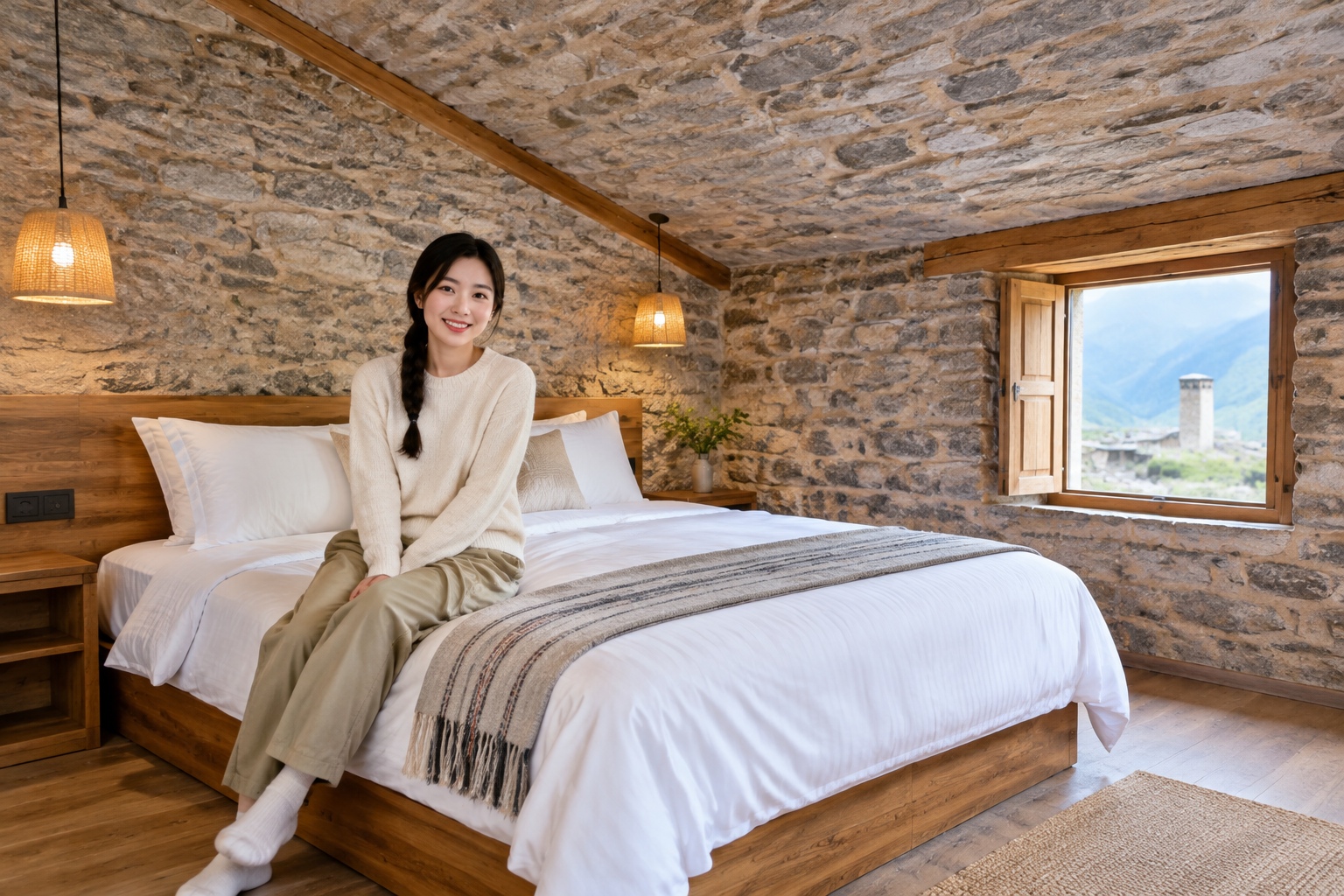
But there’s a payoff. Stone holds an even temperature, so the rooms are cool in summer and warm in winter, which matters when the sun disappears behind the mountains early. At dusk, you can climb to the small flat rooftop that sits just below the top of the tower. From there, the whole village unfolds like a fan: terraced fields, old tiled roofs, green pines, and on a clear day, the snowy peaks of the Qionglai Mountains.
“It’s like sleeping in a real castle,” said a traveler from Beijing who was staying on the same floor as me. “But without the drafts and creaky stairs.”
Small modern touches make the difference. The toilets are flush and warm after a rain shower. Underfloor heating hums quietly beneath the wooden boards. Wi-Fi works even in the thickest stone corner. Some hosts have plugged sensor lamps into the original wall niches that once housed fires and oil lamps.
Who Is Driving the Change?
The transformation isn’t just about tourism. In many villages, the population had been shrinking as young people moved to Chengdu or other cities for work. A homestay creates local jobs and gives some families a reason to stay. Hosts insist on hiring local women to cook, hire younger villagers as guides, and buy food and blankets from neighbors.

There are challenges, too. Renovating a tower is expensive and requires careful work by masons who still know the traditional techniques. Many of the older houses need serious structural reinforcement. On the other hand, tourism can be volatile, and a quiet year like the pandemic may leave owners struggling. Still, most of the people I spoke with believed it was better to have the towers full of guests than empty and falling apart.
“If we don’t use them, they’ll become ruins,” said one local preservation officer. “If we use them carefully, the next generation will know what a real watchtower looks like.”
Practical Tips for Visiting
Here are a few things to know if you plan to see or stay in a Qiang watchtower:
- Location: Taoping Qiang Village is in Li County, Aba Prefecture, about a 3-hour drive from Chengdu. A few other villages, like Chaqiu Village in Danba County, also have converted watchtowers.
- Best season: Spring to autumn is pleasant; winter can be cold but snow-covered towers are beautiful.
- Book in advance: Only a small number of room are available, and they often sell out on weekends.
- Respect cultural practices: These towers are not just hotel props; some still serve as homes or are used for traditional ceremonies. Don’t enter locked areas without permission.
What Yesterday’s Defenses Say About Today’s China
Standing on a watchtower roof in the evening, it’s easy to think about all the changes sweeping through China’s countryside. Highways now reach remote valleys. Mobile payment works in small village shops. A construction crew from the city can repair an ancient wall using modern materials, yet retain its original form. And young people who used to leave their villages for the city are now coming back with ideas to share.
That doesn’t mean rural China is a perfect picture. Some villages still struggle with depopulation, and the balance between tourism and preservation is delicate. But the stone towers of Aba have found a new life, as homes, meeting places, and windows onto the past. Behind the thick earthen walls, travelers sip coffee, make new friends, and wake up to a view that has stayed largely unchanged for centuries. The towers were built to keep people out. Now they open their doors to welcome the world in.
Start the discussion at forum.chinacomes.com