

One farmer, one field
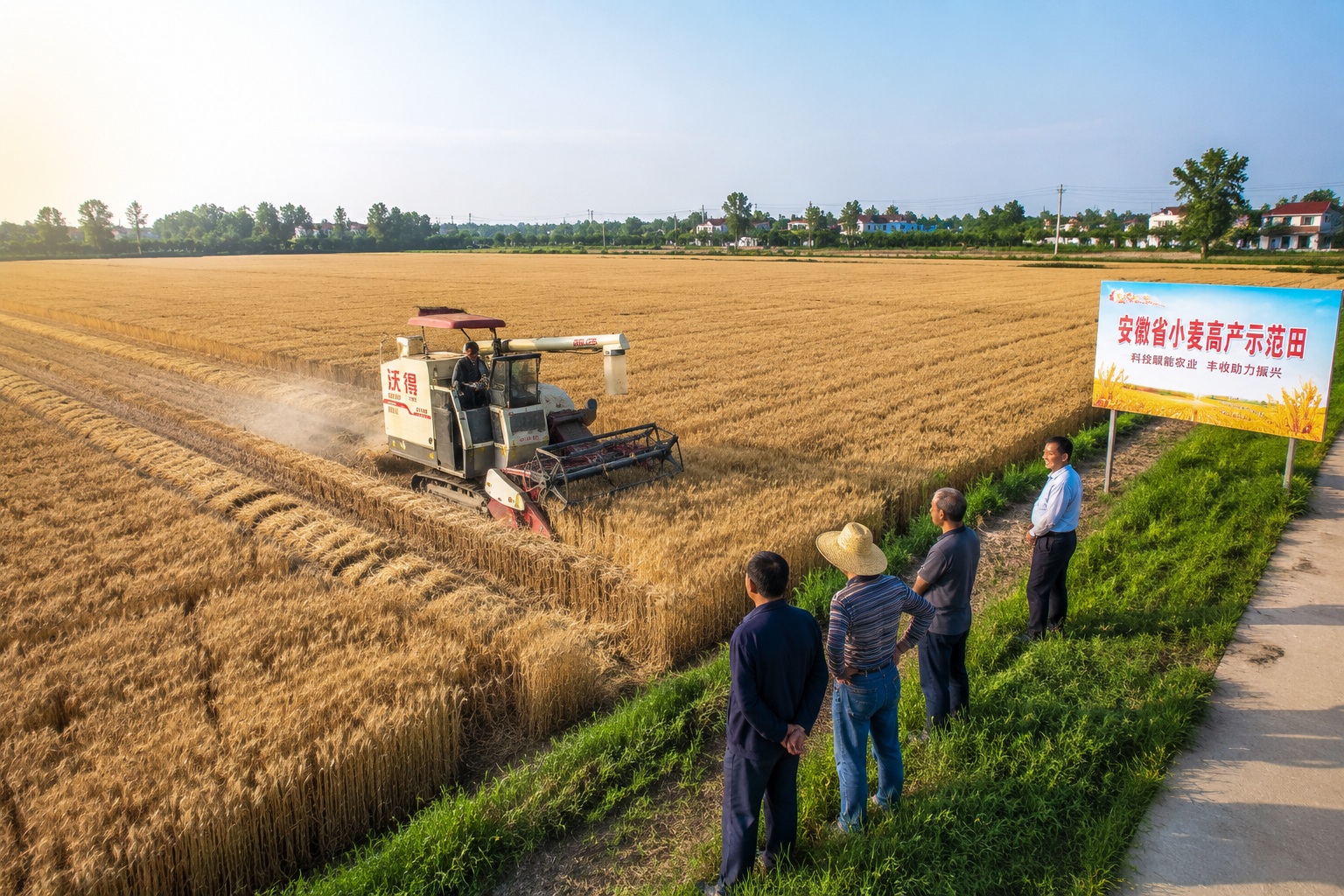
Wang Jianguo, a 58-year-old farmer from Mengcheng County, Anhui, used to tend nine separate plots of land, some so small they could barely fit a hand tractor. “I spent hours just walking between them,” he recalls. Today, Wang works one large field of 15 mu (about 2.5 acres). His wheat and soybeans are sown and harvested by machines. He spends fewer days in the field and earns more money. Wang is part of a growing experiment across Anhui called “xiao tian bian da tian” — turning small fields into big fields.
Why were Chinese fields so small in the first place?
To understand this, you need to revisit the early 1980s. After rural reforms, each village distributed farmland to households based on family size, soil quality, and distance to water. Everyone got a little bit of everything — a good plot here, a distant one there. This ensured fairness but created fragmented farms. The average farmer might own half a hectare split into seven or eight pieces. Such tiny plots are hard to farm efficiently, and as younger workers moved to cities, many fields lay idle.
For overseas readers, it helps to know that in China, land is collectively owned by villages, but households hold long-term contract rights. So the consolidation we’re talking about isn’t about privatizing land. It’s about re-arranging the physical plots while keeping each household’s total area and contract rights unchanged.
What exactly is “small fields to big fields”?
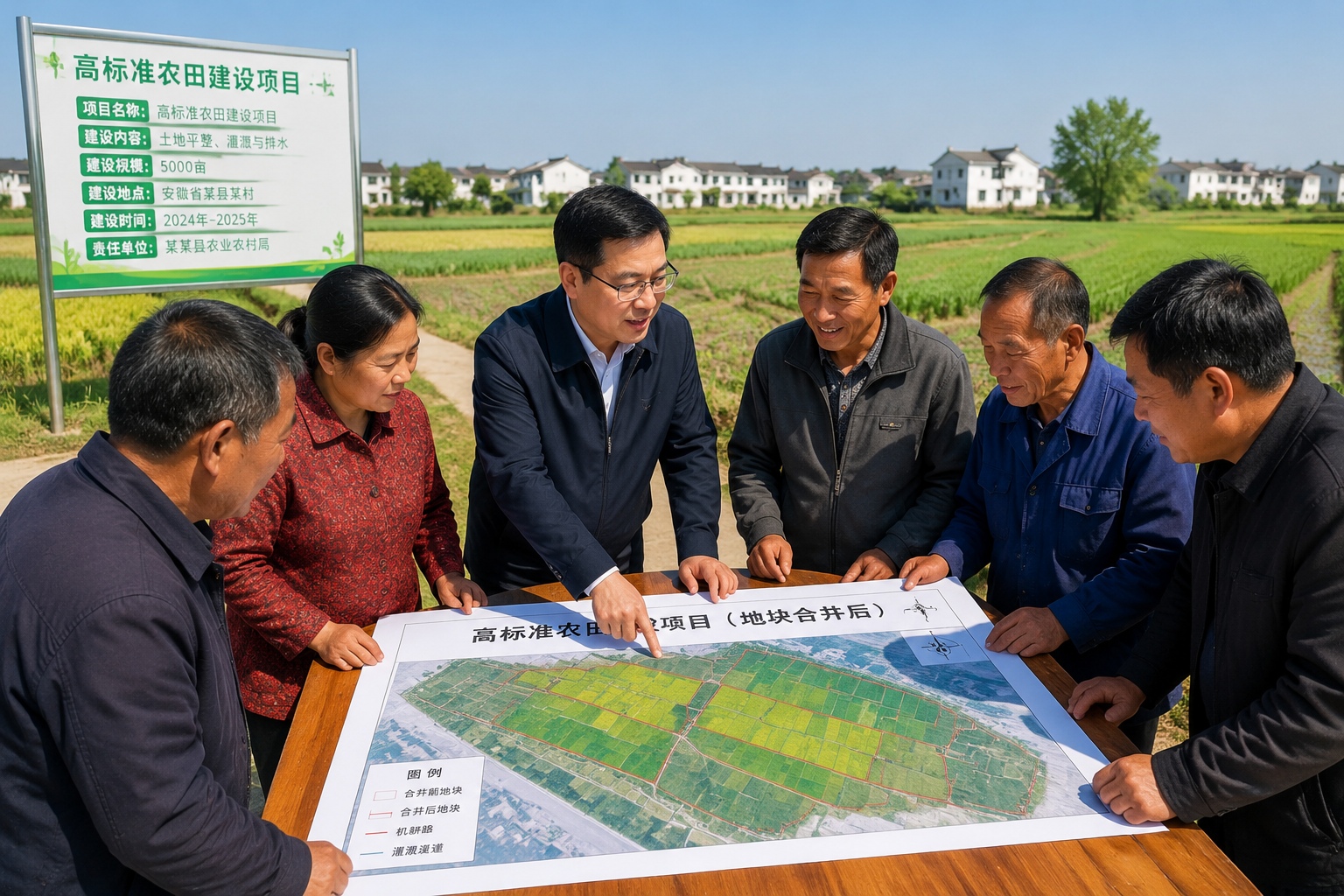
Anhui started piloting land consolidation around 2019, especially on the North China Plain. Local governments work with villages to re-divide the land. Instead of holding several small plots, each household receives one consolidated parcel of equivalent total area. This involves measuring, leveling, and digging new irrigation channels. The total arable land often increases by 5-10% because field ridges and unused borders are reclaimed. Farmers keep their land rights, but the physical shape changes.
Take Huaiyuan County, one of the earlier pilots. In Xujiang Village, farmers owned an average of 6.7 mu, spread across 4.8 plots. After reorganization, most families got a single plot of the same size. Village head Li Guoqiang says the time spent moving between fields dropped from nearly two hours to under ten minutes. “It changed everything,” he said in a local interview.
How consolidation lifts income
The benefits show up quickly in a farmer’s wallet. Let’s break down the main ways:
More usable land
Every boundary between small fields requires a ridge, a ditch, or a path. When you merge them, these useless bits are reclaimed. In many Anhui villages, this adds 5% to 10% more planting area. For a family with 10 mu, that’s like getting an extra mu of free land.
Machinery becomes practical
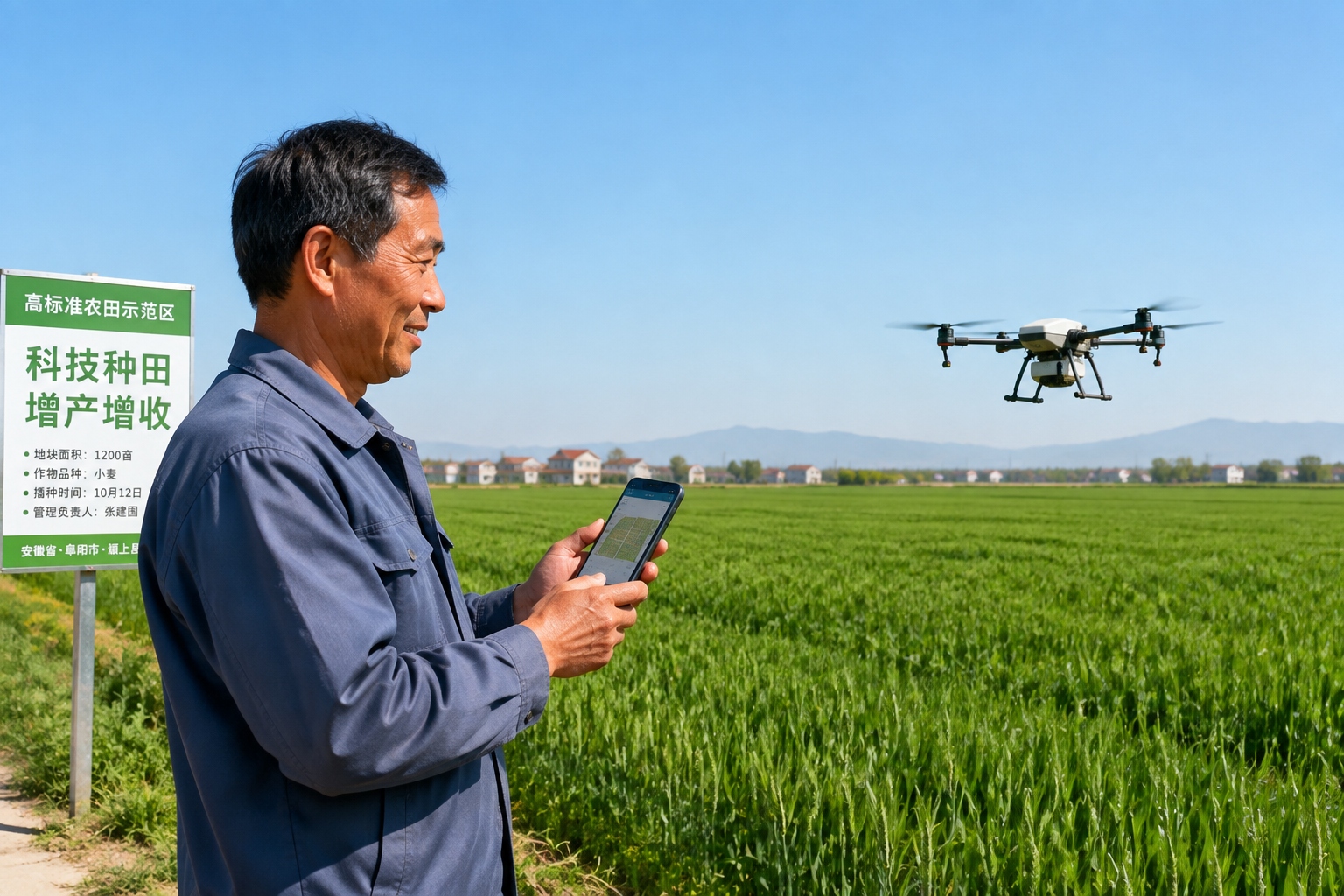
Large equipment — combine harvesters, seeders, no-till planters — cannot operate efficiently on a half-acre strip. But on a 10- or 20-acre field, they shine. In Fengyang County, a village cooperative now uses a drone to spray pesticides. Before, hand spraying took a full day per mu. The drone covers 10 mu in twenty minutes. The cost per mu falls by more than half.
Lower input costs
Large fields allow farmers to buy seeds, fertilizer, and other supplies in bulk. Cooperatives often negotiate discounts of 10-20% from suppliers. Fuel and labor costs per mu also drop because machines work faster over unbroken land.
New income streams
Consolidated land is easier to rent out. Many farmers in Anhui now lease their fields to large cooperatives or agribusinesses. They receive yearly rent plus a share of profits if the business does well. Others both rent out their land and work on the same fields as seasonal laborers. A study by Anhui Agricultural University found that in pilot villages, per-mu net income rose by 20-30% after consolidation.
What about farmers who hesitate?
Not everyone jumps in immediately. Some elderly farmers worry that swapping plots means losing the land they’ve walked for decades. A 70-year-old in Bengbu refused at first, afraid her patch near the road was better. But the village committee surveyed soil quality and promised her a comparable plot closer to home. After one season, she was pleased: the new plot had better water access, and a neighbor’s tractor could reach it easily.
The policy is strictly voluntary. Villages don’t force anyone. If a household doesn’t want to join, they are allowed to keep their original plots that are left out of the consolidation plan. In practice, fewer than 5% of families decline, often because their plots are already large enough.
Limits and challenges
This isn’t a magic cure-all. In mountainous parts of southern Anhui, terraces are too narrow and isolated to merge. There, farmers rely on tea gardens, bamboo forests, and other high-value crops instead. Even in flat areas, consolidation requires upfront investment in land leveling and irrigation. The government provides some subsidies, but village committees must often persuade people to pool savings or apply for low-interest loans.
Another issue is that bigger plots alone don’t guarantee success. Without good access to markets, storage facilities, or post-harvest processing, farmers may still struggle. Anhui is addressing this by pairing consolidation with “high-standard farmland” projects, which include better roads, irrigation, and electricity lines. The idea is to build an entire modern farming base, not just rearrange the land.
What this means beyond Anhui
“Small fields to big fields” is part of a national strategy to modernize China’s agriculture while keeping land collective. Similar pilots are running in Jiangsu, Shandong, Henan, and other provinces. The goal is not to turn China into huge private ranches. Instead, it’s to help smallholders pool their resources voluntarily, so they can use modern tools that were previously out of reach.
For farmers like Wang Jianguo, the change is deeply personal. “I used to worry about where my land was and who might step on it. Now I worry about the weather, just like a farmer should,” he laughs. That shift — from worrying about land boundaries to worrying about growing crops — is perhaps the real dividend of this reform.
The numbers matter, but so does the daily experience. A farmer who once spent hours walking to distant strips now takes a slow stroll around one field with a smartphone in hand, controlling irrigation remotely. Agriculture in China is not Hollywood’s version of ancient oxen and plows. It is a real, ongoing transformation, one field at a time.
Start the discussion at forum.chinacomes.com