

A 6:40 a.m. Stop Beside the Fifth Ring Road
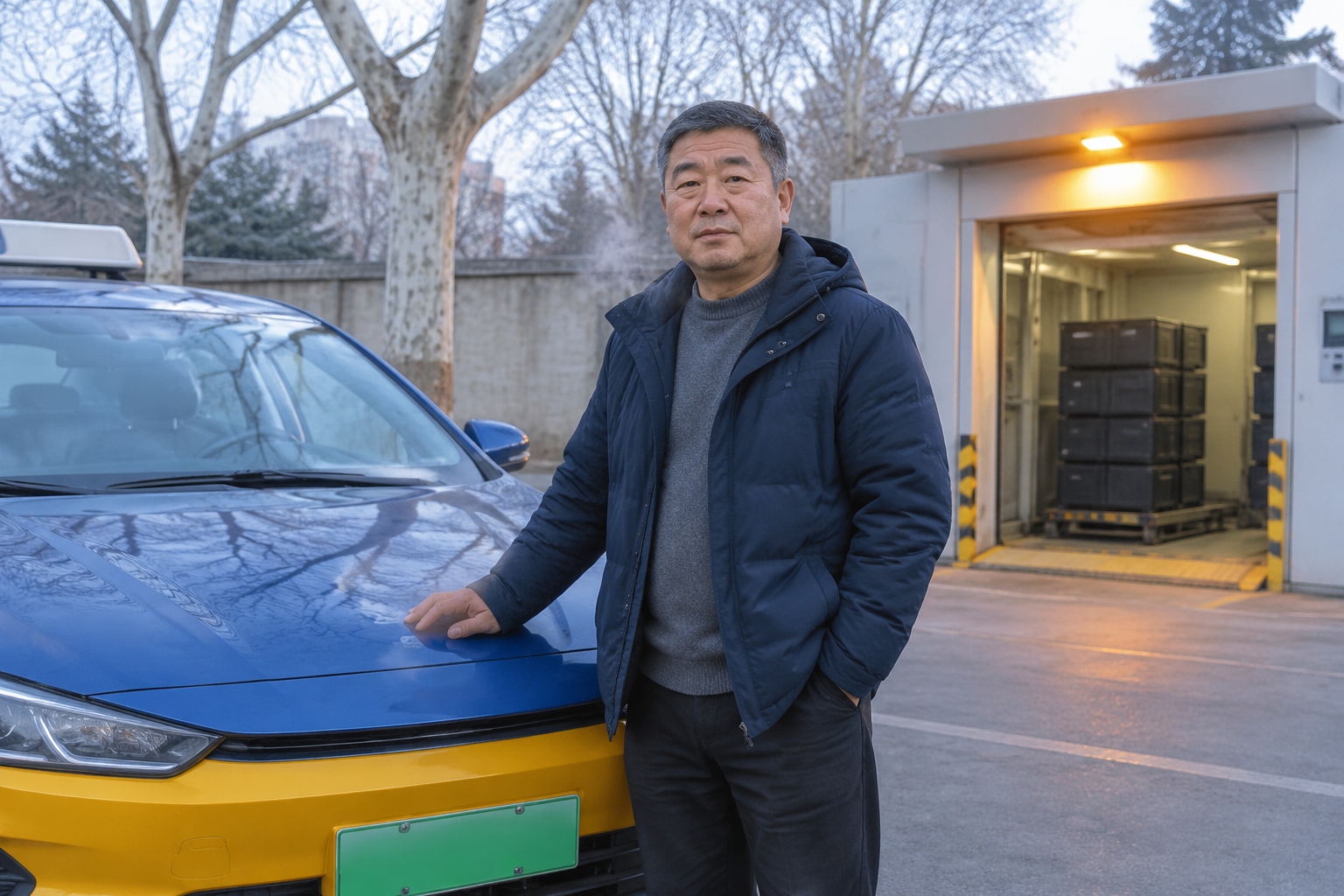
The taxi leaves the road just after 6:40 a.m., when the sky over eastern Beijing is still the colour of wet concrete. It is a blue-and-yellow cab of the kind that has worked these streets for decades, with one visible difference: a green licence plate, and the fact that the car is about to lose its battery.
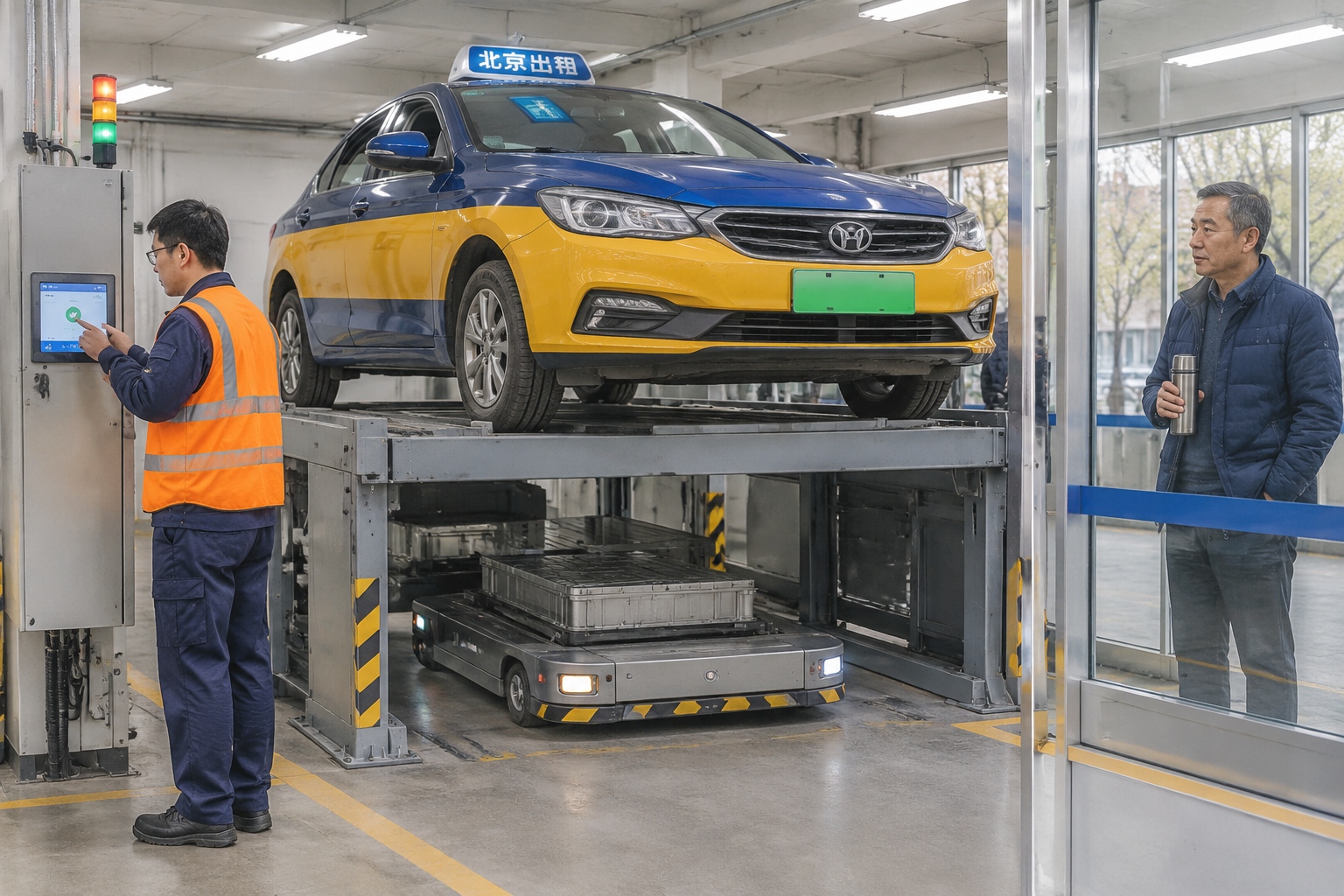
The driver, a man in his fifties in a navy padded jacket, pulls onto a steel platform beside a low building. A machine lifts the car, drops the drained pack out of its floor, slides in a charged one and tightens the bolts. Four minutes later he is back on the road with a paper cup of hot water and nothing to sign.
This scene is assembled from what drivers and station staff describe as a routine morning; the numbers below come from published municipal and industry data. The point of starting here is that Beijing’s energy transition is not usually visible as policy. It is visible as a man on a platform at dawn, doing arithmetic in his head.
Why There Are So Many Green Plates
Visitors notice the plates first. China introduced green plates for new-energy vehicles nationally in 2016 and 2017, and in Beijing they have become ordinary rather than exotic: on a normal weekday morning, electric cars are no longer a novelty in the traffic flow, they are the traffic flow. The city’s electric fleet has grown from a few tens of thousands a decade ago to well over 800,000.
Three forces pushed that number up, and none of them is mysterious.
The first is air. Beijing’s PM2.5 concentration fell from nearly 90 micrograms per cubic metre in 2013 to roughly 30 in recent years, and transport was a large part of the earlier problem. City buses were electrified first, then taxis, then delivery vans. More than 10,000 of Beijing’s city buses now run on batteries.
The second is the licence plate. Beijing caps new vehicle registrations and rations most of the quota to electric cars. Waiting for a petrol plate can take years; the electric queue is long but it moves. For a family that needs a car, the practical answer is a charging cable.
The third is cost. Electricity is cheaper than petrol per kilometre, and the gap widens for anyone who can charge at home overnight on off-peak rates.
A Taxi Driver’s Day, Measured in Kilometres and Yuan
An electric taxi in Beijing does roughly 250 to 350 kilometres a day, which is close to the edge of what a mid-priced battery will deliver in winter. Drivers talk about three numbers: how long a charge takes, what it costs, and what the range does when the temperature drops to minus eight.
On range, the honest answer is that cold weather costs you. Below freezing, most drivers expect 20 to 35 per cent less range than the official figure, more if they run the heater hard. Experienced drivers plan around it the way earlier generations planned around petrol stations in the countryside: they do not let the battery go below a certain level, and they know which stations have queues at which hours.
On money, drivers put a day’s energy bill somewhere between 80 and 130 yuan, against two to three times that for petrol, depending on whether they are on a swap plan or charging themselves. That difference is why so many of them switched without sentimentality. A taxi is a business with a meter on it.
On time, this is where swapping beats charging. Fast charging to 80 per cent takes 30 to 45 minutes in good conditions. For a driver on a twelve-hour shift, half an hour is real money. Swapping takes four to six minutes.
The Charging Map: Courtyards, Malls and Motorway Service Areas
Beijing has installed roughly 300,000 charging points, scattered across a geography that is not designed for them. The easy ones are in shopping centre car parks and office basements, where the wiring was already thick. The hard ones are in the old residential compounds built in the 1980s and 1990s, where parking was never assigned, the electricity supply was sized for lifts and air conditioners, and nobody wants a cable running past their window.
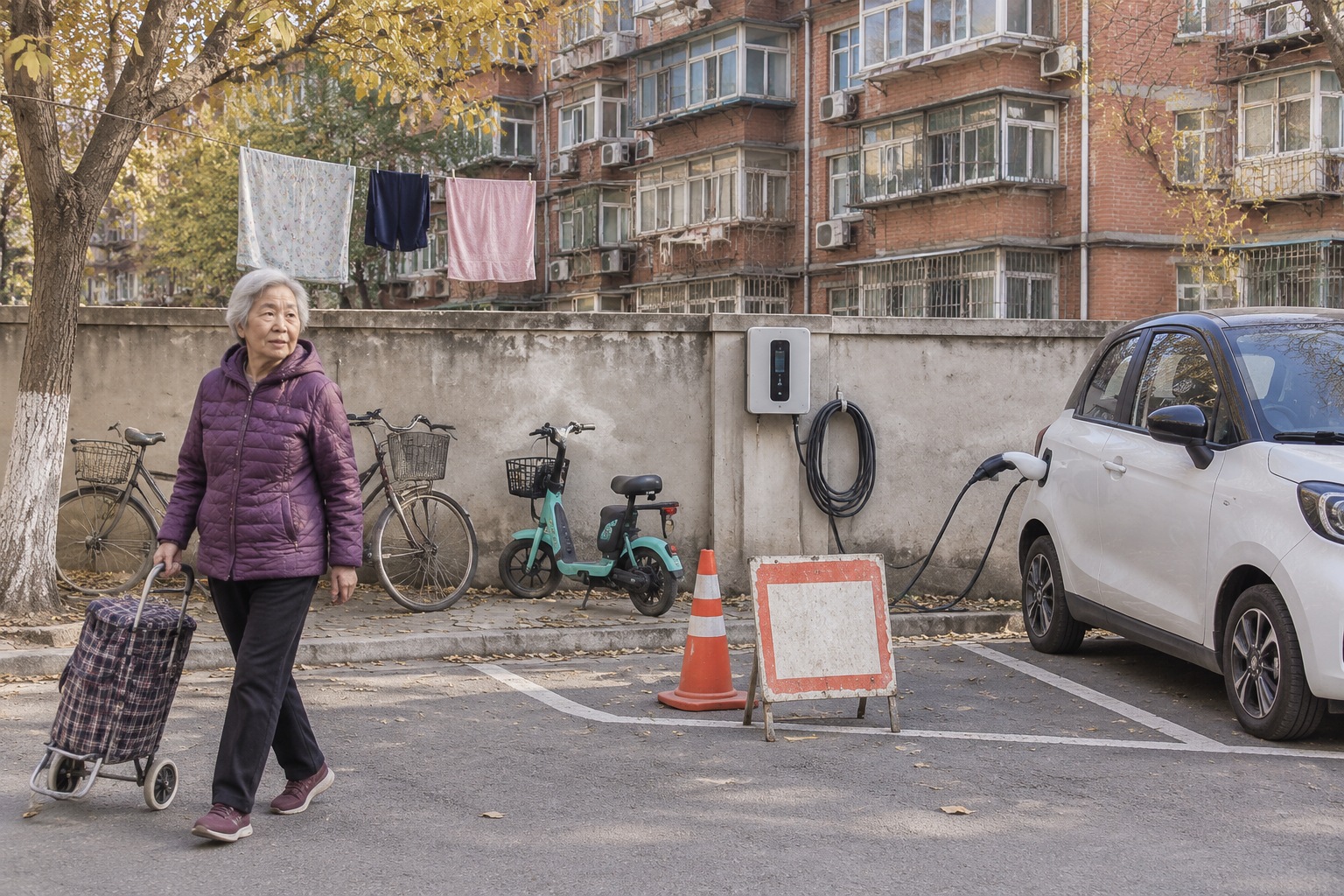
In those compounds, charging becomes a small social negotiation. Residents apply for a private charger, the property management company worries about load, and the neighbourhood committee tries to find a compromise: a shared row of slow chargers, a reserved bay with a cone in it, a rule that a charged car should move within two hours.
Payment is the easy part. Almost everything runs through two or three apps that show the nearest free connector, the price per kilowatt-hour and whether the parking fee is waived. The parking fee is the detail that catches people out: a charger can be cheap and the bay expensive, and drivers learn to read both numbers.
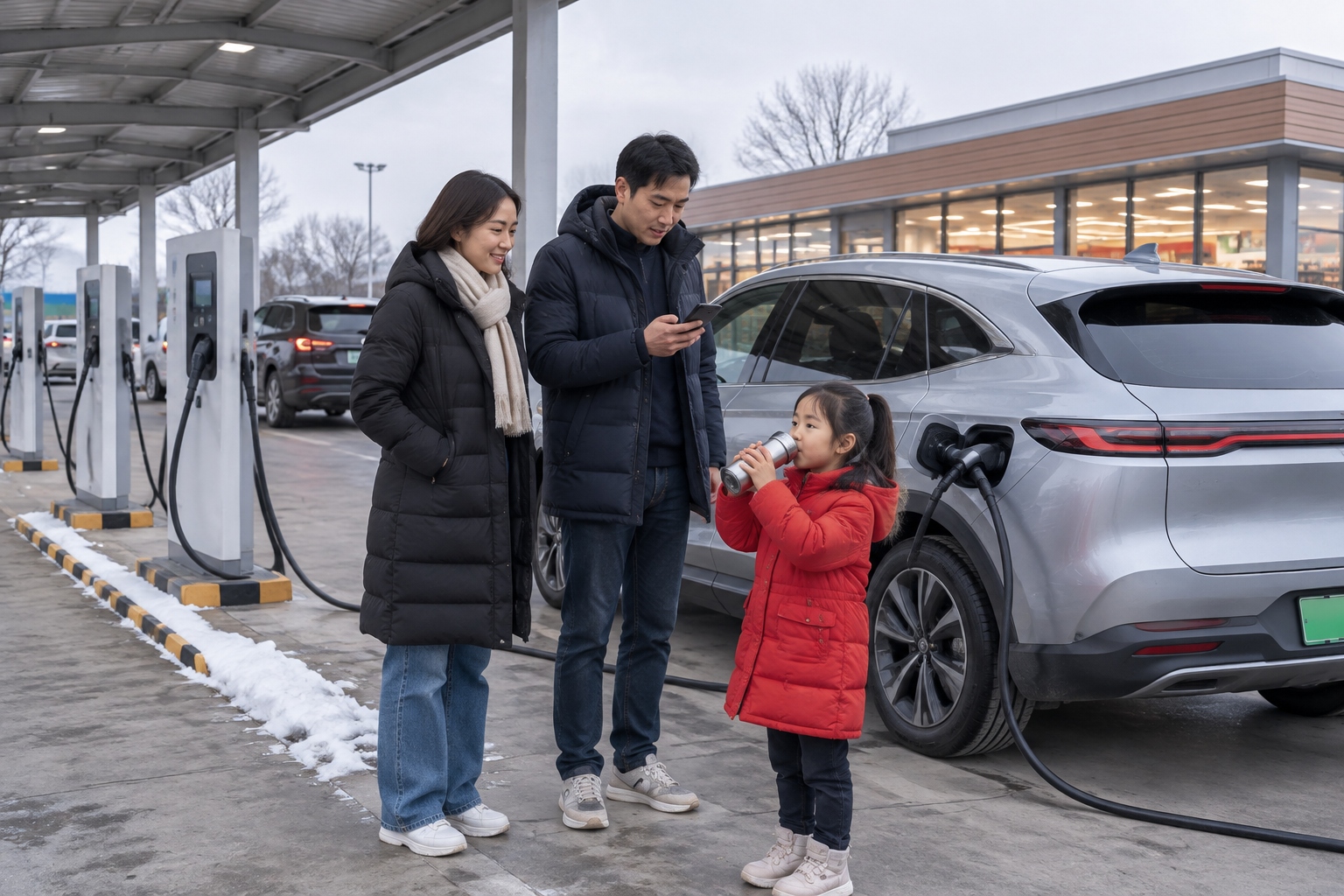
Out on the motorway, the service areas along the Jingjiazang and Jinghu expressways now have rows of fast chargers. On a holiday weekend the queue is real, and drivers treat the stop the way they once treated a fuel stop plus a meal: charge the car, eat something, walk around for twenty minutes.
Four Minutes at a Swap Station
The Chinese term is che dian fen li, car and battery separated. It sounds technical, and it is simpler than it sounds.
You buy the car; you lease the battery. The battery lives in a pool operated by the carmaker, the taxi company or a third party. When it runs low, you exchange it for a full one at a station rather than waiting for it to fill. The battery’s health, its resale value and the risk of it degrading are somebody else’s problem.
This model was built for fleets first: taxis, ride-hailing cars, small delivery vans. A car that must be on the road for twelve hours a day cannot afford to sit still, and it also cannot afford to own a battery that will be nearly worthless in eight years. Swapping solves both problems at once.
Beijing now has a few hundred swap stations, clustered where fleets operate: near taxi ranks, ride-hailing depots and logistics parks, and along the ring roads. Inside, it looks less like a petrol station and more like an automated car wash with a very heavy robot in the floor. Drivers stay in the car. Staff in orange vests stand by, mostly to troubleshoot payment.
Beyond Cars: Buses, Trucks and the Corners They Change
The most effective electrification in Beijing is the part most visitors never notice. Buses, sanitation trucks and postal vans are heavy, noisy and run fixed routes, which makes them ideal: they return to a depot every night and can be charged while the city sleeps.
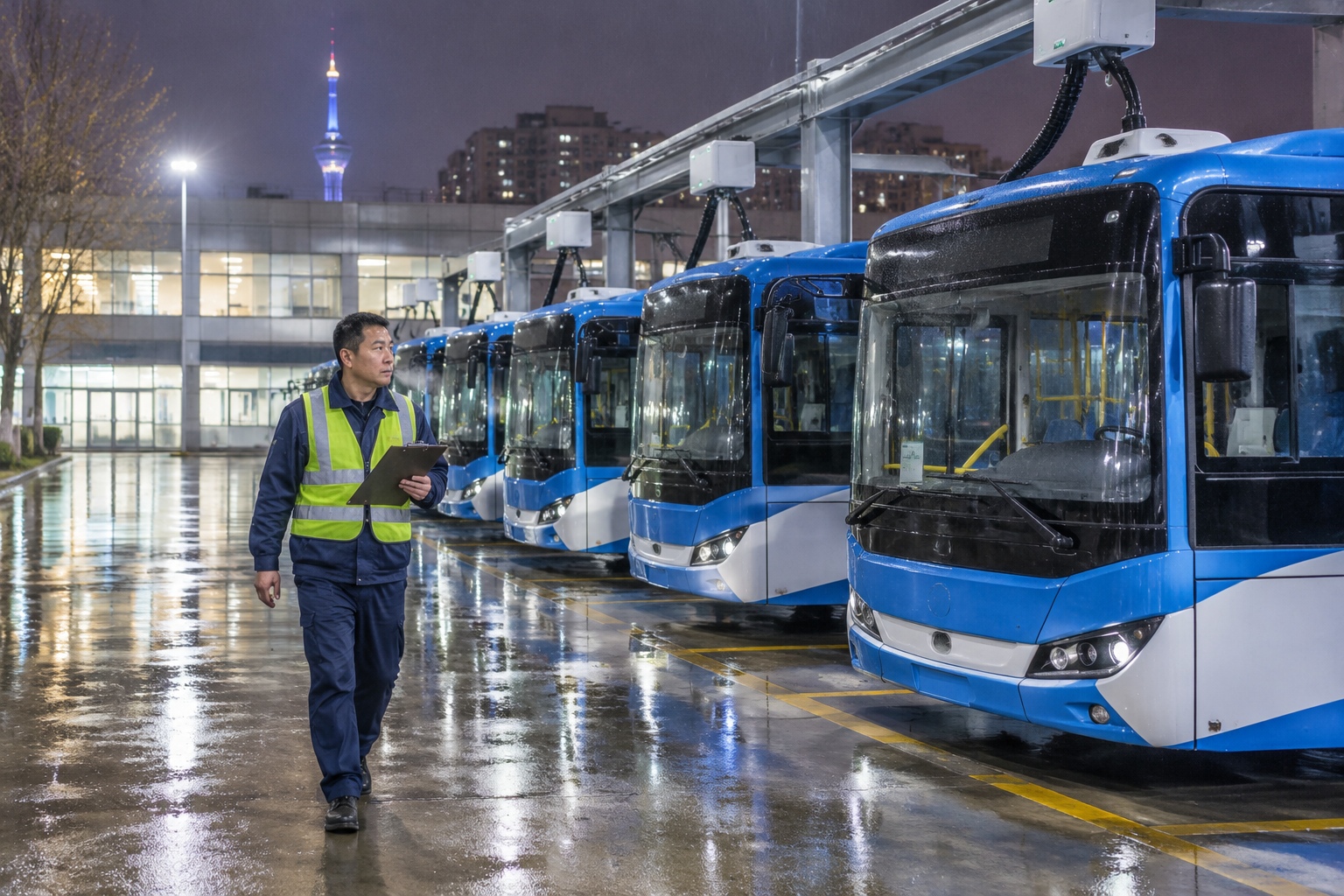
Those depots have been rebuilt around charging gantries, and the result is a small change in the sound of the city. A bus that idles quietly at a stop, a street sweeper that passes at 5 a.m. without waking the ground floor, a delivery van that no longer rattles the windows of a hutong courtyard — these are the effects residents actually register. Air quality is measured in official monitoring stations; noise is measured by whether you can sleep.
Charging has also moved into places that were previously purely petrol territory. Some filling stations have added a few fast chargers on the side. Car parks have reserved bays. Convenience stores attached to charging lots have discovered a new customer who has thirty minutes and nothing to do.
What Still Doesn’t Work
It would be dishonest to describe any of this as finished. Four problems come up repeatedly, from drivers, operators and residents.
Grid load is the biggest. A compound where thirty households install chargers is a different electrical animal from a compound where three do, and upgrading a local transformer is slow, expensive, and involves a utility, a property company and a residents’ committee agreeing on something.
Winter performance is the second. Range loss in the cold is real, and for drivers in the far suburbs it turns into genuine anxiety on the days when the temperature stays below minus ten and the heater is running.
Station economics is the third. Fast chargers are expensive to build, and their utilisation is uneven: crowded at 9 a.m. and empty at 2 p.m., busy on weekdays and dead on holidays. Operators make money on volume, and volume depends on fleets.
Battery recycling is the fourth. China requires retired packs to be tracked and sent to licensed recyclers, and a second-life industry exists for packs that are no longer good enough for a car but fine for storage. Regulated channels compete with informal ones that pay cash, and that tension has not been resolved.
What to Watch If You’re Comparing Cities
The useful comparison is not how many electric cars a city sells. It is what the city does with the ones it has.
Watch three things. First, whether fleets went electric before private cars did, because fleets are where the infrastructure pays for itself. Second, whether swapping and charging coexist, because a city that only bets on one of them will have a queue somewhere. Third, whether the boring details were solved: parking fees, transformer upgrades, the rules inside an old courtyard where nobody owns a parking space.
In Beijing, the green plate on a taxi at 6:40 a.m. is not a statement about the future. It is a working tool, with a driver inside who has already calculated what the next four hours will cost him. That is what a transition looks like when it stops being an argument and becomes a schedule.