

A Man in a Puffer Jacket, in July
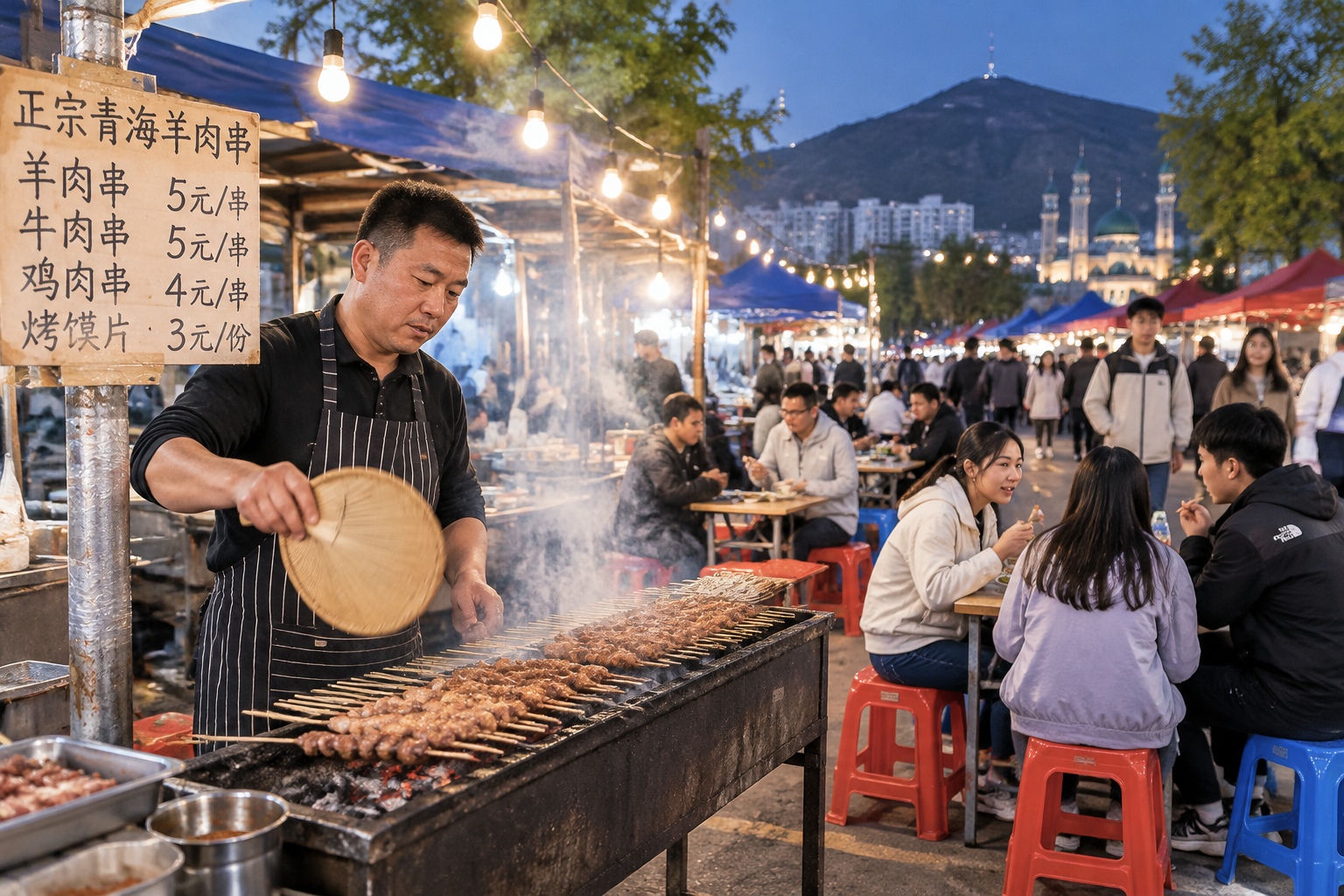
It’s 9:40 on a July evening in Xining, and the man at the next table is wearing a puffer jacket. He’s also holding a lamb skewer in one hand and scrolling his phone with the other. The skewer costs 4 yuan — roughly 55 US cents. The screen shows a payment QR code he’ll wave at the vendor, who stands three feet away behind a charcoal grill, fanning smoke into air cold enough to see your breath.
Xining sits at 2,260 meters on the northeastern edge of the Tibetan Plateau. July days are mild, around 25°C. After dark the temperature can fall below 10°C. So yes: down jackets at a summer night market. Nobody here finds that odd.
If you’ve never heard of Xining, that’s normal. It’s the capital of Qinghai province, in China’s far northwest, and for most foreign visitors it’s a one-night stopover on the way to Qinghai Lake, Chaka Salt Lake or the monasteries further south. The city gets a few tourist photos and not much attention.
That’s a mistake, and the reason has a Chinese name: yanhuo (烟火), literally “smoke and fire.”
What “Yanhuo” Actually Means
Chinese social media uses the word constantly — “this street has yanhuo,” “I miss the yanhuo of home.” It has nothing to do with pollution or fireworks. It means the audible, smellable warmth of a place where food is cooked outdoors, in public, at night, by people who live nearby. It’s the sound of a griddle, the smell of cumin hitting hot fat, strangers sharing a plastic table because there’s nowhere else to sit.
You can find it in Chengdu or Changsha. What makes Xining interesting is that the yanhuo here is cooked by four or five different cultures at once — and almost nobody photographs it, because almost no foreigner stays long enough to see it.
Xining Doesn’t Have One Night Market. It Has Several.
Ask a local where to eat at night and you won’t get one answer. You’ll get an argument.
Mojia Street (莫家街), a short walk from the city center, is the one printed in guidebooks: narrow, very bright, thick with the smell of chili oil and rendering lamb fat. Nearby Shuijing Xiang is smaller and more workaday. Xinghai Road, west of downtown, is where people actually go on a Tuesday night — fewer English signs, more families with children on scooters. And in the newer Hailu New District, a commercial block called Tangdao 637 runs a night market that looks built for social media: LED strips, craft beer, coffee carts — and, right at the edge, the same charcoal grills and plastic stools you’d find anywhere else.
The physical setup barely changes from stall to stall: foldable tables, red or blue plastic stools, a grill or a griddle, a string of bulbs, a hand-written price board taped to a pole.
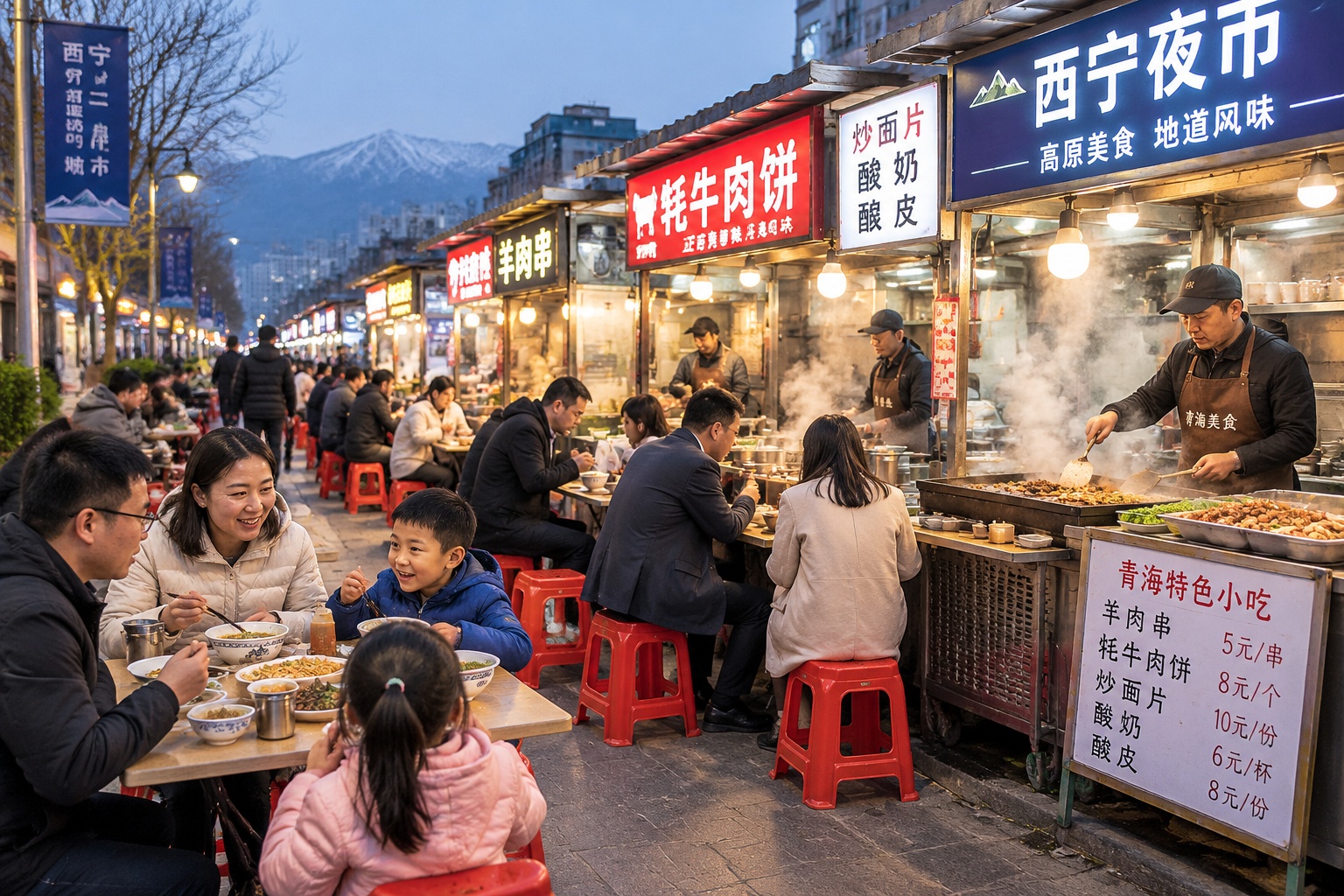
What changes is who shows up and when. Between 6 and 7 p.m. it’s office workers. From 8 p.m. it’s families. After 10 p.m. it belongs to students, delivery riders finishing a shift, and friends who haven’t seen each other in months.
The 10-Yuan Rule
Here’s the number that surprises visitors most: you can eat a full, genuinely good dinner for about 30 to 50 yuan — between four and seven US dollars.
A lamb skewer runs 3 to 5 yuan. A bowl of niangpi (cold starch noodles with chili oil, garlic water and vinegar) is 8 to 12. A ceramic bowl of yak yogurt, thick enough to hold a spoon upright, is 6 to 10. Hand-grabbed mutton — boiled, salted, eaten with your fingers and a dip of vinegar and chili — is usually sold by weight, around 70 to 90 yuan per jin (500 grams), and shared between three or four people. A bowl of Qinghai beef noodles, the provincial breakfast staple that also works fine at midnight, is 12 to 15.
Two people, three dishes, two drinks: comfortably under 100 yuan. That’s less than a single main course at a mid-range restaurant in Shanghai.
Why so cheap? Turnover, mostly. Stalls are usually family operations with one or two people cooking and a teenager or grandparent taking orders. Rents on side streets are low. Ingredients come from nearby — Haidong, Huangzhong, the Huangshui River valley — where vegetables and lamb are still bought at wholesale prices. Nobody is paying for a dining room, a host or a brand.
Who Is Actually Sitting at These Tables
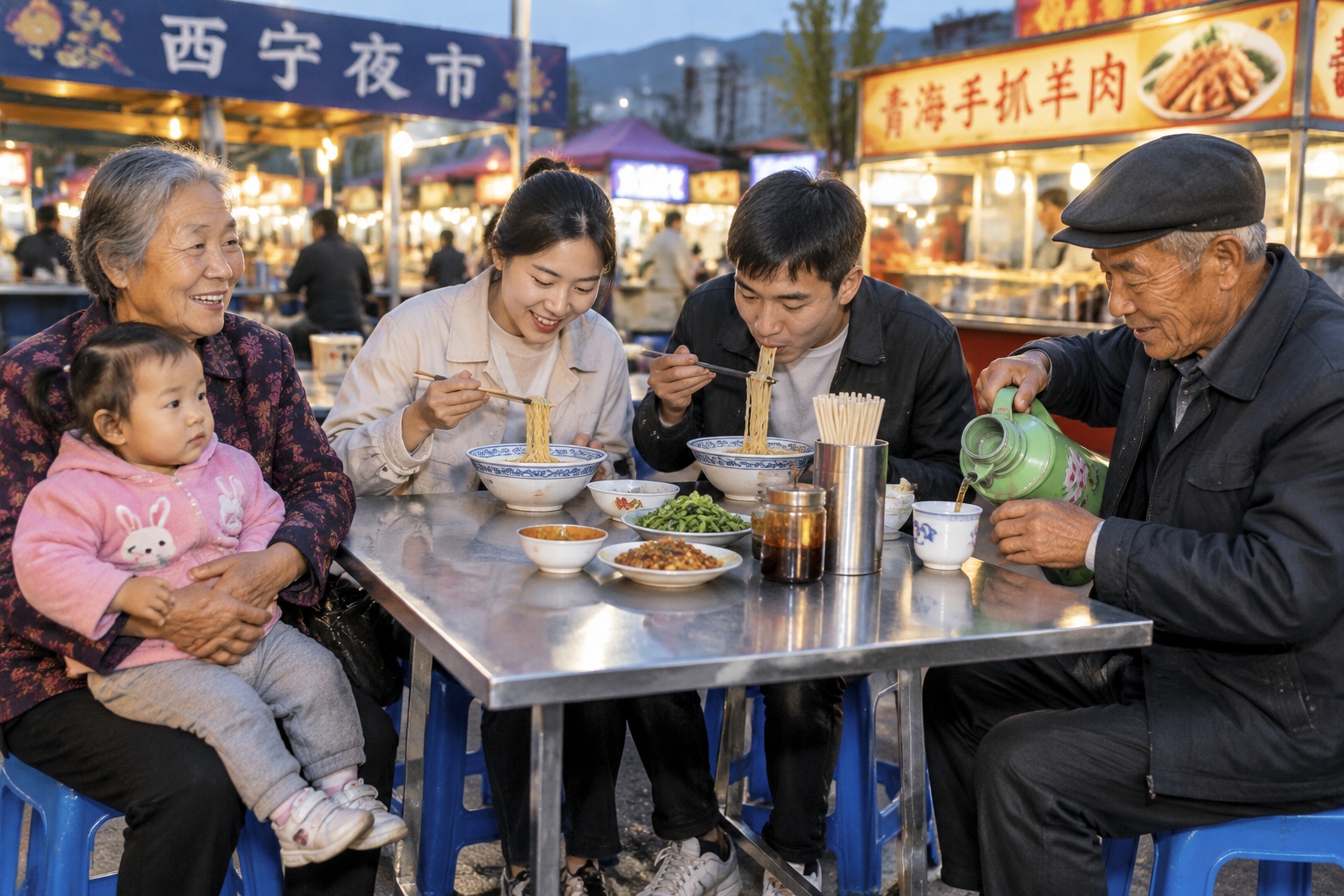
The mix is the point. On a single evening on Xinghai Road you’ll see a man in a company lanyard still around his neck, eating alone and answering messages; a grandmother holding a sleeping toddler while her daughter finishes a bowl of noodles; four university students from Qinghai University splitting a plate of skewers and arguing about who pays; two taxi drivers who’ve parked nearby and are giving each other a hard time about yesterday’s fares.
Unlike in Beijing or Shanghai, where nightlife often sorts people by income, Xining’s night markets keep everyone at the same table height. A doctor and a delivery rider sit two stools apart, eating the same thing, paying the same price. The Chinese term for this kind of place is qinmin — close to the people — but in practice it’s simpler than that: it’s cheap, it’s open late, and nobody is checking who you are.
You’ll also notice what isn’t happening. Almost no one is drinking heavily. Beer exists, but the default drink is tea — often ba bao cha, eight-treasure tea, with rock sugar, dried dates, raisins and a lump of wolfberry, endlessly refilled from a thermos. Night markets here are social spaces, not bars. They close earlier than you’d expect, usually between 11 p.m. and 1 a.m., because most people have work in the morning.
Four Kitchens on One Street
Qinghai is one of the most ethnically mixed provinces in China. In the 2020 census, ethnic minorities made up roughly half of the provincial population — Tibetan, Hui, Tu, Salar, Mongolian and others — and Xining is where all of that converges.
Practically, that means the food street is also a map. Hui stalls carry the green 清真 (halal) sign and sell beef and lamb skewers, lamb trotters braised in chili, and yangchang mian, noodles with lamb intestine. There’s no pork and no alcohol at those counters. A few meters away you’ll find Tibetan vendors with yak yogurt, yak jerky and butter tea, and Salar or Tu women selling tianpei — fermented barley or oats, served cold, faintly alcoholic, tasting like a cross between sweet rice wine and granola.
What strikes a visitor is how unremarkable the coexistence is. A Han family orders halal skewers, then walks ten steps for Tibetan yogurt with honey. Vendors borrow chairs from each other and share a thermos of tea. Older stallholders sometimes speak Qinghai dialect rather than standard Mandarin, and a customer might order in a mix of both, pointing at what they want. Nobody treats this as a cultural event. It’s just Tuesday.
For a traveler, this is the most useful thing about the night market: food is a shared vocabulary when languages aren’t. You point, you pay, you eat, and you’re part of the street within about ninety seconds.
QR Codes, E-Bikes, and an Old Habit
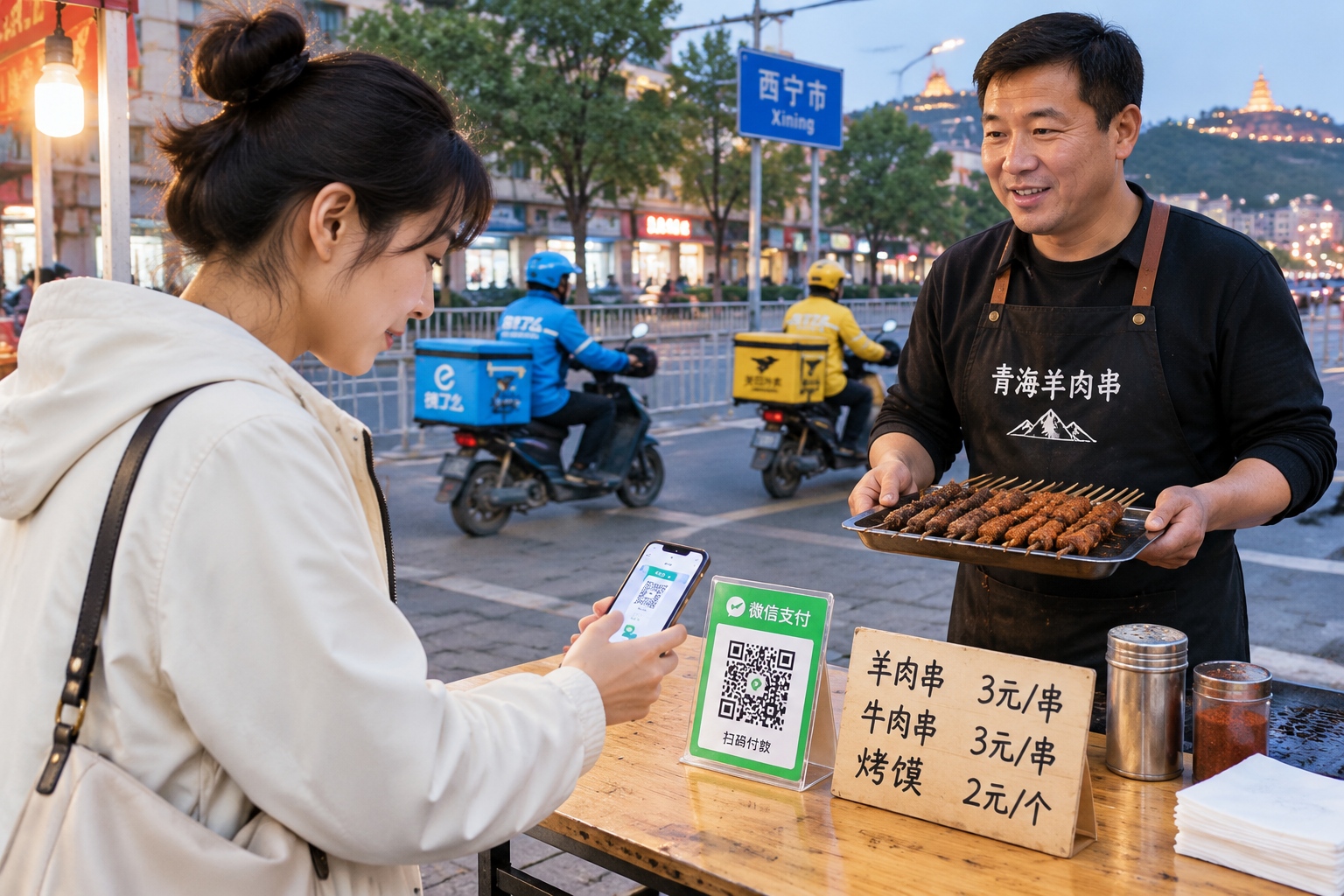
Modern life is fully present, and slightly surreal. Every stall, down to a 3-yuan skewer operation run by two people and a cooler box, has a laminated QR code taped to the table. Customers scan with WeChat Pay or Alipay. Coupons from group-buying apps like Meituan bring in a steady trickle of people who saw the stall on a phone before they saw it in person.
Delivery riders in blue and yellow jackets thread through the crowd on electric scooters, picking up orders for someone two kilometers away. A vendor with a ring light might be livestreaming his grill to a few hundred viewers. One stall sells yogurt the traditional way — in ceramic bowls, with a layer of yellow cream on top — and also sells it in sealed cups with a printed logo, because that’s what students photograph.
Two practical notes for foreign visitors. First, cash still works, though small bills help; some older vendors keep a metal box under the counter. Second, since 2023 both Alipay and WeChat Pay accept international cards, so you can set up mobile payment before you arrive and pay like everyone else. If you’d rather not, saying “cash?” while holding up a note generally gets a nod.
What to Order on Your First Night
Keep it simple and share everything.
Hand-grabbed mutton (手抓羊肉). Boiled with salt and almost nothing else, served with raw garlic and a vinegar-chili dip. This is the dish Qinghai people judge a restaurant by.
Lamb skewers (烤羊肉串). Cumin, chili powder, fat and lean alternating. Order ten. You’ll order ten more.
Yak yogurt (酸奶). Served in a shallow ceramic bowl, topped with a skin of yellow butterfat. Add sugar or honey; it’s tart.
Niangpi (酿皮). Cold, chewy starch noodles in chili oil, garlic water and vinegar. The cheapest thing on the table and often the best.
Tianpei (甜醅). Fermented barley or oats, served cold in a bowl of sweet liquid. Lightly alcoholic, closer to a dessert than a drink.
Noodles (尕面片 or 羊肠面). Small torn dough pieces in broth, or noodles with lamb intestine. Both are heavier and better than they sound.
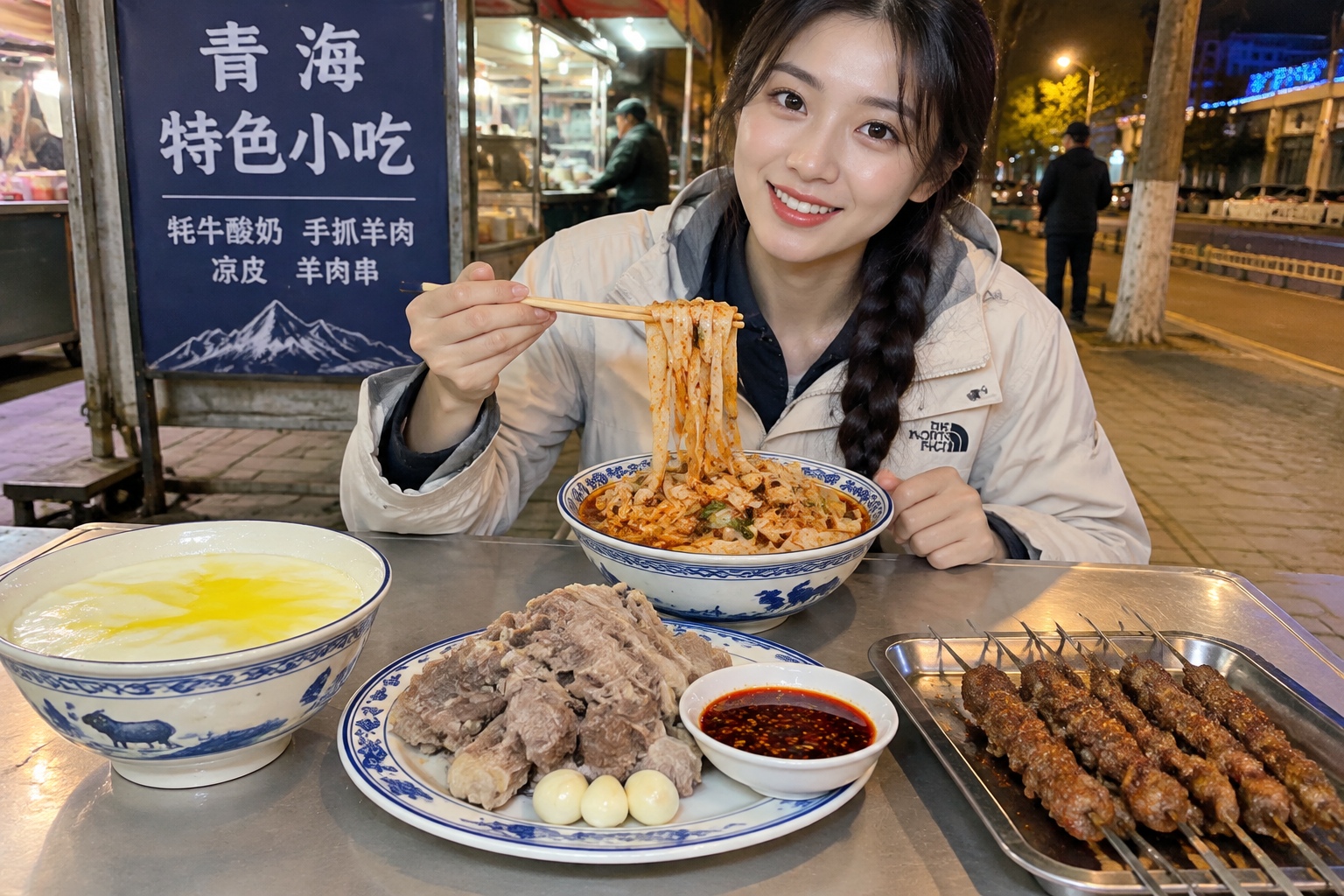
A few things worth knowing before you go: peak season runs May through October, and in winter much of this moves indoors into restaurants and food courts. Start around 7 p.m. and finish by 11. Most vendors don’t speak English — a translation app and pointing works fine. And go easy on the barley wine at 2,260 meters; altitude makes alcohol hit harder than you expect.
The City Behind the Postcard
It would be easy to write up Xining’s night markets as “unspoiled tradition.” That’s not quite right. These stalls are small businesses responding to trends. They take mobile payments, run promotions, adapt menus for students who want yogurt in a cup instead of a bowl. What hasn’t changed is the structure underneath: outdoor cooking, shared tables, low prices, and a mix of ethnicities and incomes that would be hard to engineer on purpose.
There is a broader shift visible here too. As travel within China has grown, smaller western cities have become destinations in their own right rather than transit points, and younger travelers increasingly look for the un-photogenic version of a place — the street where locals eat, not the viewpoint where tour buses stop. Xining’s night markets sit exactly at that intersection.
So if you’re passing through on the way to the lake, give yourself one more evening. Leave the camera in your bag for the first hour. Order something you can’t identify, sit on a plastic stool next to a stranger in a down jacket, and let the smoke do the rest.
Start the discussion at forum.chinacomes.com