
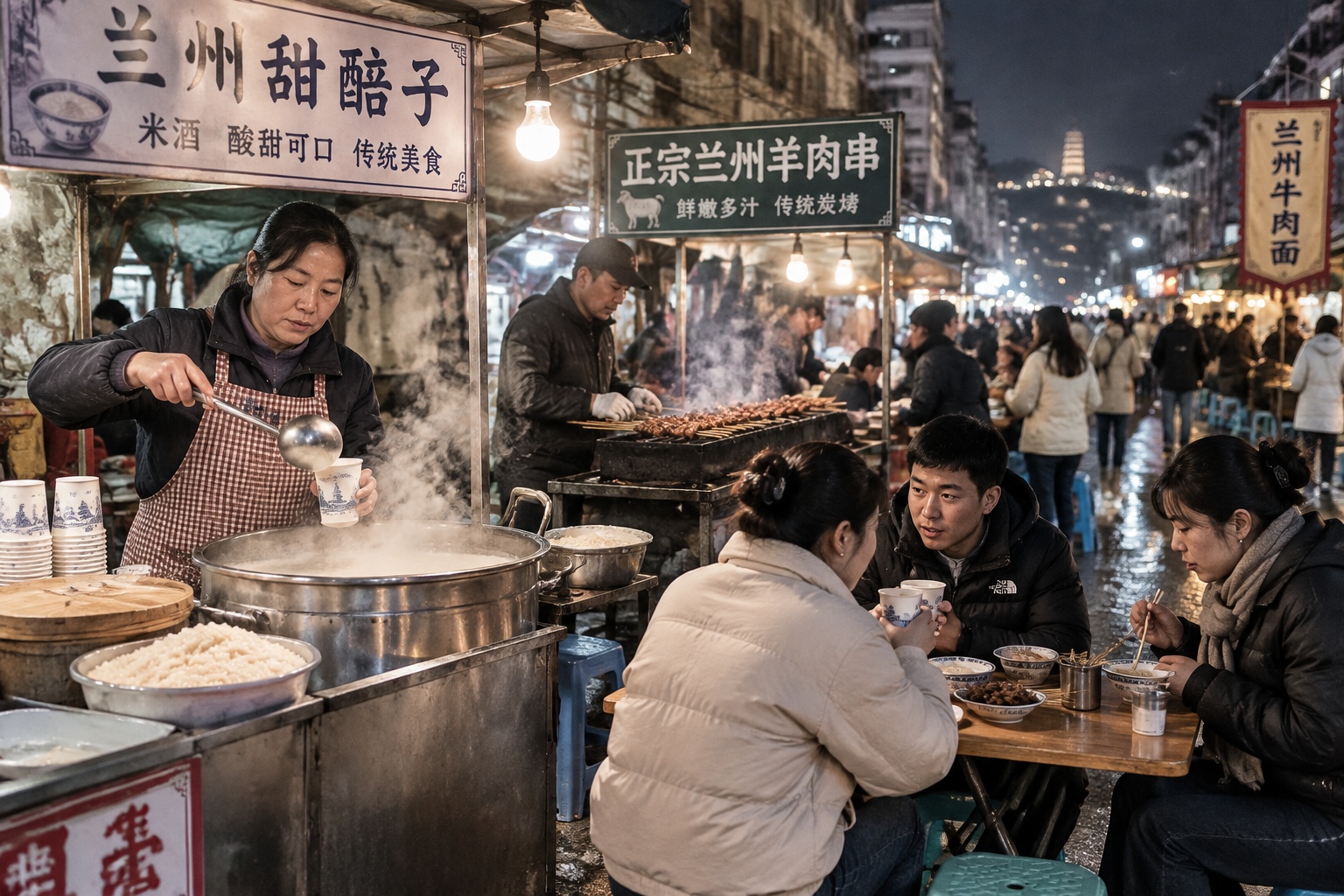

12:40 a.m. on Zhengning Road
Ma Jinhua’s pot has been at a rolling boil since six in the evening. Milk, egg, a spoonful of fermented rice wine, sesame and crushed peanuts — she stirs once, ladles it into a paper cup, and slides the cup across the counter without looking up. Behind her, lamb fat drips onto charcoal and hisses. Two meters to her left, a man watching a live-stream on his phone laughs at something nobody else can see.
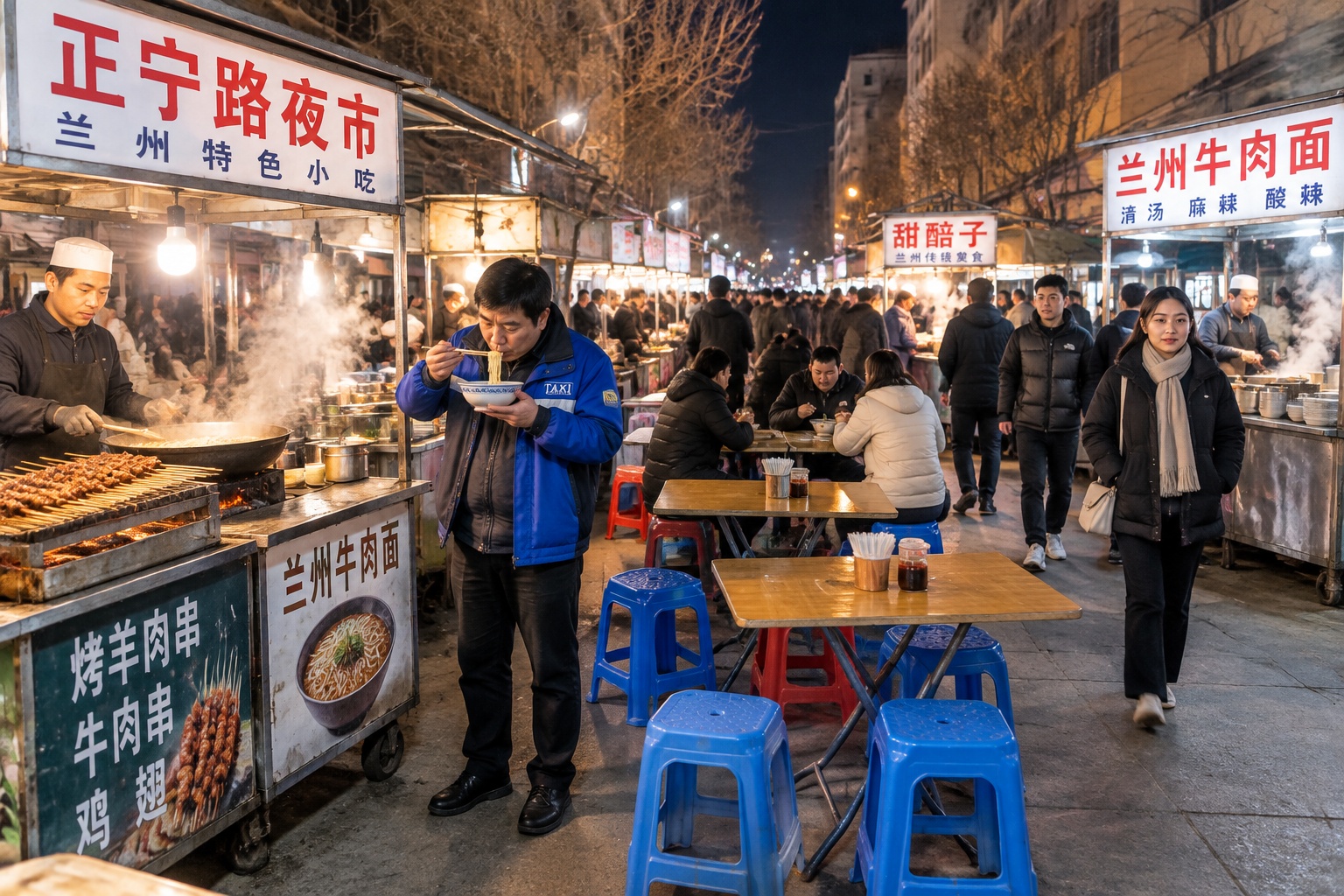
It is 12:40 a.m. on Zhengning Road, in the Chengguan district of Lanzhou, capital of Gansu province in China’s northwest. The street runs about 300 meters between two rows of food stalls, and at this hour it is still crowded enough that you have to turn sideways to get through. Plastic stools scrape against concrete. A woman in the blue jacket of a local taxi company eats standing up, one hand holding her bowl, the other holding her keys.
If your mental image of a Chinese night market comes from travel videos — neon, wok fire, a thousand tourists filming each other — Zhengning Road is both more ordinary and more interesting. It is not a set. It is where people in a city of about 4.4 million go when their working day ends at midnight.
What time a Gansu night market actually peaks
Stalls here start setting up around 5:30 in the afternoon and open by six. The first customers are families with children and office workers grabbing dinner. From 9 to 11 p.m. it’s students, couples and tourists from the hotels near the Yellow River. The shift this article is about runs from 11 p.m. to 1 a.m. Most vendors close between 2 and 3 a.m.; a handful stay until the sky turns grey.
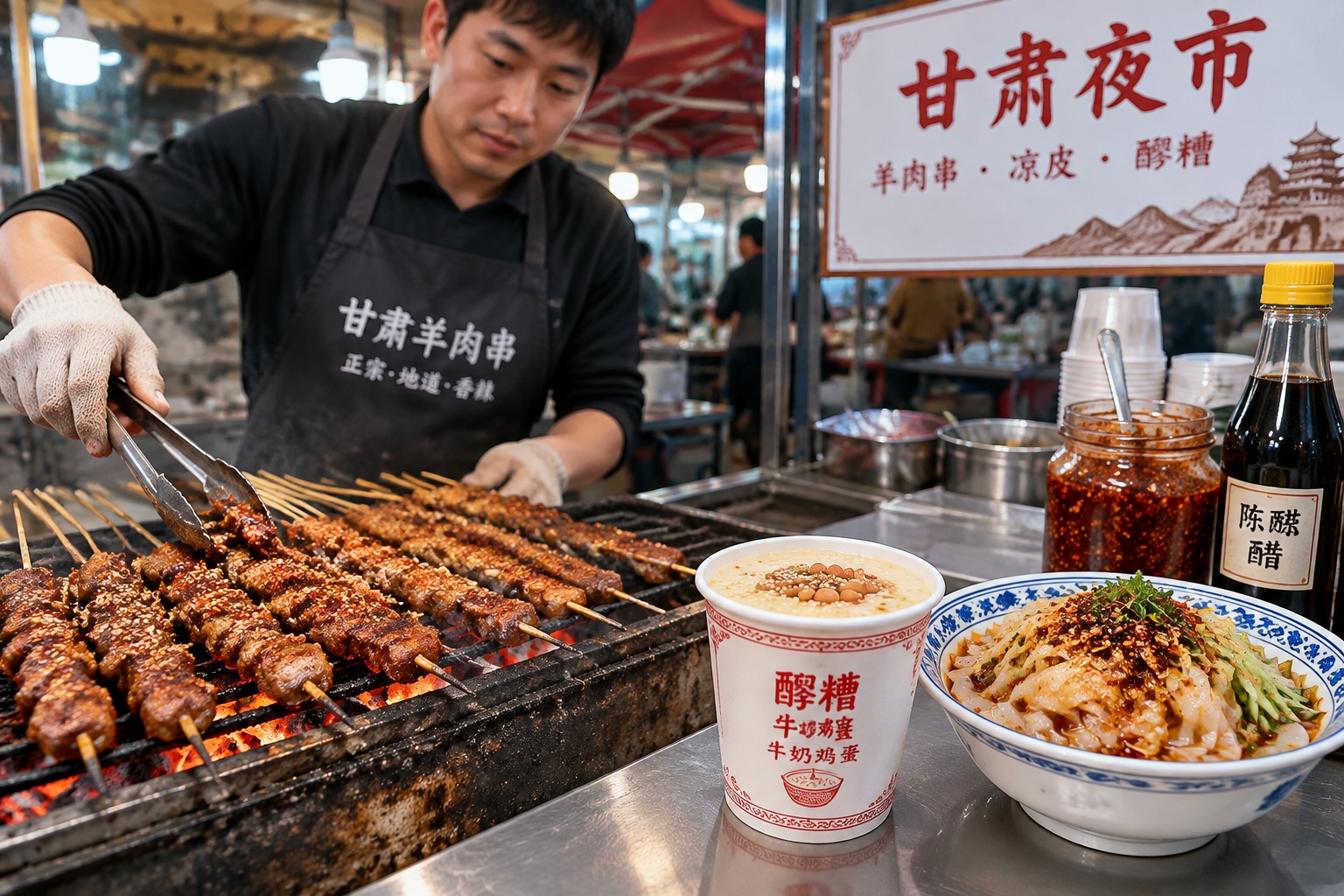
Prices are the reason this works as a nightly habit rather than a treat. A skewer of lamb, heavily seasoned with cumin and chili, costs 3 yuan — around 40 US cents. Ten skewers and a beer is a 50-yuan evening. A bowl of niang pi, cold wheat noodles with gluten, garlic water and chili oil, is 8 to 10 yuan. A cup of Ma’s hot milk-and-egg rice wine is 12. A bowl of hui douzi — black beans slow-cooked with jujube and a pinch of alkali until they turn silky — is 6.
One thing that surprises visitors: Lanzhou’s most famous dish, beef noodles, is breakfast food. The best shops open at 6 a.m., sell out by early afternoon and shut. Nobody eats beef noodles at midnight. The night belongs to lamb, offal soup, cold noodles and sweets.
Who is actually eating at 1 a.m.
Stand on the street for an hour and the crowd sorts itself out.
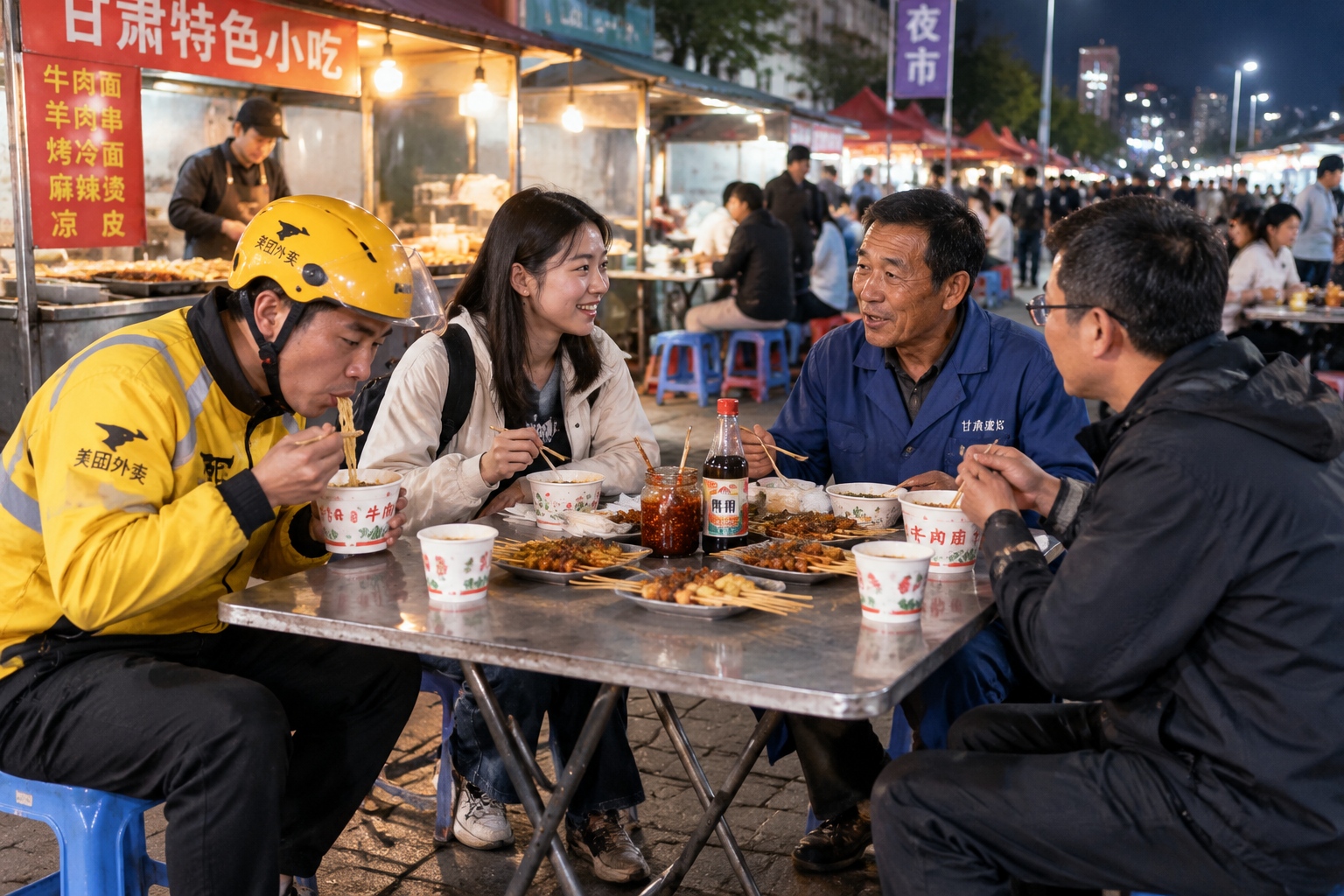
At 12:15, three delivery riders in Meituan and Ele.me jackets park their scooters at the end of the row and order together. They have just finished the 10 p.m. to 1 a.m. window, the last busy stretch for late-night food delivery. One of them, a man in his twenties from Tianshui, orders lamb and complains about a customer who lived on the sixth floor of a building with a broken elevator.
At 12:40, two nurses from a hospital a few blocks away sit down with plastic bags of takeaway for colleagues still on shift. At 1:10, a taxi driver finishes a bowl of noodles in four minutes, pays by QR code and is gone before the steam stops. Lanzhou’s last buses pass the south end of the street around midnight, and a few people who clearly missed one are killing time here instead of waiting at a stop.
Then there are the tourists. Since 2023, when videos of Lanzhou’s beef noodles and the lit-up Zhongshan Bridge spread online, the city became a stop on the “whirlwind tour” routes young Chinese travellers plan on Xiaohongshu and Douyin: three cities in four days, mostly by high-speed rail. Xi’an to Lanzhou takes about three hours. Some arrive at 10 p.m., drop their bags at a hostel and come straight here.
Sharing a table with someone you’ll never see again
Zhengning Road is too narrow and too busy for personal space. There are roughly 40 tables in the middle section, and if you sit at one with two empty stools, someone will take them. That is the whole rule. Nobody asks permission, because asking would be strange — the tables are treated as public furniture, like a bus seat.
What follows is a very specific kind of social contact: close, but not intimate. The chili oil jar and the vinegar bottle sit in the middle of the table and get passed hand to hand, sometimes wordlessly. If a stranger reaches for a skewer you weren’t going to eat, nobody minds. Silence is completely acceptable. So is talking, but only about a small number of things: what’s good here, where you’re from, how to get to the river.
Vendors are the ones who break the ice, and they do it for practical reasons. A woman hesitating over her first cup of fermented rice wine gets a free taste and then a thirty-second explanation of what’s in it. At one stall, the owner learns a customer is from Guangzhou and immediately tells the couple next to her to try his lamb — because they’re from Xinjiang, and “they know lamb.”
Three small things that happened in one night
1. The skewers that got split
A truck driver from Wuwei, in his fifties, sat down opposite two university students and ordered twenty skewers. He ate six. When he left, he pushed the plate toward them and said, “Finish these, I ordered too many.” They thanked him; he waved it off and walked back to his cab. Nobody exchanged names.
2. The photograph
A vendor in his sixties, apron stained with chili oil, asked a young tourist to take a photo of him flipping skewers. Then he asked for another one, “with the smoke.” She showed him the result, he nodded, satisfied, and went back to work.
3. The wrong bus stop
Two women from Shaanxi, in Lanzhou for a single night, couldn’t work out which direction their hotel was. Three strangers at the table answered at once, in overlapping detail, and one of them walked them to the corner to point at the right street. The whole exchange took ninety seconds. It is the sort of thing that happens here constantly and never gets written down.
What has actually changed in the night market economy
Ten years ago, buying a skewer here meant digging for cash. Now nearly every stall has a QR code taped to the counter, and some vendors look briefly pained if you hand them a 100-yuan note and they have to find change. WeChat Pay and Alipay are close to universal at street level, and that has quietly changed the economics of small stalls: no float to manage, no nightly reconciliation, and a digital record of the day’s sales sitting on a phone.
Delivery platforms reshaped the work itself. Some night market vendors now earn more from takeaway orders than from the people standing in front of them, which is why you’ll see a cook stop mid-sentence to check a tablet. A stall’s reputation now travels through app ratings and short videos rather than neighbourhood word of mouth.
City government changed the street physically. Zhengning Road has been through rounds of renovation: stall frames are roughly uniform, there are more fire extinguishers and covered bins, food-safety licences are displayed, and electric or gas grills have replaced some charcoal ones under air-quality rules. It is cleaner and easier to manage than it was. Several long-time vendors say it is also more expensive to operate and less improvised than before, and a few regulars never came back after the pandemic years.
The picture is not uniform across Gansu. Zhangye’s central food market was rebuilt into a tidier hall that draws more tour groups and fewer night-shift workers. Dunhuang’s Shazhou Night Market, a few hours west, leans heavily toward souvenirs and peaks in summer. Lanzhou’s street is a working city’s street, which is exactly why it deserves an hour of your time.
Why this matters if you don’t live in China
Most Western cities have a late-night problem. Pubs close, restaurants shut at ten, and the only people on the street after midnight are going somewhere specific. In Lanzhou, a public space stays open, lit and cheap, and a very wide range of people use it: a truck driver, two nurses, a nineteen-year-old with a backpack, a woman eating noodles alone at 1 a.m. without thinking twice.
That last detail is not small. Night-time public safety — especially for women — is something Chinese cities do unusually well, and night markets are part of the reason: lights, crowds, vendors who know their neighbours, and police who are visible but usually quiet.
The social function is real, if modest. You cannot fix loneliness at a food stall. But you can sit beside someone for fifteen minutes in a place where talking to a stranger is neither required nor forbidden, and that turns out to be a useful thing for a city to have. Very little of it happens in English, and almost none of it happens online. It happens because the table is crowded and there is nowhere else to put your chili oil.
2:20 a.m., the stools go up
By half past two the row is thinning. Ma turns off one burner and starts stacking bowls. The skewer man scrapes down his grill, folds the foil, and builds towers of plastic stools taller than he is. A woman finishes her soup, pays by phone and walks north toward the river, past a couple arguing quietly about which way their hotel is.
The last bus is long gone. There is a shared bike at the corner, and she takes it. Behind her the charcoal is still warm, and the man who sells soy milk at five in the morning is already pushing his cart into place.
Start the discussion at forum.chinacomes.com