
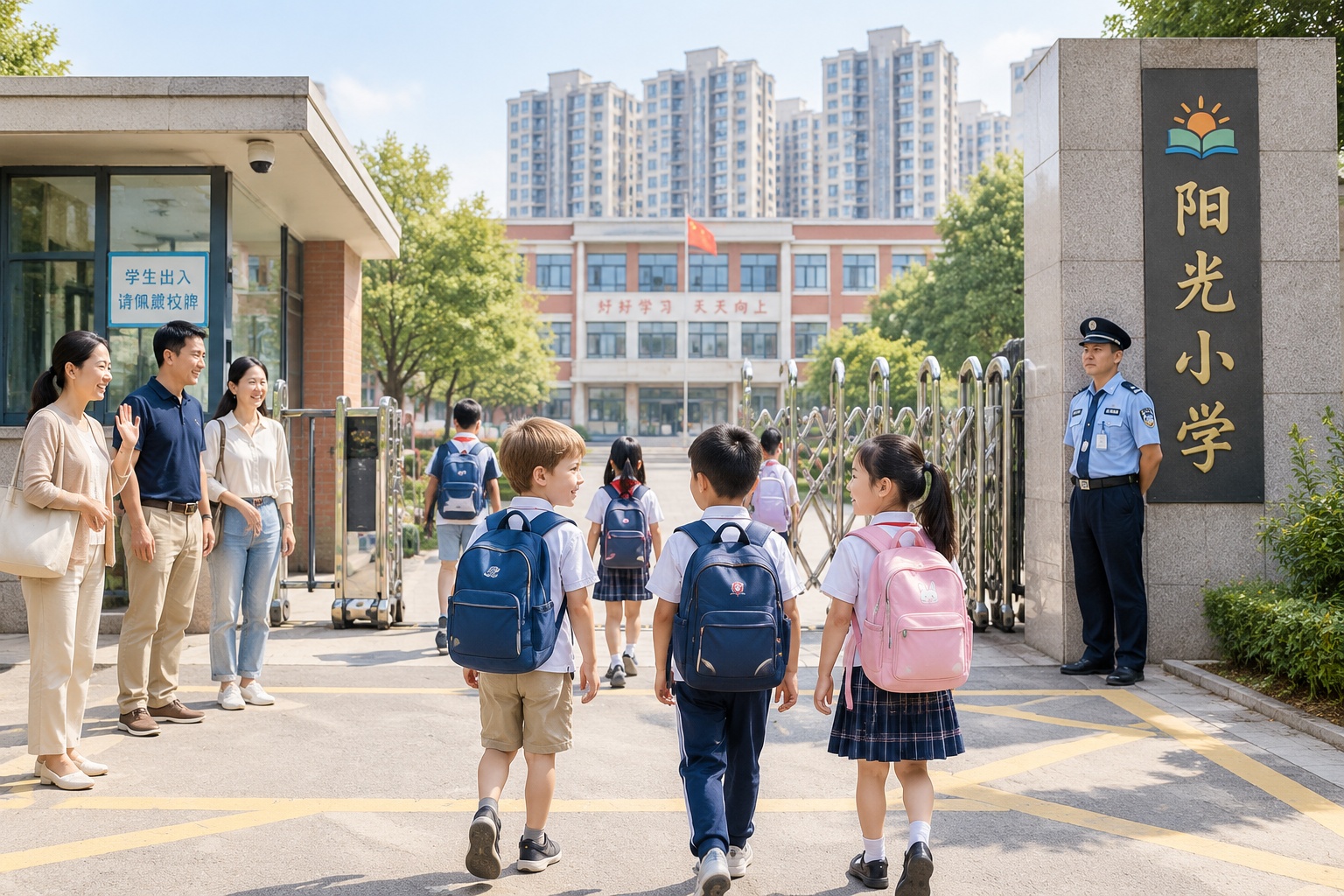

First, a Real Question
When Michael and his wife moved to Shanghai from Ohio, they didn’t think twice about schools. Like many expats, they assumed their six-year-old daughter would attend an international school. Then they saw the tuition: roughly $30,000 per year. A neighbor’s son, the child of a German engineer at SAIC, was attending a nearby public school in Pudong. His Mandarin was already better than his father’s. So Michael asked: could his own daughter also attend a neighborhood public school? The short answer is yes, but only under specific conditions that vary by city, by district, and sometimes by the school principal’s discretion.
The Official Baseline: Foreign Children in Public Schools
China’s Education Law grants nine-year compulsory education to Chinese citizens. Foreign nationals are not guaranteed a free state school place. However, a separate set of Ministry of Education regulations allows ordinary primary and secondary schools to accept foreign students, provided the school first obtains approval from its local education authority. That approval is not automatic. Schools must demonstrate that they have the staffing, facilities and safety procedures for non-Chinese speakers.
In practice, the result is a patchwork. Some local governments have simplified enrollment for foreign children when at least one parent holds an A-class Foreigner’s Work Permit or a permanent residence card. Others only allow foreign children to enter if a parent is a high-level academic or a government-invited expert. Many schools will say “no” simply because they have not been licensed to accept foreign students.
City Rules Compared: Shanghai, Beijing, Shenzhen, Guangzhou
If you are considering a public school, your street address is only one part of the puzzle. The other part is which city’s education bureau has the final say.
Shanghai
Shanghai runs pilot schemes in Pudong, Xuhui, and Minhang. A child may apply to a public elementary school in these districts if at least one parent holds an A-class Foreigner’s Work Permit or a Shanghai Overseas Talent Residence Permit (the B card), which is a special residence status. The application is filed through the district’s education platform between May and June. Even then, the school must have spare places after local Chinese children have been assigned.
Beijing
Beijing is more conservative. Public schools do admit foreign children, but usually only when the parent is recognized as top-level talent by the municipal human-resources bureau or is a foreign diplomat. Many Beijing public schools with a foreign intake run an “international section” that charges fees similar to private bilingual schools.
Shenzhen
Shenzhen allows foreign children to attend the same public school as Chinese children if the family holds a permanent residence certificate. Ordinary work-permit holders may also apply, but several districts request proof of property ownership in the school catchment area.
Guangzhou
Guangzhou is the strictest of the four. A foreign child will normally be accepted into a public primary school only if the parent is a government-invited expert, a senior researcher, or a professor at an accredited university. Children of engineers and factory managers are usually directed to international schools.
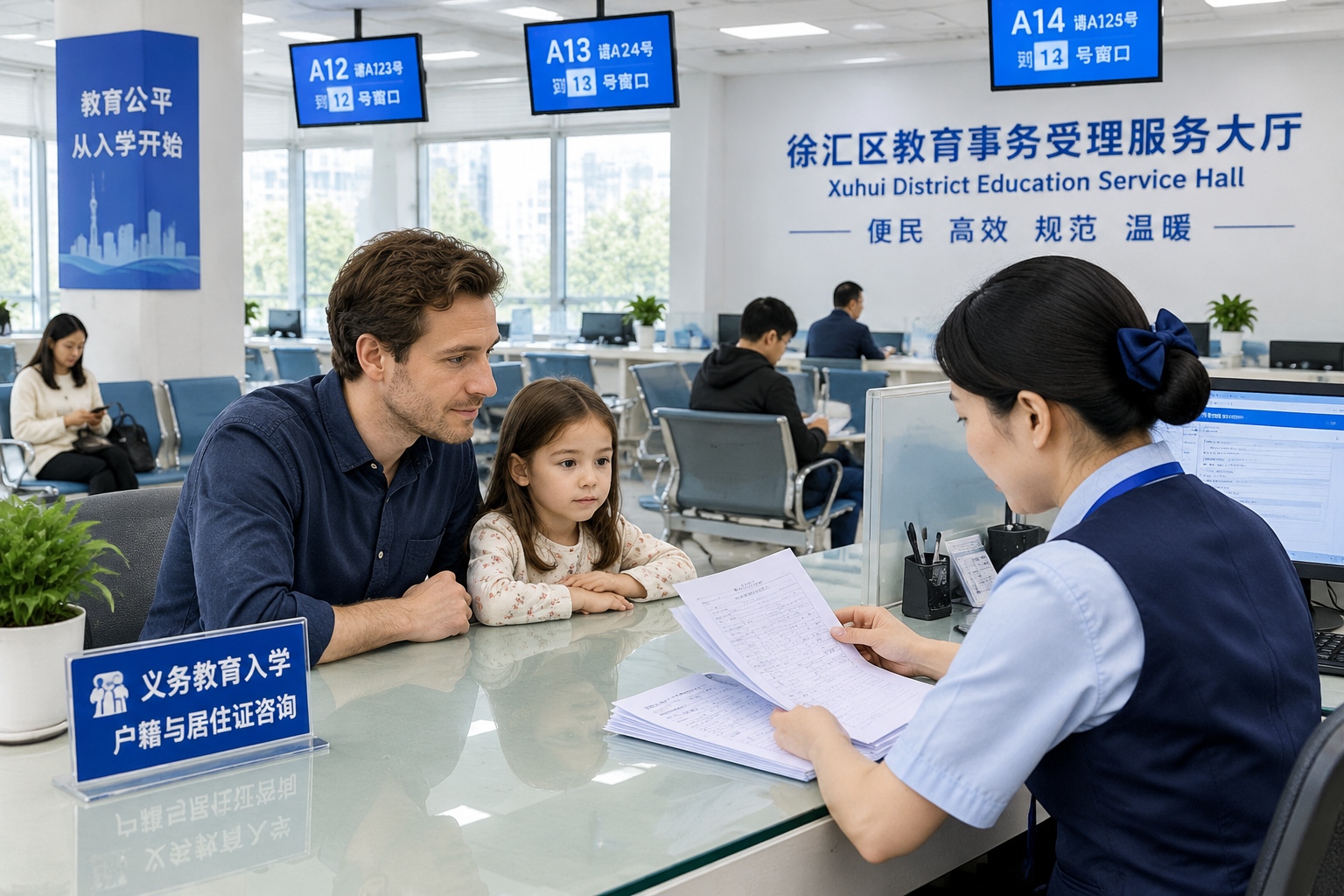
A Shanghai Engineer’s Family: What the Application Actually Looked Like
Michael is an automotive engineer at a German supplier in Shanghai. He holds an A-class work permit and a full-time contract. His daughter Clara was six, holding a family residence permit attached to Michael’s visa. In early 2023, they lived in Minhang, renting an apartment in the district for three years.
In March, Michael emailed the Minhang Education Bureau’s foreign-student enrollment office. The reply came within five working days with a document checklist and a reminder that foreign students are only considered after local mandatory enrollment is complete. He registered on the district portal in May, requesting the public primary school near his residential block. The school had a posted intake of 200 first‑graders. About 180 places went to children with Chinese household registration. The remaining seats were open to “other eligible children,” including a small number of foreign children whose parents met the talent classification.
Michael submitted scanned copies of his work permit, rental contract, passport, his daughter’s birth certificate, and a signed statement that Clara would follow the standard Chinese curriculum. He was called to the school for a short interview. Clara knew a few Chinese words but not enough to follow a full-grade-1 class. After two weeks, the school said the special “new-language support” track for foreigners was full, but a seat remained in the ordinary class. Michael declined it because Clara would have been completely lost without Chinese. He eventually placed her in a bilingual private school at around RMB 10,000 a month.
That case captures the common tension: the policy may not bar you from public school, but the lack of organized language support often makes it impractical for a child arriving with no Chinese.
The Document Checklist for Public School Enrollment
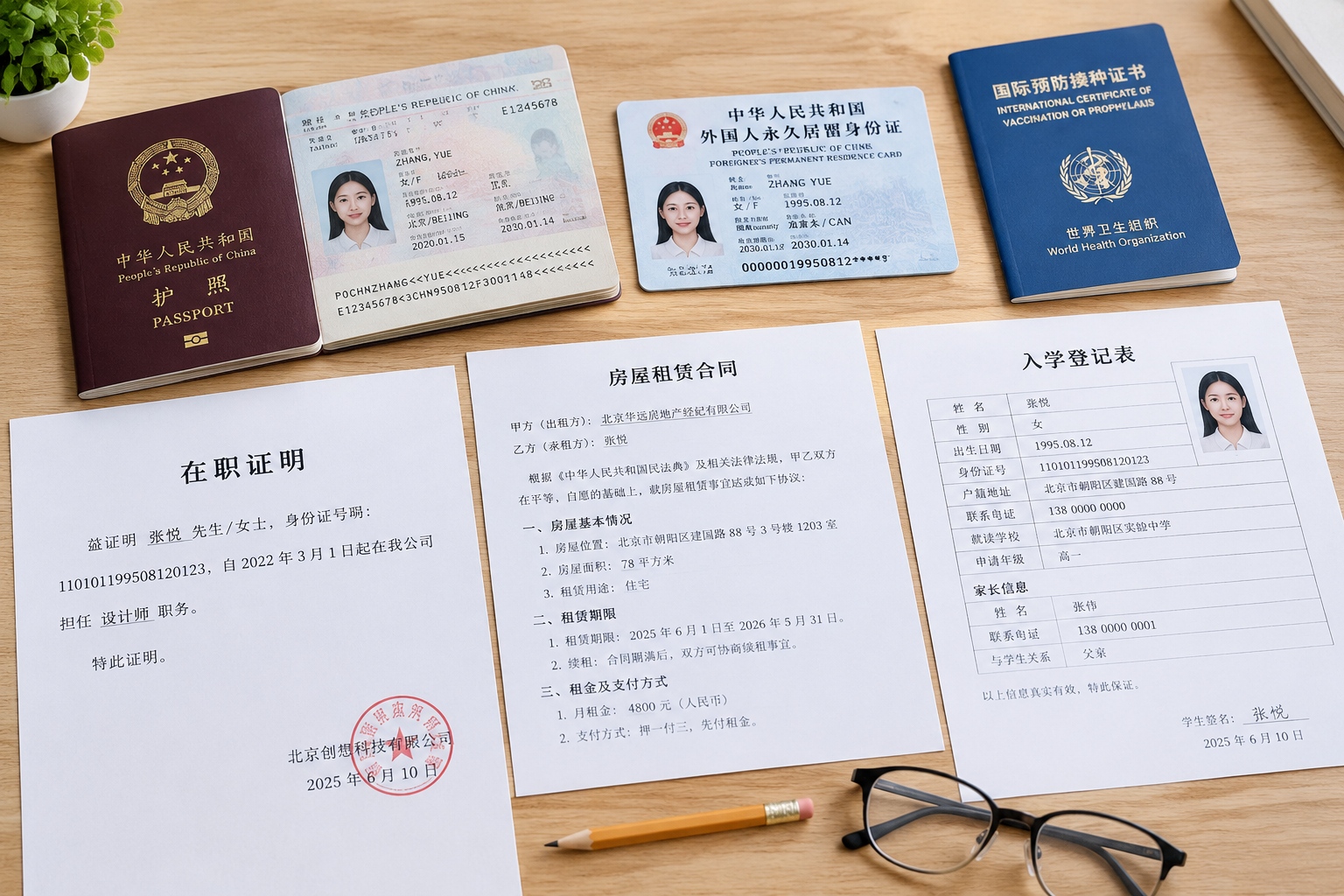
If you decide to try the public route, prepare to produce nearly every official piece of paper you own. The following list reflects current requirements in Shanghai’s pilot districts, and other cities may add their own items.
| Document | Notes |
|---|---|
| District enrollment application form | Usually filled in online |
| Child’s foreign passport with a valid visa or residence permit | The permit must cover the school year |
| Notarized birth certificate and, if needed, Chinese translation | Required to show family connection |
| One parent’s A-class work permit or permanent residence card | B-class permits are often accepted only in selected districts |
| Home-address proof in the school catchment area | Property deed OR notarized rental contract with current tax receipts |
| Parent’s employment certificate and recent salary record | To prove active employment in China |
| Foreigner’s Temporary Accommodation Registration Form | From the local police station, usually issued when you check in |
| Vaccination record with translation | The school needs a full list of immunizations |
| Previous report card or transcript | Only if transferring from another school |
| Parent’s statement that the child will follow Chinese rules and curriculum | Many districts require a signed declaration |
Why Most Foreign Families Get Rejected
Rejections do not usually come from an official “No foreign children” sign. Instead, you will hear one of these four responses:
- No quota. The school may genuinely be full of Chinese students. Only a few seats are open to non-local categories, and those seats are extremely competitive.
- No license. The school may not be approved to enroll foreign students. Some principals refuse before you even apply.
- Wrong address. The local financing of public schools relies on household registration and property. If your rental is not in the school’s catchment area, you will not be assigned there.
- Language reality. The school may worry that a zero-Chinese child will slow the class. Even when they accept a foreign student, no non-Chinese support is provided.
Also note that public-school enrollment for Chinese citizens happens in May and June. Foreign students are generally considered only after that first wave, so a seat is not guaranteed.
Alternatives If Public School Is Not on the Table
If the public route does not work for your child’s language level or your job category, you have four realistic options in most large Chinese cities.
1. International schools
These are licensed specifically for foreign children. They follow US, British, German, Japanese or other national curricula. Fees usually range from RMB 150,000 to RMB 350,000 a year. The benefit is that your own country’s education system remains on track.
2. Bilingual private schools
These combine Chinese curriculum with an international section. They teach roughly half their courses in Mandarin and half in English. Many expat families choose them as a compromise. In Shanghai, good bilingual schools charge around RMB 10,000–25,000 per month.
3. Public schools with an international department
Some state schools have separate “international departments” open to foreign nationals. These are not covered by the state’s free education, but they cost far less than international schools and follow a Chinese-adapted curriculum.
4. Homeschooling or remote learning
Homeschooling is legal in China if you follow certain notification rules, which vary by province. Some families also enroll their children in an accredited online school in their own country while living in China. This works well for younger children, but becomes harder as the child approaches high-school age.
A Final Word for Expat Parents
Public school for foreign children in China is not an official right, but it is not an outright ban either. The smartest way forward is to do what Michael’s friends advised: first, call or email the education bureau in the district where you live, before looking at any particular school. Ask three questions: Does my work permit category make my child eligible? Does the school on my street have a license to take foreign students? And is there any language-support arrangement?
If you get a “yes” to all three, prepare your documents early and have a private-school backup in hand. The window between June and August can be unpredictable, and the school office may only make its final decision days before the term begins. Being halfway prepared is not enough when your child’s classroom is at stake.
Start the discussion at forum.chinacomes.com