

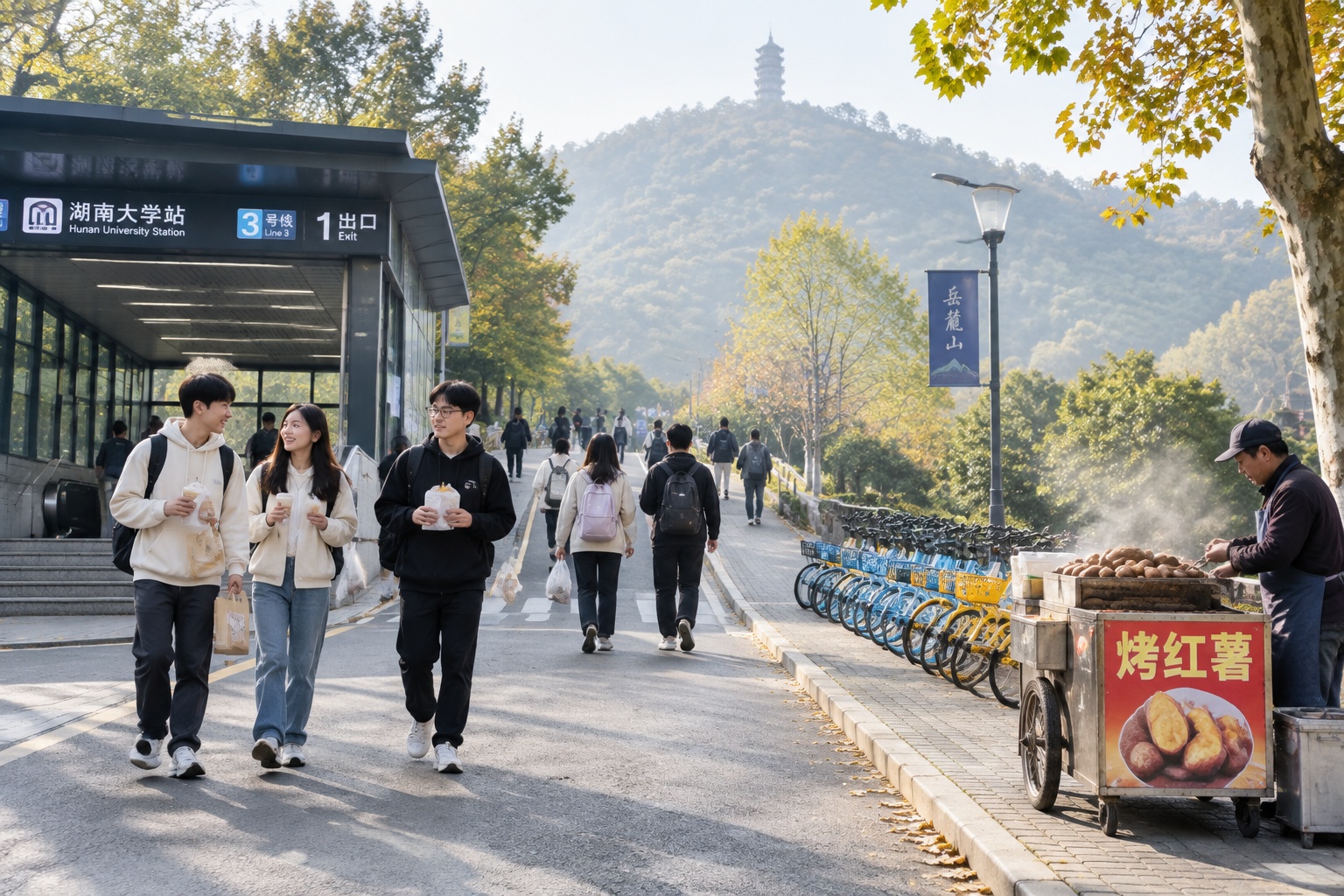
7:40 a.m., Hunan University Station
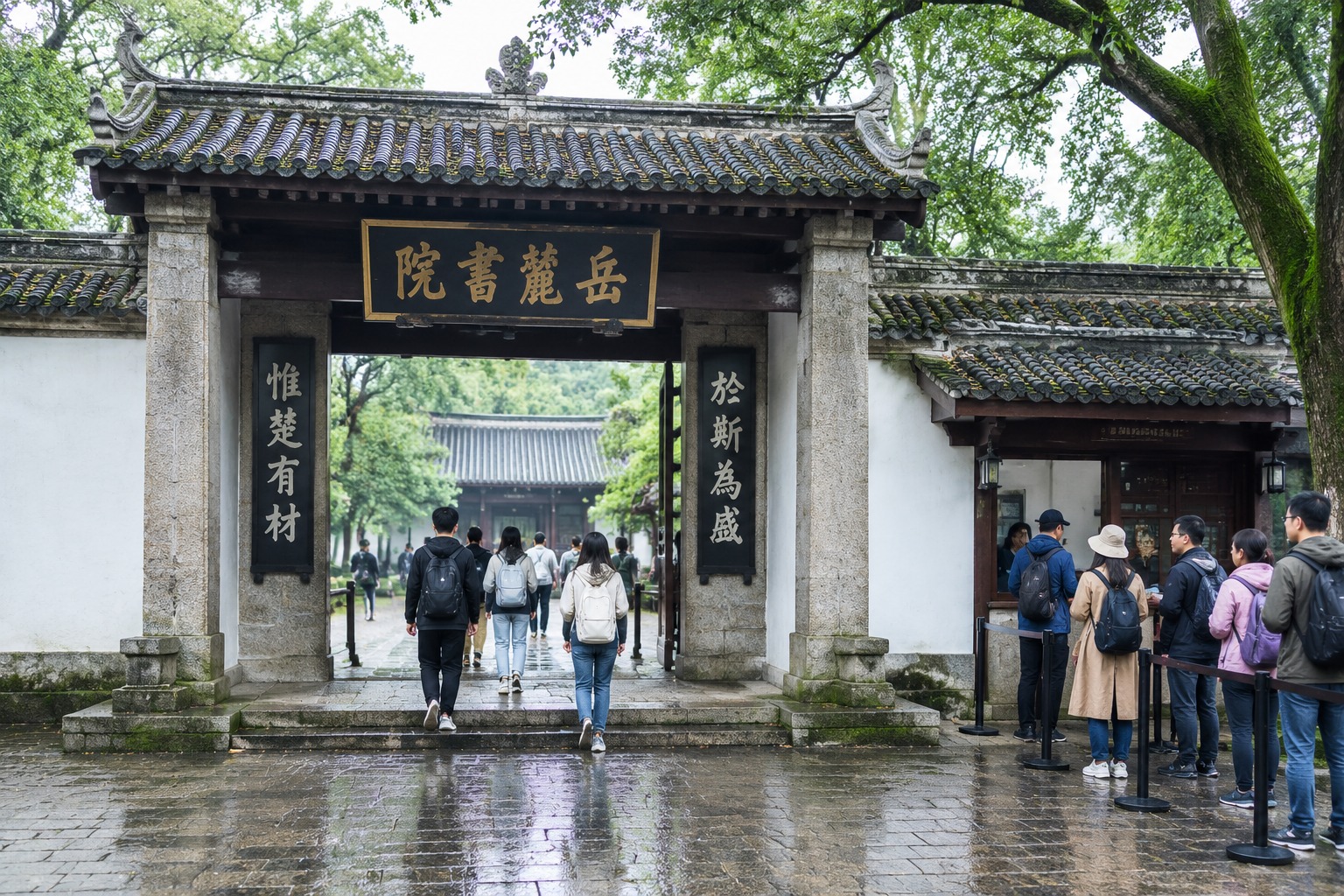
At 7:40 on an October morning, the escalator at Hunan University station lifts a crowd out of Changsha Metro Line 4 and into wet air. Students with backpacks turn left, past a man selling roasted sweet potatoes, and start up the slope toward Yuelu Mountain. The stone gate of Yuelu Academy is about ten minutes’ walk higher up. A queue is already forming at the ticket window, phones and cameras out.
But other people walk through that gate without stopping to buy anything: a professor with a folder under his arm, a woman in a blue work coat carrying a thermos, two undergraduates arguing about a deadline. This is their campus, not their field trip.
That is the first thing worth knowing about Yuelu Academy, and the thing most photographs miss. It is not a museum with a school attached. It is a school that happens to be a thousand years old.
A School That Has Been Open Since 976
Yuelu Academy was founded in 976, in the ninth year of the Kaibao era of the Northern Song dynasty, on the west bank of the Xiang River. It belongs to a category of institution that has no clean English equivalent: the shuyuan, or academy. These were study-and-lecture houses, often founded by scholars rather than by the state, where a headmaster gathered students, kept a library and argued about how to read the classics. The most famous ones became national intellectual centers. Which four count as the great academies depends on which source you read; Yuelu is on every version of the list.
In 1015, Emperor Zhenzong of the Song granted the academy its name plaque and a set of books. In 1926 it was folded into the newly founded Hunan University, and it never stopped teaching. Today it is a college inside Hunan University: it enrolls students, awards degrees in history, philosophy and related fields, and keeps a collection of old books in a building called the Yushu Lou.
So when Chinese people call it the thousand-year academy, they are not being poetic. The institution is roughly as old as the University of Bologna.
The Two-Month Argument of 1167
The event that made the academy famous happened in 1167, when Zhu Xi, a philosopher in his late thirties who would go on to shape Confucian orthodoxy for the next seven centuries, travelled from Fujian to Changsha to argue with Zhang Shi, the academy’s head. They debated for about two months.
It was not a private seminar. Local records claim the audience grew so large that the pond where visitors’ horses drank was emptied dry. That detail is probably an exaggeration, but the scale is not: the meeting, known as the Zhu-Zhang debate, is still treated in Hunan as the moment the province became an intellectual center. The ferry crossing on the Xiang River that Zhu Xi used is still called Zhu-Zhang Ferry.
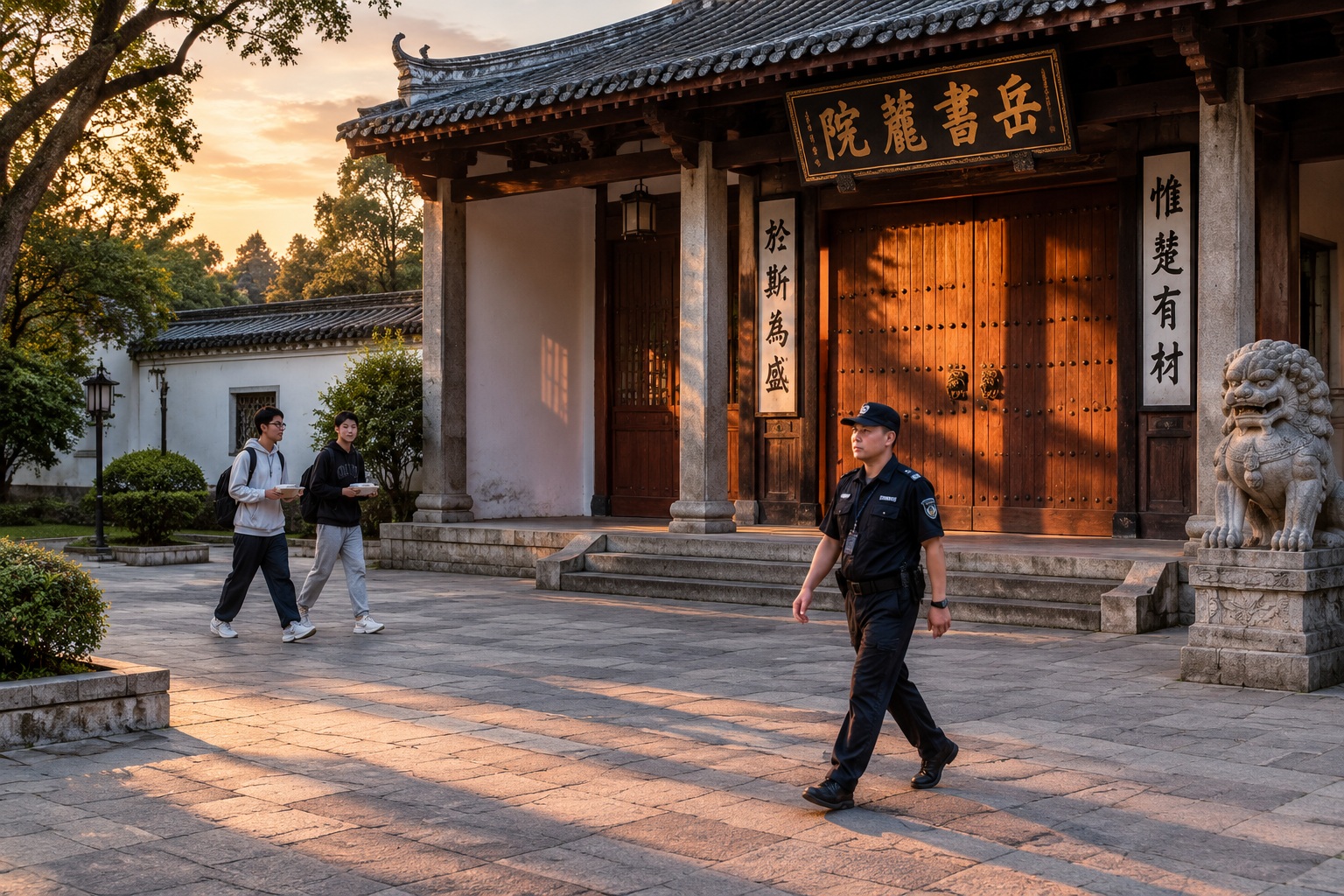
Walk through the main gate and look up. The couplet on either side — 惟楚有材,于斯为盛 — was written in 1812. The first half comes from the ancient chronicle Zuo Zhuan, the second from the Analects: roughly, Chu has talent; here it is at its most abundant. Hunan people know this is not a modest sentence, and they like it that way.
Four Characters Students Still Photograph
Inside the lecture hall, the walls carry four large characters attributed to Zhu Xi’s own hand: loyalty, filial duty, honesty, integrity. Visitors photograph them constantly. Students mostly walk past.
The characters students stop for are different: 实事求是, usually translated as seek truth from facts. The plaque was hung here in 1917 by Bin Bucheng, then head of the Hunan Institute of Technology, one of Hunan University’s predecessors. A young Mao Zedong, studying and organizing in Changsha at the time, carried the phrase with him, and decades later it became one of the most quoted four-character phrases in Chinese political life. According to the academy’s own exhibition, Mao and his friend Cai Hesen even lodged for a period in Banxue Studio, one of the side halls, while preparing to go to France on a work-study program.
This is where the academy gets interesting, and a little awkward for anyone who wants a tidy story. A building that teaches classical ethics, trains historians and philosophers, and sits on the tour-bus circuit is also the place where a phrase was picked up and turned into political language. It carries all of that at once.
Zeng Guofan, and a Story About a Thief
Many Chinese schoolchildren know Yuelu Academy through one alumnus: Zeng Guofan, who enrolled in 1834 and later became a senior official and commander of the Xiang Army. His diaries, in which he scolds himself for laziness, a bad temper and wasted evenings, are still assigned reading.
They also know a story that is almost certainly invented. Zeng, the story goes, was a slow memorizer. One night a thief hid under the beam of his room, waiting for the boy to blow out the lamp and sleep. Zeng read the same passage over and over and could not get it. Eventually the thief dropped down, recited it perfectly from memory, and left in disgust.
There is no source for this, and it survives because it is a useful moral: persistence beats raw talent, and a dull boy from a farming family can end up running the affairs of an empire. The academy’s other famous student, Wang Fuzhi, took a different road. He studied here in the 1640s, refused to serve the Qing after the dynastic change, spent his last decades writing philosophy in the mountains of southern Hunan, and was published only after his death. Reformers and revolutionaries read him later. He never came back to the academy. It keeps his portrait anyway.
What a Class Looks Like Now
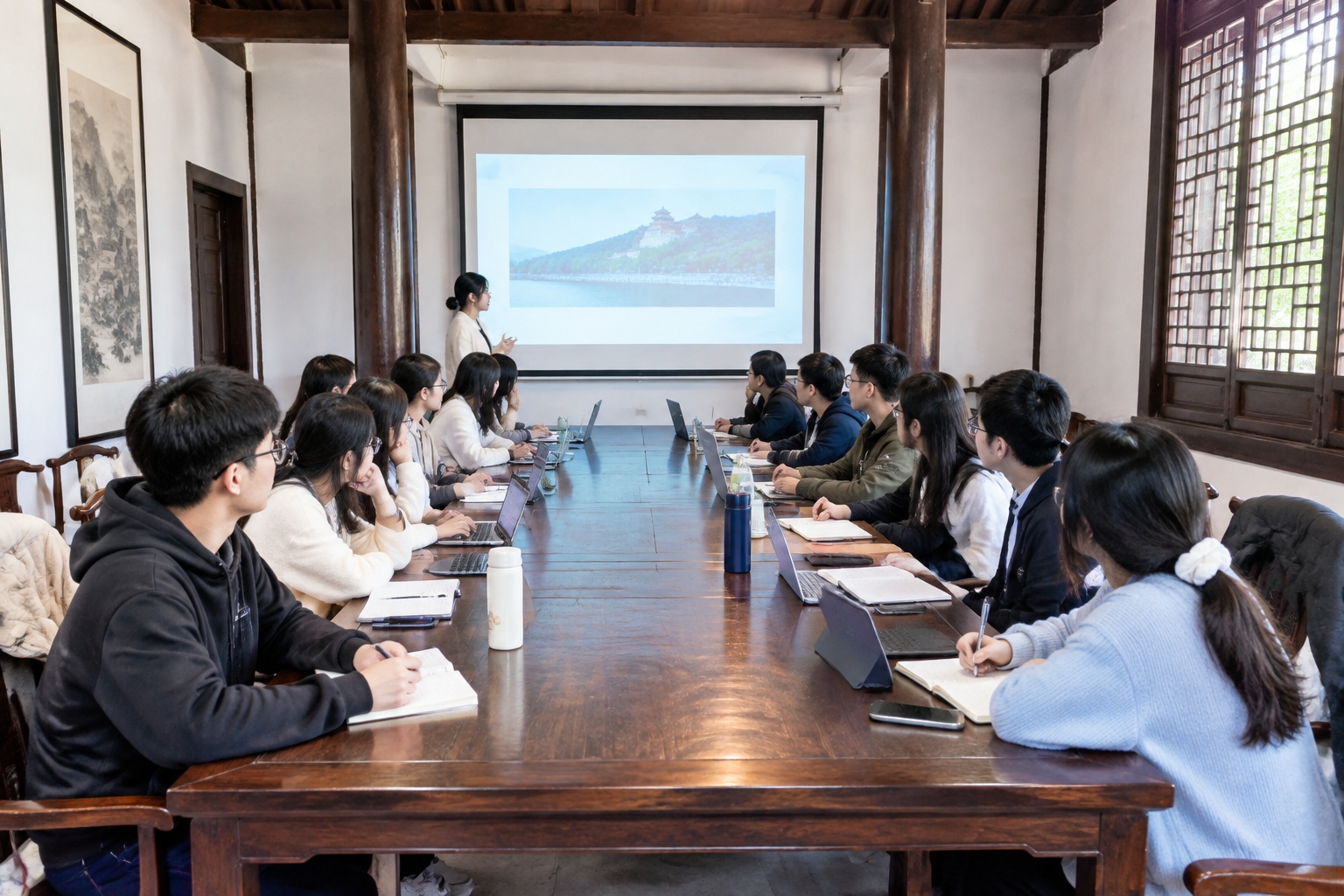
Step into one of the side halls on a weekday and the double life becomes obvious. In a second-floor seminar room, twenty students sit around a long table under old wooden beams. A projector throws a slide onto a white screen hung between two pillars. There are laptops, paper cups of tea, a phone buzzing on silent.
In winter this part of China is cold and damp, and the historic buildings have no central heating; students keep their coats on indoors. In summer the courtyards fill with cicadas and tour groups, and a sign asks visitors to lower their voices while classes are in progress.
The academy is also a 5A-level scenic area, the top tier in China’s tourist rating system. Tickets cost around 40 yuan, about six dollars; students and staff of Hunan University walk in free with a campus card. On a busy weekend the courtyards can hold more visitors than students. Undergraduates here learn to leave for class fifteen minutes early, because a tour group with a loudspeaker can block the gate.
Nobody at the university pretends this is a perfect arrangement. Ticket revenue helps pay for the upkeep of very old wood. The same crowds that fund the roof make it hard to hear a lecture through an open window. Both things are true, and the people who work here will tell you both.
Aiwan Pavilion: The Same Hill, Getting Loud
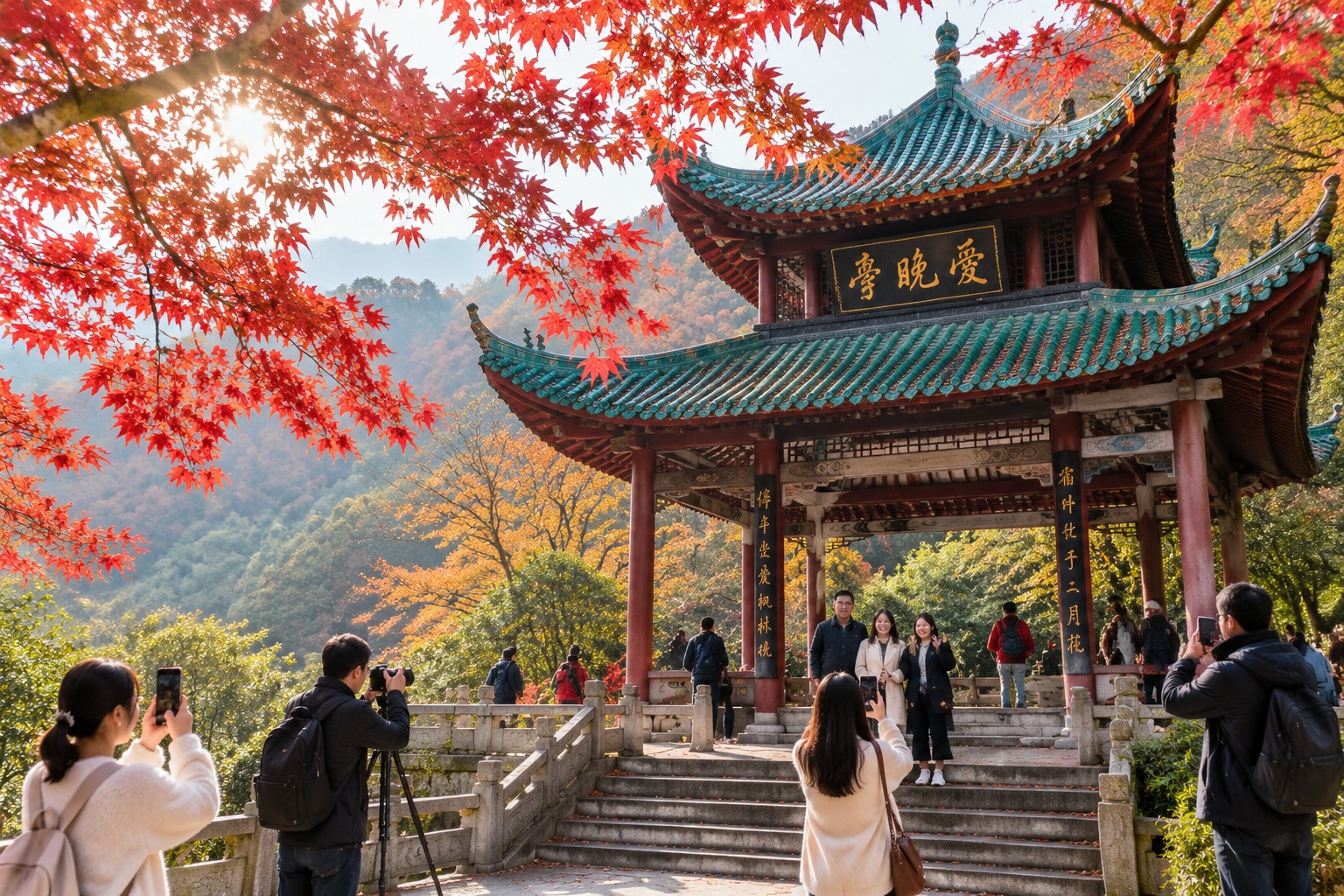
Behind the academy, a stone path climbs into Qingfeng Gorge. Twenty minutes or so up is Aiwan Pavilion, built in 1792 by Luo Dian, who was head of the academy at the time. Its name comes from a line by the Tang poet Du Mu about stopping the carriage to enjoy the maple woods at dusk. The current structure dates from 1952; the plaque above it is in Mao’s calligraphy.
For Changsha residents, this is not a history site. It is where you go in late November, when the maples turn red, to take your parents’ photograph. On a good autumn weekend the gorge is loud: tripods, children, thermoses of hot water, vendors selling roasted chestnuts and sugar-oil rice cakes at the bottom of the path.
Lower down, on the road between the metro station and the mountain gate, stands a small Qing-dynasty pavilion called Zibei Ting. Its name comes from a line in the Doctrine of the Mean: to travel far, start from what is near; to climb high, start from what is low. Thousands of students pass it every day on the way to class. Most have never read the line.
The Campus Without a Wall
Hunan University is known in China for having no perimeter wall. City buses and taxis drive through the middle of it, and the metro station is named after the university. The academy sits inside this: mountain on one side, river on the other, dormitories and noodle shops and a post office within a few minutes’ walk.
That mixture is the honest answer to what Yuelu Academy is today. Not a relic, not a theme park, but an institution that has been continuously in the way of things — students late for class, tourists late for their bus, professors who have taught in the same room for twenty years and can tell you which pillar is original.
5:30 p.m.
The gate closes to visitors in the late afternoon. The courtyards empty quickly. A guard walks the length of the main hall, checking doors; the light goes orange on the stone floor; two students cross with takeaway boxes and disappear toward the dormitories. The old buildings hold the heat of the day for another hour or so.
By seven the next morning, the slope from the metro station is full of backpacks again.
Start the discussion at forum.chinacomes.com