

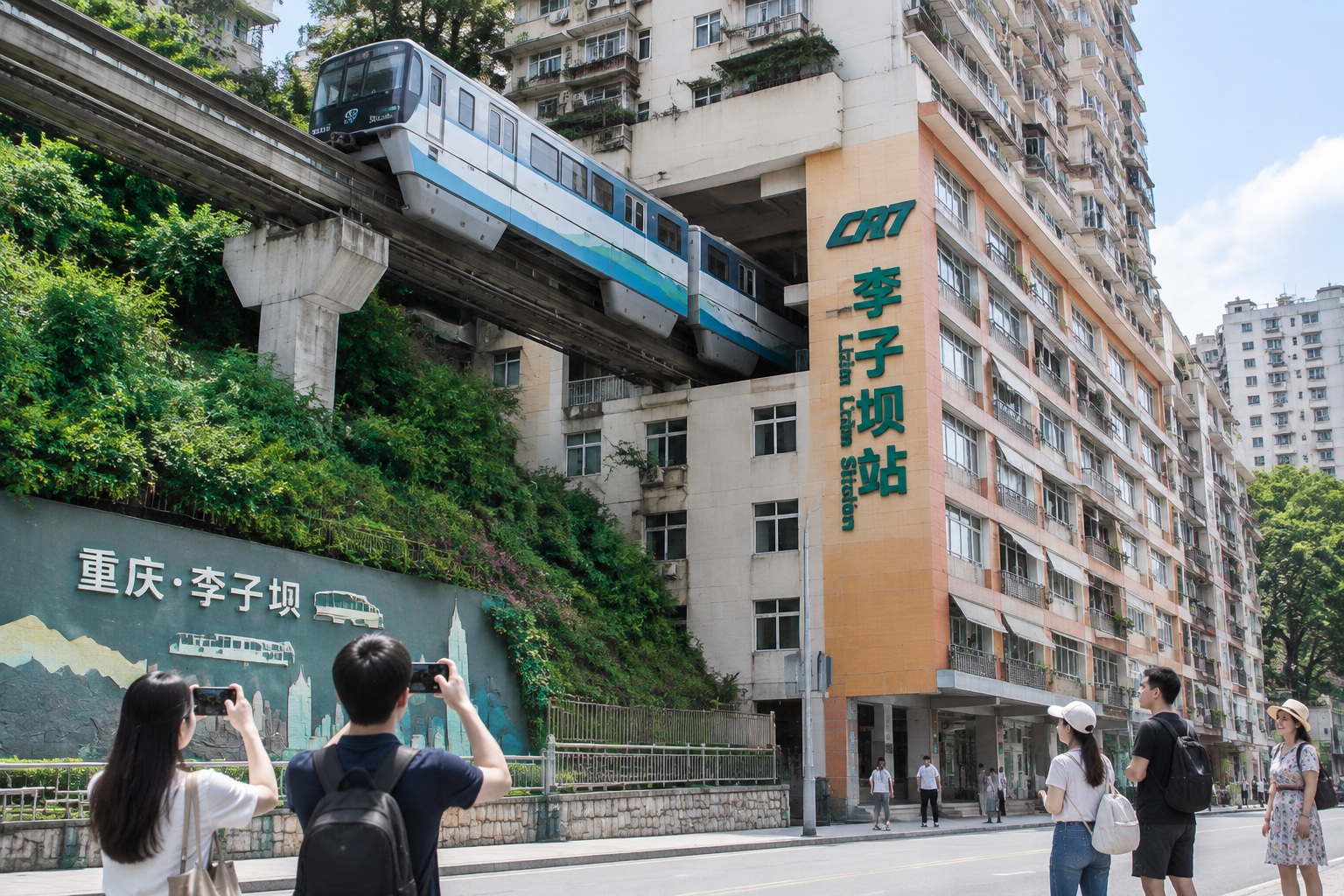
At Liziba station in Chongqing, a light rail train passes through the eighth floor of a residential building. Tourists gather below, filming the moving train. Locals barely look. Chongqing has long built through mountains, so a train through an apartment block is simply part of the city design.
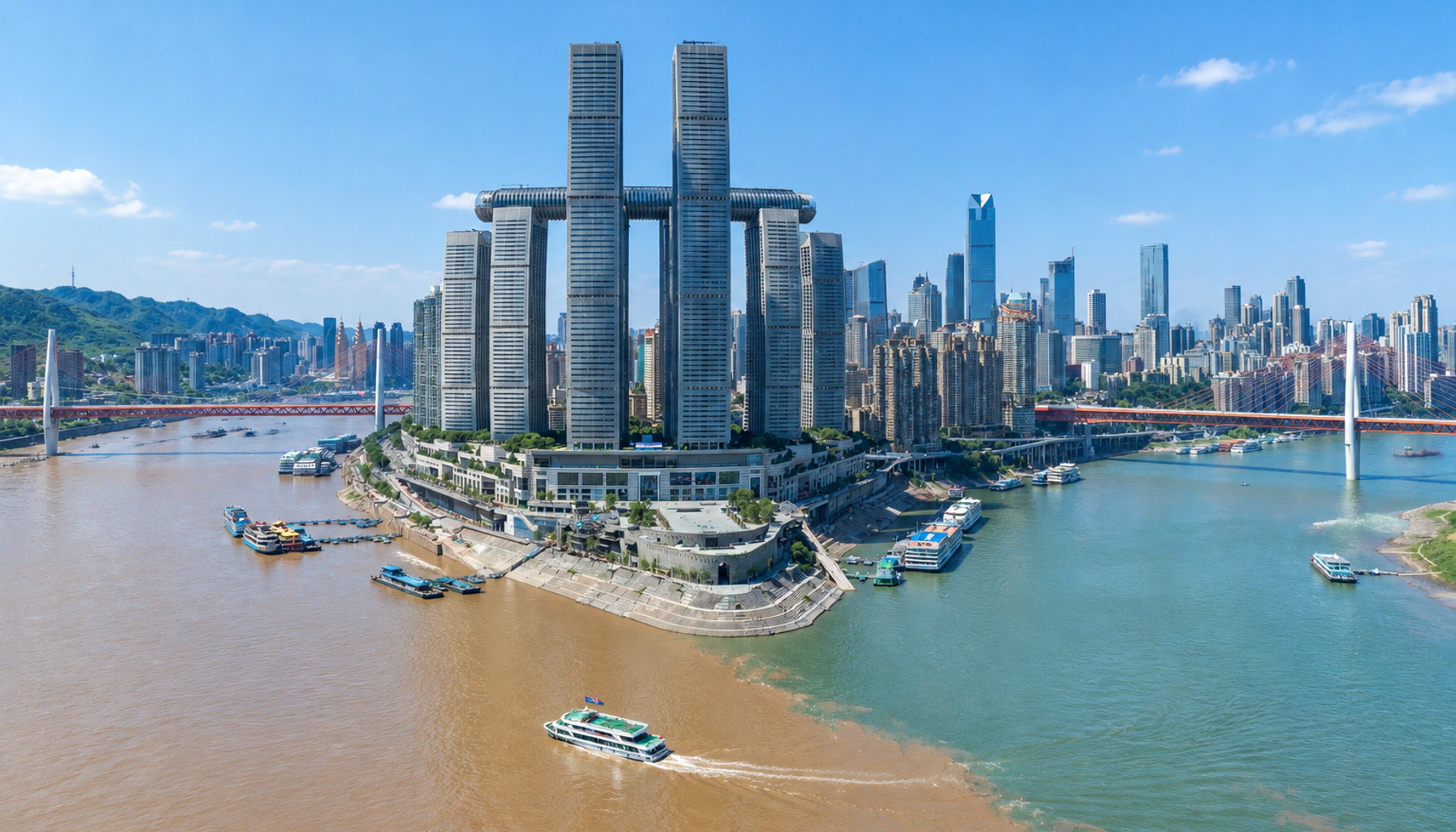
Such vertical thinking is one reason why Chongqing, a city with more than 32 million people, has become the most important urban center in China’s vast interior. The city sits where the Yangtze and Jialing rivers meet, surrounded by rolling hills. About 76 percent of its territory is mountainous or hilly. For an economist, that could be bad luck. For Chongqing, it has become a reason to invent new ways of living and trading.
Building Up, Not Out
Walking in central Chongqing often means climbing. In the old commercial district of Jiefangbei, streets follow the contours of rocky ridges rather than a flat grid. A 500-meter walk may require 200 stairs and an elevator. City planners have turned this constraint into a signature: more than 30 road bridges now cross the Yangtze inside the urban area, and subway lines run deeper than in any other Chinese city. The famous Line 2 monorail glides along a cliff and at Liziba enters a residential tower, the first case in Chinese transit planning where a station was built inside a building to avoid demolition.
The same search for space has pushed Chongqing to invest in underground logistics. In 2023, the city moved a step toward opening a freight tunnel that lets cargo trucks cross the central mountains without interrupting daily traffic. The project is expensive, but Chongqing treats it as necessary for its role as a logistics center.
Where Old Rivers Meet New Railways
Chongqing has been a river trading hub for centuries. Before railways, the city transshipped Sichuan salt, tea and rice along the Yangtze. After 1949, Beijing moved dozens of military factories into Chongqing’s hidden valleys under the Third Front program, leaving a deep base of engineers and machine operators. But for decades, Chongqing exports had to sail over 2,000 kilometers downstream before reaching the ocean, making the city uncompetitive in global markets.
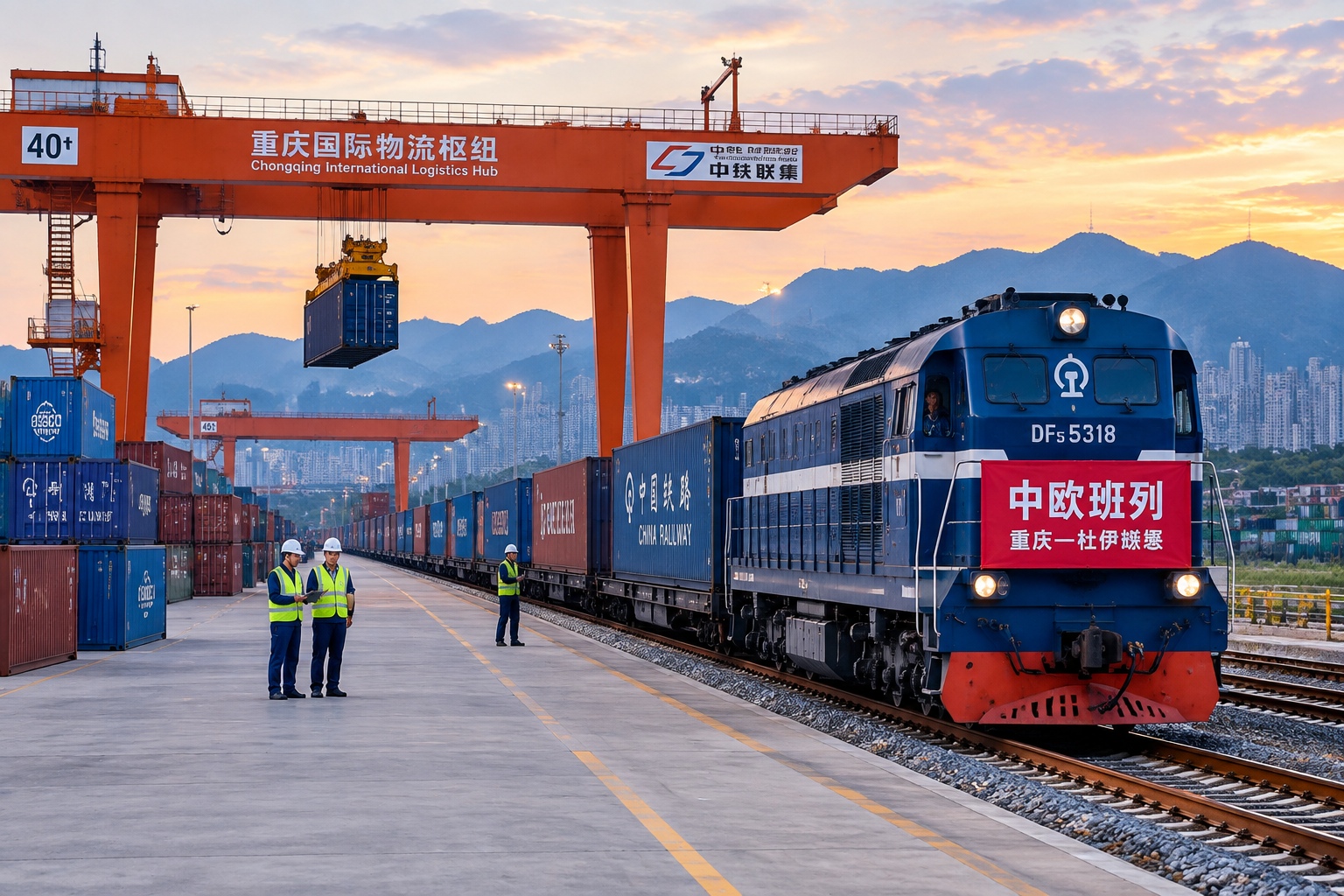
That old bottleneck led to a new plan. In 2011, with support from national customs and railway authorities, Chongqing opened the first regular China-Europe freight rail service from inland China. A train with laptop parts left a yard in Tuanjie Village and arrived in Duisburg, Germany, about 16 days later, roughly cutting the usual sea route in half. Today the route has grown into a broad network connecting Chongqing to dozens of European cities. The same rail infrastructure now feeds a southward corridor through the New International Land-Sea Trade Corridor, linking Chongqing by rail to Vietnam, Laos, Thailand and Singapore.
Factory Power: Laptops, Cars and Batteries
All those trains need cargo. The city built its manufacturing strength around two core industries: electronic information products and automobiles. In the 2010s, Chongqing attracted the world’s largest laptop assembly cluster, and even after a decade, roughly one out of every three laptops sold globally is still made in or near Chongqing for brands such as HP, Dell and Acer. The city is also one of China’s most important auto manufacturing bases, producing about 2.3 million vehicles in 2023. Its automakers, including Changan and Seres, have moved rapidly into electric vehicles and now help the city become a new-energy hub.
The transition can be seen in help-wanted signs at factory gates: they now look for battery test engineers, industrial robot maintenance staff and software developers, not just assembly workers. For a young Chinese worker, Chongqing is no longer a place to leave. Wages have risen close to coastal levels in some industries, while housing remains cheaper.
Hot Pot and the Commerce of Appetite
No visitor can understand Chongqing without trying hot pot. This dish was born along the city’s early 20th century docks, where laborers cooked cheap offal in a bubbling broth of chili and Sichuan pepper. Today more than 30,000 hot pot restaurants operate in Chongqing, and the industry has created a full value chain of pepper farms, cold chains, seasoning factories and night delivery services.
Hot pot is also a business ritual. At a nine-grid table, strangers share the same boiling pot, negotiate deals and exchange news. For overseas travelers, enjoying hot pot is a quick way to feel the Chongqing temperament: hot, open, noisy and eager to welcome strangers.

Official Support and Honest Limits
Chongqing’s progress has strong state backing. The central government’s Western Development strategy has funded cross-provincial highways, high-speed rail and port improvements since 2000. In 2015, Singapore and China launched the China-Singapore (Chongqing) Demonstration Initiative on Strategic Connectivity, making the city a testing ground for new financial and data flows. In 2023, Chongqing’s GDP reached about 3 trillion RMB, making it the fifth largest urban economy in China, after Shanghai, Beijing, Shenzhen and Guangzhou.
But the story has contradictions. Chongqing’s per-capita income remains below China’s prosperous coast. Many older workers face retraining as factories automate. Local government debt is also high, a common challenge across China. The city demonstrates not that inland development is easy, but that it can happen if trade infrastructure, industrial policy and skilled labor are connected.
How to See the New Economy on the Ground
Business travelers looking for inner-China market opportunities should reserve at least one day to visit the industrial and logistics sides of Chongqing. The Guoyuan Port area and Tuanjie Village rail yard are open for guided tours if arranged through a local trade promotion office. Both locations show just how far a landlocked city can go in connecting global supply chains.
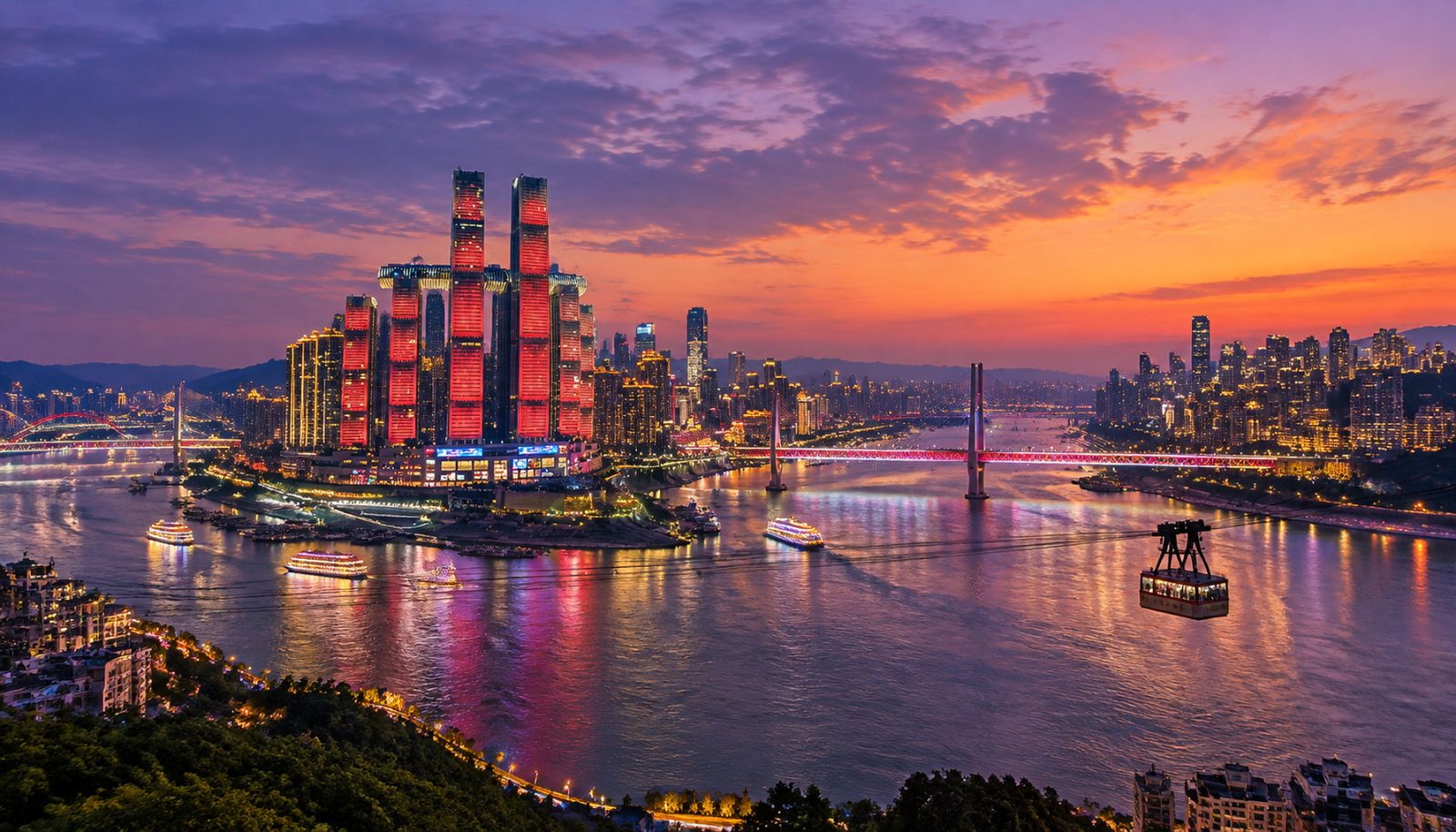
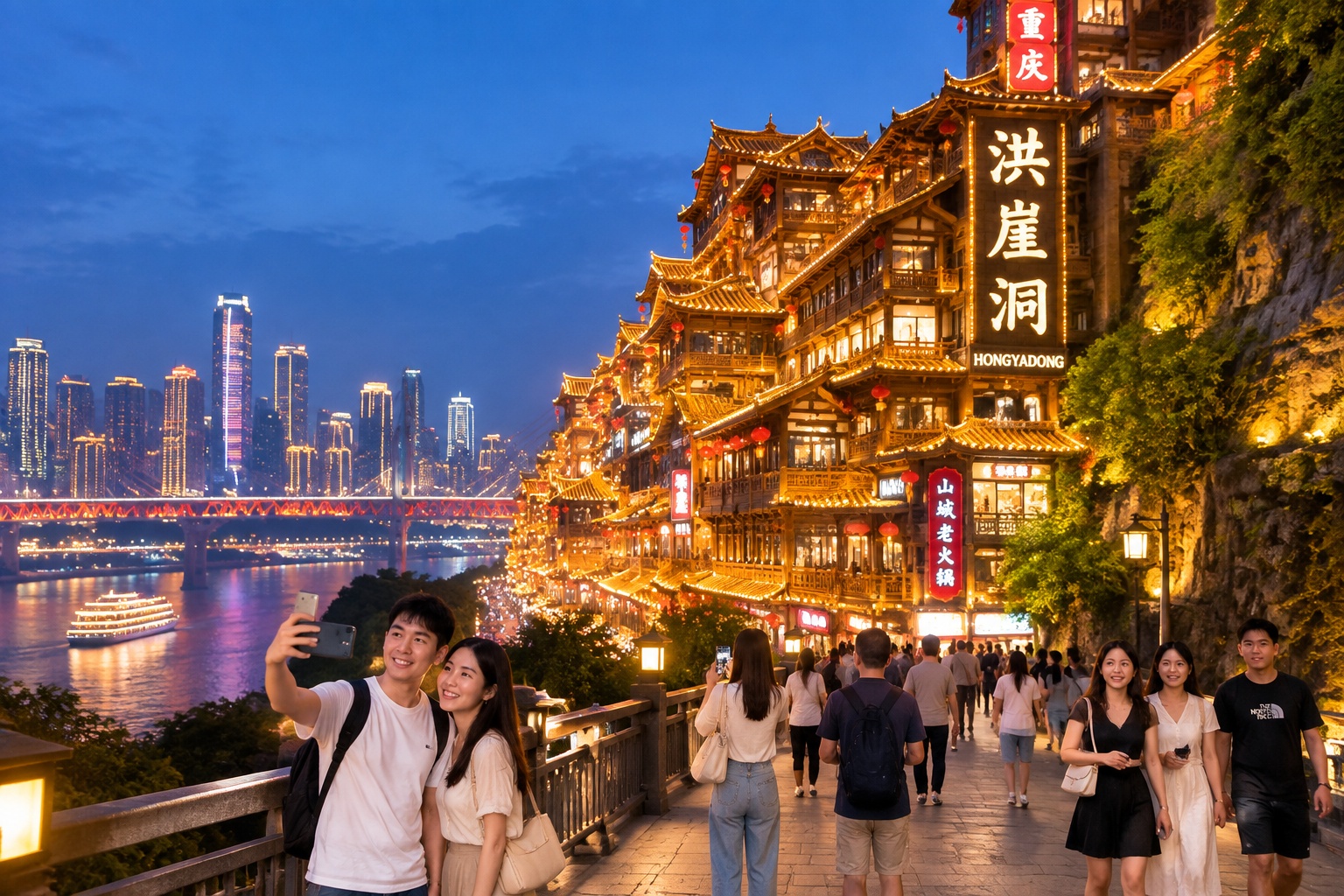
For a more scenic view, ride monorail Line 2 from downtown to Liziba and continue to the hillside park at Foton. From there, a short walk down the mountain leads to a riverside trail known as the Shibati, a hundred-year-old staircase that remains a daily route for residents. At night, Hongyadong’s cliff-side stilt houses light up like a vertical city, and although the crowds are heavy, the scene is a reminder that Chongqing has no choice but to build upward.
From Mountain City to Inland Gateway
Chongqing is not easy to flatten, and its story should not be simplified. It is humid, crowded and sometimes difficult to navigate. But it represents a new chapter in China’s economic geography. The river docks that once served as local trading posts have become rail yards for cross-Asia freight. The steep mountain paths have become transit systems that foreign companies rely on. This is not a city that conquered its environment. It is one that learned to treat every cliff as a starting point for a new solution.
Start the discussion at forum.chinacomes.com