
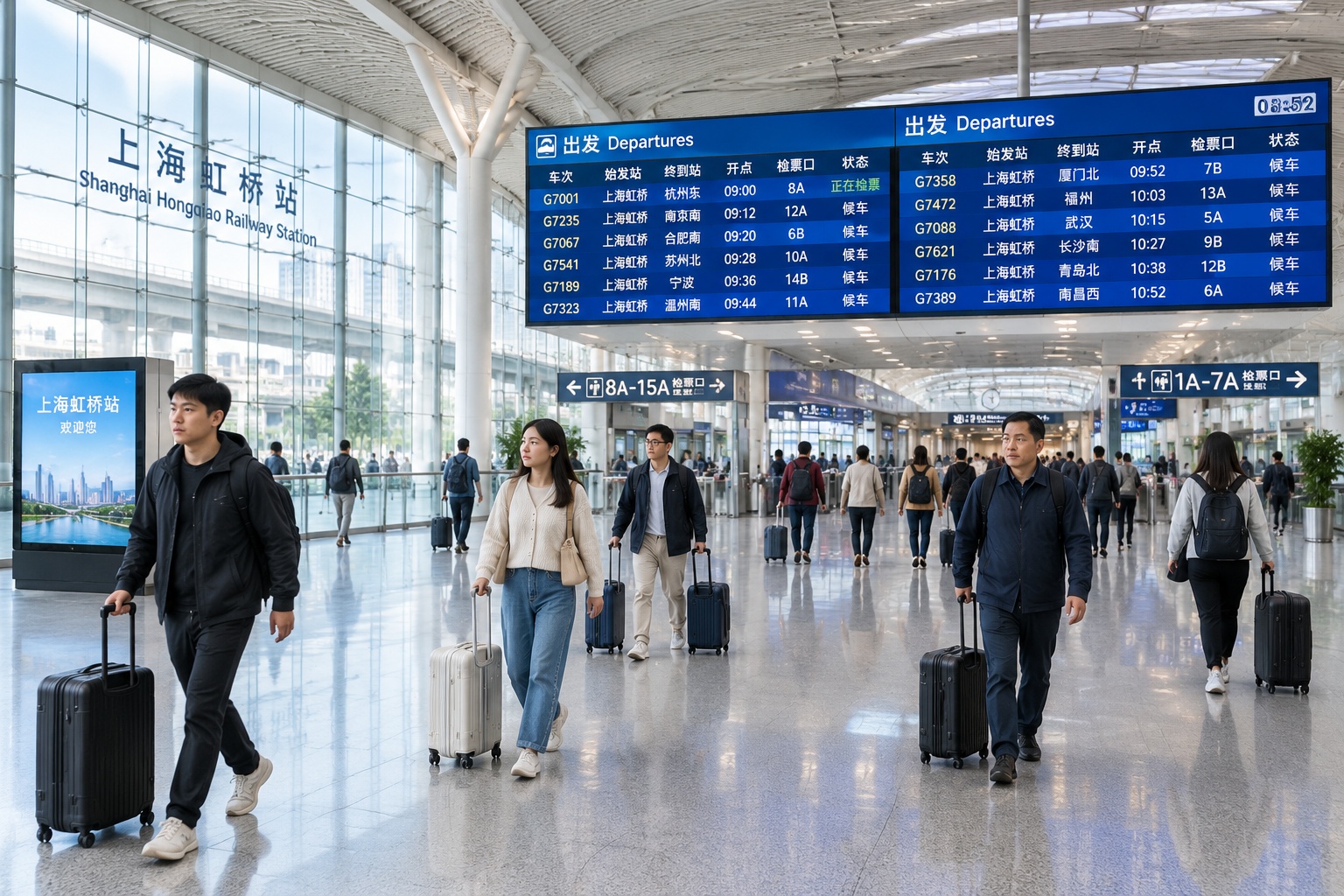

7:40 a.m., Shanghai Hongqiao
The departure board above Gate 12B lists 41 trains leaving in the next hour. One is delayed, a slow train heading north. The other 40 are on time, and the board is so calm about it that nobody looks up.
A woman in a puffer jacket buys two steamed buns from a counter and eats one standing. A student drags a suitcase with a broken wheel. A man in a suit is on a video call, apologizing to someone in another time zone. It looks less like a railway station than an airport that forgot to be stressful.
I’m here for a train to Huangshan North, the station that serves the Yellow Mountains. Roughly 450 kilometers southwest, about the distance from Paris to Lyon, or London to Newcastle. On the board, it says 2 hours 18 minutes.
The ticket: what you pay, and what you don’t
Second class on that train cost about 230 yuan, around $32. First class, with wider seats in a 2+2 layout, was roughly 380 yuan. Business class, which reclines almost flat, ran past 700.
For comparison: Acela from New York to Washington covers a shorter distance and typically costs three to six times more. An anytime ticket from London to Newcastle, a similar distance, can pass 150 pounds. None of that makes Chinese rail cheap by magic. It is cheap because the state treats it as infrastructure rather than a product, and because the network moves enough people to spread the cost.
There is no baggage fee. There is no check-in. There is no separate security ordeal of the airport kind. Your bag goes through a scanner, you walk through a gate, and you are in a hall the size of a football field, with noodle shops and a bookstore.
A station that behaves like a small city
Hongqiao deserves its own paragraph, because it explains a lot about how China builds things. Under one roof: Terminal 2 of Shanghai’s airport, three metro lines, the high-speed rail station, and a long-distance bus station. You can land from Beijing, walk indoors for ten minutes, and board a train toward the mountains without ever stepping outside.
On an ordinary weekday, roughly 200,000 people pass through the railway side. On the Friday before a public holiday, closer to 300,000. It is one of the busiest railway stations on earth, and it still feels navigable, mostly because everything is labeled in Chinese and English and the signage never tries to be clever.
If you are used to European stations, beautiful, century-old, and awkwardly connected to everything else, the first surprise is how functional the whole thing is. The second surprise is how few people seem stressed.
On board: what actually happens for two hours
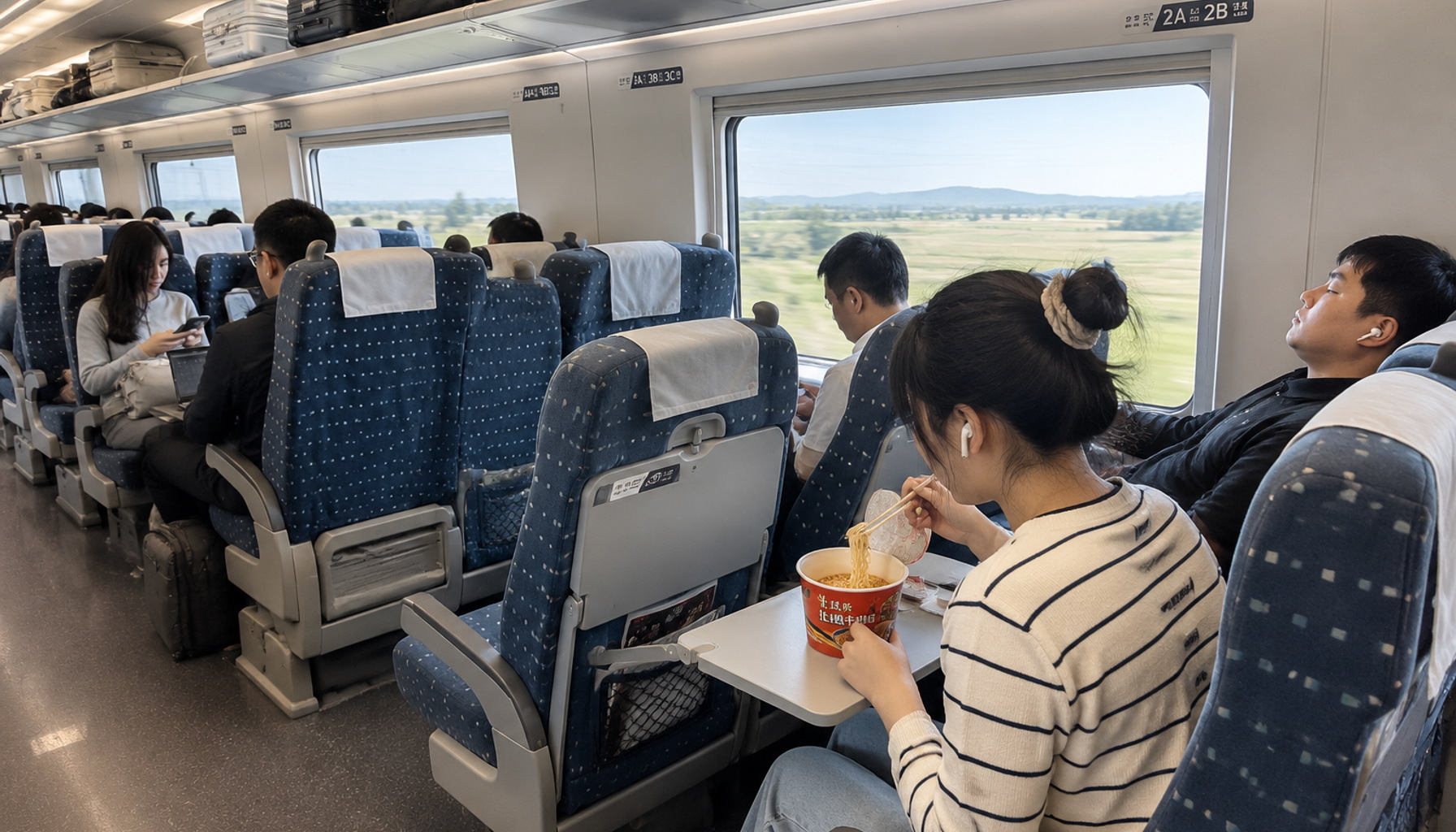
Boarding takes about four minutes. Gates close five minutes before departure, and the train does not wait. There is no seatbelt, no safety demonstration, no early queue for the toilet. People find their seats, lift bags onto the rack, and start scrolling.
Second class is 3+2, so there is a good chance you will sit next to someone. Legroom beats economy class on a plane, and the seat reclines far enough to sleep. At the end of each car there is a hot water dispenser, a genuinely important piece of Chinese train furniture, because half the carriage is eating instant noodles, brewing tea, or working through something a parent packed.
At 300 kilometers per hour, the outside turns into a blur of rice fields, low green hills, and the occasional cluster of identical white apartment towers. Announcements come in Mandarin and then English. A trolley passes once with snacks and coffee. Wi-Fi is patchy, but phone signal is mostly fine. The tunnels are short, and the coverage is deliberate.
What struck me most is not the speed. It is how ordinary everyone treats it. The woman beside me is finishing a spreadsheet on her laptop. Two rows back, a grandmother is peeling an orange for a child. Nobody is filming the speed display.
Why it runs on time, and why that is design rather than luck
China Railway says the vast majority of high-speed trains arrive within a few minutes of schedule, and on the busiest corridors the figure is close to 99 percent. That is not magic either. It comes out of a few deliberate decisions.
High-speed trains run on dedicated passenger lines. Freight stays on the older tracks. When a slow coal train and a fast passenger train share a route, delays cascade. Separating them removes most of the problem.
The rolling stock is standardized. A CRH or Fuxing trainset is built to a national specification, so maintenance, spare parts, and crew training work the same way from Shanghai to Xinjiang.
Dwell time is short. Trains sit at platforms for two or three minutes, not fifteen. Dispatch is centralized, which means one control center can hold a train for thirty seconds to let another pass, instead of negotiating between regional operators.
The trade-off is flexibility. You cannot casually add a stop, and if your train leaves at 7:52, that is the train.
The part foreigners notice last: where the stations actually are
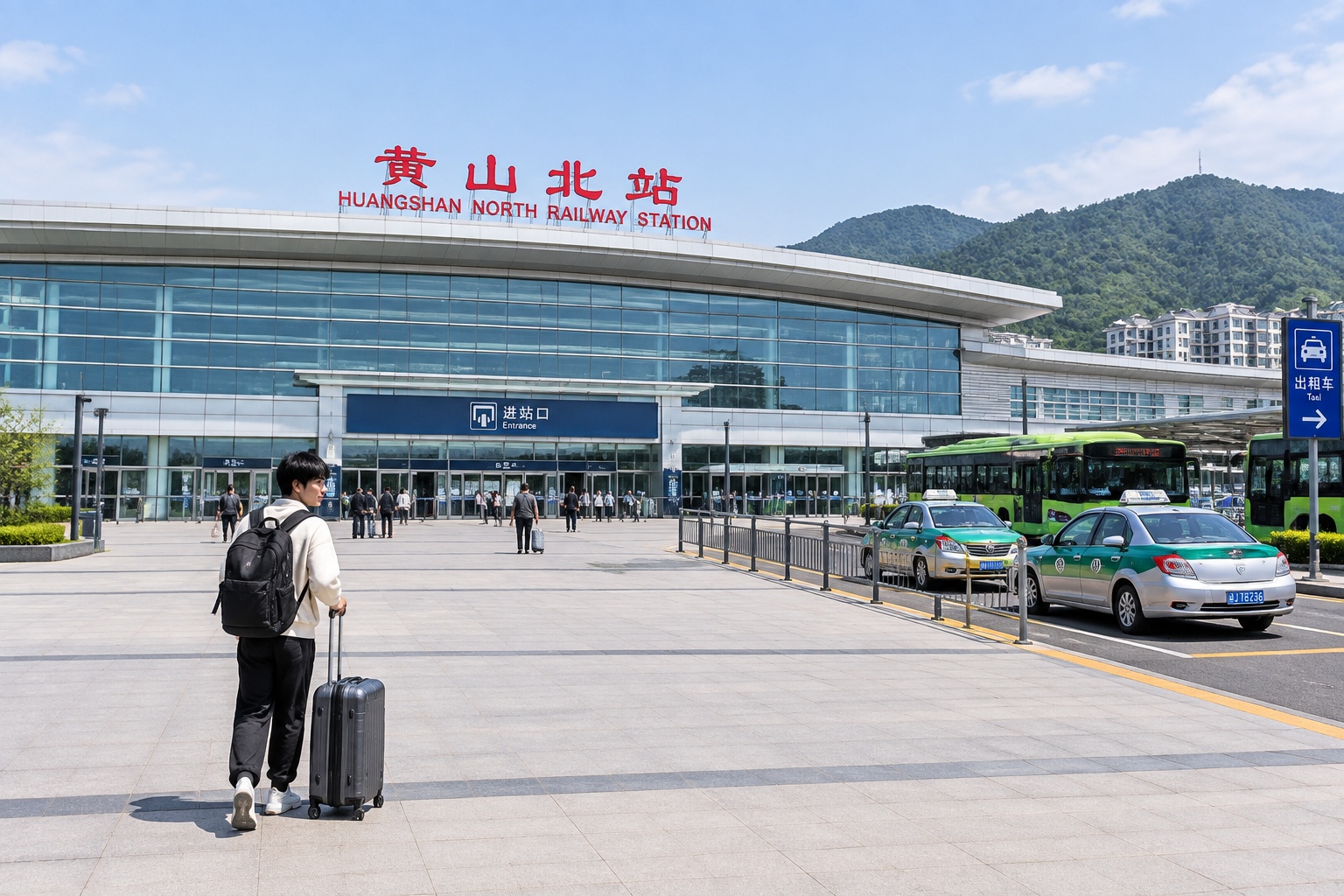
Huangshan North is not in Huangshan. It sits about fifteen kilometers from the center of Tunxi, in a district that was farmland fifteen years ago. There is a plaza, a taxi rank, a bus stop, and not much else within walking distance.
The same is true of dozens of Chinese high-speed stations, and it confuses first-time visitors. In Japan or Germany, the Shinkansen or the ICE usually stops in the middle of town. In China, the station is often built on the edge, where land is cheaper and there is room for a new district to grow around it.
Sometimes that works exactly as planned, and a station pulls offices, apartments, and shops into an empty field over a decade. Sometimes it does not, and you get a grand building surrounded by parking lots and half-finished construction. Both outcomes exist, and which one you see depends on the city.
For a traveler, the practical lesson is simple: budget another twenty to forty minutes after you step off the train.
What the line did to a mountain town
Before the Hangzhou to Huangshan line opened in late 2018, getting from Shanghai to the Yellow Mountains meant a five or six hour drive, or an overnight train. Weekends there belonged mostly to people from Anhui and Zhejiang.
Now it is a two-and-a-half hour trip. On a Saturday morning, the carriages fill with young couples in hiking shoes and retired teachers with trekking poles. The impact on the villages at the foot of the mountain has been fast and uneven.
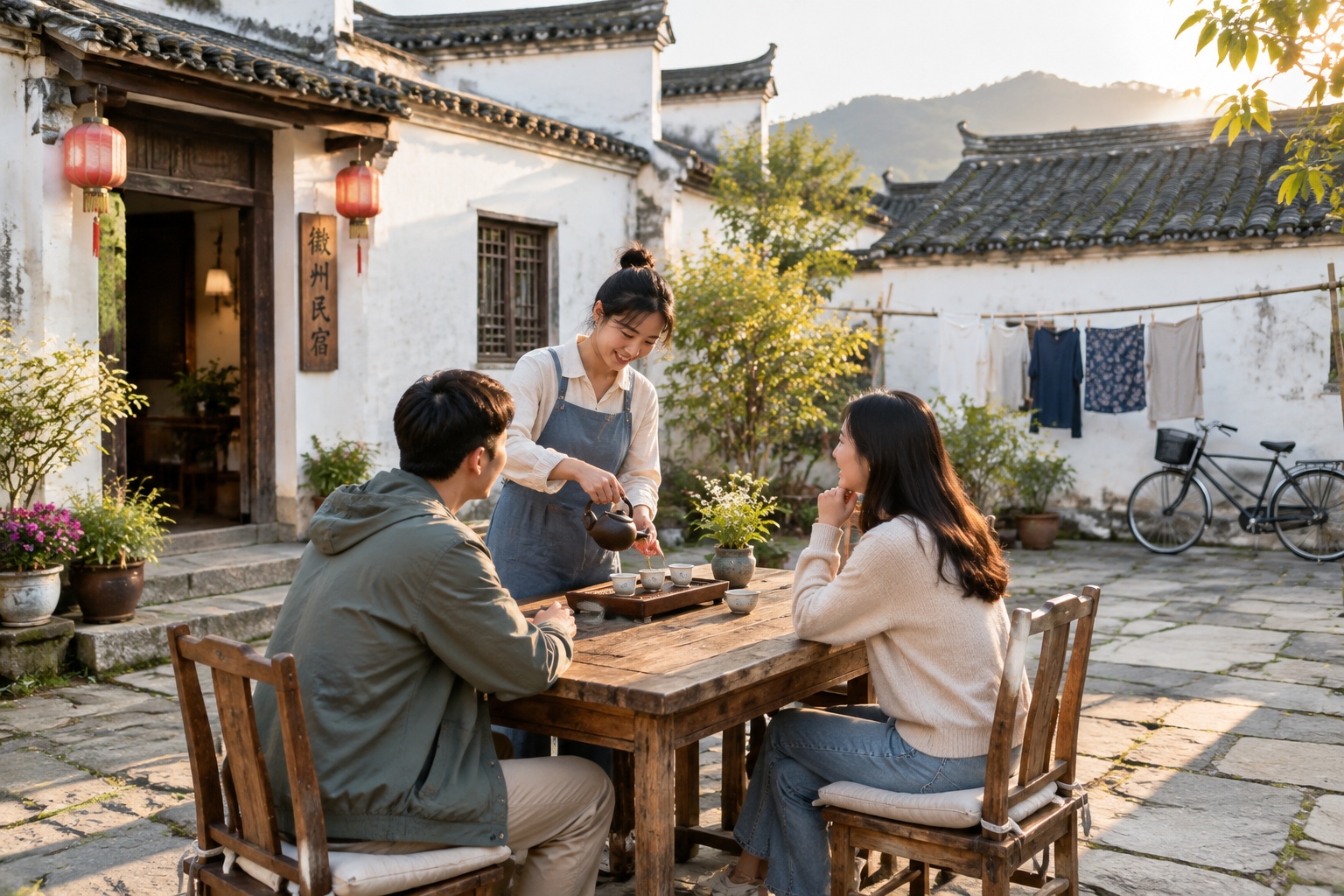
In Hongcun and Xidi, the UNESCO-listed Huizhou villages, old houses that were quietly decaying have become guesthouses. A room that cost 120 yuan a night in 2015 can go for 600 on a spring weekend. Some of the people running them are in their twenties and thirties, back from jobs in Hangzhou or Shenzhen, serving coffee and local smoked pork to guests from Shanghai.
The other side is real too. Some lanes are now pure souvenir commerce. Villagers who used to farm have become landlords and cleaners. A few villages near the line have emptied out as residents moved toward where the tourists are.
The bill that isn’t on your ticket
Here is the part that does not make it into the promotional videos. China’s high-speed rail network is more than 45,000 kilometers long, and the operator that runs it carries debt measured in the hundreds of billions of dollars. Some corridors, Beijing to Shanghai, Shanghai to Hangzhou, make money. Many lines through sparsely populated regions do not, and probably never will at current fares.
That is a policy choice, not an accident. Cheap, fast mobility is treated as a way to pull inland cities into the coastal economy. A factory in Anhui can serve a customer in Shanghai. A nurse can visit her parents in a county town for a weekend. A student can go home for a holiday without a twelve-hour bus ride.
Whether that is worth the cost is a live debate inside China, not a settled question. It is also worth knowing that not every small station benefits equally. Some county stations see a handful of trains a day and a lot of empty platform.
If you want to try it yourself
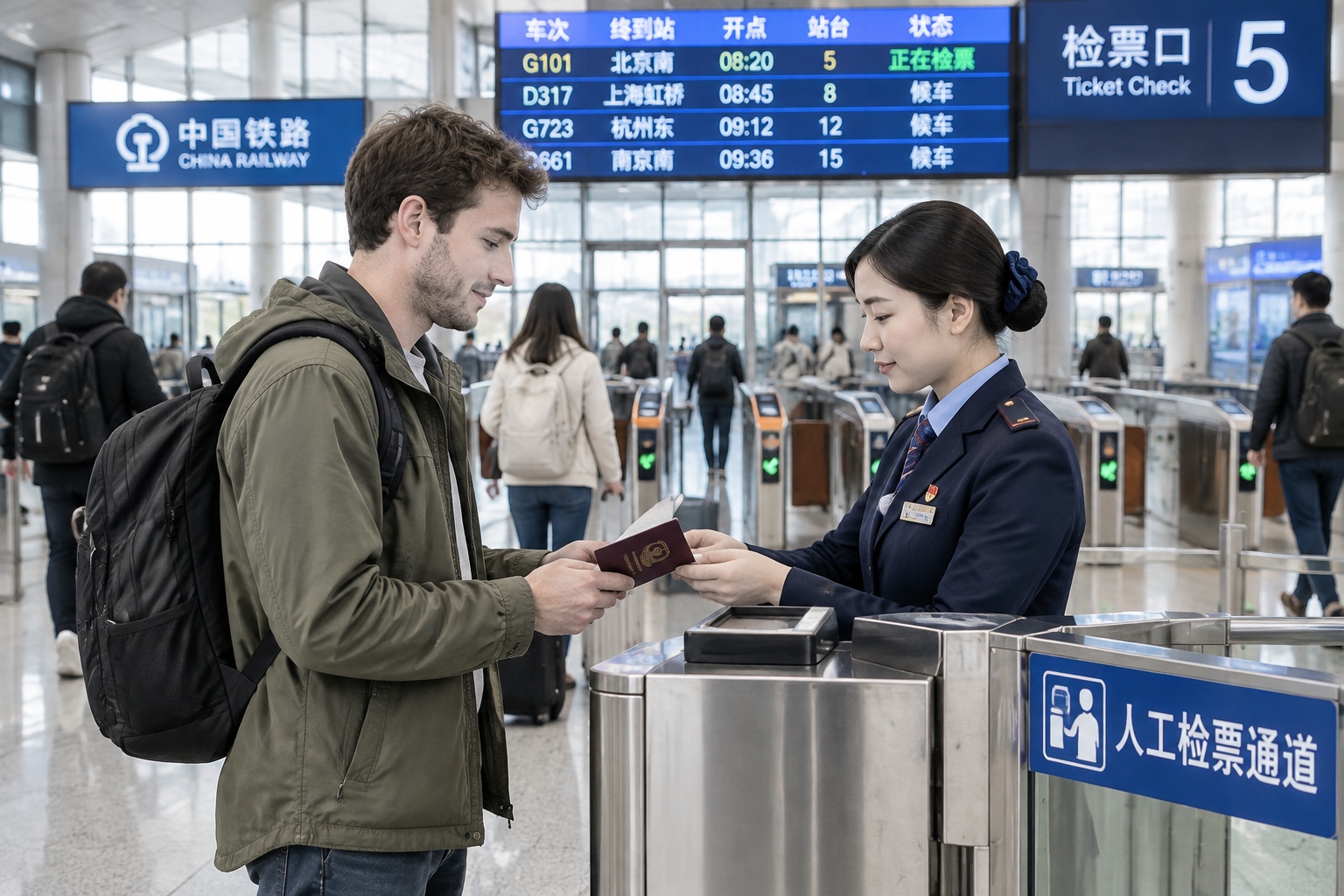
Booking: the official 12306 app has an English version, and third-party sites like Trip.com work too. You need your passport number, and the passport itself on the day. There is no printed ticket anymore.
At the gate, foreign passports usually go through a staffed lane rather than the automated gate. Allow thirty to forty minutes at a big station like Hongqiao. Twenty is enough at a small one.
Gates close five minutes before departure. Trains leave on time, and nobody will hold one for you.
Bring snacks, or buy them inside. There is hot water on board and a trolley, but most domestic routes have no dining car.
The thing I actually noticed
Two hours and eighteen minutes after leaving Shanghai, we pulled into Huangshan North. On time. The woman with the spreadsheet closed her laptop. A child was carried out asleep. Everyone walked down the escalator toward the buses and taxis, and nobody looked back at the train.
That is the part that stays with me. In the United States or Britain, a train like this would be a national event: a ribbon-cutting, a documentary, a debate about whether it was worth it. In China it is a Tuesday. The technology has become furniture.
You can argue about the debt, the station locations, the villages that got more crowded and the ones that got emptier. All of that is fair. But if you want to understand why this country moves the way it does, spend two hours on a train between two cities and watch what the passengers do. They work, they eat noodles, they sleep. They have already moved on to the next thing.
Start the discussion at forum.chinacomes.com