
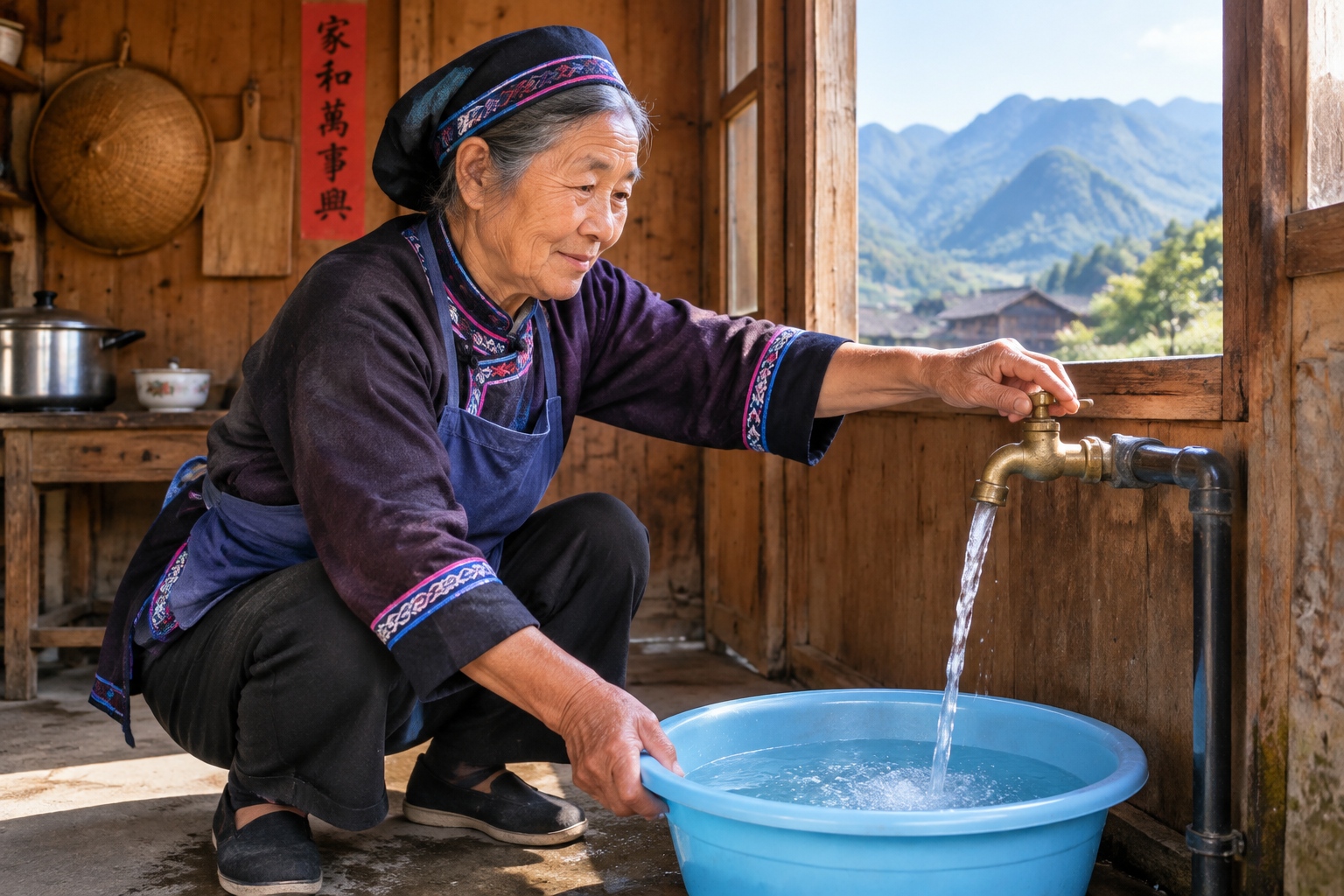

Introduction: The Taste of Memory
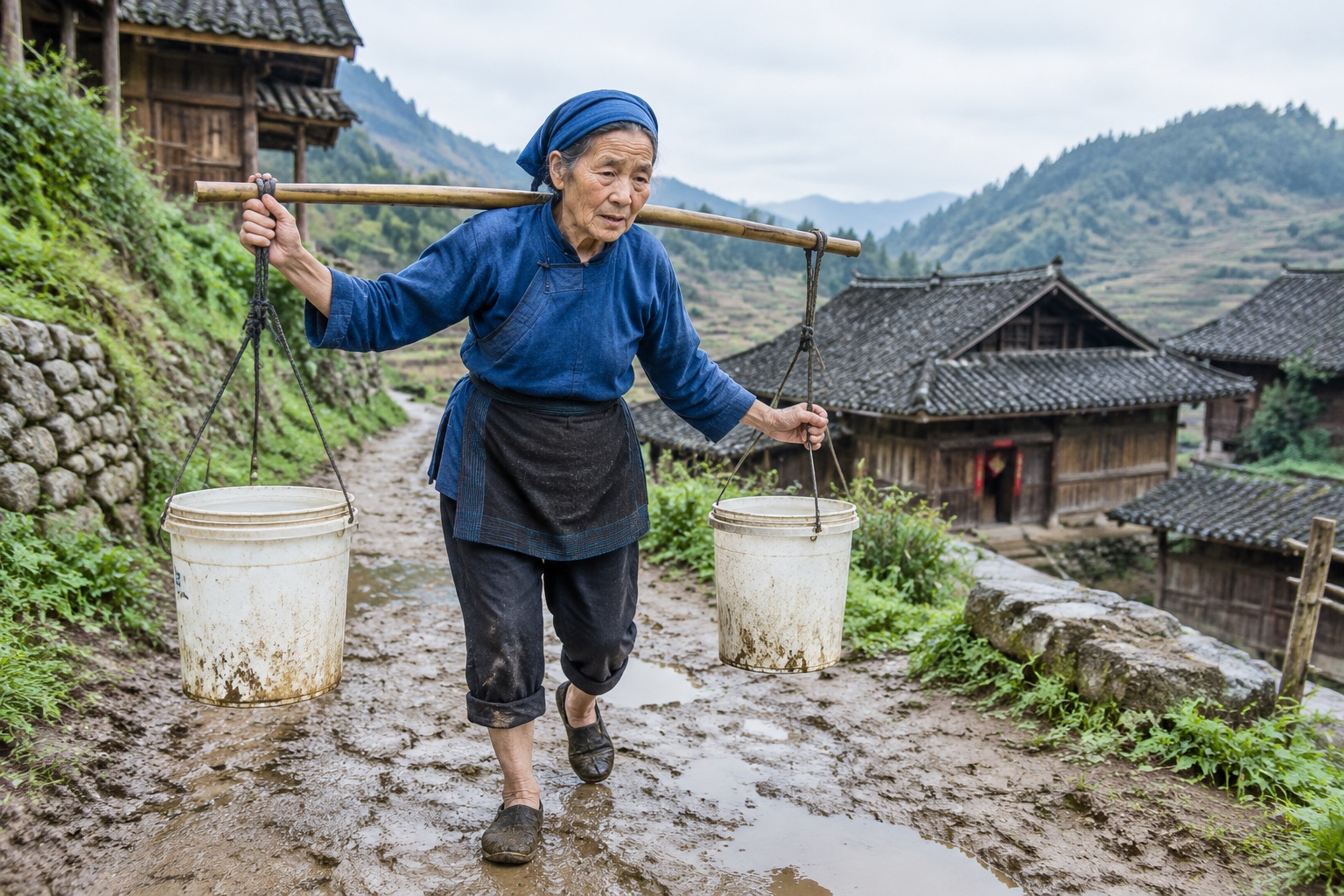
At 5:30 AM, the sky is still a deep blue-gray over the mountains of Yunnan Province. Wang Guifen, 68, used to walk downhill with two plastic buckets dangling from a bamboo pole across her shoulders. The path was slippery after rain, and the buckets would slap against her legs. She would stop at the village pond, push aside the green scum with a ladle, and fill the buckets with water that tasted of mud and faintly of animal waste. Her grandchildren, who came to stay during summer, would often get diarrhea. “The water made their bellies hurt,” she says. “I had to boil it for an hour, but it still smelled.”
That was 2015. Today, Wang Guifen turns a brass tap in her kitchen and watches clear water splash into a plastic basin. She doesn’t boil it anymore. She drinks it cold. The village she lives in—a small cluster of 47 households called Xiaoshui, set in the karst hills of Guizhou Province—is one of tens of thousands across China that have been connected to a centralized drinking water supply system in the past decade. For the first time, the water that comes out of the tap meets national safety standards for drinking.
The Turning Point: A National Promise
China’s rural drinking water safety initiative began in earnest in the mid-2000s, but the most concentrated push came after 2015, when the government declared that everyone—urban or rural—should have access to safe drinking water by 2020. In Xiaoshui, the turning point arrived in 2016. A team of engineers from the county water bureau walked the hills with GPS devices, mapping the springs and streams. They found a reliable source high in the mountain, three kilometers away. The village chief, Li Ming, remembers the day: “They sat in my yard, unfolded a map, and said, ‘We can build a pipeline from here. It will cost 1.2 million yuan. The government will pay 80%, the village will contribute labor.'”
Villagers voted unanimously. Over the next four months, men and women dug trenches alongside the roads, laid PVC pipes, and built a small concrete water tank on a hilltop. Sun Zheng, a 45-year-old farmer, became the volunteer quality supervisor. “I checked every joint,” he says. “If there was a leak, the whole village would suffer. We had to get it right.”
The Details: Pipes, Filters, and a Meter
The system is simple but effective. A spring-fed reservoir at 1,200 meters elevation feeds a 50-cubic-meter holding tank. Water flows by gravity through a sand filter and a chlorine dosing unit, then into a network of pipes that reach every household. Each home has a water meter, installed by a technician from the county. The village pays a small monthly fee—about 10 yuan ($1.40) per household—to cover maintenance and chlorine tablets. The meter is read once a month, and the readings are posted on a bulletin board near the village committee office.
In the kitchen of Li Ming’s home, the meter is a small white box with a digital display. He points to the number: 12.3 cubic meters used this month. “Before, we didn’t measure. We just carried water,” he says. “Now we know exactly how much we use. It’s like having electricity.” The water is tested quarterly by the local health department. The results are printed and pinned to the same board. Last year, all tests passed.
Life After the Tap: A Grandma’s Morning
Wang Guifen’s morning routine has changed completely. She used to wake up at 4:30 to fetch water before the pond got crowded. Now she sleeps until 6. She turns on the tap to wash rice, then fills a kettle for tea. Her grandson, who is 8, brushes his teeth with tap water, grinning with foam. “He doesn’t get sick anymore,” she says. “I don’t have to boil water for him.”
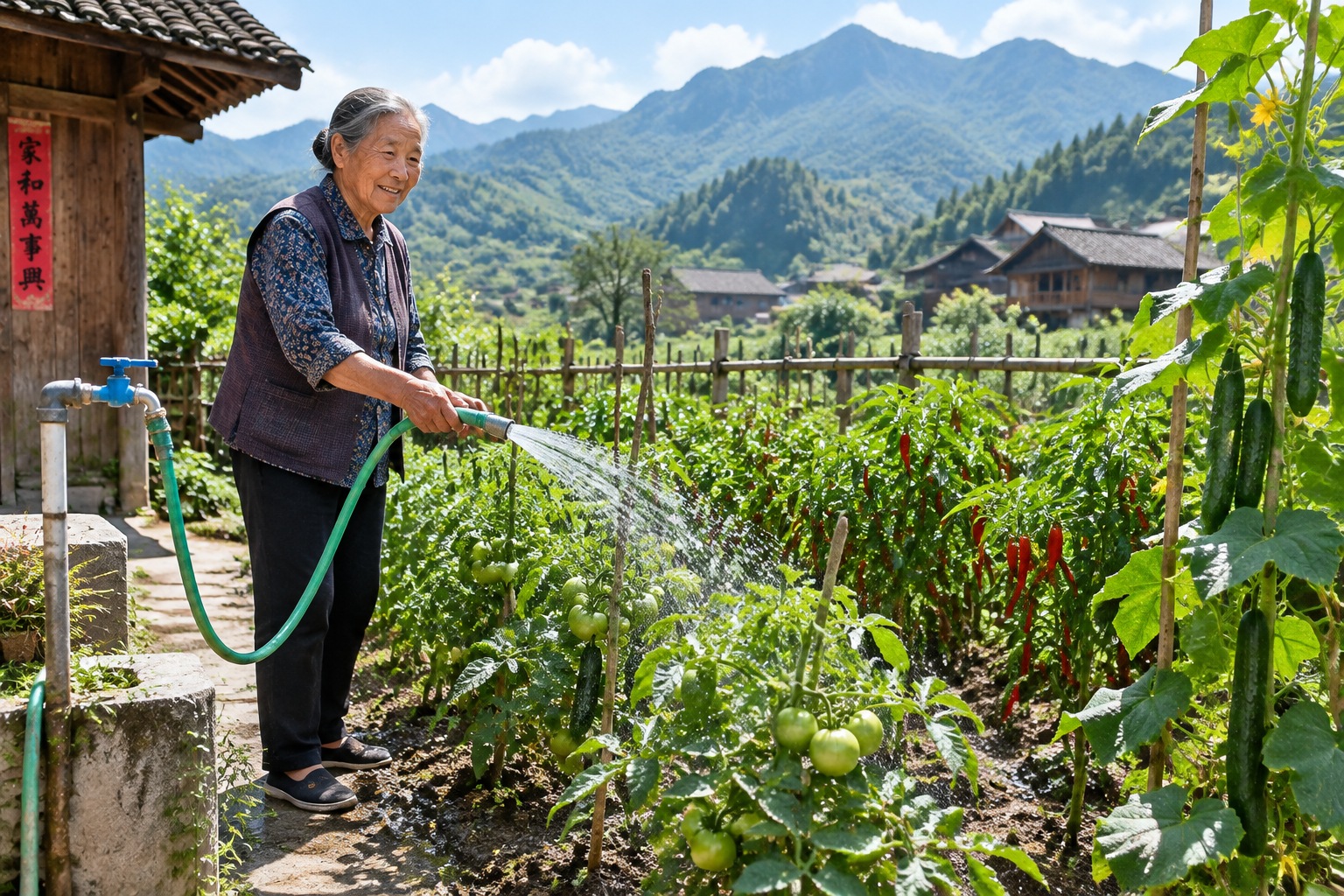
In the corner of her yard, a small vegetable patch grows tomatoes, chilies, and cucumbers. She waters them with a hose connected to the tap. “Before, I couldn’t grow vegetables in the dry season. The pond water was too precious. Now I have a garden.” Her neighbor, Zhang Wei, has started raising ducks. He built a small pond next to the house, filling it with tap water. “Ducks need clean water to stay healthy,” he says. “I sell duck eggs at the market. It’s extra income.”
Economic and Social Ripples
The impact of clean water extends beyond health. A study published in the Journal of Environmental Economics and Management in 2022 estimated that China’s rural water improvement program reduced waterborne disease incidence by 42% and saved households an average of 300 yuan ($42) per year in medical costs. In Xiaoshui, the village clinic used to see 10–15 cases of diarrhea per month among children under five. Now it’s down to one or two.
With less time spent fetching water, women have more time for other activities. Wang Guifen’s daughter-in-law, Chen Fang, 35, used to walk two hours a day to collect water. Now she works in a small embroidery cooperative that sells to tourists. “I can earn 1,500 yuan a month,” she says. “Before, I had no time.” The cooperative’s products are displayed on a website, and orders come from cities like Shanghai and Guangzhou.
Young people are also returning. Sun Zheng’s son, who studied in a vocational school in the provincial capital, moved back to Xiaoshui last year to start a small fish farm. “The water is clean, so I can raise high-value fish like tilapia,” he says. “I can sell them to the county town. It’s a good business.” He uses the same tap water, treated with a simple filter, to fill the tanks.
Challenges Ahead: Keeping the Tap Running
Not everything is perfect. The village water system requires upkeep. The chlorine tablets must be replenished monthly. The sand filter needs to be backwashed every six months. If a pipe bursts in winter, the village must pool money for repairs. The county government provides a subsidy of 5,000 yuan per year, but it’s not enough for a major replacement. “We need to save up,” says Li Ming. “We created a water fund. Every household contributes 2 yuan per month extra. It’s small, but it adds up.”
Another challenge is water source protection. The spring is surrounded by farmland, and farmers sometimes use chemical fertilizers. The village has set up a rule: no fertilizer within 50 meters of the spring. But enforcement is voluntary. “We remind each other,” says Sun Zheng. “If someone forgets, we talk to them. It’s better than the old days.”
Conclusion: A Quiet Revolution
Standing at the village water tank, the view stretches across terraced fields and distant hills. The pipeline, barely visible, runs like a thin thread connecting the mountain to the village. The transformation of Xiaoshui is not a headline-grabbing story. It’s a quiet, incremental change—one that involves concrete, PVC pipes, and a village meeting. But for Wang Guifen, it’s the difference between a life of carrying water and a life of simply turning a tap.
Across China, similar stories are unfolding in tens of thousands of villages. The government says that by 2020, more than 84% of the rural population had access to centralized tap water, up from 60% in 2010. This is infrastructure that doesn’t make the news. It happens in places where no one is watching, where the only measure of success is a child who doesn’t get sick, a grandmother who can water her garden, a young man who starts a fish farm. This is the real story of China’s rural transformation: not a spectacle, but a tap.
Start the discussion at forum.chinacomes.com