
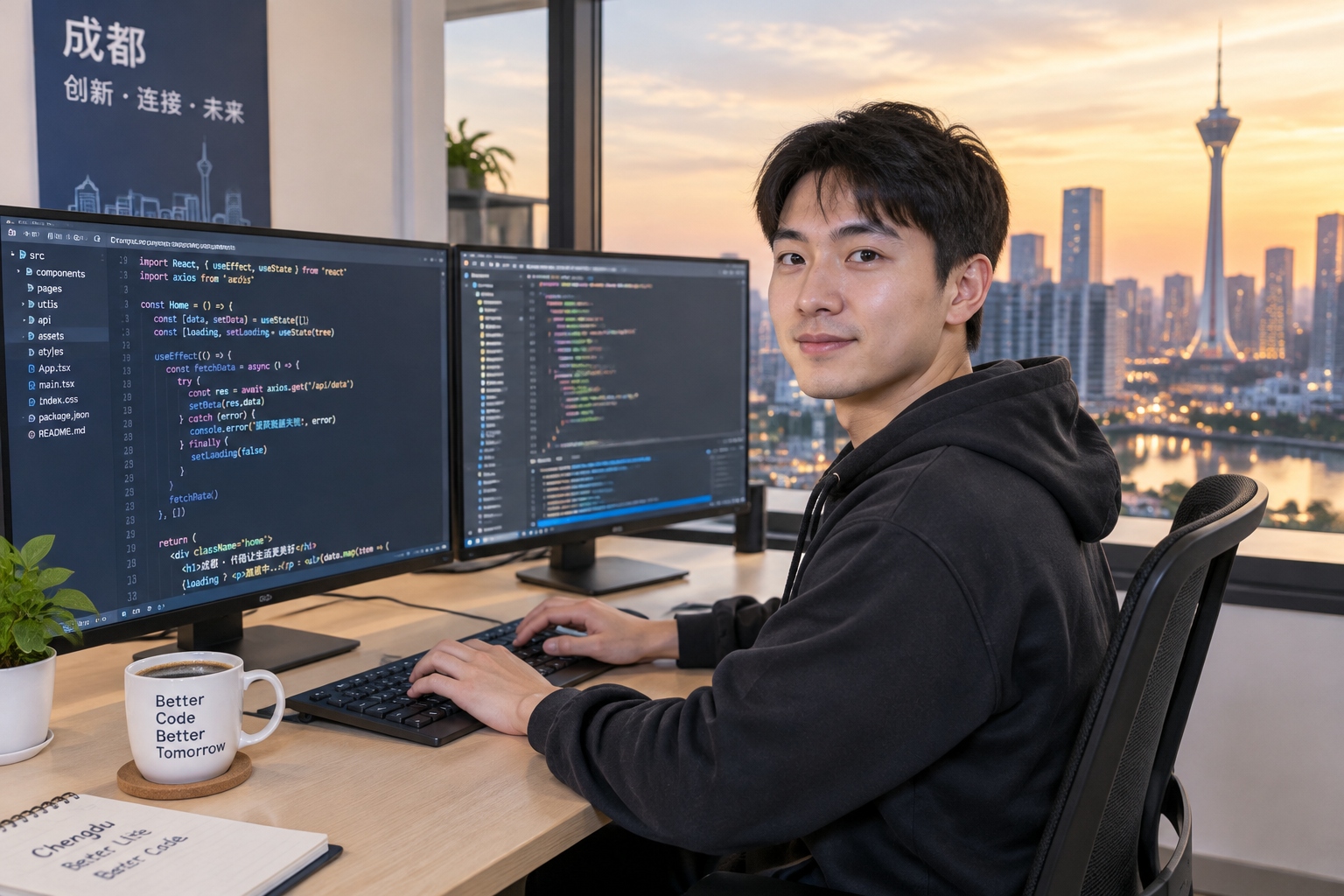

An Office That Smells of Coffee and Cold Noodles
At 9 a.m. on a Tuesday, Zhou Wei slides his access card across the sensor in a 22-story office tower in Chengdu’s Hi-tech Zone. The elevator smells of coffee, wet umbrellas, and steamed buns from the breakfast stall outside. He nods at the security guard, steps out on the 14th floor, and walks past rows of standing desks, sleeping pods, and a fridge stuffed with energy drinks. On his own desk, a monitor displays a code review that should have been finished last night.
Zhou Wei is 29, a backend engineer at a fintech company. He has worked here for two years. Like many of his colleagues, he comes from a smaller city in Sichuan — the province capital Chengdu has become a magnet for young talent from the region. But unlike the stereotype of programmers in Shenzhen or Shanghai sprinting toward stock options, Zhou says his life here feels more like a long-distance run with frequent stops for tea.
His morning commute takes 35 minutes: a shared bike to the metro, three stops on Line 1, then a walk through a plaza where vendors sell grilled corn and bubble tea. The subway car is crowded but not crushed — nothing like the packed trains of Shenzhen. He tells a friend in Beijing he can afford a one-bedroom near the office; the friend doesn’t believe him.
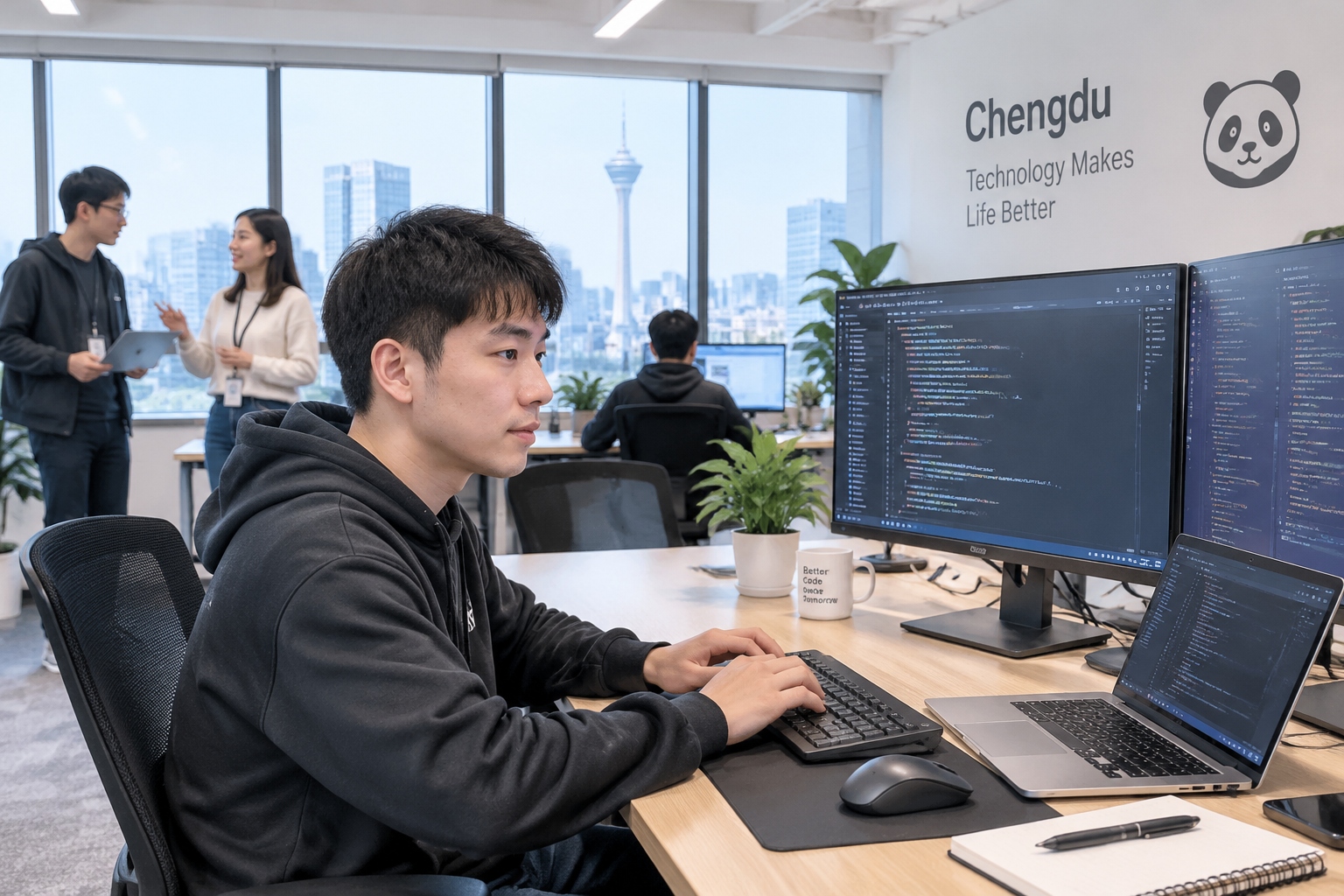
The office isn’t a Silicon Valley campus. It’s a converted commercial building with fluorescent lights, exposed cables, and a sliding door that keeps breaking. Still, there’s a canteen, a nap room with foldable beds, and a balcony with random mint plants. At 10 a.m., Zhou buys a latte from a vending machine. ‘The machine is from Beijing,’ he says. ‘The coffee tastes like it’s still angry about the move.’
Coding Under Fluorescent Lights
He spends most of the day writing and deleting Python and Java. The company uses agile, so there’s a stand-up at 10:30, planning on Monday, demo on Friday. ‘The meetings are usually shorter than the traffic jam outside,’ he jokes. But work can stretch late, especially before a launch.
His current project is an internal tool that processes insurance claims. It’s not flashy, but it automates manual work. He feels a quiet pride when an older clerk in a small agency uses the tool on her tablet. ‘Code doesn’t care about your mood,’ he says. ‘It runs or it doesn’t. When it runs, it helps someone.’
The Price of Tolerance: Lower Rent, Some Trade-Offs
The Chengdu tech scene has grown quickly. Intel and SAP have R&D centers here; Tencent and Alibaba have offices. The government promotes the city as a ‘new first-tier city’ with lower costs. For developers, it’s a compromise: a mid-level engineer earns 200,000 to 400,000 RMB a year, with rent half of Beijing’s.
But ‘less pressure’ is relative. Zhou’s colleague Xiao Li, a front-end developer, says the city’s nickname, ‘Land of Abundance,’ can be deceptive. ‘People work hard here. We just complain in dialect.’ She spent two years in Beijing. ‘I regret working in Beijing, not moving back. Here I eat a proper lunch for 15 yuan. My mother comes by high-speed rail in two hours.’
Lunch, Tea, and the Art of Distraction
Lunch and tea are rituals. At noon, Zhou joins colleagues at a ‘fly restaurant’ downstairs, a no-frills eatery. The owner knows their order: two bowls of noodles, mapo tofu, boiled vegetables, rice. The meal costs 150 yuan for four. After lunch, some nap, others go to a tea house where 15 yuan buys unlimited jasmine tea.
Chengdu is famous for tea houses, and programmers are part of the tradition. ‘To think through a problem, I go to a tea house by the river,’ Zhou says. ‘I unplug, order green tea, write pseudo-code in a notebook. The noise of card games helps me focus.’
The tea house is also where he met other developers. Some form open-source communities. They meet monthly in a hotpot restaurant, discussing code and side projects over spicy broth and beer.

After Work: Hotpot, Serial Skewers, and Side Projects
At 7:30 p.m., Zhou wraps up. The office is still half full. He shuts his laptop, puts a small fan in his backpack, and walks to an alley where Uncle Chen has run a skewer stall for seven years. Zhou orders beef, tripe, mushrooms. For two people, the bill rarely exceeds 80 yuan. ‘A programmer in Chengdu can live well on 150,000 a year,’ he says, ‘but we also work a lot.’
The city’s image as ‘southern California of China’ sometimes masks the grind. Tech firms here have adopted versions of the 996 culture. Zhou’s company asks for nine hours a day, but during releases, he’s stayed until 1 a.m. ‘There’s an unwritten rule: leave too early, you’re disloyal; stay too late, you’re inefficient.’ He shrugs. ‘Everyone tries to find a balance.’

The Weekend: Hiking the Suburbs or Sleeping In
That balance is easier on weekends. On Saturday, Zhou joins a hiking group for a one-hour train ride to Qingcheng Mountains. The trail is full of engineers. They eat roasted sweet potatoes at a temple gate. On Sunday, he sleeps in or visits his parents, who bought a new apartment with his help.
Weekends also leave room for side projects. Zhou is building a small app to help elderly people book doctor appointments. It grew from watching his grandmother wait an hour at a hospital. He plans to open-source it. ‘The hardest part isn’t code,’ he says. ‘It’s understanding what old people need.’
A Changing City, an Uncertain Future
Chengdu is visibly changing. New subways open every few years. Tech parks expand south. The government is pushing semiconductors, software, e-commerce. But rents in some neighborhoods have climbed. A flat near the office starts at 1.5 million yuan — still far below Beijing, but not cheap for locals. Some programmers worry about being priced out. Zhou is philosophical: ‘I don’t need a huge apartment. Just near a metro and a good hotpot place.’
His generation grew up during intense digitalization. They learned to code for exams and jobs, but many now see it as a language. ‘Code is like the Sichuan dialect of the digital world,’ he says. ‘Full of symbols, but if you know it, you can talk to machines.’
Conclusion: A Life Between Code and Chill
Near the end of the evening, Zhou looks at the skyline. City lights mix with construction cranes. He takes a photo. ‘I’ll send this to my friend in Beijing. He’ll think I’m showing off. But I just want him to know that in Chengdu, even programmers have time to look at the sky.’ He pauses. ‘Even if we’re dead tired.’
That is the contradiction of being a programmer in Chengdu: you work hard, but there’s room for life beyond the screen. Whether the trade-off is worth it is something every developer must answer for themselves.
Start the discussion at forum.chinacomes.com